Bank Nifty Stocks List 2026: Constituents & Weightage | Stoxra
Explore the Bank Nifty stocks list, Nifty Bank constituents, NSE symbols, index weightage and a practical framework for analysing banking-sector stocks.
Bank Nifty Stocks List: Nifty Bank Constituents
The Nifty Bank, commonly known as Bank Nifty, is a sectoral index designed to represent the performance of major and liquid banking stocks listed on the National Stock Exchange of India.
For traders and investors, the Bank Nifty stocks list provides a useful starting point for understanding the companies that contribute to the banking-sector benchmark. However, constituents and their weights can change over time, so the latest official index information should always be checked before making investment decisions.
If you are new to the stock market, it can help to first understand basic market terminology through our stock market terminology guide for beginners .
You can also review the stock market basics for beginners before studying sectoral indices such as Bank Nifty.
Key Takeaway
Bank Nifty is a banking-sector benchmark, not a permanently fixed list of stocks. Its constituents and weights can change after index reviews. Before trading or investing, always check the latest constituent list, index weightage, market trend, sector conditions and your personal risk limits.
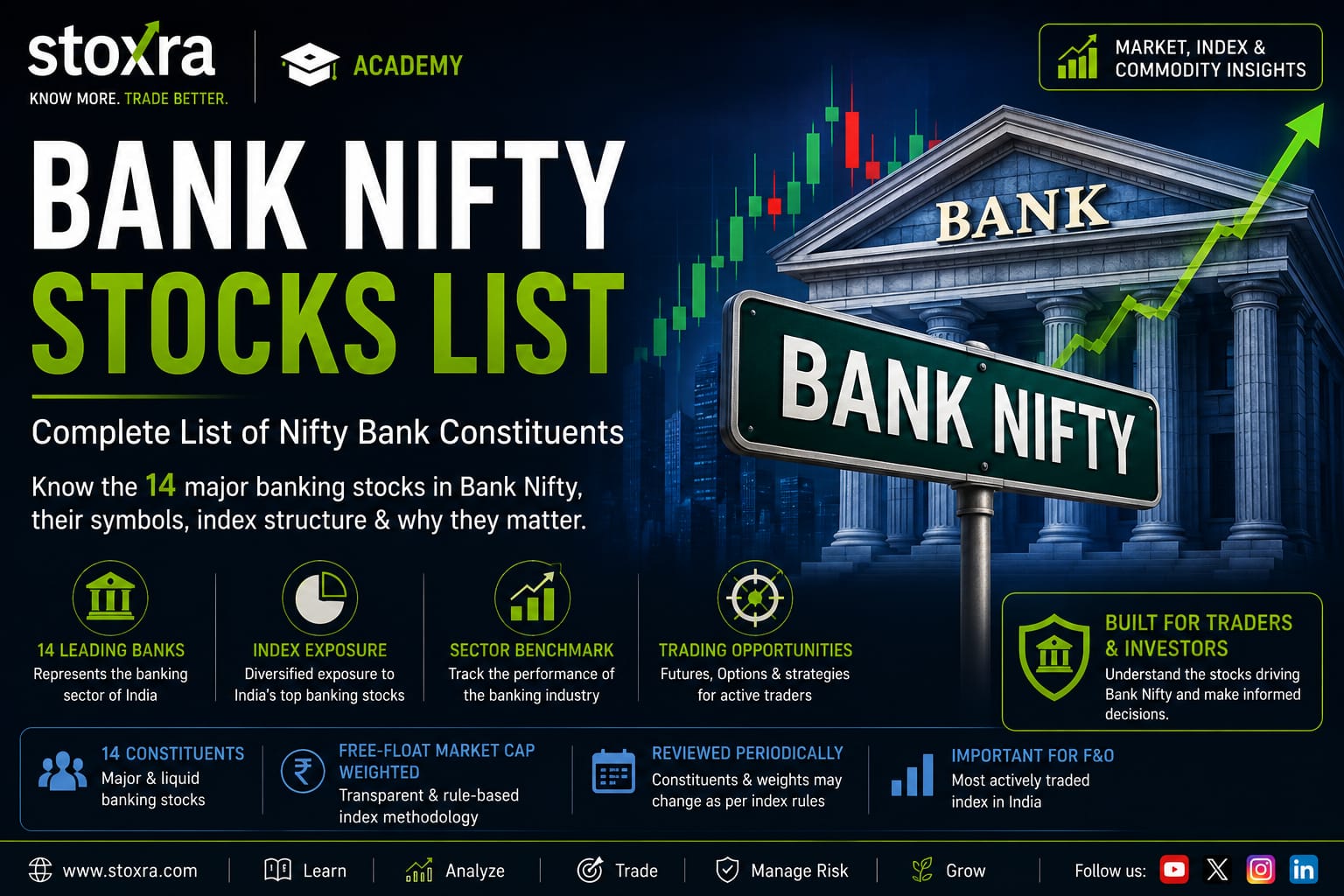
What Is Bank Nifty?
Bank Nifty is the commonly used market name for the Nifty Bank index. It tracks a basket of banking companies and provides a benchmark for the Indian banking sector.
The index is widely followed by investors and traders because banking companies play an important role in India's financial system.
Changes in RBI policy, interest-rate expectations and banking-sector conditions can influence the index. Traders interested in this relationship can also explore Bank Nifty and RBI policy strategies .
Current Bank Nifty Stocks List
The Bank Nifty basket consists of selected banking companies that meet the applicable index eligibility and methodology requirements. The exact constituent list should be verified from the latest official NSE Indices information because index composition can change following periodic reviews.
| # | Company | NSE Symbol |
|---|---|---|
| 1 | HDFC Bank Ltd. | HDFCBANK |
| 2 | ICICI Bank Ltd. | ICICIBANK |
| 3 | State Bank of India | SBIN |
| 4 | Kotak Mahindra Bank Ltd. | KOTAKBANK |
| 5 | Axis Bank Ltd. | AXISBANK |
| 6 | Federal Bank Ltd. | FEDERALBNK |
| 7 | IndusInd Bank Ltd. | INDUSINDBK |
| 8 | AU Small Finance Bank Ltd. | AUBANK |
| 9 | IDFC First Bank Ltd. | IDFCFIRSTB |
| 10 | Bank of Baroda | BANKBARODA |
| 11 | Punjab National Bank | PNB |
| 12 | Yes Bank Ltd. | YESBANK |
| 13 | Canara Bank | CANBK |
| 14 | Union Bank of India | UNIONBANK |
The names above are provided as a reference list. Always verify the latest constituents and methodology from the official index provider before using the list for trading or investment research.
Understanding how individual companies are evaluated can also help investors compare Bank Nifty constituents. For example, our guide on how to value a stock using fundamental analysis explains some of the basic approaches investors can use.
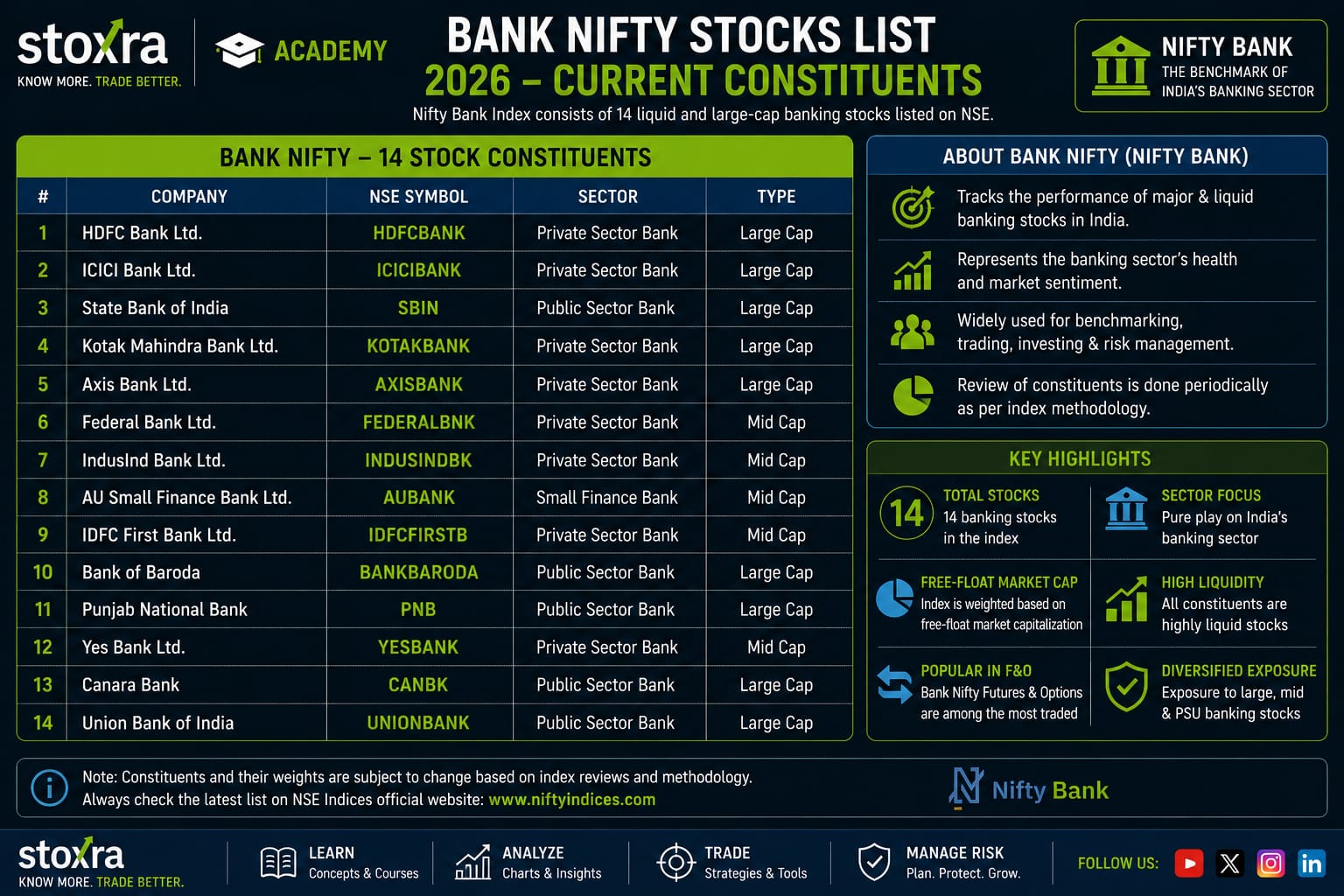
Major Bank Nifty Stocks
Some constituents have a substantially larger index weight than others. Large private banks and major public-sector banks can therefore have a greater influence on the overall movement of the index.
HDFC Bank
NSE Symbol: HDFCBANK
HDFC Bank is one of India's largest private-sector banks and is an important constituent of the Nifty Bank index.
ICICI Bank
NSE Symbol: ICICIBANK
ICICI Bank is another major private-sector banking constituent and is closely followed when analysing Bank Nifty movements.
State Bank of India
NSE Symbol: SBIN
State Bank of India is a major public-sector banking company and an important component of the banking-sector index.
Kotak Mahindra Bank
NSE Symbol: KOTAKBANK
Kotak Mahindra Bank is a major private-sector bank represented in the Bank Nifty basket.
Axis Bank
NSE Symbol: AXISBANK
Axis Bank is another major private-sector constituent that traders commonly monitor when analysing the banking sector.
Bank Nifty Weightage
Bank Nifty does not give every constituent exactly the same influence. The index follows its defined methodology for determining constituent weights, including free-float market-capitalisation considerations and applicable weight caps.
As a result, a large percentage move in a heavyweight constituent can have a greater effect on the index than a similar move in a smaller-weight constituent.
This is one reason investors should understand the difference between a company's individual performance and its contribution to an index. For broader analysis, qualitative vs quantitative stock analysis can provide useful context.
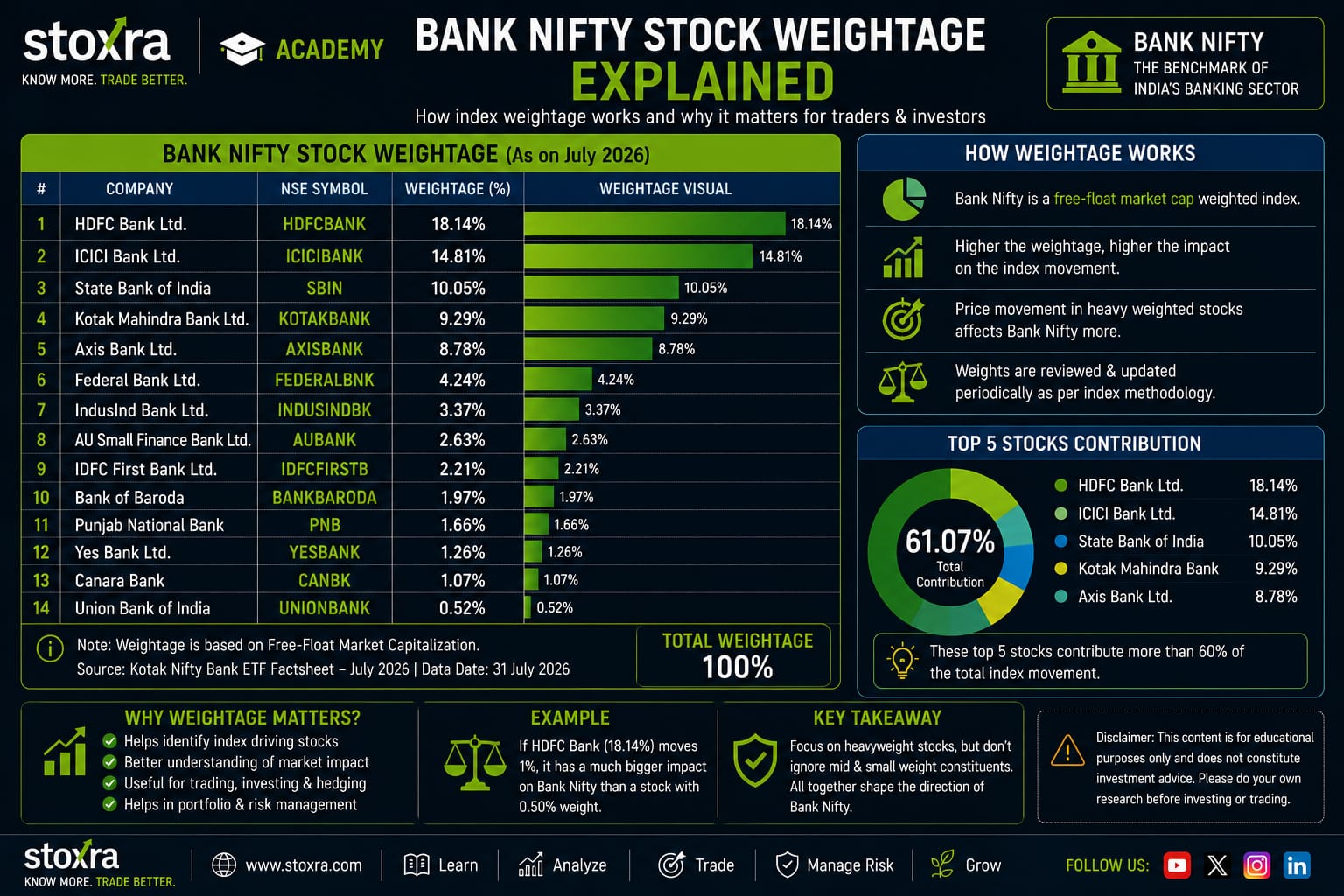
Why Does Bank Nifty Weightage Matter?
Suppose two banking stocks both rise by 5%. If one stock has a significantly higher index weight, its movement can have a greater direct contribution to the index.
This is why traders often look at:
Price Movement + Index Weight + Market Context
rather than analysing percentage changes alone.
Investors should also avoid making decisions based on one indicator or one price move. Our guide to common stock market mistakes beginners make covers several errors that can affect decision-making.
What Factors Affect Bank Nifty Stocks?
Banking stocks can respond to a wide range of company-specific and macroeconomic factors. Important factors include:
- Interest rates
- Credit growth
- Loan demand
- Net interest margins
- Asset quality
- RBI policy
- Economic growth
- Liquidity conditions
- Banking regulations
- Quarterly earnings
For example, changes in net interest margins can influence banking-sector earnings expectations. STOXRA also tracks developments related to bank stocks and NIM concerns .
Investors who want to understand broader market rules can also read our guide to stock market rules for beginner traders in India .
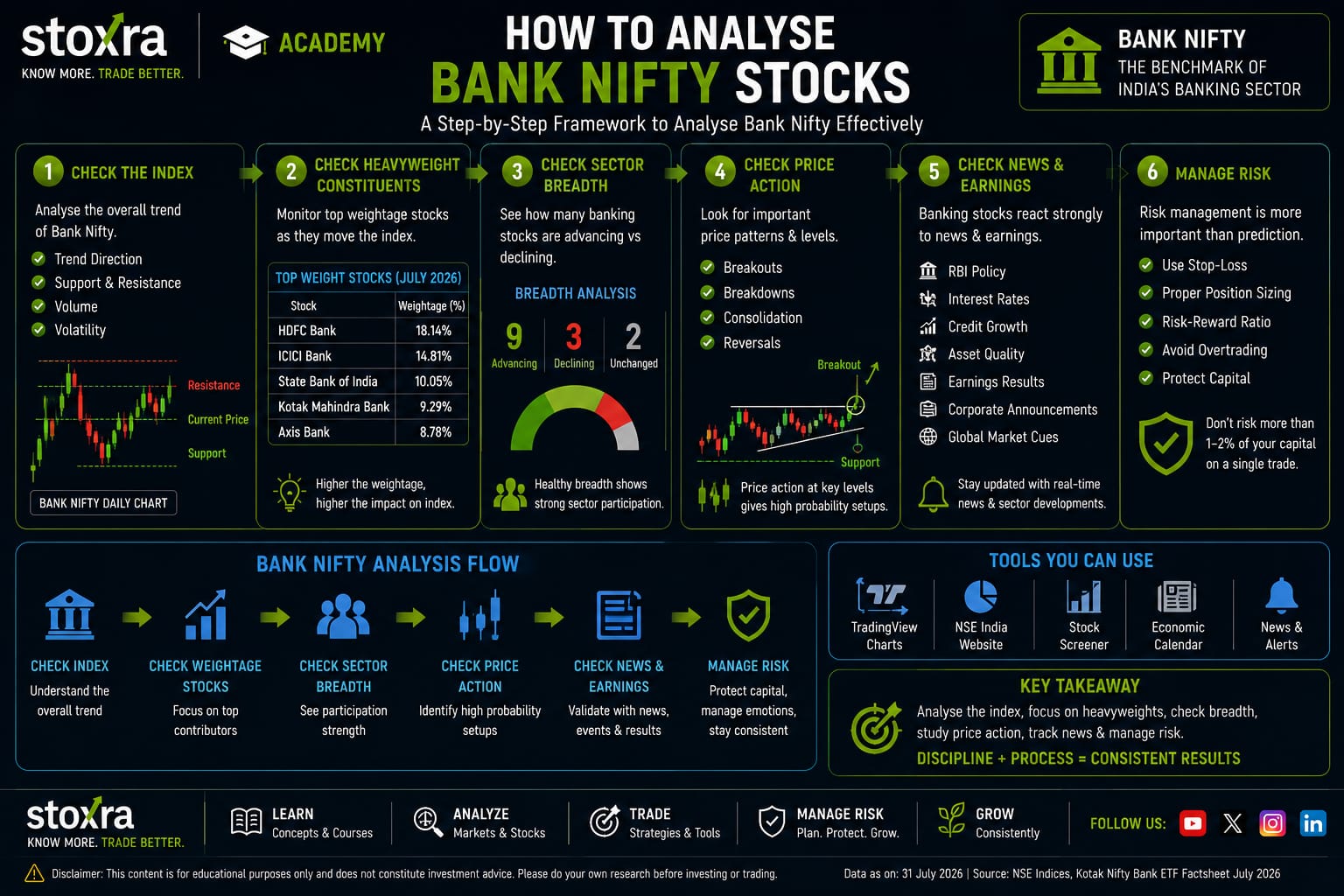
How to Analyse Bank Nifty Stocks
A practical approach is to analyse both the index and its individual constituents.
Step 1: Check the Bank Nifty Trend
Start by identifying the broader direction of the index and important support and resistance areas.
Understanding technical charts can be easier after learning the basics of technical analysis in stock trading .
Step 2: Monitor Heavyweight Constituents
Pay attention to the largest-weighted banking stocks because their movements can have a meaningful influence on the index.
Step 3: Check Sector Breadth
Look at how many constituent stocks are rising versus falling. Broad participation can provide additional context about sector strength or weakness.
Step 4: Study Price Action
Look for breakouts, breakdowns, consolidations, reversals and reactions around important technical levels.
Traders can also study candlestick patterns for beginners to improve their understanding of price action.
Step 5: Check News and Earnings
Company announcements, earnings reports, RBI developments and broader economic news can affect banking stocks.
Step 6: Manage Risk
No index setup is guaranteed. Define the trade's invalidation level and maximum acceptable risk before entering a position.
Risk management becomes especially important when trading leveraged derivatives. For more information, see options trading risk management for beginners .
Position sizing is another important part of risk control. Our guide on position sizing for intraday trading explains how traders can think about exposure before entering a trade.
Bank Nifty and F&O Trading
Bank Nifty is widely followed in the derivatives market. Traders may use futures and options for directional strategies, hedging, spreads and other structured strategies.
However, derivatives involve leverage and can magnify both gains and losses. Traders should understand contract specifications, margin requirements, expiry rules and position risk before trading.
Option-chain information can also be useful when analysing index derivatives. For additional context, explore NIFTY option chain analysis and weekly expiry strategy .
Traders interested in broader derivatives indicators can also explore the best indicators for options trading .
If you are learning options, understanding options rollover can also help you understand how positions may be managed around expiry.
Bank Nifty vs Nifty 50
| Feature | Bank Nifty | Nifty 50 |
|---|---|---|
| Focus | Banking sector | Broad Indian equity market |
| Sector exposure | Banking companies | Multiple sectors |
| Purpose | Banking-sector benchmark | Broad-market benchmark |
| Trading relevance | Banking-sector analysis and derivatives | Broad-market analysis and derivatives |
The choice between Nifty and Bank Nifty can depend on the trader's objective, market view and risk tolerance. The comparison is particularly relevant for traders evaluating index options.
Traders should also be aware that emotional decisions can affect leveraged trading. Our guide on trading psychology for beginners explores some of the behavioural factors involved in trading.
Can Bank Nifty Constituents Change?
Yes. Index constituents and their weights can change following periodic reviews and changes in eligibility under the applicable index methodology.
This means an old Bank Nifty list may not represent the current index.
For accurate research, traders and investors should verify the latest constituent information from the official NSE Indices source.
Why You Should Not Use an Old Bank Nifty List
A previously published constituent list can become outdated after an index review. Companies can be added or removed and constituent weights can also change.
Therefore, always check the date of the information before using a Bank Nifty stock list for research.
Avoiding outdated information is particularly important when building a trading plan. Traders can also learn about trade expectancy and win rate to understand why a single successful or unsuccessful trade should not determine the overall evaluation of a strategy.
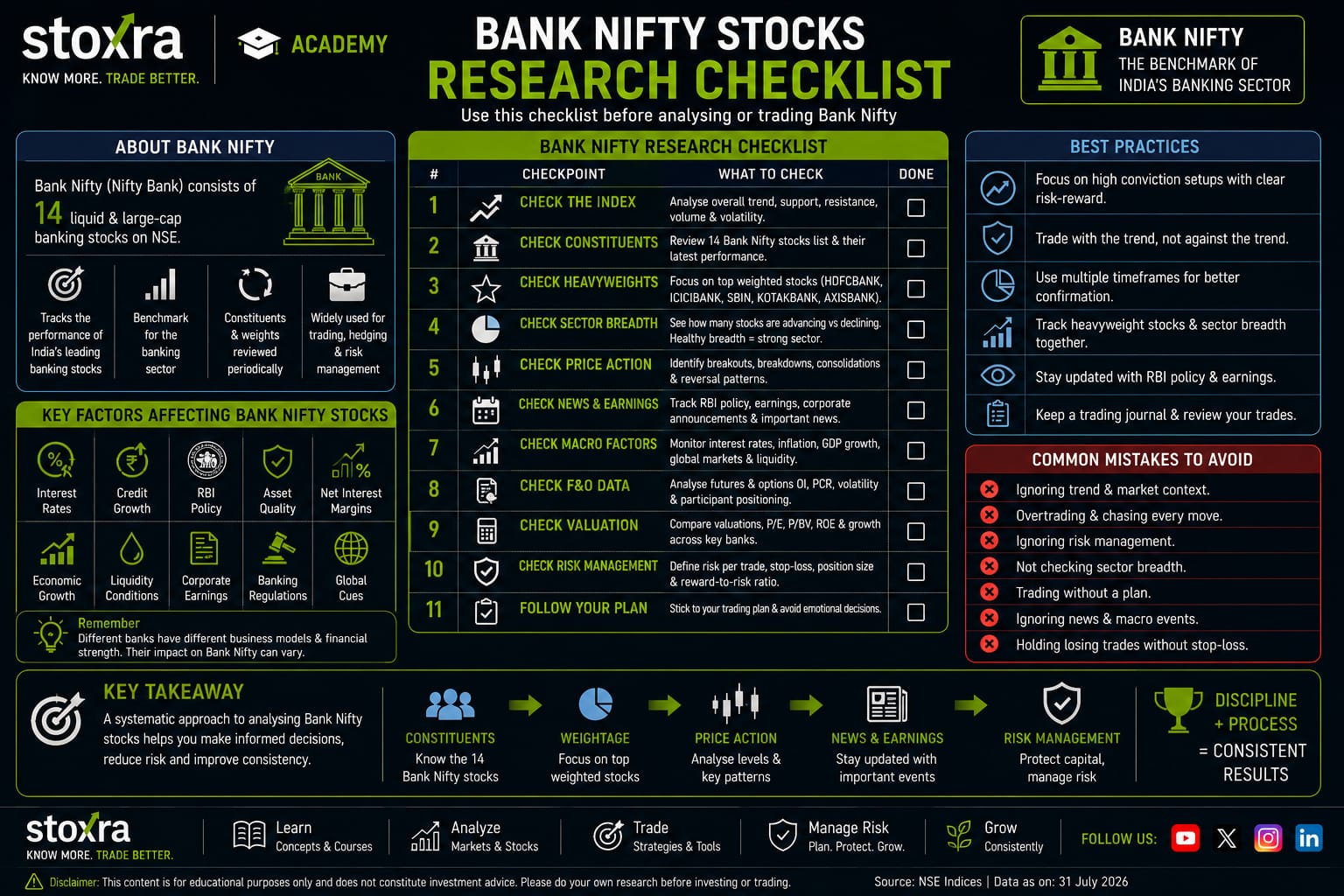
Bank Nifty Research Checklist
- ☑ Check the current constituent list.
- ☑ Check the latest index weights.
- ☑ Identify major heavyweight stocks.
- ☑ Check sector breadth.
- ☑ Analyse price action.
- ☑ Review trading volume.
- ☑ Check RBI and macroeconomic developments.
- ☑ Review earnings announcements.
- ☑ Check relevant market news.
- ☑ Define your risk limits.
- ☑ Create a trading plan before taking a position.
Traders should also consider drawdown risk when evaluating a strategy. See our guide on risk-management techniques to reduce drawdown for additional risk-management concepts.
Final Takeaway
The Bank Nifty stocks list is useful for understanding the companies that represent India's banking-sector benchmark.
However, the constituent list and index weights are not permanent. Traders and investors should always verify the latest information before making decisions.
A useful Bank Nifty analysis framework is:
Constituents → Weightage → Price Action → Sector Breadth → News → Risk Management
Bank Nifty can provide valuable insight into banking-sector sentiment, but it should not be treated as a guaranteed indicator of future market direction.
For traders using automated or AI-assisted tools, you can also explore the STOXRA AI Trading Platform to learn more about technology-assisted market research and trading workflows.
Continue learning through STOXRA Learn , where you can explore additional educational resources related to markets, trading and investing.
Frequently Asked Questions
What is Bank Nifty?
Bank Nifty is the commonly used name for the Nifty Bank index, which tracks selected banking companies listed on the National Stock Exchange of India.
How many stocks are in Bank Nifty?
The number of constituents can change according to the applicable index methodology and periodic reviews. Always check the latest official NSE Indices information for the current list.
Which stocks are major Bank Nifty constituents?
Major constituents can include large private-sector and public-sector banks such as HDFC Bank, ICICI Bank, State Bank of India, Kotak Mahindra Bank and Axis Bank.
Does every Bank Nifty stock have the same weight?
No. Constituents have different weights based on the index methodology, so some stocks can have a greater influence on index movements than others.
Can Bank Nifty stocks change?
Yes. Constituents and their weights can change following index reviews and applicable eligibility requirements.
Is Bank Nifty suitable for beginners?
Bank Nifty can be useful for learning about the banking sector, but derivatives trading can involve substantial risk. Beginners should understand the product, leverage and risk-management requirements before trading.
Disclaimer
This article is for educational and informational purposes only and does not constitute investment, financial or trading advice. Index constituents, weights and market conditions can change. Always verify the latest information from official sources before making investment or trading decisions. Trading and investing involve market risk, including the possible loss of capital.