Covered Call Strategy for Beginners
Learn the covered call strategy for beginners with simple examples, strike-price selection, option premiums, assignment, breakeven, profit potential and key risks.
Related Options Resources
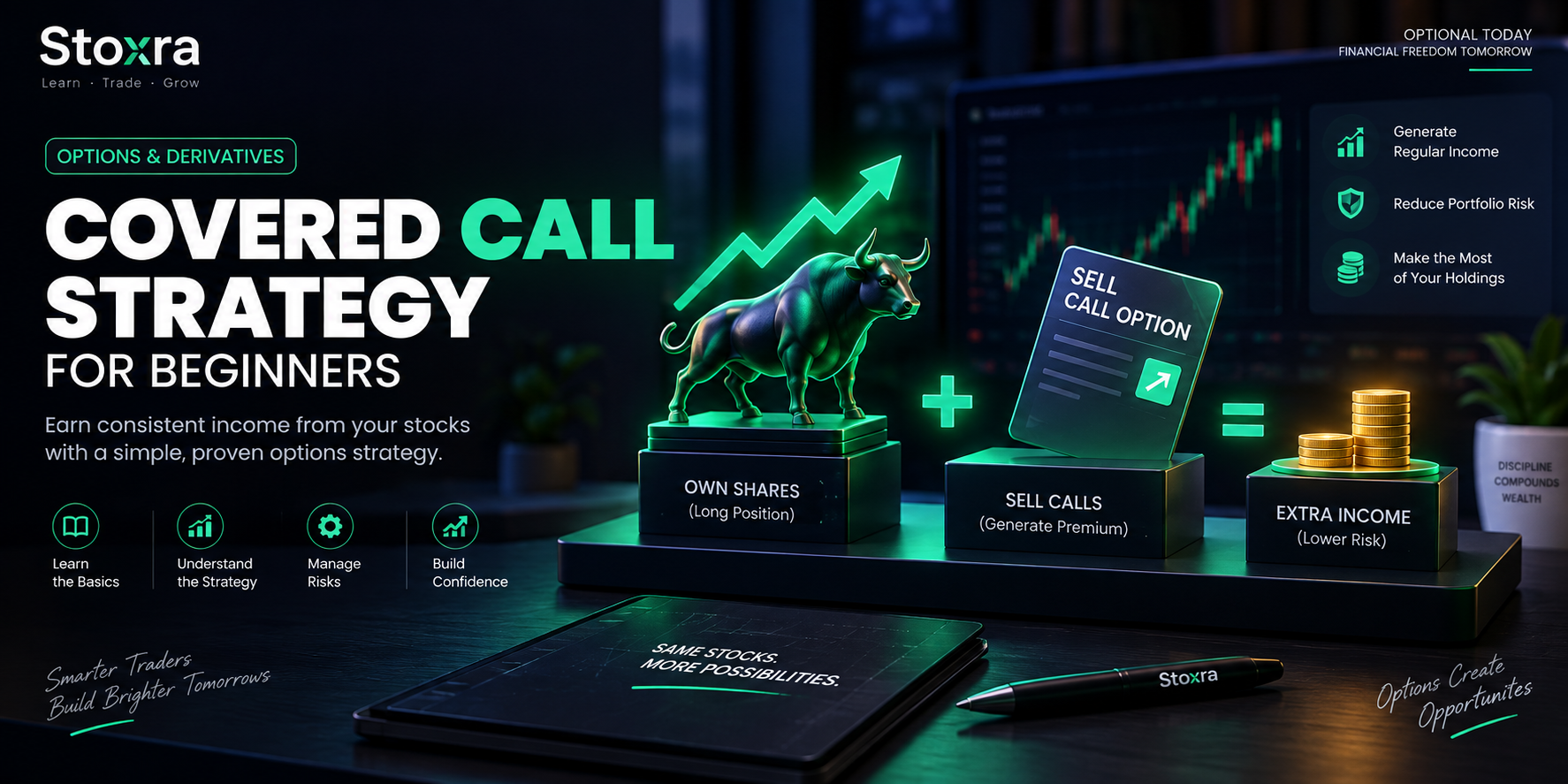
A covered call means owning shares and selling a call option against those shares.
You receive an option premium immediately, but in exchange you accept the possibility that your shares may be sold at the selected strike price. The strategy can be useful when you are neutral to moderately bullish and are willing to sacrifice some upside in exchange for premium income.
This beginner-friendly guide explains the covered call strategy without assuming advanced options knowledge. You will learn how calls work, how premiums are calculated, how to select a strike, what expiration means, how assignment works, where the profit comes from, how losses can occur and why selling the highest premium is not necessarily the smartest decision.
What Is a Covered Call Strategy?
A covered call is an options strategy in which an investor owns an underlying stock or other eligible asset and simultaneously sells a call option against that position. The investor receives a premium from selling the call and accepts an obligation to sell the underlying shares at the strike price if the option is exercised and assignment occurs.
The strategy is called “covered” because the investor already owns the underlying shares needed to satisfy the obligation. This is an important distinction from an uncovered or naked call, where the seller does not already hold the underlying asset.
At a basic level, the strategy creates a trade-off. The investor receives premium income today, but gives another market participant the right to buy the shares at a predetermined price. If the stock stays below the strike, the call may expire worthless and the seller can generally retain the premium. If the stock rises substantially above the strike, the seller may have to give up the shares at the strike price.
That trade-off is the entire point of the strategy. A covered call is not a free income machine and it is not a substitute for understanding the underlying stock. It is a structured decision about how much upside you are willing to exchange for premium.
If you would be unwilling to sell your shares at the selected strike price, you should think twice before selling the call. The premium does not remove the obligation created by the option.
Beginners should first understand basic option mechanics. If the terminology is unfamiliar, start with how to enter an options trade and then review common options trading mistakes .
How Does a Covered Call Work?
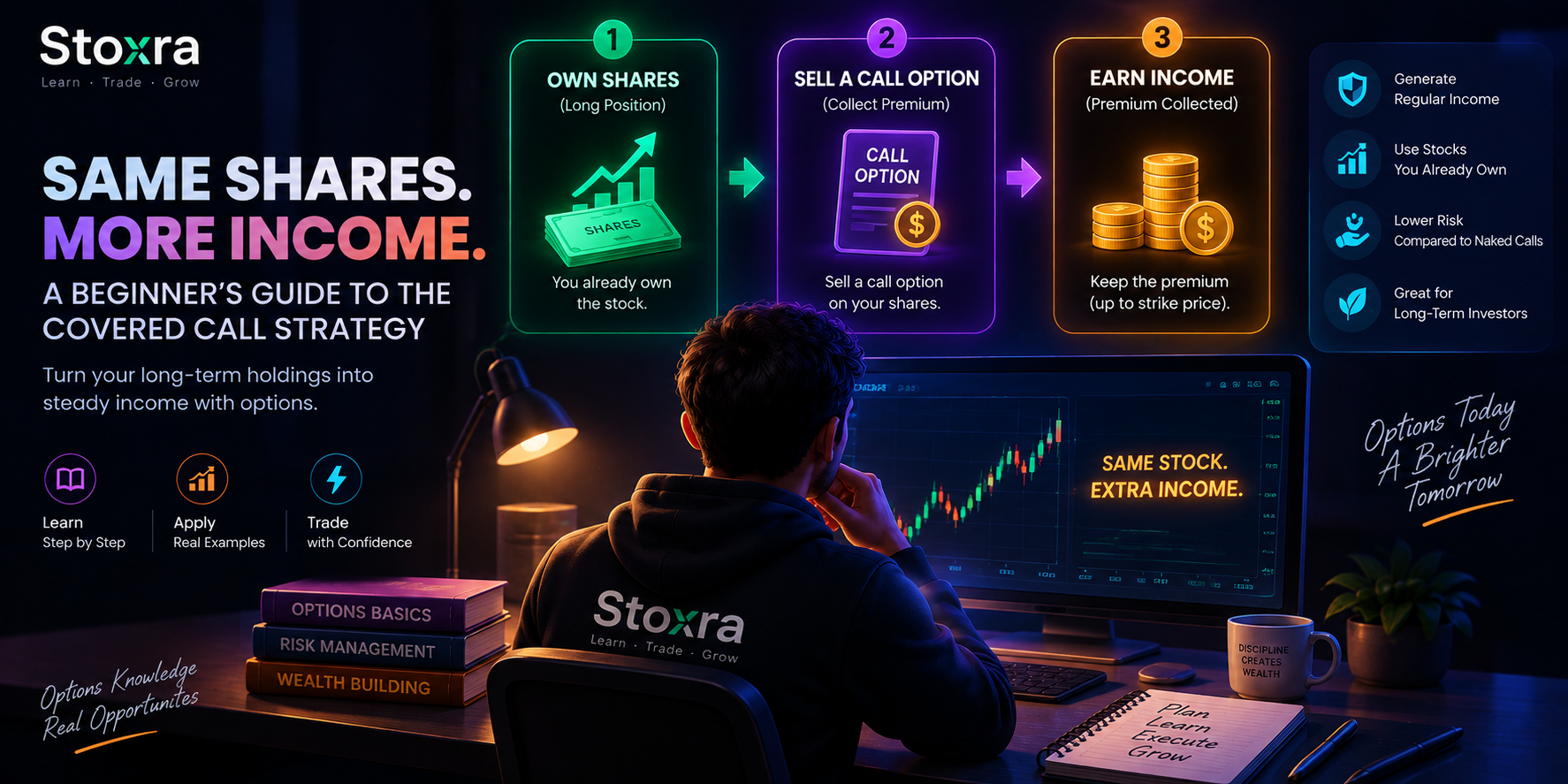
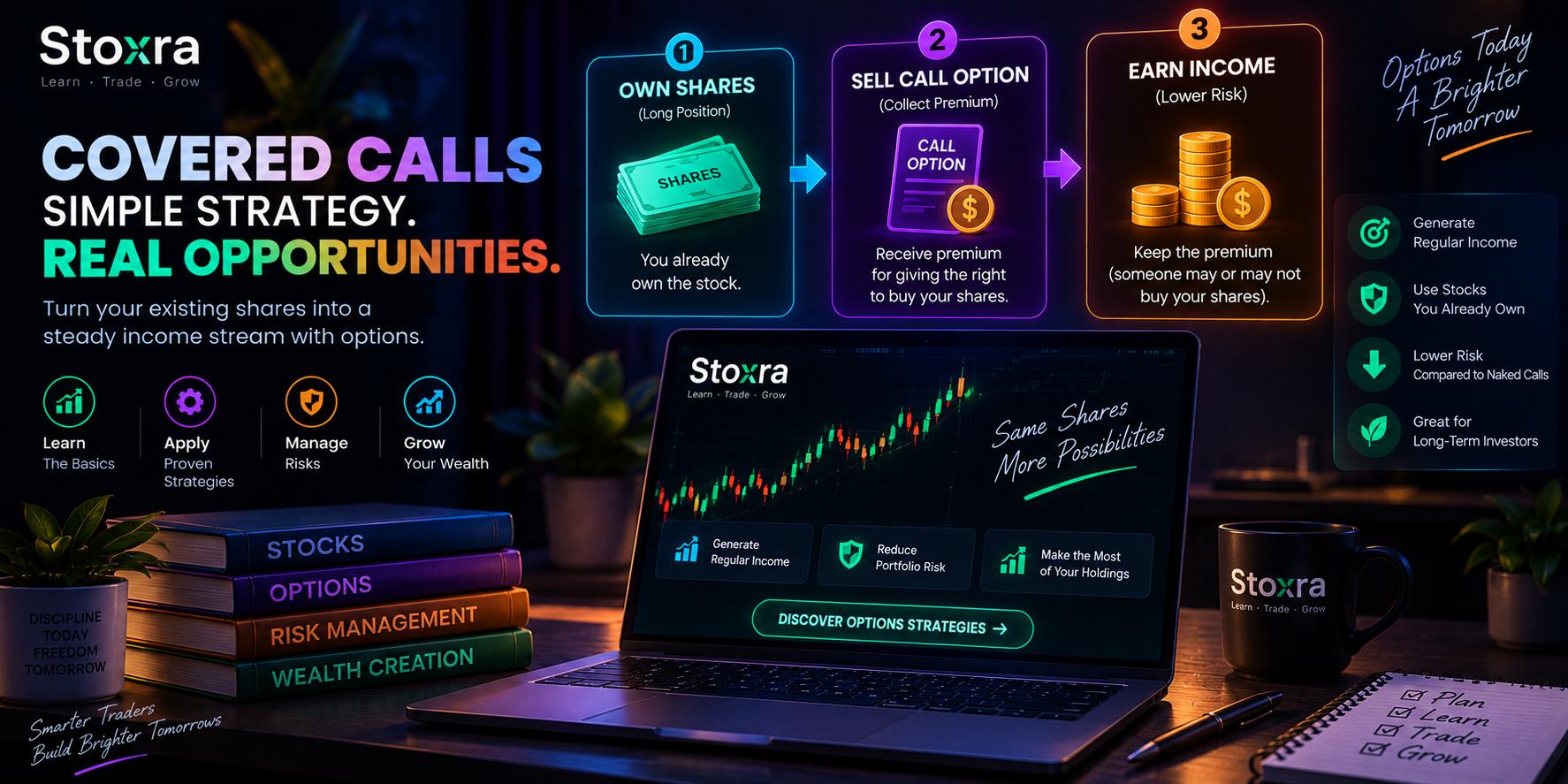
The mechanics can be reduced to a straightforward sequence. First, you own the underlying shares. Second, you select a call option with a specific strike price and expiration date. Third, you sell that call and receive a premium.
Own Shares
Hold the underlying shares required to cover the call position.
Sell Call
Select a strike price and expiration and sell the call option.
Receive Premium
Collect the option premium while accepting the assignment risk.
Imagine that you own 100 shares of a hypothetical company trading at ₹500. You decide to sell one call with a ₹550 strike price. Suppose the premium is ₹12 per share.
That ₹1,200 is received because the buyer is paying for the right, but not the obligation, to purchase the shares at the strike price. As the seller, you have accepted the other side of that contract.
If the stock remains below ₹550 at expiration, the call may expire worthless. In that case, the investor may retain the shares and the premium. If the stock moves significantly above ₹550, assignment may occur and the shares can be sold at the strike.
This is why understanding option-chain data is useful. The option chain provides information about available strikes, premiums and expirations, allowing traders to compare different contracts rather than blindly selecting the highest premium.
Covered Call Example: Profit and Loss Scenarios
The easiest way to understand a covered call is to examine different possible prices at expiration. Consider a hypothetical investor who owns 100 shares purchased at ₹500 per share.
| Trade Component | Example Value |
|---|---|
| Shares owned | 100 |
| Share purchase price | ₹500 |
| Call strike | ₹550 |
| Call premium | ₹12 |
| Total premium | ₹1,200 |
Scenario 1: Stock falls
Suppose the stock falls to ₹450. The call will likely be out of the money, but that does not mean the investor made a profit. The shares have declined by ₹50 each. The ₹12 premium provides only a limited cushion.
Before costs and taxes, the simplified position loss would be approximately ₹38 per share, or ₹3,800, assuming the call expires worthless.
Scenario 2: Stock remains below the strike
Suppose the stock finishes at ₹530. The call remains below the ₹550 strike. The seller may keep the shares and the ₹12 premium. The investor has a ₹30 stock gain plus ₹12 premium per share in this simplified example.
Scenario 3: Stock reaches the strike
If the stock reaches approximately ₹550, the call is around the strike. Assignment becomes a relevant consideration and the exact outcome depends on the option contract and market mechanics.
Scenario 4: Stock rises above the strike
Suppose the stock reaches ₹600. Without the call, the investor would have a ₹100 stock gain per share. With the ₹550 short call, the investor may have to sell the shares at ₹550.
Add premium = ₹50 + ₹12 = ₹62 per share
The investor therefore participates in the stock gain up to the strike plus the premium, but generally does not participate in the additional ₹50 move from ₹550 to ₹600.
This is the opportunity cost of the strategy. Covered calls can look excellent during sideways markets, but a strong rally can make the investor wish they had never sold the call.
How to Choose the Covered Call Strike Price
Strike selection is arguably the most important decision in a covered call. The strike determines how much room the stock has to rise before the short call becomes in the money.
A beginner should not choose a strike simply because it offers the highest premium. The better question is whether you are genuinely willing to sell your shares at that price.
At-the-money calls
An at-the-money call has a strike close to the current underlying price. It can offer a relatively attractive premium, but the stock has less room to rise before the option becomes in the money.
Out-of-the-money calls
An out-of-the-money call has a strike above the current stock price. This provides greater room for appreciation before assignment becomes likely, but the premium will often be smaller.
In-the-money calls
An in-the-money call can provide a larger premium, but it also creates a much greater likelihood that the shares will be called away. Beginners should understand the consequences before using this structure.
Pick the strike based on the price at which you would actually be comfortable selling the shares. Do not pick the strike solely by looking for the largest premium.
To strengthen your understanding of strike selection and market positioning, review how to identify a strong options trade setup and support and resistance with option-chain data .
Strike selection should also be considered alongside implied volatility. Read the implied volatility guide before assuming that a large premium automatically represents a better opportunity.
How Expiration Date Changes a Covered Call
Every option has an expiration date, and the amount of time remaining can materially change the premium, risk and management requirements of a covered call.
Shorter-dated calls generally give the investor more frequent opportunities to sell new contracts, but they also require more active management. Longer-dated calls may generate a larger upfront premium, but they can restrict the investor's upside for a longer period.
There is no universal expiration that is best for every investor. The appropriate choice depends on the underlying asset, market conditions, volatility, desired income, expected holding period and willingness to manage the position.
Shorter Expiry
More frequent decisions and potentially faster premium cycles.
Medium Expiry
A balance between premium collection and time commitment.
Longer Expiry
More time value but less flexibility while the call remains open.
Time decay is another important concept. An option's time value tends to decline as expiration approaches, all else equal. But that does not make selling calls risk-free. A large movement in the underlying can overwhelm the effect of time decay.
If you trade index options, resources such as NIFTY weekly expiry analysis and NIFTY vs Bank NIFTY options can help you understand how expiry-specific decisions fit into the broader options market.
Covered Call Profit, Breakeven and Downside Risk
A covered call changes the payoff profile of owning the underlying shares. The premium received lowers the effective cost basis, while the short call limits the upside beyond the strike.
If you bought shares at ₹500 and received ₹12 from selling the call, the simplified breakeven becomes ₹488 per share before brokerage, taxes, fees and other costs.
But do not confuse a lower breakeven with complete downside protection. If the stock falls to ₹300, the ₹12 premium does very little to offset the ₹200 decline in the stock.
| Underlying Price | Likely Covered Call Effect |
|---|---|
| Large decline | Stock loss dominates; premium provides limited cushion. |
| Below strike | Call may expire worthless and premium may be retained. |
| Near strike | Assignment becomes increasingly relevant. |
| Above strike | Upside becomes capped around the strike. |
A covered call is still a stock position. If the underlying falls heavily, the investor can lose a substantial amount of capital. The option premium is a limited buffer, not insurance.
Risk management should therefore be designed before entering the position. Read options trading risk management , how much money to risk in options and options stop-loss concepts before building a repeatable strategy.
What Happens When a Covered Call Is Assigned?
Assignment means the short call seller is required to fulfill the obligation associated with the option contract. For a covered call, that generally means delivering the underlying shares at the strike price.
Consider the earlier example. You own 100 shares purchased at ₹500 and sell a ₹550 call. If the call is assigned, you may have to sell those 100 shares at ₹550.
If the stock is trading at ₹600, that may feel frustrating because you could have sold the shares at a higher market price. But that is the trade you accepted when you sold the call. The premium was the compensation for taking that obligation.
Why assignment should be planned in advance
Before selling a call, decide what you will do if the stock moves through the strike. There should be no surprise when the position becomes profitable but your upside is capped.
Some traders close the option before expiration. Others consider rolling the option to another strike or expiration. Neither choice is automatically better. Closing or rolling changes the economics of the trade and should be evaluated using the current option price rather than emotional attachment to the original position.
Review how to exit an options trade without panic and common options entry and exit mistakes to build a more disciplined approach.
Common Covered Call Mistakes Beginners Make
Covered calls are relatively straightforward compared with many multi-leg options strategies, but that does not mean they are foolproof. The biggest mistakes usually come from misunderstanding the trade-off between income and upside.
- Selling a call on shares you are unwilling to sell.
- Choosing the highest premium without analysing the strike.
- Assuming the premium makes the position safe.
- Ignoring the possibility of a sharp stock rally.
- Ignoring the downside risk of the underlying shares.
- Forgetting transaction costs and taxes.
- Using illiquid options with wide bid-ask spreads.
- Changing the strategy after every losing trade.
- Failing to understand assignment.
- Treating monthly premium as guaranteed income.
Mistake 1: Chasing premium
A high premium can be attractive, but it often reflects greater uncertainty or a strike closer to the current price. Premium should never be evaluated in isolation.
Mistake 2: Ignoring opportunity cost
Imagine collecting ₹1,000 in premium and then watching the underlying rise dramatically. If your short call forces you to sell at a much lower strike, the premium may be tiny compared with the upside you surrendered.
Mistake 3: Treating covered calls as guaranteed income
Premium income can vary significantly. Market volatility, expiration, strike selection and underlying price movements can all affect the result. A strategy that produced attractive premium last month may not offer the same opportunity next month.
For a broader view of trading discipline, compare when to book options profits with common options mistakes .
Covered Call Calculator: Understand the Basic Economics
Use the simple educational calculator below to estimate the simplified breakeven and maximum effective gain before transaction costs and taxes. It does not predict whether a trade will succeed.
For broader option-chain analysis, you can continue with option-chain trading analysis , Bank NIFTY option-chain analysis , PCR analysis and Max Pain theory .
When Does a Covered Call Make Sense?
A covered call can make conceptual sense when an investor already wants to hold the underlying shares but is comfortable accepting a predetermined ceiling on part of the upside. The investor may expect the stock to remain relatively stable or appreciate moderately rather than experience a massive rally.
The strategy can also be useful as a structured way to define a potential exit price. Instead of simply waiting indefinitely for a stock to rise, an investor can choose a price at which they would be comfortable selling and receive premium in exchange for accepting that obligation.
However, covered calls become less attractive when the investor has a very strong bullish thesis. If the expected move is much larger than the selected strike allows, the opportunity cost of selling the call can outweigh the premium.
They can also be inappropriate for someone who cannot tolerate the underlying stock falling. The strategy does not remove the fundamental risks of owning shares.
Potentially Useful
You already own shares and would be comfortable selling them at a selected price.
Needs Caution
You expect a major rally and do not want your upside restricted.
Poor Fit
You do not understand assignment or the downside risk of the underlying shares.
The strategy should therefore be judged against your actual objective, not against a generic promise of “income.” If your goal is to learn rather than immediately trade, paper trading can provide a way to practise option decisions without immediately putting real capital at risk. You can explore paper trading for options before moving further.
Beginner Checklist Before Selling a Covered Call
Before entering a covered call, make sure you can answer every question below without guessing.
- Do I actually own enough underlying shares to cover the call?
- Would I be comfortable selling those shares at the strike price?
- Why did I choose this specific strike?
- Why did I choose this expiration?
- How much premium am I receiving?
- What happens if the underlying falls 10%, 20% or more?
- What happens if the underlying rallies sharply?
- Do I understand assignment?
- Have I considered transaction costs and taxes?
- Is the option sufficiently liquid?
- Do I have a plan for expiration?
- Am I relying on premium income as if it were guaranteed?
If you cannot answer these questions, do not rush into the trade. Learning the mechanics first is cheaper than learning them through a real loss.
You can strengthen your process by reviewing strong options trade setups and options risk management before considering real-money execution.
Understand the Strategy Before You Risk Capital
Covered calls may look simple, but the trade-off between premium, upside, assignment and downside risk deserves serious attention. Build your options knowledge, analyse the market and practise your process before moving toward real-money trading.
Explore Options Learning →Frequently Asked Questions
A covered call combines ownership of an underlying asset with selling a call option against that position. The seller receives a premium but accepts the possibility that the shares may be called away at the strike price.
Is a covered call risk-free?No. The underlying shares can decline significantly. The premium provides only a limited cushion and does not eliminate the risk associated with owning the stock.
Can covered calls limit profits?Yes. If the stock rises above the call strike and assignment occurs, the investor may have to sell the shares at the strike, giving up additional upside above that level.
What happens if the call expires out of the money?If the option expires out of the money and is not assigned, the seller generally keeps the premium and continues holding the underlying shares, subject to applicable contract rules.
Should beginners always sell calls every month?No. There is no requirement to sell calls continuously. The strategy should only be used when the investor understands the trade-off and is comfortable with the potential outcomes.
Is a higher option premium always better?No. A higher premium may come with a closer strike, higher volatility or greater probability of assignment. Premium should be evaluated alongside risk and the investor's market outlook.
Can AI choose the best covered call for me?AI can assist with analysis and organisation, but it should not replace understanding the underlying strategy, risks, assumptions and market mechanics. You remain responsible for evaluating the trade.
Can I practise covered calls before using real money?Yes. Paper trading can help you practise the process and observe how option prices and underlying movements affect the position before committing real capital.
A covered call is an exchange: premium income in return for giving up some upside potential.
The strategy starts with owning the underlying shares and selling a call against them. If the stock remains below the strike, the call may expire worthless and the premium can be retained. If the stock rises strongly above the strike, assignment can limit further upside. If the stock falls sharply, the investor remains exposed to the underlying's downside.
That makes the strategy neither a guaranteed-income product nor a risk-free hedge. It is a deliberate options strategy that works only when the investor understands the underlying position, the strike, expiration, premium, assignment mechanics and downside risk.
Financial Disclaimer: This article is for educational and informational purposes only and does not constitute investment, financial, tax or trading advice. Options involve significant risks and may not be suitable for every investor. Examples shown in this article are hypothetical and exclude brokerage, taxes, fees, slippage and other transaction costs. Covered calls can limit upside while leaving the investor exposed to losses in the underlying asset. Conduct independent research and consider your own financial circumstances and risk tolerance before making investment decisions.