Debit Spread vs Credit Spread: Which Options Strategy Fits?
Learn the key differences between debit spreads and credit spreads, including their payoff, risk, breakeven, time decay, volatility and suitability for different market views.
Debit Spread vs Credit Spread: Which Options Strategy Fits?
Debit spreads and credit spreads are two important defined-risk options structures. Learn how they differ in entry cost, maximum profit, maximum loss, breakeven, time decay, volatility and market outlook so you can evaluate a spread based on its complete payoff rather than simply the premium.
Options spreads can help traders structure a position using multiple options contracts rather than buying or selling a single option. Two broad categories that traders commonly encounter are debit spreads and credit spreads. Understanding the structure of each strategy is an important part of learning the basics of options trading and derivatives.
Traders who are still building their foundation can first review stock market basics for beginners and stock market terminology before moving into more advanced options strategies.
The key difference is simple:
- Debit spread → You pay a net premium to enter.
- Credit spread → You receive a net premium to enter.
But that difference alone does not tell you which strategy is better. Both strategies have defined structures, different profit and loss characteristics, and different risks. The right choice depends on the trader's market view, expected price movement, time to expiry, volatility and risk tolerance.
Before comparing spread structures, traders may also benefit from understanding the broader risks involved in option buying vs option selling .
Key Takeaway
Debit spreads require a net premium payment, while credit spreads generate a net premium received. Neither structure is automatically safer or better. The right choice depends on the expected market move, maximum profit, maximum loss, breakeven, volatility, time to expiry, liquidity and the trader's risk limits. Always calculate the complete payoff before entering an options spread.
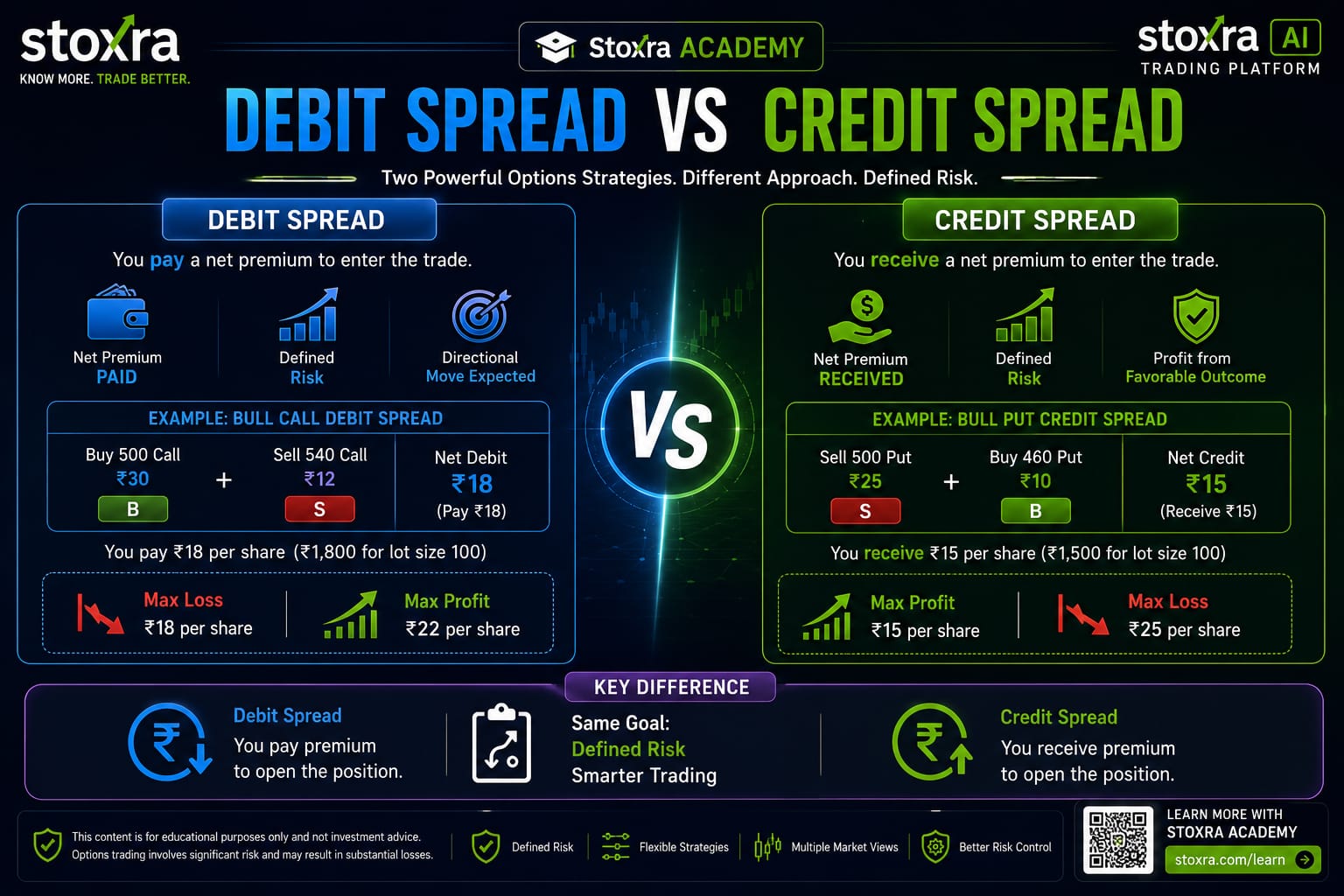
What Is a Debit Spread?
A debit spread is an options strategy in which the premium paid for one option is greater than the premium received from the other option. The result is a net debit, meaning money is paid when the position is opened.
A debit spread normally consists of:
- Buying one option
- Selling another option
- Both options generally having the same expiry
- Different strike prices
The purchased option provides the primary exposure, while the sold option helps reduce the upfront cost. Traders should understand the basic option contract structure and terminology before using such strategies.
Simple Debit Spread Example
Bull Call Spread Example
Imagine a trader has a bullish view on a stock trading around ₹500. They could construct a bull call spread:
- Buy ₹500 Call for ₹30
- Sell ₹540 Call for ₹12
Net debit: ₹30 − ₹12 = ₹18
If the contract has 100 shares: Maximum initial debit = ₹1,800
The maximum loss is generally limited to the net debit paid, ignoring transaction costs. The maximum profit is limited by the difference between the strikes minus the net debit.
Strike difference = ₹540 − ₹500 = ₹40
Maximum profit = ₹40 − ₹18 = ₹22 per share
Therefore: Maximum loss = ₹18/share and maximum profit = ₹22/share.
This is the basic structure of a bull call debit spread. Traders can also learn about position sizing before applying any defined-risk strategy to real capital.
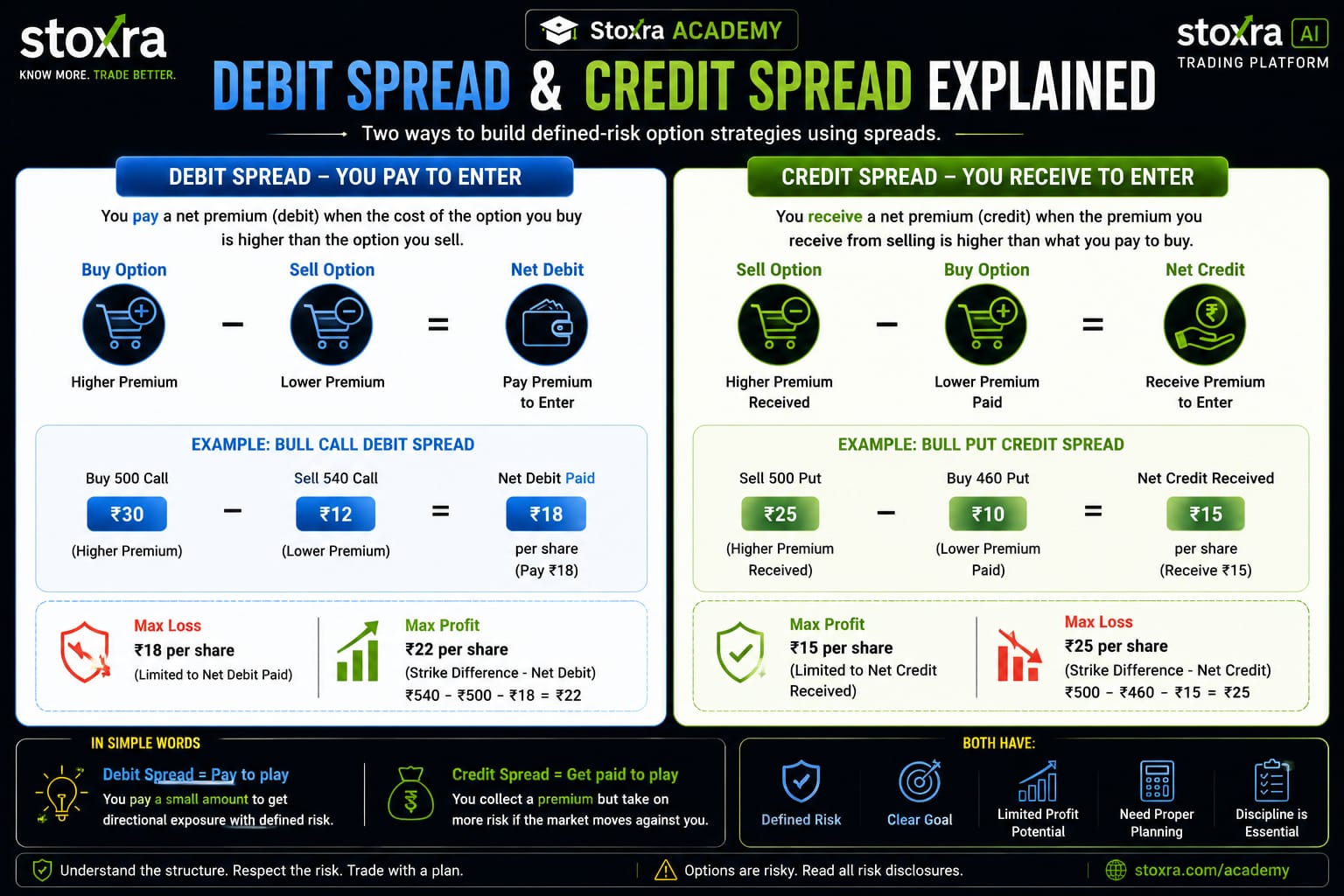
What Is a Credit Spread?
A credit spread is an options strategy where the premium received from one option is greater than the premium paid for the other. The trader therefore receives a net credit when entering the position.
A credit spread typically involves:
- Selling one option
- Buying another option
- Same expiry
- Different strikes
The purchased option provides protection against losses beyond the spread's defined structure. However, defined risk does not mean that the strategy is risk-free.
Traders should understand position sizing and risk controls before using premium-selling strategies. The concepts discussed in intraday risk management can also help traders think about how much capital is exposed to a single trade.
Simple Credit Spread Example
Bull Put Spread Example
Suppose a trader has a moderately bullish view and constructs a bull put spread:
- Sell ₹500 Put for ₹25
- Buy ₹460 Put for ₹10
Net credit: ₹25 − ₹10 = ₹15
If the contract contains 100 shares: Maximum credit = ₹1,500
The maximum profit is generally the net premium received if the spread expires under favorable conditions. The maximum loss is based on the strike difference minus the premium received.
Strike difference = ₹500 − ₹460 = ₹40
Maximum loss = ₹40 − ₹15 = ₹25 per share
Therefore: Maximum profit = ₹15/share and maximum loss = ₹25/share.
This ignores transaction costs and assumes the strategy reaches its expiration payoff conditions. For a broader discussion of option-selling risk, see options trading risk management .
Debit Spread vs Credit Spread
| Feature | Debit Spread | Credit Spread |
|---|---|---|
| Entry | Net premium paid | Net premium received |
| Maximum loss | Generally limited to debit | Generally limited by spread width minus credit |
| Maximum profit | Generally limited | Generally limited |
| Typical objective | Benefit from directional movement | Benefit from price staying beyond a level or favorable movement |
| Time decay | Depends on structure | Often beneficial when position is otherwise favorable |
| Volatility sensitivity | Depends on structure | Depends on structure |
| Risk | Defined | Defined |
| Typical market view | Directional | Directional or range-bound depending on structure |
The important point is that neither spread is automatically better. The choice should be based on the expected market behavior, payoff structure and risk limits.
For traders learning how market analysis works, the difference between fundamental and quantitative approaches can also be explored through qualitative vs quantitative analysis of stocks .
Bull Call Spread: Debit Strategy
A bull call spread is commonly constructed by:
It generally requires a net debit. The strategy is designed for a bullish outlook with a defined maximum loss and maximum profit.
Example
Stock: ₹500
Buy: ₹500 Call
Sell: ₹540 Call
The trader benefits if the underlying rises sufficiently. However, profits are capped above the higher strike.
Before taking a directional position, traders ca