How Margin Works for Futures and Options Trading
Learn how margin works in futures and options trading with simple examples. Understand initial margin, maintenance margin, SPAN margin, exposure margin, mark-to-market, leverage and margin risk.
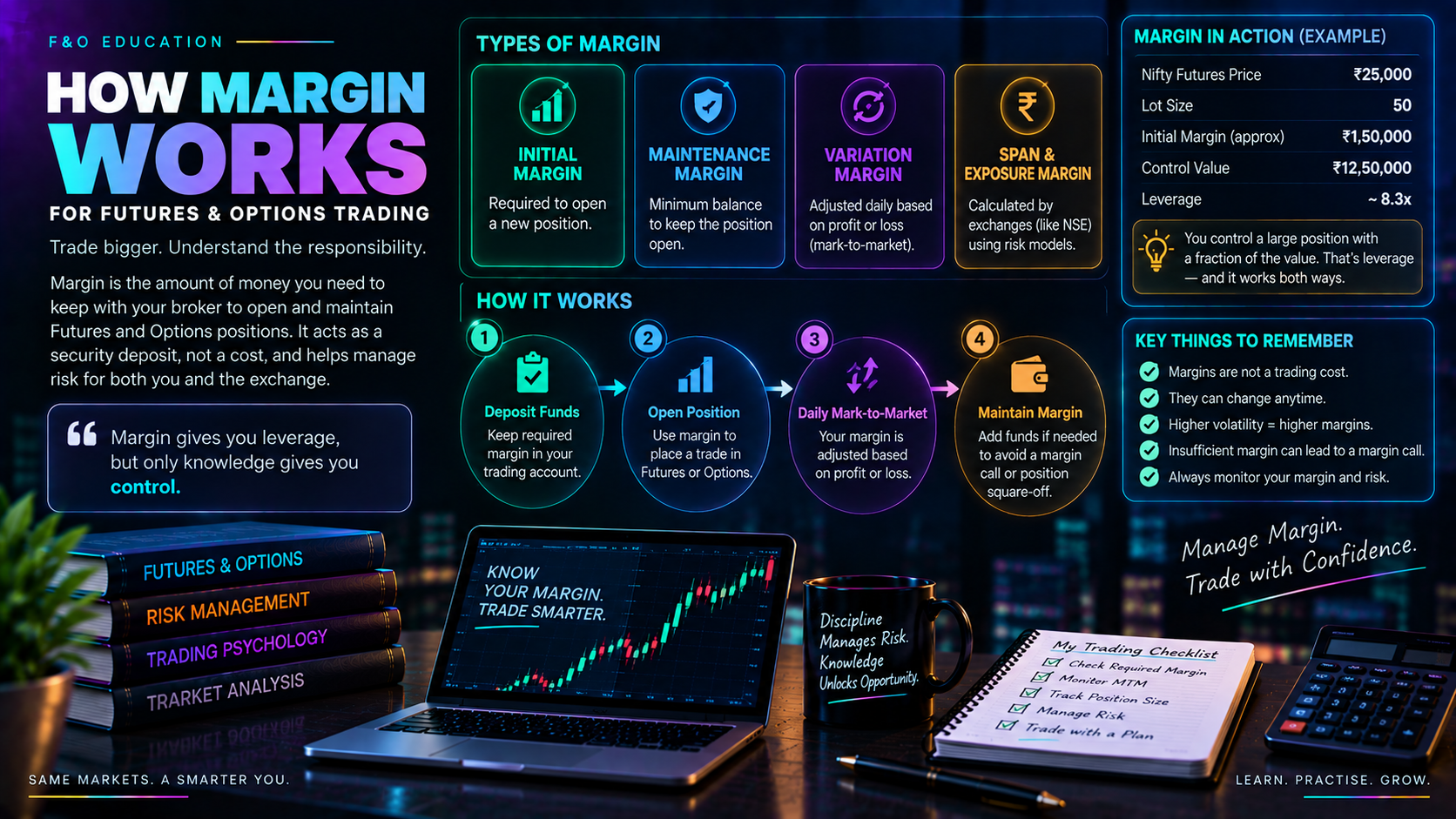
Quick Answer: What Is Margin?
Margin is the amount of funds or eligible collateral that must be available to establish and maintain certain derivatives positions. It exists because futures and some options strategies create financial obligations that can change rapidly as the market moves.
Think of margin as a financial buffer supporting a derivatives position. It is not the same thing as the total value of the underlying asset or contract.
This distinction is critical. A futures contract can represent a large notional value while requiring only a fraction of that value to be deposited as margin. That creates leverage.
Initial Margin
Capital required when establishing a position.
Maintenance
Funds needed to keep a position adequately funded.
MTM
Profit and loss can change available funds as positions are marked.
Leverage
A smaller capital commitment controls larger exposure.
Why Do Futures and Options Need Margin?
Derivatives are different from simply buying a stock with cash. A futures contract creates an obligation tied to the underlying, while an option seller can take on potentially significant obligations depending on the position.
Because market prices can change rapidly, exchanges and clearing systems require financial safeguards.
Margin helps provide a buffer against losses and supports the orderly settlement of positions.
For a beginner, the easiest way to think about it is:
The exact margin requirement can depend on the instrument, volatility, expiry, position structure, exchange rules, broker policies and other factors.
This is why the margin shown on your trading platform should be treated as dynamic rather than as a permanent fixed number.
The Main Types of Margin
“Margin” is not always one single number. Several margin concepts can be involved in derivatives trading.
Initial Margin
The amount required to establish a position under the applicable margining framework.
Maintenance Margin
The level of available funds or collateral needed to keep a position adequately supported.
Variation / MTM
Reflects changes arising from the profit or loss of positions as they are marked to market.
SPAN & Exposure
Risk-based components used to account for potential market exposure and additional risk.
The terminology can vary between markets, exchanges and brokers, so always check the applicable margin statement and contract specifications for the product you are trading.
How Futures Margin Works
Futures are one of the clearest examples of how leverage works.
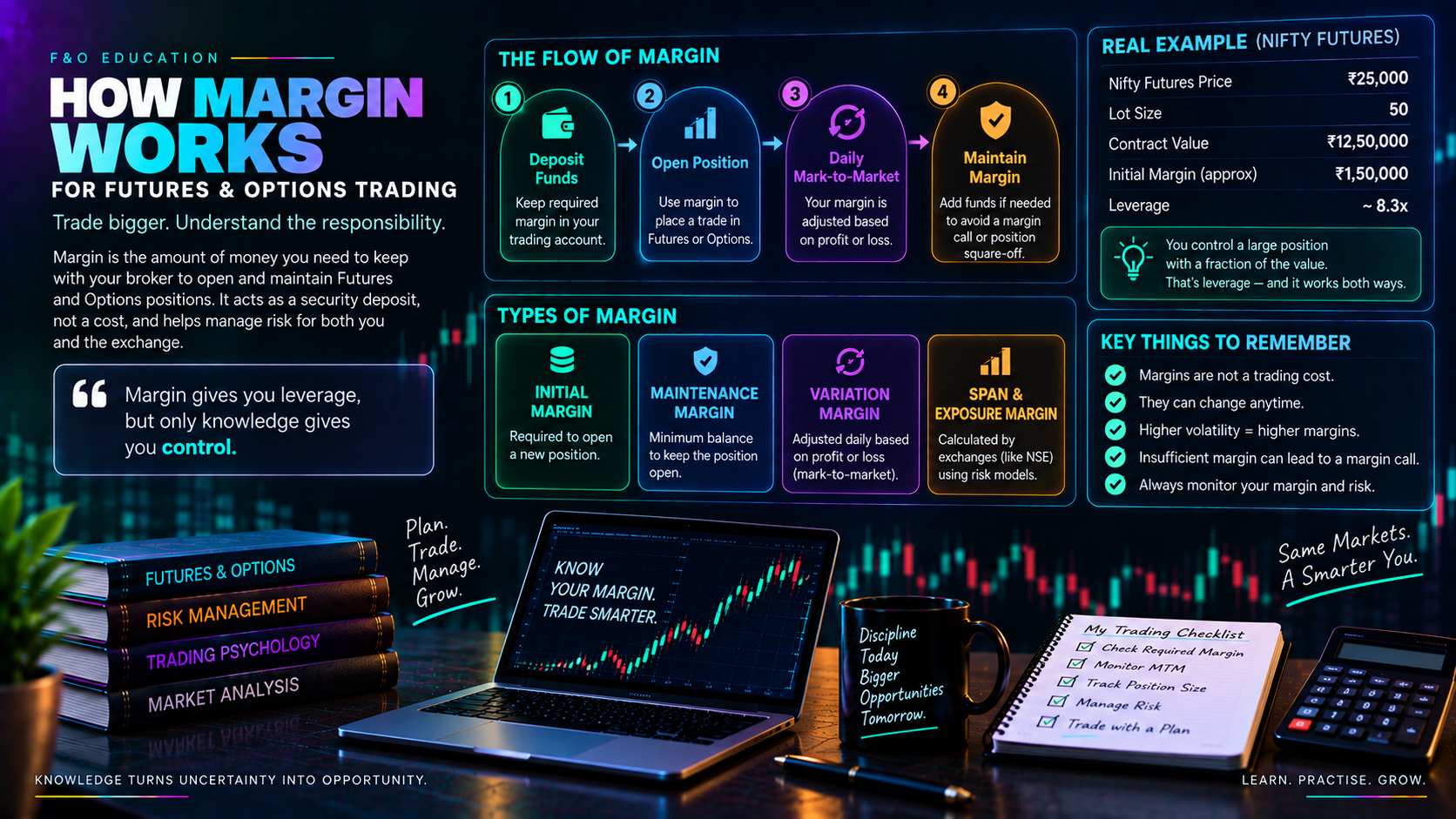
Imagine a hypothetical Nifty futures contract with a notional value of ₹12,50,000. You might not need to deposit the entire ₹12,50,000 to establish the position. Instead, the applicable margin could be a fraction of that value.
The exact amount is not fixed for all situations and should not be inferred from a single example.
₹12,50,000
₹1,50,000
₹1,50,000
₹12,50,000
The example demonstrates the mechanics of leverage rather than a live margin quote.
In this simplified example:
That sounds attractive until you understand the other side of leverage: gains and losses are measured against the larger exposure, not simply against the amount initially deposited.
Leverage: The Most Important Margin Concept
Leverage allows you to control a larger notional position with a smaller amount of capital.
That can increase capital efficiency, but it can also magnify losses relative to the capital you have committed.
Suppose a position has ₹10,00,000 of exposure and you have committed ₹1,00,000 as margin.
A 1% movement in the underlying exposure would correspond to approximately ₹10,000 of change in the notional value, before considering the exact contract mechanics.
That is 10% of the ₹1,00,000 capital committed.
This is why position-risk management and disciplined loss management matter so much in F&O trading.
How Mark-to-Market Works
Mark-to-market, commonly abbreviated as MTM, is another concept beginners must understand when trading futures.
As the market moves, the value of your futures position changes. The resulting profit or loss affects the funds available to support the position according to the applicable settlement and broker process.
Consider a simplified example where a futures position moves against you.
₹10,00,000
1%
₹10,000
Depends on the margin and account balance
The point is not the exact rupee amount. The point is that losses can reduce the funds available to maintain a leveraged position.
A trader who ignores MTM can suddenly discover that a position requires additional capital after an adverse market move.
For more on managing exits, read how to exit an options trade without panic .
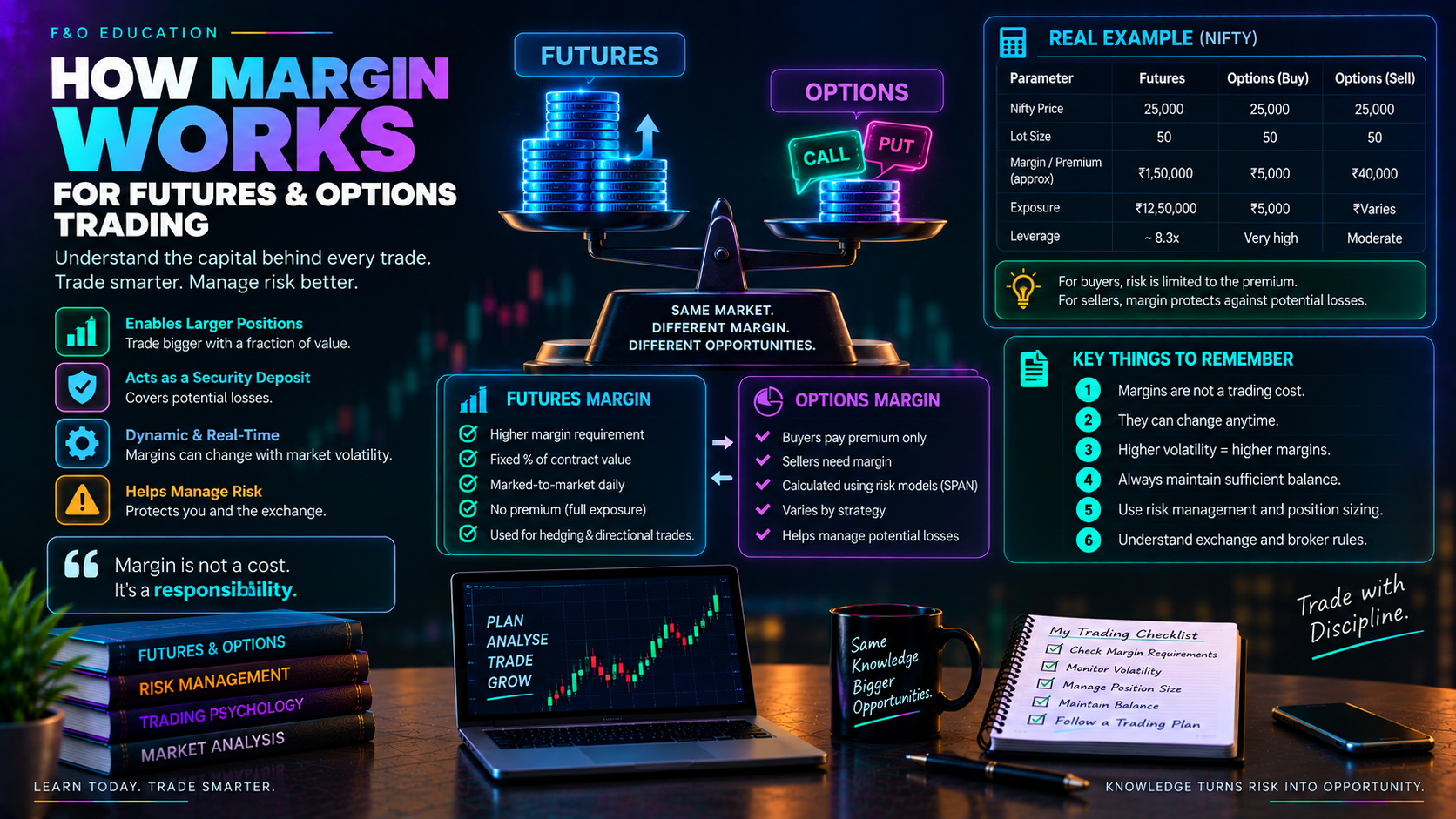
Futures Margin vs Options Margin
Futures and options should not be treated as if their margin mechanics are identical.
| Feature | Futures | Option Buyer | Option Seller |
|---|---|---|---|
| Basic Exposure | Contract obligation | Right without obligation to exercise | Obligation if exercised/assigned under applicable rules |
| Upfront Requirement | Margin | Premium generally paid | Margin requirements apply |
| Leverage | Significant | Can be significant | Can be significant |
| Loss Characteristics | Can be substantial | Generally limited to premium for a long option | Depends on strategy; can be substantial |
| Margin Sensitivity | Can change with risk conditions | Different from seller requirements | Often substantial |
The key distinction is especially important for option sellers. Selling an option may generate premium income, but the position can create significant obligations and therefore requires adequate margin.
If you are new to options, read our guide to options Greeks before analysing complex positions.
Why Option Buyers and Sellers Have Different Margin Profiles
An option buyer pays a premium to obtain the option right. For a standard long option, the premium paid generally represents the maximum option premium at risk if the option expires worthless.
An option seller receives premium but takes on an obligation. Depending on the strategy, the potential loss can be much larger than the premium received.
That is why option selling generally requires substantially more financial support than simply buying the option.
However, this does not mean option selling is automatically safer just because margin is collected. Margin is a risk-management mechanism, not a measure of how much you can afford to lose.
A structured strategy such as a butterfly spread can have defined risk, while an uncovered position can have very different risk characteristics.
What Is SPAN Margin?
SPAN is a risk-based margining framework designed to estimate potential losses under a range of market scenarios.
Instead of simply applying one fixed percentage to every position, risk-based systems consider how a portfolio could behave under different price and volatility conditions.
This matters because two positions with the same notional value can have very different risk profiles.
A hedged options structure, for example, may have a different margin requirement from an uncovered short position because the overall portfolio risk is different.
What Is Exposure Margin?
Exposure margin is an additional margin component used alongside other applicable risk requirements.
The objective is to provide additional protection against market exposure and risks that may not be completely represented by the core risk-margin calculation.
The exact requirement can vary by instrument, market conditions and applicable exchange or regulatory framework.
For that reason, traders should not memorise one percentage and assume it will apply to every futures or options position.
How Margin Requirements Can Change
One of the most dangerous assumptions beginners make is that the margin displayed when they enter a trade will remain unchanged forever.
Margin requirements can change as market risk changes.
Volatility, concentration, expiry, underlying movement and other risk factors can influence the amount of capital required to support a position.
That means a trader should maintain a reasonable capital buffer instead of operating permanently at the edge of the required margin.
This becomes especially important during volatile periods. If you are analysing Nifty or Bank Nifty derivatives, combine margin awareness with implied-volatility analysis and option-chain analysis .
Margin Calls: What Happens When Funds Are Not Enough?
A margin call or margin shortfall occurs when the funds or collateral available to support a position are insufficient under the applicable requirements.
Depending on the broker and applicable rules, the trader may need to add funds or collateral. Positions may also be reduced or closed if the shortfall is not addressed.
This is why waiting until a margin shortfall occurs is a poor risk-management strategy.
- Monitor available margin before opening a position.
- Keep additional capital available when appropriate.
- Understand how adverse price movements affect the account.
- Avoid using the entire available margin for one position.
- Understand your broker's liquidation and risk-management procedures.
A Simple Nifty Futures Margin Example
Consider a purely illustrative Nifty futures position.
| Parameter | Illustrative Value |
|---|---|
| Nifty Futures Price | ₹25,000 |
| Lot Size | 50 |
| Contract Value | ₹12,50,000 |
| Illustrative Margin | ₹1,50,000 |
| Illustrative Leverage | ~8.33× |
If the futures price changes by 100 points, the approximate contract-level impact before considering the precise contract mechanics would be:
A 300-point movement would correspond to approximately:
Again, these figures are purely educational and are not a current margin quote or trading recommendation.
The example demonstrates why even apparently small movements in the underlying can have meaningful consequences when a leveraged position is involved.
Margin and Position Sizing
Margin should influence position sizing, but it should not be the only input.
A common beginner mistake is to calculate:
A better question is:
Those are completely different questions.
Your position size should account for the possible loss, account size, trading plan, volatility and your tolerance for drawdowns.
Read how much money to risk in options trading for a broader risk framework.
Margin vs Premium: Do Not Confuse Them
Margin and premium are different concepts.
When you buy an option, you generally pay the premium for the right obtained through the contract. When you trade futures, you generally provide margin rather than paying the full notional contract value upfront.
| Concept | Meaning |
|---|---|
| Premium | Price paid by an option buyer for the option contract. |
| Margin | Funds or collateral supporting a derivatives position. |
| Notional Value | The larger value represented by the derivative contract. |
| Leverage | The relationship between exposure and capital committed. |
Understanding this distinction becomes especially important when comparing futures with long options.
A long option may require a relatively small premium, but that does not mean the underlying exposure behaves exactly like a futures contract.
Margin and Options Strategies
Different options strategies can produce very different margin requirements because their risk profiles differ.
| Strategy | General Risk Structure | Margin Consideration |
|---|---|---|
| Long Call | Premium risk | Generally different from short-option margin |
| Long Put | Premium risk | Generally based around premium payment |
| Covered Call | Stock + short call | Depends on the overall position structure |
| Vertical Spread | Defined risk | Can differ from naked short options |
| Butterfly | Defined risk | Depends on structure and applicable rules |
| Uncovered Short Option | Potentially substantial risk | Can require significant margin |
If you are learning strategy construction, our butterfly spread guide explains how a defined-risk multi-leg strategy works.
How Margin and Volatility Are Connected
Market volatility is closely connected to derivatives risk. When the market becomes more volatile, potential future losses can increase, which can influence margin requirements.
This is one reason traders should not treat margin as a static percentage.
A position that appears comfortable during calm markets may require much more capital during a period of elevated risk.
This is particularly relevant for short option positions because their risk can increase rapidly when the underlying moves sharply or implied volatility changes.
To understand volatility from an option-pricing perspective, read our complete implied-volatility guide .
Margin and Options Greeks
Margin tells you how much financial support is required for a position. Greeks tell you how the option's value can respond to different market variables.
They answer different questions.
Margin = Capital Requirement
How much capital or collateral is required to support the position?
Greeks = Risk Sensitivity
How might the position respond to price, time and volatility changes?
Combining both perspectives gives a more complete picture of an options position.
For example, a short option can require substantial margin while also carrying negative Gamma and potentially significant sensitivity to volatility.
Read Delta, Gamma, Theta and Vega to understand the sensitivity side of the equation.
How to Check Margin Before Entering a Trade
Before placing an F&O order, build a simple process.
- Identify the exact instrument. Check whether you are trading a future, call, put, spread or another derivative structure.
- Check the contract specifications. Confirm expiry, lot size and other relevant details.
- Check the current margin requirement. Do not rely on an old screenshot or a margin number from another day.
- Calculate your total exposure. Margin is not the same as notional exposure.
- Estimate adverse movement. Ask what happens if the underlying moves sharply against the position.
- Leave a capital buffer. Avoid operating with no room for adverse movements or changing requirements.
- Define your exit plan. Decide how you will respond if the position invalidates your thesis.
This process works well alongside identifying strong options setups and avoiding entry and exit mistakes .
Common Margin Mistakes Beginners Make
1. Treating margin as the maximum possible loss
Margin is a capital requirement, not necessarily a statement of maximum loss. A leveraged position can lose substantially more than the initial margin committed.
2. Using all available margin
Having enough buying power for five lots does not mean you should trade five lots.
3. Ignoring changing requirements
Margin requirements can change. Treating yesterday's requirement as today's permanent number is dangerous.
4. Ignoring MTM
Futures losses can affect available funds as the position is marked to market.
5. Confusing premium with margin
An option premium and a futures margin requirement represent different concepts.
6. Assuming leverage equals opportunity
Leverage creates larger exposure relative to capital. That can increase both upside and downside.
7. Forgetting transaction costs
Brokerage, taxes, exchange charges and slippage can reduce realised returns, especially when positions are frequently adjusted.
Review our options trading mistakes guide before increasing position size.
Margin Calculator: Estimate Leverage and Exposure
Use this simple educational calculator to understand the relationship between contract value, margin and leverage.
Why Margin Is Not the Same as Risk
This distinction deserves its own section because it is responsible for a large number of beginner mistakes.
Suppose two traders each have ₹2,00,000 available.
Trader A uses ₹1,50,000 of margin to control a highly leveraged futures position.
Trader B uses ₹50,000 of margin for a smaller defined-risk options strategy.
Trader A has used more margin, but that alone does not tell us the complete risk. Trader B may have a smaller capital requirement but could still lose the entire premium paid.
Risk depends on the complete position structure, not simply on the margin number displayed beside the order.
Risk management answers “How much can I realistically afford to lose?”
Never substitute one question for the other.
Margin, Expiry and Short-Dated Trading
Expiry can change the risk profile of derivatives positions quickly.
Short-dated options can experience rapid changes in Gamma and Theta, while futures positions remain exposed to the underlying's price movement and applicable margin requirements.
This makes expiry trading particularly demanding for inexperienced traders.
If you trade around expiry, combine margin awareness with your understanding of expiry behaviour , Theta decay and options Greeks .
Margin and Option-Chain Analysis
Margin should not be analysed separately from the position you are building. If you are considering an options strategy, start with the option chain and understand the strikes, premiums, open interest, liquidity and volatility.
Our Nifty option-chain guide can help you understand the basic layout.
You can then examine support and resistance using option-chain data , Put-Call Ratio and Max Pain as additional analytical inputs.
None of these tools removes uncertainty. They simply help create a more structured decision-making process.
Should Beginners Trade With High Margin Leverage?
Generally, beginners should focus on understanding the mechanics before attempting to maximise leverage.
The ability to control a large position with relatively little capital can make F&O trading look deceptively attractive.
But leverage also means that relatively small underlying movements can create meaningful changes in account equity.
A better progression is:
- Learn how the derivative contract works.
- Understand the margin calculation concept.
- Learn how profits and losses affect capital.
- Practise with paper trading.
- Start with position sizes where a loss is financially manageable.
- Increase complexity only after you understand the risk.
You can practise your process with paper trading before real trading .
Can Technology Help Track Margin?
Trading platforms and analytical tools can make it easier to monitor positions, exposure and available capital.
AI-assisted trading tools can also help organise large amounts of market information, but technology should not be confused with risk elimination.
If you are exploring technology-assisted trading, see AI trading platform resources and AI vs manual trading .
You can also explore AI tools for stock-market analysis and how AI is changing trading workflows .
Always understand the position yourself before relying on an automated dashboard, alert or analytical model.
A Practical Margin Checklist Before Every F&O Trade
Before clicking the order button, run through this checklist:
- What exact derivative am I trading?
- What is the total notional exposure?
- What is the current margin requirement?
- Can the margin requirement change?
- What happens if the underlying moves sharply against me?
- How much capital will remain after entering the position?
- Do I have a buffer for adverse movement?
- What is my maximum acceptable loss?
- Where is my exit point?
- Am I using leverage because the setup is strong or simply because the broker allows it?
If the answer to the last question is the second option, stop and reassess.
Good trading is not about using the maximum capital available. It is about taking exposure that you can manage.
Final Takeaway: Understand Margin Before You Use Leverage
Margin is one of the foundations of futures and options trading. It allows traders to establish derivative positions without paying the full notional value upfront, but that capital efficiency creates leverage.
The concepts worth remembering are simple:
Initial margin supports opening a position.
Maintenance requirements help keep the position adequately funded.
MTM reflects the effect of changing position value.
SPAN and exposure components help account for market risk.
Leverage increases exposure relative to capital.
Risk management determines whether that exposure is appropriate for you.
The biggest mistake is thinking that the margin number tells you how much you should trade. It does not.
Margin tells you about the capital required to support the position. Your trading plan must tell you how much risk you are willing to take.
Frequently Asked Questions
What is margin in futures and options trading?
Margin is the amount of funds or eligible collateral required to establish and maintain certain derivatives positions. It helps support obligations and manage potential market losses.
Why is margin required for futures?
Futures create obligations linked to the underlying asset. Margin helps provide financial protection against potential losses as the market moves.
Do options buyers need margin?
A standard option buyer generally pays the premium upfront rather than posting the same type of margin associated with an option seller. Requirements can vary depending on the product and account structure.
What is SPAN margin?
SPAN is a risk-based margining framework that evaluates potential portfolio losses under defined market scenarios.
What is exposure margin?
Exposure margin is an additional margin component intended to provide protection against risks associated with market exposure.
What happens when I do not have enough margin?
A margin shortfall can require the trader to add funds or collateral. Depending on applicable rules and broker procedures, positions may also be reduced or closed.
Does leverage reduce trading risk?
No. Leverage increases exposure relative to capital committed. It can increase the impact of both gains and losses.
Can margin requirements change?
Yes. Margin requirements can change based on the product, market risk, volatility, expiry and applicable exchange, clearing and broker rules.
Is margin the same as the maximum loss?
No. Margin is a capital requirement. Maximum loss depends on the structure of the derivative position and the market movement.
Know Your Margin. Know Your Risk.
Futures and options can provide powerful capital efficiency, but leverage should never be confused with free opportunity. Understand your margin, calculate your exposure, maintain a sensible capital buffer and define your risk before entering a position.
Continue building your F&O knowledge with Stoxra.
Explore Stoxra Learn →