How Options Expiry Affects Stock Prices
Learn how options expiry affects stock prices through open interest, gamma, hedging, option unwinding, volatility, max pain and expiry-day positioning with practical examples.
Explore related Stoxra resources
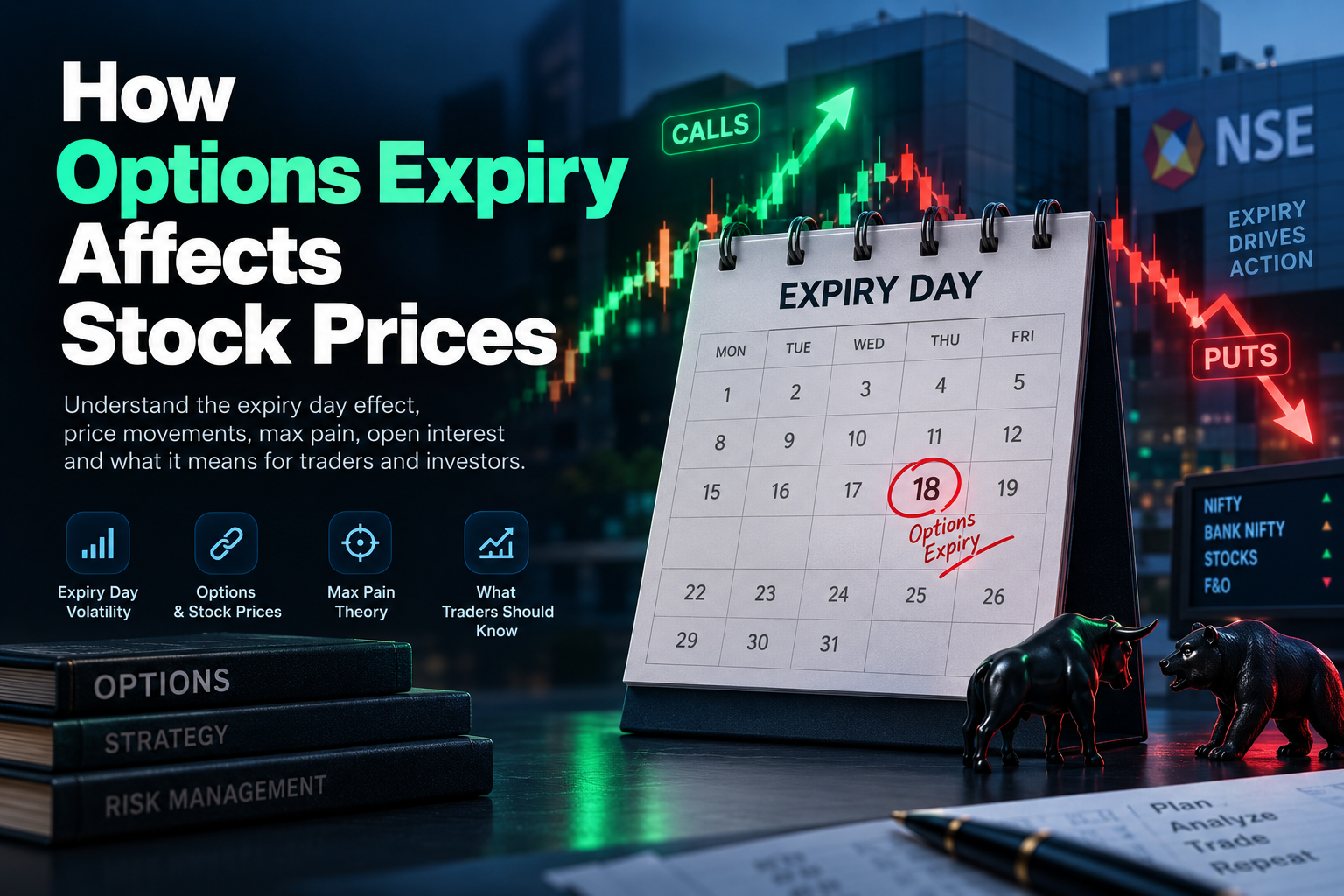
The Short Answer: Does Options Expiry Move Stock Prices?
Options expiry can influence short-term stock-price behaviour, but expiry itself does not automatically push a stock higher or lower. The important mechanism is what market participants do as contracts approach expiration.
Traders and market makers may need to adjust their hedges as the underlying price changes. Option positions may be closed, rolled, exercised or allowed to expire. Large concentrations of open interest can create important strike-price zones, while rapidly changing option Greeks can make hedging activity more sensitive near expiry.
That means an expiry day can sometimes produce unusual volume, temporary price attraction around important strikes, sudden intraday reversals or higher volatility. But these effects are conditional, not guaranteed.
Do not think of expiry as a magical force that moves stocks. Think of it as a deadline that forces existing derivative positions to be resolved, rolled or hedged. The resulting flows can interact with the underlying market.
1. What Actually Happens When an Option Expires?
An option is a derivative contract whose value is linked to an underlying asset. That underlying might be an individual stock, an index or another financial instrument. The option has a strike price, an expiration date and a specific contract structure.
As expiration approaches, the option has less time remaining for the underlying to move into a favourable position. This is one reason implied volatility and time-related option pricing become increasingly important.
At expiry, the contract reaches its final state. Depending on the contract and settlement rules, an option can finish in the money, at the money or out of the money. Traders may have already closed their positions before that point, or they may roll positions into another expiry.
The key point is that the option disappearing is not the same thing as the stock being forced to move. The stock responds to buying and selling in the underlying market. Expiry matters because derivative positioning can create transactions, hedging requirements and changes in risk around that market.
2. Why Can Expiry Create Extra Volatility?
Volatility around expiry is usually discussed as if it has one simple cause. In reality, several mechanisms can overlap.
Position Unwinding
Traders may close positions rather than carry them into settlement. Large positions being closed at the same time can increase short-term order flow.
Hedging Adjustments
Market participants managing option exposure may need to adjust positions in the underlying as the stock price moves.
Strike Concentration
Heavy open interest around particular strikes can make those levels important reference points for traders and hedgers.
These forces can be amplified when liquidity is thin. A relatively modest change in order flow can then produce a larger price response than traders might expect.
This is why expiry-day trading should be treated differently from ordinary market sessions. If you are still developing your process, review options trading risk management before increasing position size simply because the market appears more active.
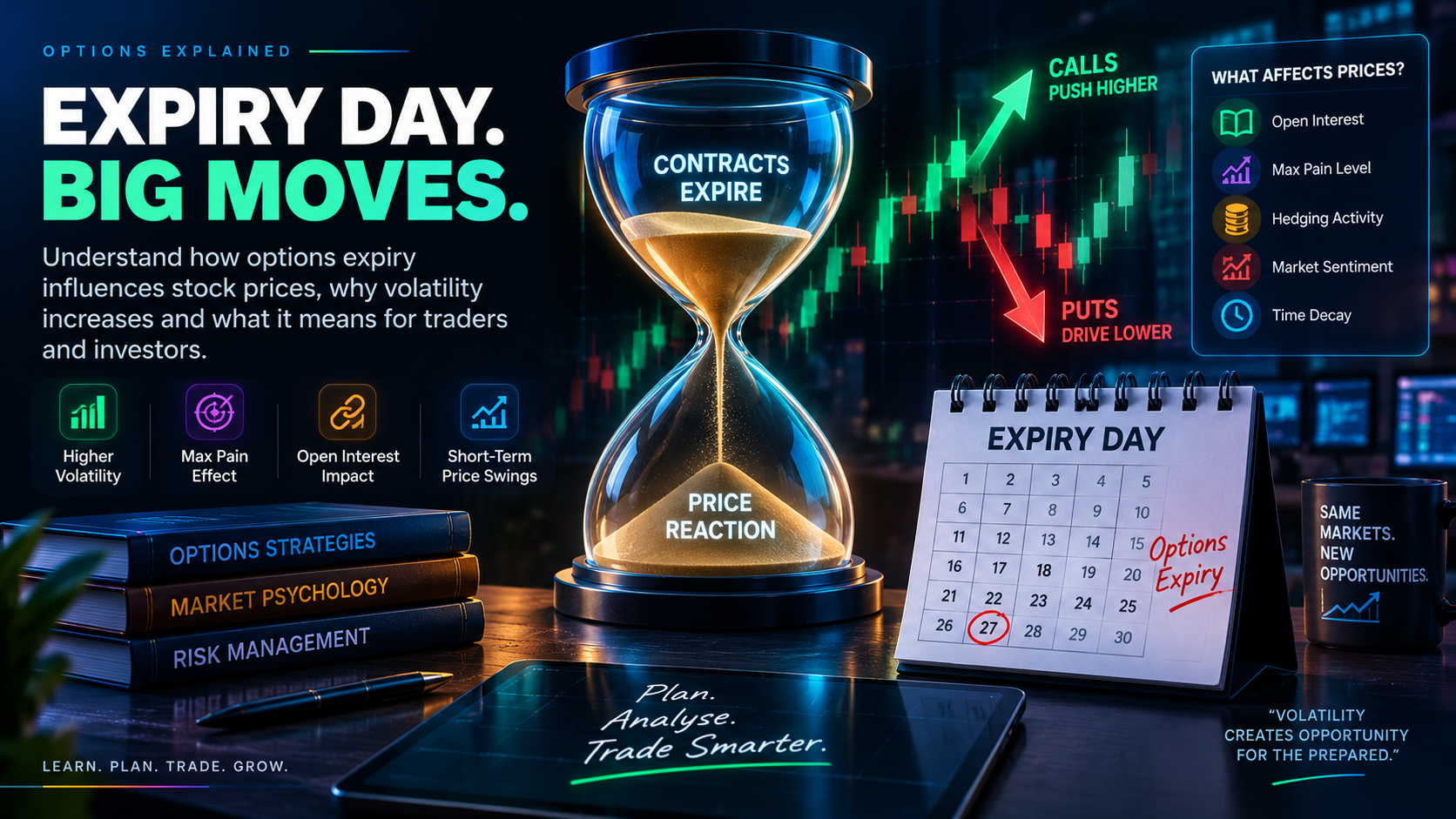
3. Open Interest: The First Thing to Check
Open interest, or OI, represents outstanding derivative contracts. It is different from trading volume. Volume measures contracts traded during a period, while open interest represents positions that remain open.
Around expiry, traders often look at where call and put open interest is concentrated. The option chain can therefore provide useful context for identifying strikes that are attracting significant positioning.
If you are learning this process, start with how to read option-chain data rather than trying to predict the stock price from a single OI number.
A large call OI concentration may be interpreted as an area of potential resistance by some traders. A large put OI concentration may be treated as a potential support reference. But these are not guaranteed support and resistance levels. Positions can be closed, rolled, hedged or changed before expiry.
You should therefore pay attention to changes in OI, not just the absolute number. This is where a deeper OI heatmap approach can make large amounts of option-chain information easier to interpret.
4. Gamma Explains Why Expiry Can Become Sensitive
One of the most important concepts for understanding expiry is gamma.
Gamma measures how quickly an option's delta changes when the underlying price moves. Delta tells us approximately how much an option's price responds to a small move in the underlying, while gamma describes how quickly that delta itself changes.
Near expiry, especially for options close to the current underlying price, gamma can become very important. A small movement in the stock can cause a relatively large change in the option's delta. If a market participant is hedging that option exposure, the hedge may need to be adjusted quickly.
Expiry reduces the amount of time remaining. Near-the-money options can become highly sensitive to small underlying moves. If large positions are being hedged, those changing sensitivities can create additional buying or selling in the underlying market.
Gamma should not be interpreted as a directional indicator. High gamma does not mean the stock must rise or fall. It means the relationship between the option and the underlying can change rapidly.
5. How Hedging Can Influence the Underlying Stock
Hedging is one of the most important links between the derivatives market and the underlying market.
Imagine a market participant has significant option exposure. Depending on the position, they may use shares or other derivatives to reduce directional risk. When the stock price changes, the required hedge can change as well.
During periods of high sensitivity, this can result in repeated buying or selling of the underlying. The resulting order flow can interact with other market participants, technical levels, institutional orders and broader market sentiment.
This is one reason an expiry-day move can sometimes look unusual. The price may initially move in one direction, trigger hedging or stop activity, and then reverse when the underlying flow changes.
Traders who want to understand this alongside broader price action should also learn support and resistance using option-chain data .
6. Does Max Pain Really Pull Stocks Toward a Strike?
Max pain is one of the most popular expiry concepts among options traders. It attempts to identify the strike price at which the aggregate intrinsic value of outstanding options would be lowest for option holders, based on the open-interest distribution used in the calculation.
This leads to a common claim: "The stock or index will move toward max pain on expiry."
That statement is too strong.
Max pain can be used as a contextual reference, but it does not create a mechanical force that guarantees a particular settlement price. The underlying market can be driven by earnings, news, institutional flows, macroeconomic events, sector movements, liquidity and positioning that has nothing to do with max pain.
For a deeper explanation, read the guide to max pain theory in NIFTY options .
Max pain is a calculation, not a price target. Never build an expiry-day trade solely around the assumption that the underlying must move toward the max-pain level.
7. Time Decay Becomes Extremely Important Near Expiry
Options are wasting assets in the sense that the amount of time available for the underlying to move favourably keeps decreasing. This is commonly represented by the Greek known as theta.
As expiration gets closer, an option with little intrinsic value may lose time value quickly. This is particularly important for traders buying short-dated options because being correct about the direction is not enough.
The underlying must move sufficiently, sufficiently quickly, for the option position to compensate for time decay, spread costs and other factors.
This is why expiry-day option trading can feel extremely fast. Premiums can change rapidly even when the underlying stock appears to move only modestly.
Beginners should first understand common options-trading mistakes before treating short-dated options as an easy way to generate returns.
8. What Happens Around Major Strike Prices?
Strike prices become particularly important when a large amount of open interest is concentrated around them.
Suppose a stock is trading close to ₹1,000 and a large amount of call and put positioning exists around the ₹1,000 strike. As the expiry approaches, relatively small changes in the stock price can alter the value and delta of many contracts simultaneously.
That does not mean ₹1,000 becomes an invisible magnet. Instead, it becomes a level where market participants may be paying more attention and where hedging flows can become more relevant.
The behaviour can also change when the stock moves decisively away from the strike. A level that appeared important earlier in the session can become less relevant once the positioning changes.
| Market Situation | Possible Effect | What Traders Should Watch |
|---|---|---|
| Large call OI near price | Potential resistance reference | OI changes, price reaction, volume |
| Large put OI near price | Potential support reference | Put unwinding, fresh OI, price acceptance |
| Price near major strike | Greater sensitivity possible | Gamma, volume, hedging behaviour |
| Price breaks away strongly | Positioning may shift rapidly | Momentum, OI changes, liquidity |
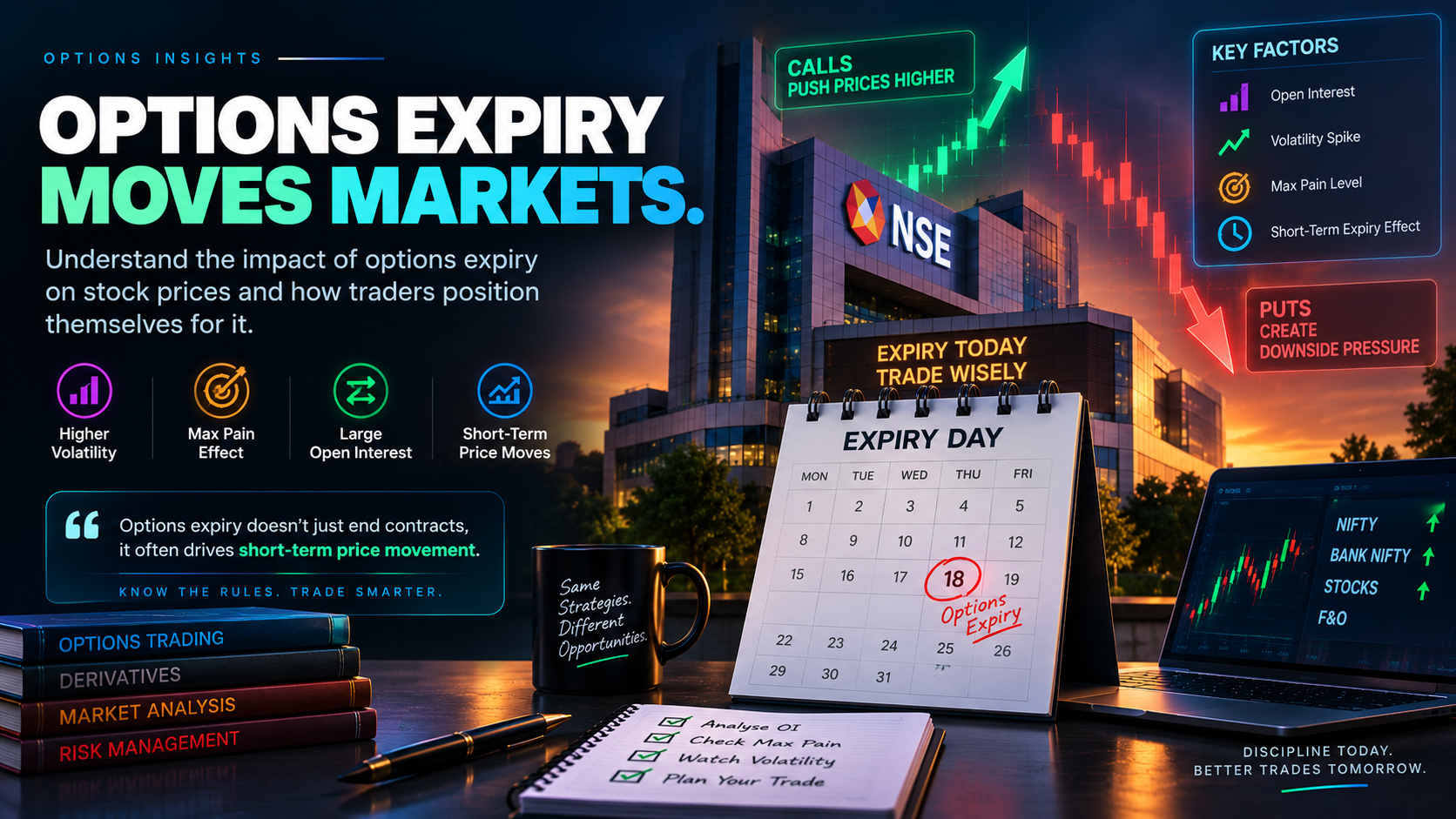
9. How Expiry Can Affect Individual Stocks
Most discussions about expiry focus on NIFTY and BANK NIFTY, but individual stocks with active derivatives markets can also experience expiry-related flows.
The effect is generally more meaningful when the options market is liquid and there is substantial positioning. If a stock has very little options activity, there may be little expiry-related flow capable of materially influencing the underlying.
The distinction between index and stock derivatives also matters. Current NSE contract specifications provide expiry structures for index and individual-security derivatives, with individual-security options using the expiry framework specified by the exchange.
Therefore, do not assume every stock will behave like NIFTY on an expiry session. Liquidity, market participation, corporate events, sector news and the distribution of open interest can be completely different.
If you trade individual stocks, combine expiry analysis with broader technical and fundamental context rather than treating the option chain as a standalone forecasting system.
10. NIFTY, BANK NIFTY and Expiry-Day Structure
Index options are particularly important in India because of the large amount of trading activity concentrated around benchmark derivatives.
Current NSE specifications list weekly NIFTY 50 index option expiries on Tuesdays, while several other index and individual security contracts follow monthly Tuesday expiry structures. If an expiry day is a trading holiday, the relevant previous trading day applies under the exchange rules.
This makes the expiry calendar an important part of an options trader's routine. Before taking a trade, you should know whether you are dealing with a same-day expiry, a weekly contract or a longer-dated monthly position.
Traders comparing major Indian indices can also review NIFTY vs BANK NIFTY options to understand why their behaviour and risk characteristics can differ.
For a more practical approach, study NIFTY option-chain analysis around weekly expiry before attempting to interpret live expiry-day positioning.
11. Expiry Does Not Work in Isolation
One of the biggest mistakes beginners make is blaming every expiry-day move on options.
Imagine a stock has a major earnings announcement on the same day as expiry. The earnings announcement can dominate the market's reaction. Similarly, an unexpected central-bank announcement, geopolitical development, sector-wide news or large institutional transaction can overwhelm any expiry-related positioning.
This is why experienced analysis combines multiple layers:
- Underlying price trend and market structure
- Call and put open interest
- Change in open interest
- Implied volatility
- Volume and liquidity
- Major strike concentrations
- Broader index and sector behaviour
- News and scheduled events
- Position sizing and risk limits
If you are still developing your trading process, the guide on identifying strong options setups can help you think in terms of confluence rather than one-variable predictions.
12. A Practical Expiry-Day Analysis Framework
Instead of asking "Where will the stock go because today is expiry?", use a structured process.
Confirm the contract, expiry date and settlement structure.
Identify major call and put OI concentrations.
Compare option-chain levels with actual price behaviour.
Reduce exposure if volatility or execution risk becomes excessive.
This framework is deliberately simple. The objective is not to predict every tick. It is to avoid making decisions based on assumptions that cannot be verified.
13. Expiry Pressure Estimator
Use this educational estimator to think about how several expiry conditions interact. It does not predict stock prices and should not be treated as a trading signal.
Expiry Sensitivity Check
14. Common Expiry-Day Mistakes Beginners Make
Treating Max Pain as a Target
Max pain can provide context, but it is not a guaranteed destination for the underlying.
Buying Cheap Options
A low premium does not automatically mean an option is cheap. Time decay and probability matter.
Ignoring Liquidity
Wide spreads and poor execution can turn a seemingly correct directional view into a poor trade.
Other mistakes include increasing position size after a winning trade, trading every small move, ignoring stop-loss rules and confusing high volume with a guaranteed directional signal.
If this sounds familiar, review stop-loss principles for options trading and how much money to risk on an options trade before increasing your expiry-day exposure.
15. How to Read Expiry Moves Without Chasing Them
Suppose a stock is trading at ₹1,000 and moves to ₹1,008 during expiry. A beginner may immediately conclude that call buying is driving the stock higher.
That conclusion is not justified from price alone.
You would need to examine what happened to volume, open interest, option premiums, implied volatility, broader market direction and the stock's own technical structure.
A stronger analysis asks:
- Did call OI increase or decrease?
- Did put OI change meaningfully?
- Did the stock break an important technical level?
- Was there sector-wide buying?
- Did implied volatility rise or fall?
- Was the move accompanied by strong underlying volume?
- Did the move hold after the initial expiry reaction?
This is the difference between observing expiry behaviour and inventing an explanation after the fact.
Don't Learn Expiry Trading With Real Money First.
Expiry sessions can move quickly. If you are still learning option chains, entries, exits and risk management, use a structured practice workflow before treating live expiry trading as a source of easy profits.
You can explore Stoxra's paper trading vs real trading guide and review the paper-trading approach for options before putting real capital at risk.
Explore Stoxra →16. Expiry Trading vs Normal Trading Sessions
Expiry does not automatically make a trading session better or worse. It changes the environment.
| Factor | Normal Session | Near Expiry |
|---|---|---|
| Time value | Usually decays gradually | Can decay rapidly |
| Gamma sensitivity | Depends on maturity and moneyness | Can become significant near ATM strikes |
| Position management | More time available | Closure or rolling becomes more urgent |
| Strike focus | Important but less deadline-driven | Can become highly relevant |
| Execution risk | Varies by market | Can rise during fast moves |
The lesson is not "avoid expiry." The lesson is to understand the environment before participating in it.
17. A Better Expiry-Day Checklist
Before taking an expiry-related trade, run through this checklist.
- Confirm the exact expiry date and contract.
- Identify major call and put OI concentrations.
- Check changes in OI rather than only absolute OI.
- Identify important strikes close to the current price.
- Observe whether price is accepting or rejecting those levels.
- Check implied volatility and option premium behaviour.
- Check underlying volume and liquidity.
- Look for major news or scheduled events.
- Define your maximum acceptable loss before entering.
- Avoid increasing risk merely because the market is moving quickly.
You can also study when to book profits in options trading so your exit plan is defined before market conditions become emotional.
18. Can Expiry Be Used as a Trading Strategy?
Yes, traders can build strategies around expiry, but the fact that an expiry exists is not itself a strategy.
A legitimate expiry strategy needs clearly defined conditions: what market environment qualifies, what data is used, where the entry occurs, where the trade is invalidated, how position size is calculated and how the position is exited.
For example, a trader might research whether a specific option-chain configuration combined with a particular price-action setup has historically produced an edge. That hypothesis should then be tested rather than assumed.
Paper trading can be useful during this stage. Review paper trading vs backtesting to understand why historical testing and simulated execution answer different questions.
If you eventually automate a strategy, compare the approach with algorithmic vs manual trading rather than assuming automation automatically creates an edge.
19. The Biggest Myth: "Expiry Controls the Stock Price"
This is the idea worth eliminating completely.
Expiry does not give option traders a secret mechanism for deciding where the stock must close.
The underlying market remains a market. Buyers and sellers continue to interact based on information, valuation, expectations, liquidity, hedging requirements and positioning.
Expiry can change the incentives and risk management decisions of derivative participants, which can influence order flow. But that influence exists alongside thousands of other market forces.
Expiry is a catalyst for position resolution, not a guaranteed directional signal. Use expiry information to understand market structure, not to replace analysis.
20. Final Takeaway
Options expiry can affect stock prices indirectly through the behaviour of participants in the derivatives market. Open interest, gamma, hedging, position unwinding, time decay, implied volatility and liquidity can all become important as contracts approach their final trading session.
But there is no universal expiry-day formula. A stock does not have to move toward max pain. A large call OI level does not guarantee resistance. A large put OI level does not guarantee support. High option volume does not guarantee a breakout.
The strongest approach is to combine the option chain with actual price action, market structure, volume, volatility and risk management.
If you are building your options foundation, continue with how to enter an options trade , learn how to exit without panic , and understand common entry and exit mistakes .
The goal is not to predict every expiry move. The goal is to understand why the market can behave differently around expiry and how to manage that uncertainty intelligently.
Frequently Asked Questions
No. Expiry can increase activity or volatility, but it does not guarantee a large price movement. The effect depends on positioning, liquidity, hedging flows, market conditions and other events.
Why can stocks move toward certain strike prices?Large concentrations of derivative positions can make certain strikes important for hedging and repositioning. This can sometimes create temporary price attraction or resistance, but it is not guaranteed.
What is gamma's role on expiry day?Gamma measures how quickly an option's delta changes as the underlying moves. Near expiry, at-the-money options can become particularly sensitive to small underlying price changes.
Can options expiry affect individual stocks?Yes. Stocks with active and liquid options markets can experience expiry-related flows, especially when positioning is concentrated around particular strikes.
Is max pain a reliable expiry-price prediction?No. Max pain is a theoretical calculation based on option positioning. It can be used as context but should not be treated as a guaranteed price target.
Should beginners trade aggressively on expiry day?No. Fast premium changes, time decay, changing Greeks, slippage and rapid underlying moves can increase risk. Beginners should focus on understanding the mechanics first.
This article is for educational and informational purposes only and is not financial advice, investment advice or a recommendation to buy or sell any security or derivative. Options and F&O trading involve substantial risk and may result in significant losses. Market behaviour around expiry is not guaranteed. Historical or illustrative examples do not guarantee future results. Always understand the contract specifications, costs, liquidity and risks involved before trading.