How to Read a Company's Balance Sheet as a Beginner
Learn how to read a company’s balance sheet as a beginner. Understand assets, liabilities, shareholders’ equity, key ratios, warning signs, and how to evaluate financial strength before investing.
What Is a Balance Sheet?
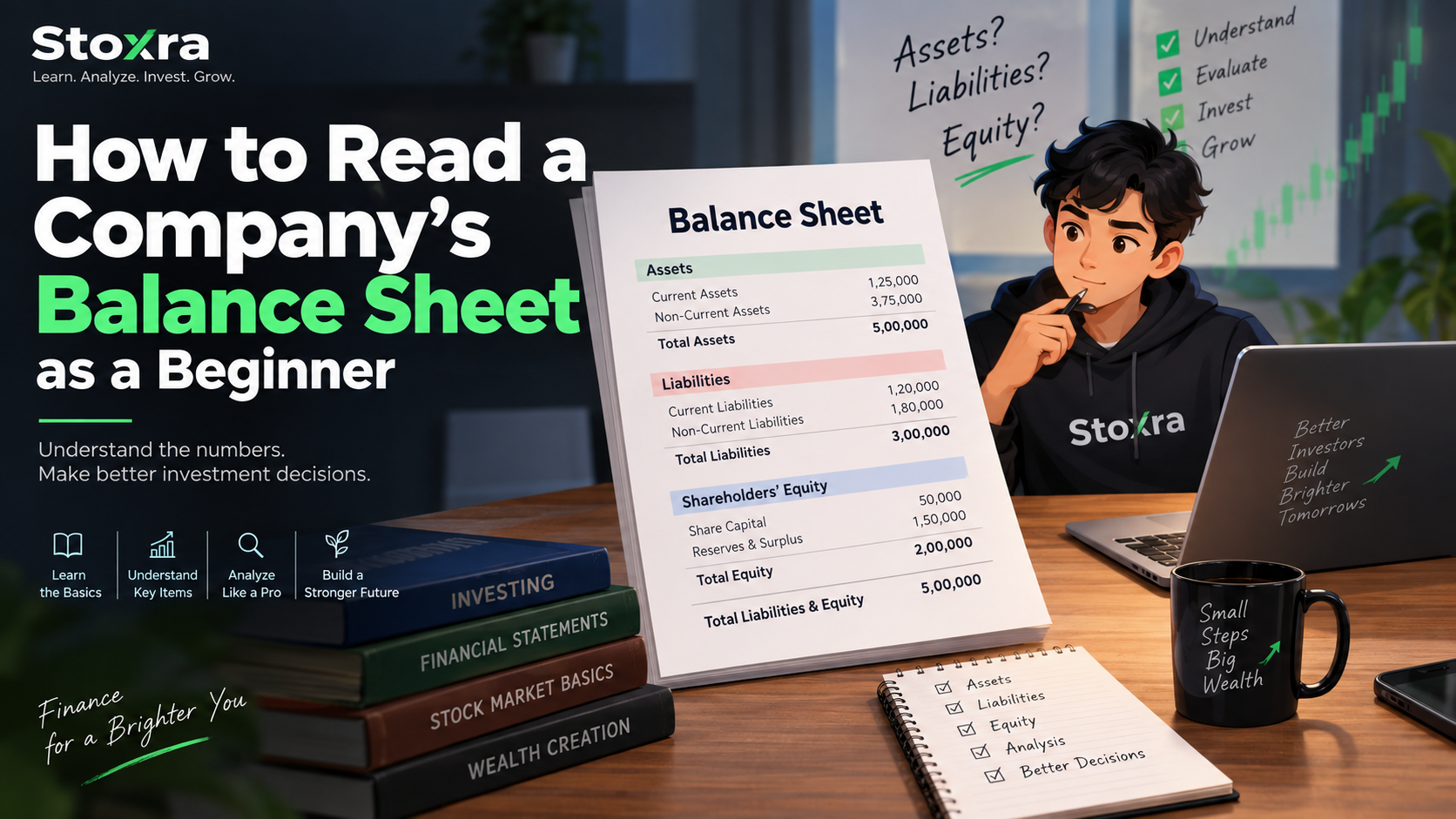
A balance sheet is a financial statement that reports a company's financial position on a specific date. Unlike an income statement, which measures performance over a period, the balance sheet is a snapshot. It tells you the resources available to the business and the claims against those resources.
The statement follows one central accounting equation:
This equation must balance. If a company reports ₹100 crore in assets and ₹40 crore in liabilities, shareholders' equity is ₹60 crore. The equation is simple, but the quality of the assets and the cost of the liabilities require deeper analysis.
If you are still learning the basics, start with this stock market basics for beginners guide before moving into company-level research.
The Three Main Parts of a Balance Sheet
Assets are resources controlled by the company. They may include cash, inventory, receivables, property, equipment, investments, and intangible assets. For additional practice and research, explore AI trading platform.
Liabilities are obligations the company must settle. Examples include trade payables, borrowings, lease obligations, provisions, and other dues. For additional practice and research, explore AI vs manual trading.
Equity represents the residual value belonging to shareholders after liabilities are deducted from assets. It includes share capital and accumulated reserves. For additional practice and research, explore automated trading software.
Current versus non-current items
Current assets and current liabilities are generally expected to be converted, used, or settled within the operating cycle or roughly twelve months. Non-current items extend beyond that period. This distinction helps investors evaluate liquidity and near-term repayment pressure. For additional practice and research, explore trading competitions. For a related practical resource, see paper trading platforms.
How to Read Assets Properly
Do not assume that a larger asset base automatically means a stronger company. Start by asking what the assets are and how easily they can support operations or be converted into cash. For additional practice and research, explore funded trading in India.
- Cash and cash equivalents: provide flexibility and help the company handle unexpected pressure.
- Trade receivables: show money owed by customers. Rapid growth can be a warning if sales rise much faster than collections.
- Inventory: is useful when it sells efficiently, but obsolete or slow-moving inventory can reduce its real value.
- Property, plant and equipment: may support future production, but heavy capital expenditure can also create depreciation and financing burdens.
- Intangible assets and goodwill: require attention because their carrying value may not equal easily recoverable cash value.
Compare asset growth with revenue and cash flow. A company whose receivables and inventory grow much faster than sales deserves closer investigation. This is a practical part of fundamental analysis. For additional practice and research, explore internship program. For a related practical resource, see how paper trading helps beginners.
How to Evaluate Liabilities and Debt
Liabilities are not automatically bad. Borrowing can help a company expand, buy equipment, or fund working capital. The risk appears when debt grows faster than earnings or when repayment obligations become difficult to meet. For additional practice and research, explore whether AI trading is legal in India.
| Item | What to ask |
|---|---|
| Short-term borrowings | Can the company repay or refinance them without stress? |
| Long-term debt | Is the borrowing being used productively, and is interest affordable? |
| Trade payables | Are supplier dues rising because of growth or because cash is tight? |
| Lease liabilities | Does the business have fixed commitments that reduce flexibility? |
| Provisions and contingent obligations | Could legal, tax, warranty, or other claims create future cash outflows? |
Useful ratios include debt-to-equity, interest coverage, and the current ratio. Ratios should be compared with the company's own history and with similar businesses, not treated as universal pass-or-fail numbers. For additional practice and research, explore trading leaderboard. For a related practical resource, see paper trading versus real trading.
Understanding Shareholders' Equity
Shareholders' equity generally includes paid-up share capital, securities premium, retained earnings, and other reserves. It rises when the company earns profits and retains them, and it can fall because of losses, dividends, write-downs, or other adjustments. For additional practice and research, explore Stoxra compliance information.
Positive equity is not enough. Look for steady growth supported by genuine profits and operating cash flow. If equity rises mainly because of repeated share issuance while per-share earnings remain weak, investors should examine dilution and capital allocation. For additional practice and research, explore Stoxra partner program. For a related practical resource, see algorithmic trading.
Book value per share is calculated as equity attributable to ordinary shareholders divided by the number of outstanding shares. It can be useful for banks, insurers, and asset-heavy businesses, but it is less informative for companies whose value depends heavily on brands, software, networks, or future growth. For additional practice and research, explore SAC Hub.
Balance Sheet at a Glance
A balance sheet is easiest to understand when you separate the company’s resources from the claims against those resources. For additional practice and research, explore SAC Clubs.
Assets: What the company owns
- Cash and bank balances
- Trade receivables
- Inventory
- Property, plant and equipment
- Investments and other assets
Liabilities and Equity
- Loans and borrowings
- Trade payables
- Other obligations
- Share capital
- Retained earnings and reserves
Total Assets = Total Liabilities + Shareholders’ Equity
Five Ratios Beginners Should Check
- Current ratio: Current assets ÷ current liabilities. It offers a basic view of short-term liquidity.
- Debt-to-equity: Total debt ÷ shareholders' equity. It indicates how much the company relies on borrowing relative to equity.
- Debt-to-assets: Total debt ÷ total assets. It shows the proportion of assets financed through debt.
- Return on equity: Net profit ÷ average shareholders' equity. It measures how effectively equity is being used to generate profit.
- Asset turnover: Revenue ÷ average total assets. It helps assess how efficiently the asset base produces sales.
These figures become more useful when read with the income statement and cash-flow statement. For example, high return on equity can be caused by strong profitability, but it can also be inflated by excessive leverage. For additional practice and research, explore SAC Constitution.
Red Flags to Watch For
- Receivables growing much faster than revenue.
- Inventory rising for several periods without matching sales growth.
- Debt increasing while operating profit or cash flow weakens.
- Large goodwill or intangible assets followed by impairment risk.
- Frequent equity dilution without a clear productive use of funds.
- Negative working capital that is worsening without a business explanation.
- Major contingent liabilities hidden in notes to accounts.
Never judge a company from the balance-sheet headline alone. Review the notes, auditor comments, related-party transactions, and management explanation. Also avoid the common stock market mistakes beginners should avoid mistake of buying simply because one ratio looks attractive.
A Simple Balance Sheet Reading Process
- Read the reporting date and accounting period.
- Check whether the statement is consolidated or standalone.
- Note total assets, total liabilities, and equity.
- Separate current and non-current items.
- Inspect cash, receivables, inventory, and debt.
- Compare at least three to five years of trends where available.
- Calculate a few relevant ratios.
- Cross-check the balance sheet against profits and operating cash flow.
- Read notes and disclosures before forming a conclusion.
Use a consistent checklist rather than switching between random metrics. Stoxra Learn can help you build a structured learning routine, while stock market analysis can support broader market research.
Balance Sheet vs Income Statement vs Cash Flow
| Statement | Main question | Time view |
|---|---|---|
| Balance sheet | What does the company own and owe? | One specific date |
| Income statement | How profitable was the company? | A period of time |
| Cash-flow statement | Where did cash come from and go? | A period of time |
A profitable company can still face pressure if cash is tied up in receivables or inventory. That is why balance-sheet analysis should always be connected to cash generation. For a related practical resource, see stock market terminology.
Relevant Tools for Better Stock Research
Use these Stoxra resources to practise financial analysis, compare ideas and build a more disciplined research process.
📊 Stock Market Basics
Build a clear foundation before interpreting financial statements. Explore resource For a related practical resource, see technical analysis guide.
🧠 AI Stock Analysis Tools
Explore tools that can help organise research and compare market information. Explore resource
📝 Paper Trading
Practise your decision-making without risking real capital. Explore resource
🏆 Trading Competitions
Use structured practice to improve discipline and review your decisions. Explore resource For a related practical resource, see AI trading platforms.
Final Takeaway
Reading a balance sheet is not about memorising accounting terms. It is about asking whether the company has productive assets, manageable obligations, and a growing financial base that is supported by real cash generation. Start with the equation, follow the trends, compare peers, and investigate unusual movements before making an investment decision.
For a more complete process, combine balance-sheet work with technical analysis, company news, and your own written investment thesis. Tools such as AI tools for stock market analysis may help organize research, but no tool replaces judgment or independent verification.
Frequently Asked Questions
How often should beginners read a balance sheet?Review the latest annual and quarterly statements, then compare them with earlier periods. Focus on trends rather than one isolated number, and read the notes for unusual changes.
Can a balance sheet predict a stock’s future price?No. It provides evidence about financial condition, not a guaranteed share-price outcome. Combine it with earnings, cash flow, valuation, industry conditions, and the company’s future prospects.
What does negative working capital mean?Working capital is current assets minus current liabilities. Negative working capital can signal pressure, but it is not automatically bad; some businesses collect cash from customers before paying suppliers.
How can I tell whether a company has too much debt?Compare debt with equity, cash, operating profit, and the company’s ability to pay interest. Also compare the figures with competitors because acceptable leverage differs across industries.
Is a company with more assets always better?No. Assets can include slow-moving inventory, doubtful receivables, goodwill, or assets that generate weak returns. Quality, liquidity, and productivity matter more than the headline asset total.
Which balance-sheet items should beginners check first?Start with cash, total debt, current assets, current liabilities, shareholders’ equity, and any large changes from the previous year. These items quickly show whether the company has liquidity and whether leverage is rising.
Why must assets equal liabilities plus equity?This is the accounting equation. Every asset is financed either by borrowing money, by the owners’ capital, or by profits retained in the business. If the totals do not match, the statement or the data needs to be checked.
What is a balance sheet in simple terms?A balance sheet is a snapshot of what a company owns, what it owes, and what belongs to shareholders at a specific date. It helps beginners judge financial strength, liquidity, and the level of debt.
Disclaimer
This article is provided for educational and informational purposes only. It is not investment advice, a recommendation to buy or sell any security, or a guarantee of investment performance. Balance-sheet figures may be incomplete, outdated, or interpreted differently depending on the company and industry. Investors should independently review official financial statements, annual reports, regulatory filings, valuations, business risks, and other relevant information before making investment decisions. Stoxra is not responsible for any losses resulting from decisions made based on this content.