How to Read Options Greeks: Delta, Gamma, Theta, Vega
Learn how to read options Greeks with simple examples. Understand Delta, Gamma, Theta and Vega, how each affects option prices, and how traders use them together to understand risk.
How to Read Options Greeks: Delta, Gamma, Theta, Vega
Options prices do not move simply because the stock or index moves. Time changes. Implied volatility changes. The option's sensitivity to the underlying changes. That is why professional options analysis looks beyond the premium and studies the Greeks. This guide explains Delta, Gamma, Theta and Vega in simple terms, with examples, comparisons and a practical framework for reading them together.
Quick Answer: What Are Options Greeks?
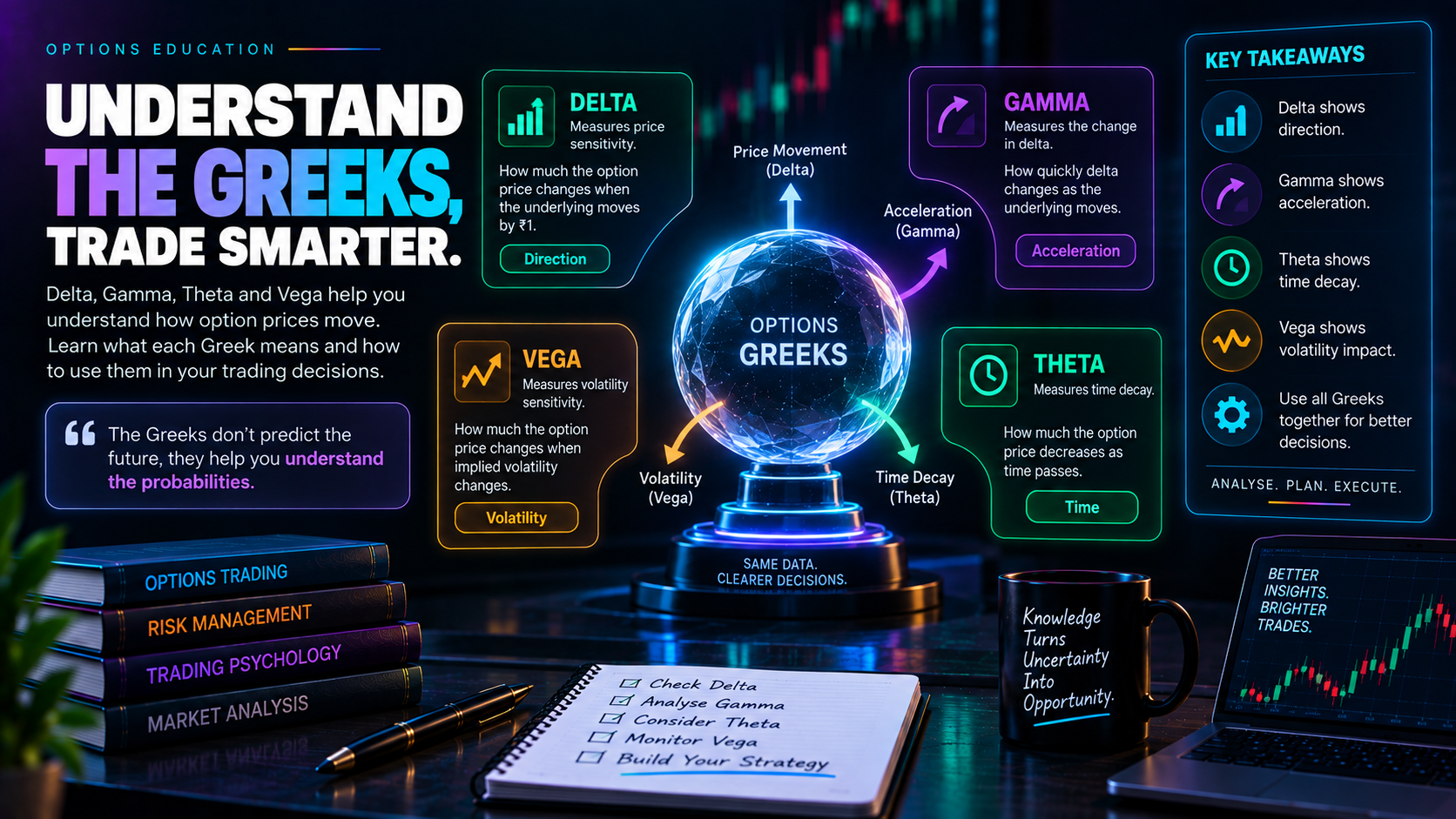
Options Greeks are measurements that describe how sensitive an option price is to different variables. Instead of looking only at the current premium, Greeks help you understand why that premium could change.
The four Greeks most beginners encounter are Delta, Gamma, Theta and Vega. Each answers a different question.
Delta
How sensitive is the option to a move in the underlying?
Gamma
How quickly does Delta change when the underlying moves?
Theta
How does the passage of time affect option value?
Vega
How sensitive is the option to implied volatility?
Why Options Greeks Matter
Suppose you buy an option because the underlying is moving in the direction you expected. Yet the option barely increases in value. That situation confuses many beginners.
The reason could be that the option has low Delta, substantial Theta decay , falling implied volatility or a combination of these factors.
Greeks provide a framework for understanding those effects. They can help you connect the option premium to the underlying price, time-to-expiry and implied volatility.
This becomes especially important when trading index options such as Nifty or Bank Nifty. Before entering a position, you should understand the option chain, liquidity, strike selection and the risk created by the Greeks.
If you are still learning the basics, start with how to enter an options trade and how to exit without panic .
Delta Explained: Direction and Price Sensitivity
What does Delta mean?
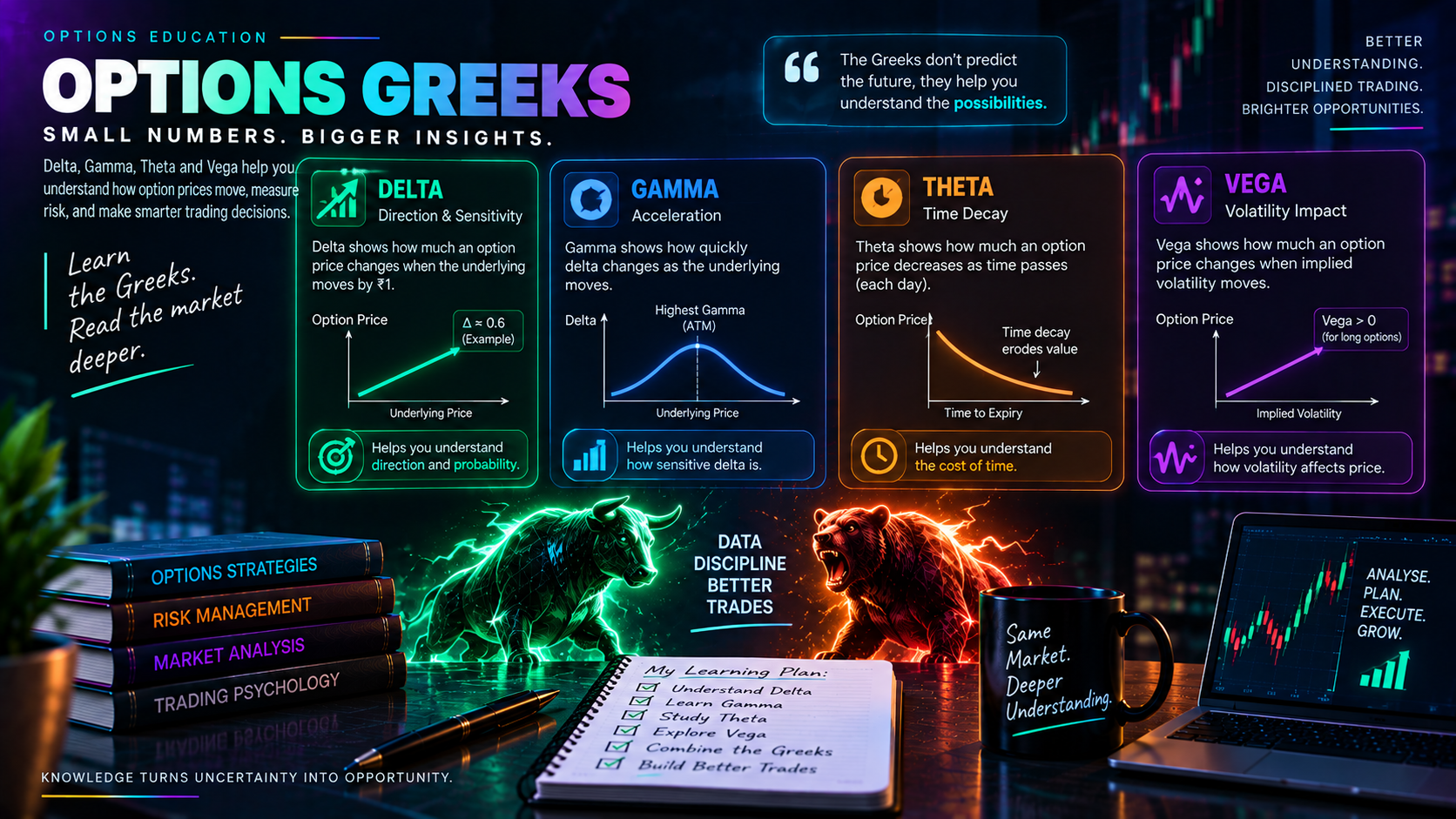
Delta measures how much an option's theoretical price is expected to change for a one-unit change in the underlying asset, assuming other variables remain constant.
For example, imagine a call option has a Delta of 0.60. A ₹1 increase in the underlying would theoretically correspond to roughly a ₹0.60 increase in the option premium, all else equal.
It is important to remember that this is an approximation. Delta itself changes as the underlying moves, which is where Gamma becomes important.
Call Delta vs Put Delta
Call options generally have positive Delta because their value tends to increase when the underlying rises. Put options generally have negative Delta because their value tends to increase when the underlying falls.
| Option | Typical Delta Range | General Interpretation |
|---|---|---|
| Deep ITM Call | Closer to +1 | High sensitivity to upside moves |
| ATM Call | Often around +0.50 | Moderate sensitivity |
| OTM Call | Closer to 0 | Lower immediate sensitivity |
| Deep ITM Put | Closer to -1 | High downside sensitivity |
| ATM Put | Often around -0.50 | Moderate sensitivity |
| OTM Put | Closer to 0 | Lower immediate sensitivity |
Gamma Explained: Why Delta Does Not Stay Constant
Gamma Measures the Change in Delta
Gamma tells you how much an option's Delta changes when the underlying moves by one unit.
This is why Gamma is often described as the acceleration of Delta.
Imagine a call starts with a Delta of 0.50. If its Gamma is 0.04, a ₹1 move in the underlying could theoretically move Delta toward approximately 0.54, assuming the simplified conditions used for the estimate.
The important point is that your option's sensitivity can change while you are holding it.
Where Is Gamma Usually Highest?
Gamma is generally most significant for options that are near the at-the-money strike, particularly when expiry is approaching.
This creates an important trade-off. Near expiry, an option can become extremely responsive to relatively small changes in the underlying. That can produce rapid gains, but it can also produce rapid losses.
This is one reason expiry trading requires more discipline than simply predicting whether the market will go up or down. Our guide on how options expiry affects stock prices provides additional context.
Theta Explained: The Cost of Waiting
Theta Measures Time Decay
Theta measures the sensitivity of an option's price to the passage of time, assuming other factors remain constant.
For a typical long option position, Theta is negative. That means simply holding the option while time passes can work against the position.
This is why buying an option is not only a directional decision. You are also buying time, and time has a cost.
Theta becomes particularly important as expiry approaches. An option with only a few days remaining can behave very differently from an otherwise similar option with several weeks or months remaining.
For a deeper explanation, read What Is Theta Decay in Options Trading .
Why Buyers Often Fight Theta
Suppose you buy an OTM call expecting a large upward move. The market stays almost flat for several sessions. Even though your directional thesis has not technically been disproved, the option may lose value because there is less time remaining.
This is one of the classic mistakes beginners make in options trading : focusing entirely on direction while ignoring time.
Vega Explained: Understanding Volatility Sensitivity
Vega Measures Sensitivity to Implied Volatility
Vega describes how sensitive an option's theoretical value is to a change in implied volatility.
A common convention is to quote Vega for a one percentage-point change in implied volatility.
Long options generally have positive Vega. If implied volatility rises, their theoretical value tends to rise, all else equal. Short options generally have negative Vega.
Vega matters because the option premium reflects more than the current price of the underlying. The market also prices uncertainty about future movement.
Our detailed guide to implied volatility in options trading explains why IV can have such a significant effect on premiums.

Delta vs Gamma vs Theta vs Vega
The easiest way to remember the four major Greeks is to connect each one to the variable it describes.
| Greek | Main Variable | Core Question | Typical Long Option Effect |
|---|---|---|---|
| Delta | Underlying price | How much does option price respond? | Call positive / Put negative |
| Gamma | Delta | How quickly does Delta change? | Generally positive |
| Theta | Time | What happens as expiry approaches? | Generally negative |
| Vega | Implied volatility | What happens if IV changes? | Generally positive |
Remember that these are general relationships. The exact values depend on the option, market conditions, model inputs and position structure.
How Greeks Change for ITM, ATM and OTM Options
Strike selection changes the Greek profile of an option. That is why two options on the same underlying can behave very differently even when their expiry is identical.
| Position | Delta | Gamma | Theta | Vega |
|---|---|---|---|---|
| Deep ITM Call | High + | Usually lower | Negative | Positive |
| ATM Call | Moderate + | Often high | More sensitive near expiry | Positive |
| OTM Call | Low + | Can be significant near ATM transition | Negative | Positive |
| ATM Put | Moderate - | Often high | Negative | Positive |
There is no universally “best” strike. The correct strike depends on your objective, expected move, time horizon, volatility assumptions and risk tolerance.
If you are analysing Nifty specifically, combine the Greeks with option-chain data instead of looking at a Greek in isolation.
A Simple Example: Reading All Four Greeks Together
Imagine an illustrative Nifty call option with the following hypothetical characteristics:
Nifty: 25,000
Strike25,000 Call
Premium₹180
+0.50
Gamma+0.04
Theta-₹8/day
Vega+₹10 per 1% IV change
These numbers are purely illustrative. They are not a live quote or trading recommendation.
Delta of +0.50 suggests that a ₹1 increase in the underlying would theoretically correspond to roughly ₹0.50 of option-price increase, before accounting for the fact that Delta itself changes.
Gamma of +0.04 suggests that the Delta can change as the underlying moves. If the underlying rises, Delta could increase; if it falls, Delta could decrease, depending on the position and market conditions.
Theta of -₹8/day suggests that time passing can theoretically reduce the option value by approximately ₹8 per day, assuming other inputs remain unchanged.
Vega of +₹10 means that a one percentage-point increase in implied volatility could theoretically add around ₹10 to the option value, all else equal.
How to Read Greeks on an Option Chain
Many trading platforms display Greeks alongside strike prices and premiums. When analysing an option chain, avoid looking at Delta, Gamma, Theta or Vega as isolated numbers.
- Check the underlying price first.
- Identify the strike and expiry.
- Compare the option's Delta with nearby strikes.
- Check Gamma, especially when expiry is close.
- Review Theta before buying short-dated options.
- Check Vega when implied volatility is elevated or falling.
- Compare bid-ask spreads and liquidity.
- Consider the position size and maximum acceptable loss.
For a deeper chain-reading process, see how to read option-chain data for Nifty trading and how to read the Bank Nifty option chain .
Greeks Near Expiry: Why Things Can Move So Fast
Options can become much more sensitive near expiry, particularly around at-the-money strikes.
Gamma can become important because Delta can change quickly. Theta can also become increasingly significant because there is less time remaining for the option to retain extrinsic value.
This combination can create an unusual experience for beginners: an option can gain value extremely quickly when the underlying makes the expected move, but lose value just as quickly when the move fails to materialise.
Before trading expiry, understand your options risk management rules and know how much capital you are willing to expose.
How Greeks Affect Common Options Strategies
Greeks become even more useful when you stop analysing individual options and start analysing complete strategies.
| Strategy | General Delta | Gamma | Theta | Vega |
|---|---|---|---|---|
| Long Call | Positive | Positive | Negative | Positive |
| Long Put | Negative | Positive | Negative | Positive |
| Covered Call | Generally positive net exposure | Negative from short call | Can benefit from option decay | Negative from short call |
| Protective Put | Positive stock + negative put | Positive from long put | Negative from put | Positive from put |
Strategy-level Greeks are especially useful because one position can offset another. A spread, for example, can have very different sensitivity from either option considered individually.
If you want to explore defensive structures, read our protective put strategy guide .
Why You Should Never Read One Greek Alone
This is probably the most important lesson in the entire article.
Suppose an option has attractive Delta. That does not automatically make it attractive.
Perhaps Theta is extremely negative because expiry is approaching. Perhaps implied volatility is unusually high and Vega exposure is significant. Perhaps Gamma makes the position highly sensitive to small movements.
Every Greek tells only part of the story.
Greeks and Risk Management
Greeks should ultimately improve risk awareness, not encourage larger trades.
Before entering a position, ask:
- How much directional exposure am I taking?
- How quickly can my Delta change?
- How much time decay am I accepting?
- What happens if implied volatility falls?
- What happens if the underlying moves sharply against me?
- How much money can I lose if the thesis is wrong?
- Does my position size match that risk?
For position-sizing principles, read How Much Money Should You Risk in Options Trading?
You can also review stop-loss concepts for options beginners before building a trading plan.
Options Greeks Calculator: A Simple Educational Tool
Use the calculator below to understand how hypothetical Greek values can translate into approximate price effects. This is an educational calculator, not a pricing engine and not a trading signal.
The calculator deliberately keeps the mathematics simple. Real option pricing depends on multiple variables simultaneously, and Greeks can change as those variables change.
Common Beginner Mistakes With Options Greeks
1. Treating Delta as a guaranteed probability
Delta can have a probability-like interpretation under particular assumptions, but it is not a guarantee of profit or expiry outcome.
2. Ignoring Gamma
Traders may focus on current Delta without considering how quickly that Delta can change.
3. Forgetting Theta
A correct directional prediction can still produce a disappointing option trade if time decay consumes enough premium.
4. Buying expensive volatility without understanding Vega
If implied volatility falls, a long option can lose value even if the underlying moves in the expected direction.
5. Looking only at the premium
A ₹20 option is not automatically cheaper or better than a ₹200 option. The premium must be considered alongside strike, expiry, volatility, liquidity and Greeks.
6. Ignoring position size
Understanding Greeks does not compensate for excessive leverage. Combine Greek analysis with a clear entry and exit framework .
A Practical Greek Checklist Before an Options Trade
If you want a simple workflow, use this five-step process.
- Start with the underlying. Understand the current price, trend and important levels.
- Choose the expiry. More time changes the option's sensitivity and premium structure.
- Compare strikes. Look at Delta and Gamma across nearby strikes.
- Check Theta and Vega. Understand the cost of time and exposure to implied volatility.
- Define risk before entry. Decide your position size, invalidation point and maximum acceptable loss before committing capital.
This approach is far more useful than simply searching for an option with a particular Greek value.
You can combine this framework with identifying strong options trade setups and planning when to book profits .
How Greeks Fit Into a Larger Options Analysis
Greeks are one layer of analysis. They should not replace understanding the underlying market.
A more complete process can combine price structure, option-chain positioning, implied volatility, liquidity and risk management.
For example, traders studying Nifty options may combine Greeks with Put-Call Ratio analysis , Max Pain concepts and support and resistance from option-chain data .
These tools still do not predict the market with certainty. They simply provide different pieces of information that can improve the quality of your analysis.
If you are interested in technology-assisted analysis, explore AI tools for stock-market analysis and learn more about how AI is transforming stock-market trading .
Can AI Help With Options Greeks?
AI can make large amounts of market information easier to organise, compare and interpret. It can help surface relationships between option-chain data, volatility, price movement and historical behaviour.
However, AI does not remove market uncertainty. A sophisticated dashboard can still be wrong if the underlying assumptions are wrong or the market behaves unexpectedly.
Stoxra's broader AI trading platform resources and AI vs manual trading guide can help you understand where technology fits into the decision-making process.
The goal should be better analysis and better discipline—not blindly handing decisions to an algorithm.
Delta, Gamma, Theta and Vega: The Simple Mental Model
If you remember nothing else from this guide, remember this:
Delta asks: “What happens if the underlying moves?”
Gamma asks: “How quickly will that Delta change?”
Theta asks: “What does the passage of time cost me?”
Vega asks: “What happens if implied volatility changes?”
Together, these four measures turn a simple option premium into a much clearer picture of risk exposure.
Once you understand them, option-chain screens become much less intimidating. Instead of seeing dozens of numbers, you can begin asking structured questions about direction, acceleration, time and volatility.
Frequently Asked Questions
What are options Greeks?
Options Greeks are sensitivity measures used to understand how an option's theoretical price can respond to changes in the underlying, time and implied volatility.
What does Delta mean in options?
Delta measures an option's approximate price sensitivity to a one-unit move in the underlying, with other variables held constant.
What does Gamma mean?
Gamma measures how quickly an option's Delta changes when the underlying asset moves.
What does Theta mean?
Theta measures the sensitivity of an option's price to the passage of time. Long options generally have negative Theta.
What does Vega mean?
Vega measures an option's sensitivity to changes in implied volatility. Long options generally have positive Vega.
Which Greek is most important?
There is no universally most important Greek. Delta, Gamma, Theta and Vega describe different types of exposure and should generally be considered together.
Are options Greeks trading signals?
No. Greeks describe sensitivity and risk. They do not guarantee the future direction of an underlying asset or the profitability of a trade.
Do Greeks change over time?
Yes. Greeks can change as the underlying price, time to expiry, implied volatility and other inputs change.
Learn the Greeks. Then Learn to Manage the Risk.
Understanding Delta, Gamma, Theta and Vega is a major step toward understanding how options actually behave. But knowledge becomes useful only when it is combined with disciplined analysis, position sizing and risk management.
Continue learning through Stoxra's options education and trading tools.
Explore Stoxra Learn →