How to Scale Out of a Winning Trade
Learn how to scale out of a winning trade using partial exits, predefined targets, trailing stops and risk-based position management.
How to Scale Out of a Winning Trade
Learning how to scale out of a winning trade can help traders manage profits without treating every winning position as an all-or-nothing decision. Instead of closing the entire position at one price, scaling out means gradually reducing position size as the trade develops according to a predefined plan.
A winning trade can create a different psychological challenge from a losing trade. When a position moves in the expected direction, traders may become afraid of giving back profits, exit too quickly, increase the target emotionally, or hold everything while hoping for an unusually large move.
A structured scale-out plan attempts to replace those reactions with rules. The trader defines how much of the position may be closed, what conditions justify each reduction, where the remaining risk should be managed, and what would invalidate the original trade thesis.

What Does Scaling Out of a Winning Trade Mean?
Scaling out means reducing a position in stages instead of exiting the entire trade at once. For example, a trader might enter with a planned position and close a portion after the first objective, another portion after a second objective, and leave a smaller remainder for a potentially extended move.
The percentages are not universal. One trader may use equal reductions, while another may use a larger first reduction and a smaller runner. The correct structure depends on the strategy, volatility, timeframe, liquidity, transaction costs and risk tolerance.
Why Traders Scale Out of Winning Positions
The primary reason for scaling out is flexibility. A trader does not need to predict the exact highest price of the move. Instead, the trade can realize some profit while maintaining exposure to a possible continuation.
This can also make trade management more systematic. Once a partial exit occurs, the trader has a smaller position to manage, which may reduce emotional pressure. However, scaling out can also reduce the profit captured from a strong trend if too much of the position is closed too early.
Potential Advantages
- Realizes part of an open gain.
- Maintains some exposure to a continuing trend.
- Can reduce psychological pressure.
- Creates predefined decision points.
- Can be combined with trailing stops.
- Allows different portions of a trade to have different exit objectives.
Potential Disadvantages
- Early partial exits can reduce upside during strong trends.
- Too many exit levels can make management complicated.
- Frequent transactions can increase costs.
- Emotional scaling may become disguised profit-taking.
- A trader may move stops irrationally after booking profit.
Scaling Out Starts With the Original Trade Plan
A scale-out plan should ideally exist before the trade becomes profitable. If the trader waits until the position is already moving rapidly, decisions can become influenced by fear, greed and recent price movement.
A proper plan should answer several questions: Why was the trade entered? What price or structure confirms the thesis? What invalidates the thesis? Where are the logical profit areas? How much should be closed at each area? What happens to the remaining position?
A disciplined trader can document these decisions alongside the broader technical analysis used to identify the setup.
Choose Logical Profit Zones
Profit-taking levels should not be selected simply because a round number feels comfortable. They should have a relationship with the trade structure.
Possible reference points include previous resistance, measured moves, chart structures, volatility-based objectives and predefined reward-to-risk levels. Traders can also consider broader support and resistance when determining where a move may encounter opposing interest.
The objective is not to predict the exact turning point. The objective is to create repeatable areas where reducing exposure makes sense according to the strategy.
Fixed Percentage Scaling vs R-Multiple Scaling
There are several ways to structure partial exits. Two simple approaches are fixed percentage exits and reward-to-risk, or R-multiple, exits.
Fixed Percentage Method
Under a fixed percentage method, the trader defines portions of the original position to exit at predetermined conditions. For example, the plan might specify 25%, 25%, and the remaining 50%.
R-Multiple Method
An R-multiple approach connects exits to the initial risk. If the planned initial risk per share is ₹10, then a move of ₹20 in the favorable direction represents 2R for that example. The trader can then define partial exits around predetermined R levels.
How Position Size Changes After a Partial Exit
Once part of a position is closed, the remaining exposure is smaller. This changes the risk profile of the trade and should be reflected in the management plan.
For example, a trader holding 100 shares who closes 40 shares now has only 60 shares remaining. If the stop remains at the original location, the maximum potential loss from the remaining position is lower than it was before the partial exit.
Position sizing should be connected to the original risk rather than adjusted impulsively because the trade is profitable. A structured position-sizing framework can help keep exposure consistent.
Should You Move the Stop After Scaling Out?
This is one of the most important questions in trade management. There is no universal rule that says a trader must immediately move the stop to breakeven after a partial exit.
Moving the stop too aggressively can remove a trade from a normal market fluctuation. Keeping the original stop indefinitely can leave more unrealized profit exposed than the trader intended.
The stop should therefore be connected to the strategy. Possible approaches include structure-based trailing, volatility-based trailing, moving-average rules or a predefined breakeven condition.
Risk management remains important even after a trade becomes profitable. Review intraday risk management principles before changing the protection rule.

Use Market Structure to Manage the Remaining Position
After the first partial exit, the remaining position should continue to follow a logical framework. Price structure can help determine whether the original trend is still intact.
For a bullish trade, higher highs and higher lows may support continued exposure. Repeated failure at resistance, a meaningful support break or a major change in market context may provide reasons to reduce or exit the remaining position.
Technical tools should support the decision rather than become an excuse to hold. The trader can also combine price structure with volume, volatility and indicators already validated by the strategy.
Scaling Out in Intraday Trading
Intraday traders often face fast price movements and limited time for decision-making. A predefined scale-out structure can therefore be useful, provided it does not create too many decisions during the session.
Indicators such as VWAP, volume and moving averages may be used as confirmation depending on the strategy. For traders building a broader indicator framework, best intraday trading indicators can provide additional educational context.
VWAP may also be useful for traders whose methodology specifically incorporates it; see the VWAP trading strategy resource for additional context.
Scaling Out in Swing Trading
Swing traders may hold positions for several sessions or longer. Their scale-out levels can therefore be based on larger chart structures rather than short-term intraday fluctuations.
Potential reference points include previous swing highs, resistance zones, measured moves, trend structure and volatility-adjusted objectives. The trader should also consider overnight and event risk.
Chart patterns can help define the structure of a swing trade, but a pattern alone does not determine the correct exit. It should be considered alongside the complete trade plan.
Scaling Out During a Strong Trend
A strong trend creates an important trade-management dilemma. Taking profits too quickly can reduce participation in the trend, while holding the entire position without a defined exit framework can allow a large unrealized gain to disappear.
One solution is to treat the remaining position as a runner. After the initial partial exits, the runner can be managed using a rule such as a structural trailing stop, volatility-based stop or confirmed trend failure.
Scaling Out Near Resistance
Resistance can be a logical area for partial profit-taking when it was identified before the trade. However, resistance is not automatically a sell signal.
Price can reject resistance, pause below it, break through it or consolidate before continuing. A scale-out plan should account for these possibilities instead of assuming that every resistance level will stop the trend.
This is where predefined scenarios are useful. The trader can specify what happens if price reaches resistance with strong momentum, reaches it with weak momentum, breaks through it, or reverses from it.
Do Not Confuse Scaling Out With Random Profit Booking
Random profit booking happens when a trader exits because the profit “looks good.” That decision can change from trade to trade and often depends on emotional state.
Scaling out is different because the reduction rules are defined in advance. The specific levels can still be adjusted by a tested strategy, but they should not be invented simply because the current profit feels large.
How to Scale Out Without Destroying Reward-to-Risk
A common problem with aggressive partial exits is that the trader repeatedly takes small profits while occasionally allowing losses to reach the original stop. This can produce an unfavorable distribution even when many trades are profitable.
The exit strategy must therefore be evaluated as a complete system. Do not judge it only by the percentage of winning trades.
Important measurements can include average winner, average loser, expectancy, maximum drawdown, profit factor, number of partial exits, average holding time and how much of the original position was closed at each stage.
When Should You Avoid Scaling Out?
Scaling out may not fit every strategy. A system specifically designed around full-position exits may perform differently when partial exits are introduced.
It may also be unsuitable when transaction costs, liquidity constraints or the strategy's statistical edge depend on maintaining the full position until a specific exit condition.
The correct question is not “Should every trader scale out?” The better question is “Does scaling out improve the tested performance and risk characteristics of this specific strategy?”
Common Scaling-Out Mistakes
1. Taking Profit Too Early
A trader may close most of the position after a small favorable move. This can create many small wins but leave little exposure to larger trends.
2. Moving the Stop Too Quickly
Immediately moving a stop to breakeven after a small gain can expose the trade to normal market noise.
3. Increasing the Target Emotionally
A trader may refuse to take the planned partial exit because the position is moving strongly. Sometimes that is justified by the strategy, but changing the plan purely because of excitement can create inconsistent results.
4. Scaling Out Too Many Times
Ten different partial exits may sound sophisticated but can make execution difficult. A simpler framework may be easier to test and follow.
5. Ignoring Position Size
The remaining position still carries market exposure. After every partial exit, the trader should know exactly how many shares or contracts remain and what the current risk is.
6. Overtrading After a Large Win
A profitable trade can increase confidence and lead to unnecessary additional trades. Following a clear process can help avoid overtrading after an unusually strong result.
Scaling Out and Trading Psychology
Trading psychology becomes especially relevant when unrealized profits become large. The trader may start thinking about the money rather than the setup.
A predefined exit framework reduces the number of decisions that need to be made under pressure. This is closely related to trading discipline and trading psychology .
The goal is not to remove emotion completely. That is unrealistic. The goal is to create rules strong enough that emotion does not continuously rewrite the plan.
A Practical Three-Stage Scale-Out Framework
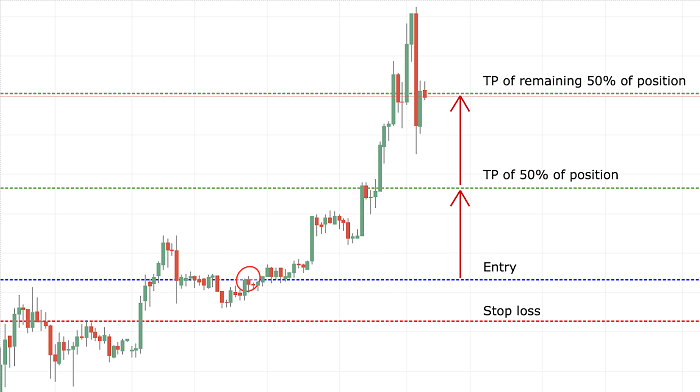
A simple three-stage framework can make the concept easier to understand. The exact percentages should be determined by the trader's strategy rather than copied blindly.
- Stage One: Take a planned partial profit at the first objective.
- Stage Two: Reduce another portion at the next structural or reward-based objective.
- Stage Three: Manage the remaining position using a predefined trailing or final-exit rule.
This framework gives the trader three different jobs: realize some profit, continue participating if conditions remain favorable, and eventually exit when the remaining thesis is no longer valid.
How to Scale Out When the Market Suddenly Accelerates
Sometimes a position reaches multiple objectives very quickly. In such cases, traders may feel pressure to change the plan.
The better approach is to distinguish between a genuine change in market conditions and emotional excitement. If the strategy has rules for unusually strong momentum, follow those rules. Otherwise, avoid inventing new targets during the move.
Broader market conditions can also matter. A strong individual stock move occurring against a weak broader market may behave differently from a move supported by strong market participation.
Monitoring market trend analysis can therefore provide useful context, although it should not override the specific trade setup.
Scaling Out Around Major Market Events
Corporate announcements, earnings, macroeconomic developments and major geopolitical events can change volatility rapidly. A position that looked stable before an event may behave differently afterward.
For swing positions, traders should know whether an important event falls inside the planned holding period. Educational material on earnings trading signals can help traders understand why event awareness matters.
Market-wide volatility can also change the distance between price levels. Traders should avoid mechanically applying a scale-out rule when the market environment is materially different from the conditions under which the rule was developed.
Scaling Out and Options Positions
Options positions introduce additional variables such as time decay, implied volatility and changes in the underlying. Partial exits therefore need to be evaluated in the context of the complete options strategy.
A trader managing an options position should not assume that a favorable underlying move will translate into a simple one-for-one profit pattern in the option. Options risk management should remain part of the framework.
How to Record Scale-Out Decisions in a Trading Journal
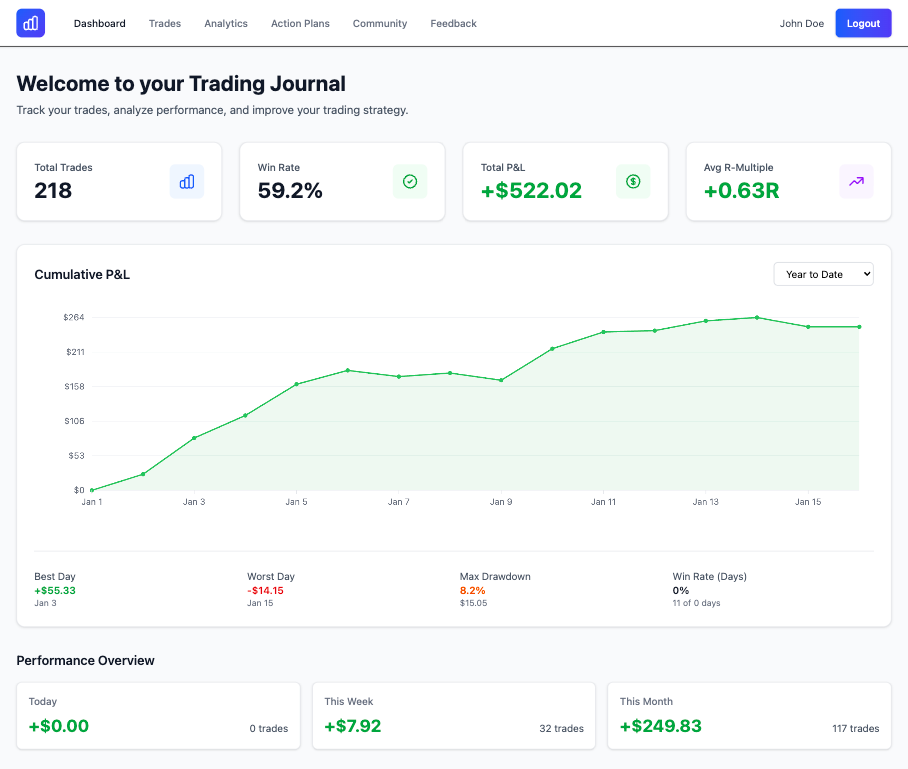
A trading journal should record more than the final profit or loss. If a trade was scaled out, record the original position, each partial exit, the reason for each exit, the remaining quantity, stop changes and final outcome.
A structured trading journal can help identify whether partial exits are improving the process or simply reducing the average winner.
After a meaningful sample, compare trades that were fully exited with trades managed through partial exits. Also review how much profit was left on the table after each partial exit.
Review Your Scale-Out Strategy After Market Hours
The best time to evaluate an exit rule is usually after the emotional pressure of the trade has passed. Review the chart and reconstruct the decisions objectively.
Ask whether the first exit happened at the planned level, whether the stop was moved according to the rules, whether the remaining position was managed consistently and whether the final exit was triggered for a valid reason.
A dedicated trade-review process can help separate a good decision from a lucky outcome.
How to Improve a Scale-Out System Without Overfitting
One of the biggest dangers in strategy development is changing the rules after every trade. A single unusually large winner may tempt a trader to increase the runner portion. A single failed breakout may lead to an unnecessarily early exit rule.
Instead, collect enough observations to identify repeated behavior. Change one major variable at a time and compare the results with the previous framework.
A trading plan should also remain stable enough to test. Resources on how to follow a trading plan without breaking rules can help reinforce the importance of process consistency.
A Complete Scale-Out Checklist
- Was the original entry based on a valid setup?
- Was the initial risk defined before entry?
- Were partial exit levels identified before the trade?
- Does each exit have a specific reason?
- Is the remaining position size known?
- Is the stop location still valid?
- Has the trade thesis changed?
- Is current volatility compatible with the trailing rule?
- Are transaction costs being considered?
- Is the trader following the plan rather than reacting to profit?
Example of a Rules-Based Winning Trade
Consider a hypothetical long trade where the trader enters after a defined breakout. Before entry, the trader identifies the initial stop, first objective, second objective and final trailing condition.
The stock reaches the first objective, so the planned portion is closed. The remaining position continues while the trend structure remains intact. Price reaches the second objective, another portion is closed. The final position is then managed using the predefined trailing rule.
Notice that the trader does not need to know the highest price in advance. Each decision is based on a condition that was defined before or objectively generated by the strategy.
What If the Trade Reverses After the First Partial Exit?
This is an important scenario. Taking a partial profit does not make the remaining position risk-free unless the strategy specifically defines it that way.
If price reverses and reaches the valid stop for the remaining position, the trader should follow that exit rule. The fact that some profit was already booked should not automatically justify giving the remaining position unlimited room.
A partial exit should therefore be viewed as a change in exposure, not permission to ignore the original risk framework.
What If the Trade Never Reaches the First Target?
A scale-out framework does not guarantee that the first profit objective will be reached. Some trades will reverse before any partial exit occurs.
That is why the initial invalidation condition remains important. The trader should know when the setup has failed rather than waiting indefinitely because the position was expected to become profitable.
The daily risk framework should also remain active. Traders can review daily loss-limit principles when designing broader session-level controls.
Scaling Out Should Fit Your Trading Style
An intraday momentum trader, swing trader and positional trader may all use scaling out, but their rules can be very different.
Intraday traders may use shorter-term price levels and time-based exits. Swing traders may use daily chart structures. Positional traders may use weekly levels and broader fundamental or macro context.
There is no requirement to make every trading style use the same scale-out framework. The system should match the timeframe and objective of the strategy.
Using Technology to Track Partial Exits
Technology can make trade management easier by recording entries, exits, position size and performance. However, technology should support the rules rather than create additional complexity.
Algorithmic tools and automated systems may be useful for traders whose strategies require them. Educational resources explaining how algorithmic trading bots work can help traders understand the broader concept.
AI-based tools can also assist with organization, analysis and research, but traders should distinguish analytical assistance from guaranteed trading performance. See how AI is transforming stock market trading for broader context.
How to Measure Whether Scaling Out Is Working
Do not evaluate a scale-out method using only total profit. A complete evaluation should consider how the method changes the entire distribution of outcomes.
- Average winning trade.
- Average losing trade.
- Win rate.
- Expectancy.
- Profit factor.
- Maximum drawdown.
- Average holding time.
- Percentage of trades reaching each scale-out level.
- Average profit captured before final exit.
- Profit given back by the remaining runner.
This type of review helps answer whether the strategy is genuinely improving or merely producing a more comfortable psychological experience.
Scale Out, But Do Not Scale Up Risk Emotionally
One dangerous behavior is increasing position size after a trade has already produced a profit. A trader may feel that the market is “paying for the next trade.”
That mindset can quickly turn a disciplined scale-out system into an aggressive position-sizing system.
The next trade should be evaluated independently. A winning trade does not change the quality of the next setup.
Final Rules for Scaling Out of a Winning Trade
- Define the initial risk before entering.
- Decide whether scaling out actually fits the strategy.
- Predefine the partial-exit structure.
- Use logical price or reward-based objectives.
- Track remaining position size after every partial exit.
- Do not move stops randomly.
- Allow the remaining position enough room according to the tested strategy.
- Do not turn a partial exit into an excuse to ignore invalidation.
- Record every scale-out decision in the journal.
- Evaluate the method over a meaningful sample.

Frequently Asked Questions
1. What does it mean to scale out of a winning trade?
It means closing part of an open position while keeping the remaining position active according to a predefined management rule.
2. What percentage should I scale out?
There is no universal percentage. The appropriate allocation depends on the strategy, timeframe, volatility, liquidity and tested performance.
3. Is scaling out better than exiting the whole position?
Not necessarily. Scaling out changes the distribution of returns. It should be compared with full-position exits using historical or simulated results.
4. Should I move my stop to breakeven after taking profit?
Not automatically. The stop should be moved only according to a predefined and tested rule because an overly tight stop can exit a position during normal volatility.
5. Can swing traders use scaling out?
Yes. Swing traders can use partial exits around predefined chart levels, reward objectives or trend-management rules.
6. Can options traders scale out?
Yes, but options introduce additional variables such as time decay and implied volatility. The scale-out plan should be integrated with the overall options risk framework.
7. Does scaling out guarantee that I will keep profits?
No. It can realize part of a gain, but the remaining position can still lose value. Scaling out is a risk-management and trade-management technique, not a guarantee.
8. How can I know whether my scale-out strategy works?
Record partial exits and compare the results with an alternative exit method over a meaningful sample. Review average winners, expectancy, drawdown, profit factor and profit captured.
Traders who want to strengthen the broader risk process can also review how to avoid losses in intraday trading before changing a scale-out rule.
Build a More Structured Trading Process With STOXRA
Scaling out works best when it is part of a larger rules-based trading process. Entries, position size, stop placement, profit objectives, market context and review should all connect to one another rather than being managed as isolated decisions.
For traders interested in combining structured analysis with modern technology, explore the STOXRA AI Trading Platform India to learn more about AI-assisted trading workflows and market-analysis tools.
Disclaimer
This article is for educational and informational purposes only. Trading and investing in stocks, derivatives and other financial instruments involves risk, including the possibility of losing capital. Scaling out, partial profit booking and trailing-stop methods do not guarantee profits or protect against losses. Examples in this article are illustrative and should not be treated as personalized investment advice.