How to Trade the First Hour of Market Open
Learn a structured approach to trading the first hour of market open by analysing opening ranges, price action, volume, VWAP, market and sector context, breakouts, reversals and risk management.
How to Trade the First Hour of Market Open
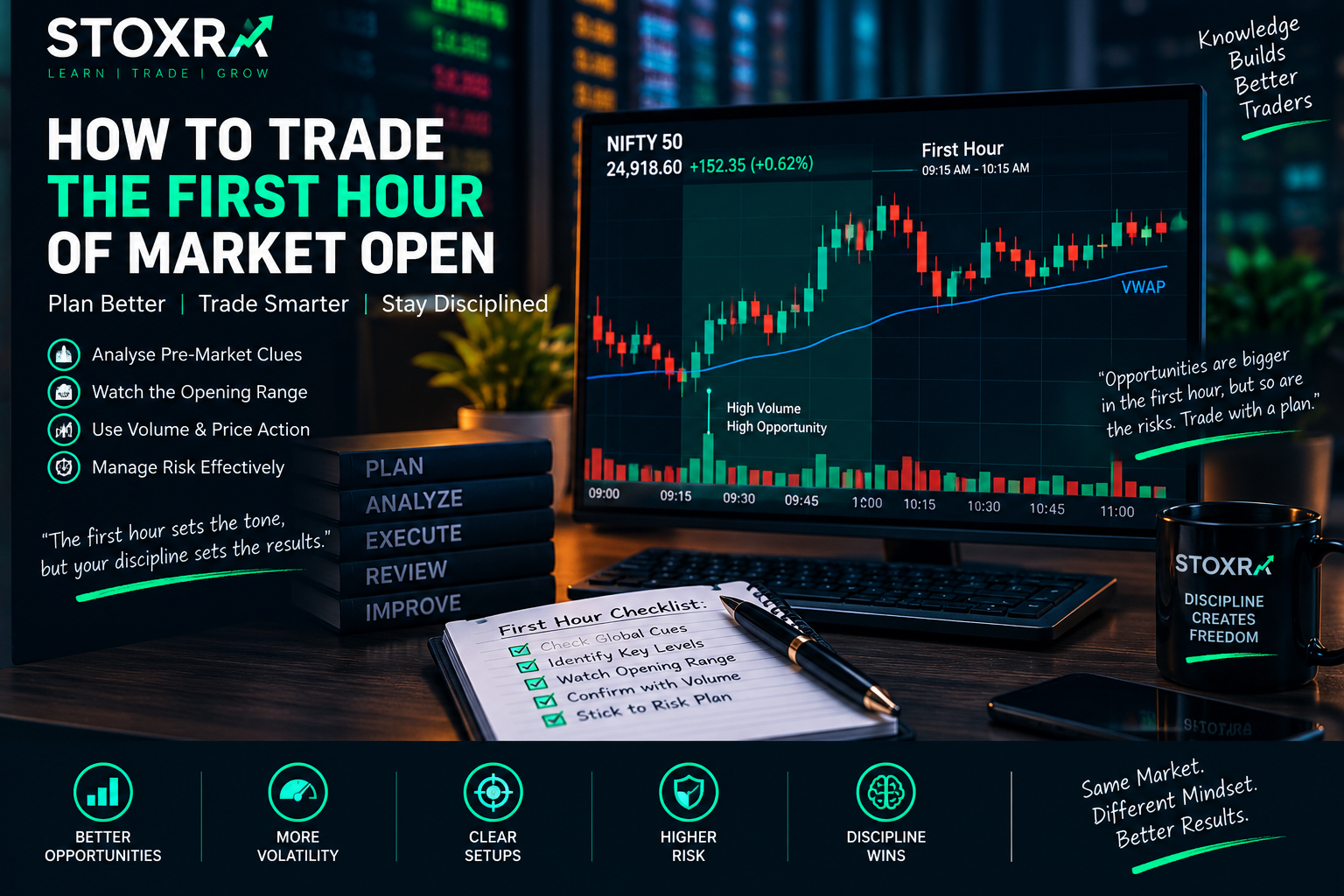
The first hour of the market can be one of the most active and information-rich parts of the trading session. Overnight developments, global markets, company news, sector movement, previous-day levels and fresh orders all interact after the opening bell. This can create clear opportunities for intraday traders, but it can also produce sharp reversals, false breakouts, fast gaps and difficult execution. Learning how to trade the first hour therefore requires more than finding a stock that is moving quickly. It requires a structured process for preparation, observation, confirmation, risk management and review.
Key Takeaway
The first hour should be treated as a period for collecting information and waiting for a defined setup, not as a race to place the first trade. Prepare important levels before the open, observe the opening behaviour, understand volume and market context, define invalidation and position size, and trade only when the complete setup matches your rules.
What Does the First Hour of Market Open Mean?
The first hour refers to the opening portion of the regular trading session. During this period, information that was accumulated before the market opened begins to interact with actual buy and sell orders. The resulting price action can be fast because participants are adjusting positions, responding to news and discovering where buyers and sellers are willing to transact. For additional context, see What Is Technical Analysis In Stock Trading.
There is no universal direction for the first hour. Some sessions begin with a strong trend and continue. Some sessions produce an opening move followed by a reversal. Others remain inside a range while traders wait for more information. A good first-hour process is therefore based on scenarios rather than predictions.
Why the First Hour Can Be Important for Intraday Traders
Early-session activity can establish important reference points for the rest of the day. The opening range, first major high, first major low, previous-day levels and early volume behaviour may all become useful context. A trader who prepares these areas in advance can evaluate price movement more systematically.
At the same time, high activity can increase risk. A market that moves rapidly can make an entry appear attractive while leaving little room for a logical stop. The first-hour trader therefore needs both opportunity recognition and the ability to reject trades that do not provide manageable risk.
What Makes the Opening Session Different?
Before the open, traders often work with expectations based on overnight information. After the open, the market provides actual evidence about how participants are responding. This difference matters. A stock expected to rise may open higher and immediately weaken. A stock expected to fall may find buyers and recover. For additional context, see how to follow a trading plan without breaking rules.
The first-hour plan should therefore focus on observed behaviour. The goal is not to prove a pre-market opinion correct. The goal is to identify whether the live market is creating the conditions required by the trading strategy.
Pro Tip
Prepare scenarios before the opening bell, but remain willing to change your view when the actual market invalidates it. Preparation creates structure; flexibility prevents attachment to a prediction.
Prepare Before the Market Opens
First-hour trading begins before the first candle. A trader can review the previous session, identify important support and resistance, check relevant company developments, observe sector conditions and understand the broader market environment. This preparation reduces the number of decisions that need to be made under pressure. For additional context, see support and resistance levels.
The most useful preparation produces a shortlist of scenarios. For example, a trader may note that a stock is near an important resistance level and write down what confirmation would be needed for a breakout. The trader can also define what would invalidate that idea. This is more useful than simply writing “buy if price goes up.”
Build a Focused First-Hour Watchlist
A first-hour watchlist can include liquid stocks, stocks with unusual volume, stocks affected by relevant news, stocks near important technical levels and stocks showing a structure that fits the trader's method. The list should remain manageable. For additional context, see how to avoid overtrading in intraday trading.
A watchlist is not a list of stocks that must be traded. Its purpose is to focus attention. If none of the candidates produces a valid setup, the correct result can be zero trades.
Check Liquidity Before the Session
Liquidity matters because intraday traders often need to enter and exit within a relatively short period. A stock with sufficient trading activity may offer a more practical environment than a thinly traded stock, although actual execution conditions can change quickly.
Consider liquidity together with spread, expected position size, current volume and volatility. A stock can be generally liquid but still become difficult to trade during an unusual event. The trader should evaluate the actual conditions rather than rely on a label.
Review the Previous-Day High
The previous-day high can act as a useful reference point. When price approaches it during the first hour, the trader can observe whether buyers are able to sustain the move, whether price rejects the level or whether the market consolidates nearby.
The level itself is not an automatic buy signal. Its value comes from the behaviour around it and the strategy being used. Mark it before the session so that the reaction can be interpreted quickly.
Review the Previous-Day Low
The previous-day low provides the opposite reference. A move toward that level can create a possible breakdown, support reaction or range scenario. Again, the level should be treated as an area for observation rather than a guaranteed signal.
Check the Previous Close
The previous close is particularly useful when a stock opens away from its prior closing price. Comparing the opening price with the previous close can help describe the initial market condition and identify whether a gap scenario needs attention.
Understand Opening Gaps
A gap occurs when the opening price differs materially from the previous session's close. Gaps may be caused by company announcements, earnings-related information, global market movement, sector developments or other changes in expectations.
A gap does not have a single expected outcome. It can continue, retrace partially, retrace completely, consolidate or reverse. The first-hour trader should therefore avoid assuming that every gap must either fill or continue.
What Is an Opening Range?
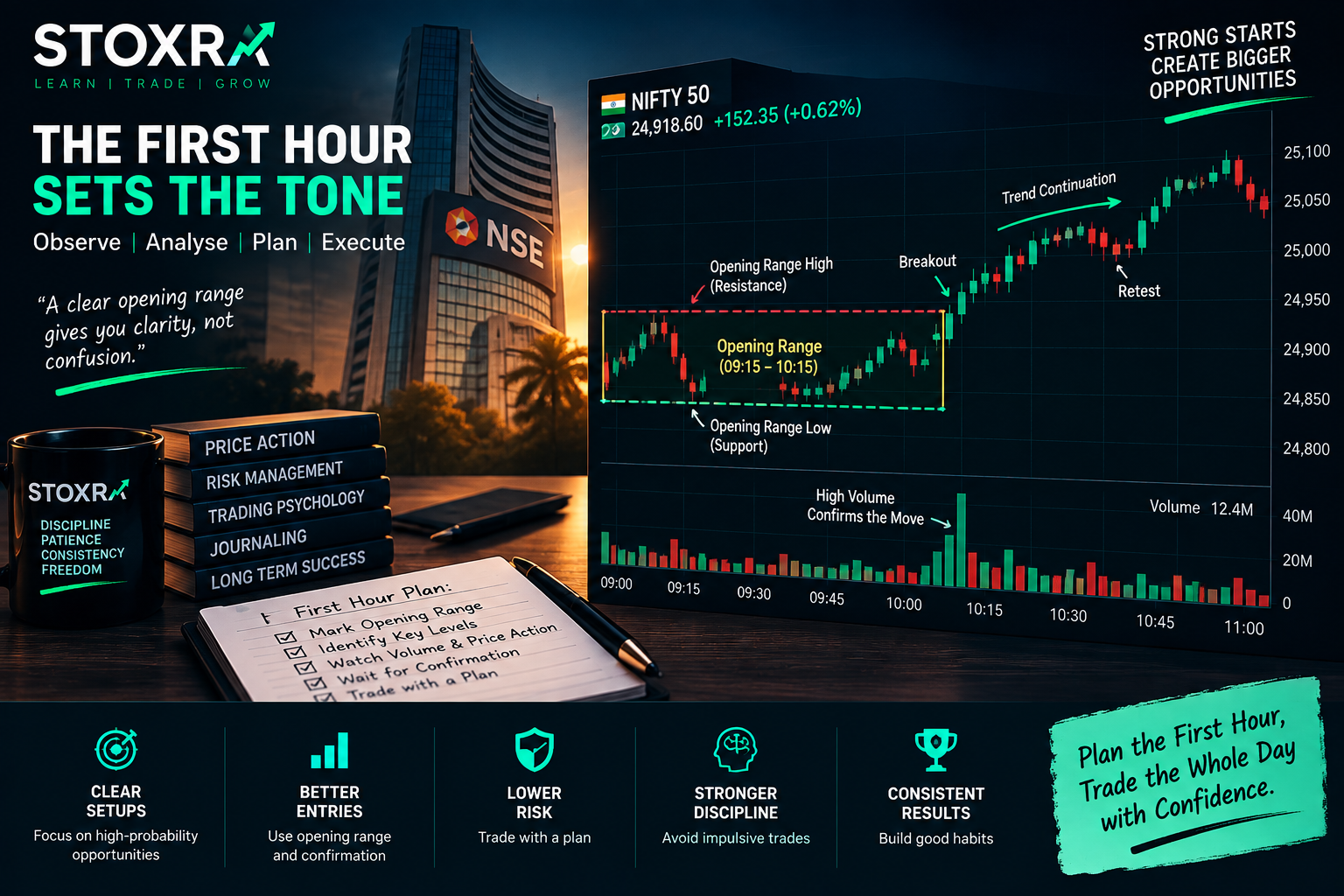
An opening range is a predefined early-session price range. The trader decides the measurement period in advance, such as a selected number of minutes, and then records the high and low produced during that period.
The range can provide a framework for analysing the first-hour market. A move above the range high may create a breakout scenario, while a move below the range low may create a breakdown scenario. Price remaining inside the range may indicate that the market is still balancing.
How to Define the Opening Range Consistently
Consistency is more important than choosing a particular range length because different strategies use different timeframes. Decide the period before the session and apply the same rule during testing and live trading.
Changing the range definition after seeing the price movement can introduce hindsight into the process. A strategy should be evaluated using the same rules that would have been available in real time.
Opening Range High and Resistance
The opening-range high can become an important area when price returns to it. A sustained move above the level may attract attention, but the trader should still look for the confirmation required by the strategy.
A brief move above the high followed by a quick return inside the range can represent a failed breakout. It should not automatically become a reversal trade unless that scenario is part of the tested plan.
Opening Range Low and Support
The opening-range low can similarly act as a reference. A breakdown may be watched for continuation, while a quick rejection and return into the range may create a different scenario.
The trader should define the confirmation and invalidation rules before the level is tested. This prevents the decision from being created emotionally after the move has already occurred.
Do Not Automatically Trade the First Candle
The first candle can be large because the opening session contains concentrated activity. Its direction may persist, but it can also reverse quickly. Entering solely because the candle is large can create a poor entry location.
Waiting for additional structure can provide more information. Traders using a specific opening strategy may have rules that permit earlier entries, but those rules should be defined and tested rather than improvised.
Let Price Structure Develop
Price structure can include consolidation, higher highs and higher lows, lower highs and lower lows, breakouts, retests and rejections. The relevant structure depends on the strategy and timeframe.
Structure is useful because it transforms a moving chart into a scenario. Instead of simply saying “price is rising,” a trader can describe the condition more precisely, such as “price broke resistance and is holding above the level.”
Use Volume to Confirm Participation
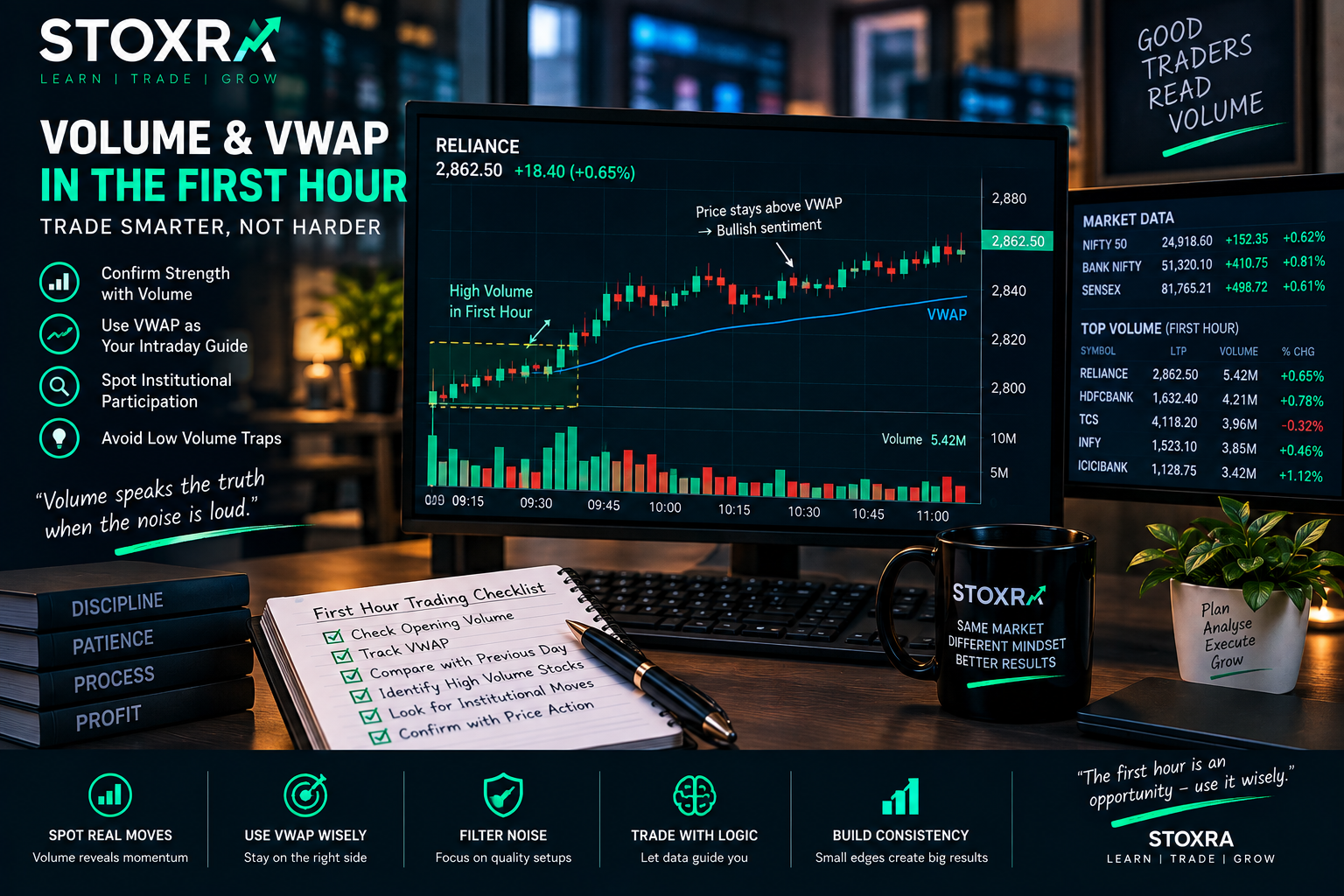
Volume can provide context for the strength of a move. A price breakout accompanied by increased participation may deserve closer attention than a breakout occurring with unusually weak activity. For additional context, see best intraday trading indicators.
Volume is not a prediction tool by itself. It should be interpreted with price structure, liquidity, market conditions and the specific strategy. A high-volume move can still fail.
Use VWAP as a Reference
Traders who use VWAP may monitor how price behaves around it during the first hour. Holding above, below or repeatedly crossing the reference can add context to the intraday picture. For additional context, see VWAP trading strategy for intraday traders.
VWAP should not be turned into an automatic signal. A trading decision should still consider structure, market conditions, confirmation and risk.

Check the Broader Market
Individual stocks are influenced by the broader market environment. Index movement can affect sentiment, liquidity and the probability that certain intraday moves continue or reverse. For additional context, see STOXRA's Sensex and Nifty market-opening analysis.
The broader market does not have to dictate every trade. It is an additional context layer. A trader should know whether the market is trending, ranging or unusually volatile before assigning too much confidence to an individual chart.
Check Sector Strength
Sector strength can provide useful context when selecting first-hour candidates. A stock showing strength while its sector is also active may deserve attention. A stock moving against its sector may also be interesting, but the reason for the divergence should be understood. For additional context, see open interest in intraday Nifty trading.
Check Relevant News and Catalysts
Company news, earnings developments, regulatory announcements, major orders, management updates and sector news can change first-hour activity. A catalyst may explain why volume and volatility are elevated. For additional context, see Q4 earnings trading signals.
The headline and the market reaction are not always the same. A positive announcement can be followed by selling, while negative information can sometimes be absorbed. Observe the actual price behaviour.
Important Note
A headline is not a guaranteed trading signal. News-driven markets can move quickly and may create wider spreads, fast reversals and execution challenges. Treat the catalyst as context and follow the predefined risk process.
Identify Relative Strength
Relative strength can help compare a stock's behaviour with a relevant benchmark or sector. A stock that remains strong while the broader market weakens may deserve attention, but it still needs a valid setup.
Avoid selecting a stock only because it is the day's biggest percentage mover. The move may already be extended or the logical stop may be too far away.
First-Hour Breakout Framework
A breakout framework begins with a clearly identified resistance area such as an opening-range high, previous-day high or another tested technical level. The trader then waits for the predefined confirmation.
- Mark the resistance area before or early in the session.
- Wait for price to approach the level.
- Observe volume and broader market conditions.
- Define the confirmation rule.
- Define invalidation before entry.
- Calculate position size from the acceptable risk.
- Enter only if all required conditions are satisfied.
First-Hour Breakdown Framework
A breakdown framework applies similar logic to support. A stock may be monitored as it approaches an opening-range low, previous-day low or another important support zone.
The trader should distinguish between a genuine breakdown and a temporary move below support. Confirmation, volume, market context and invalidation all remain important.
First-Hour Reversal Framework
A reversal scenario can develop when an early directional move fails to hold an important level. The trader should not assume every rejection will reverse the whole session. The setup must include a defined trigger and a logical invalidation point.
Reversal trades can be psychologically difficult because they may involve taking a position against recent momentum. A written plan can help prevent emotional decisions.
First-Hour Continuation Framework
Continuation refers to an initial directional move that develops a structure capable of supporting further movement. The trader should avoid assuming continuation solely because the opening candle was strong.
A continuation plan can require a pullback, consolidation, retest or another form of confirmation depending on the strategy.
How to Recognise a False Breakout
A false breakout occurs when price moves through a level but fails to sustain the move. The market may return inside the previous range or move sharply in the opposite direction.
False breakouts are particularly relevant during the opening session because volatility can be elevated. The trader should define what constitutes confirmation rather than treating every level crossing as a valid trade.
How to Use a Retest
Some trading strategies wait for a retest after a breakout. The price returns toward the broken level and the trader observes whether the former resistance behaves like support or the former support behaves like resistance.
A retest is not guaranteed. Waiting for it may mean missing a fast move, but if retests are part of the tested strategy, they can provide a clearly defined decision point.
Risk Management Before Entry
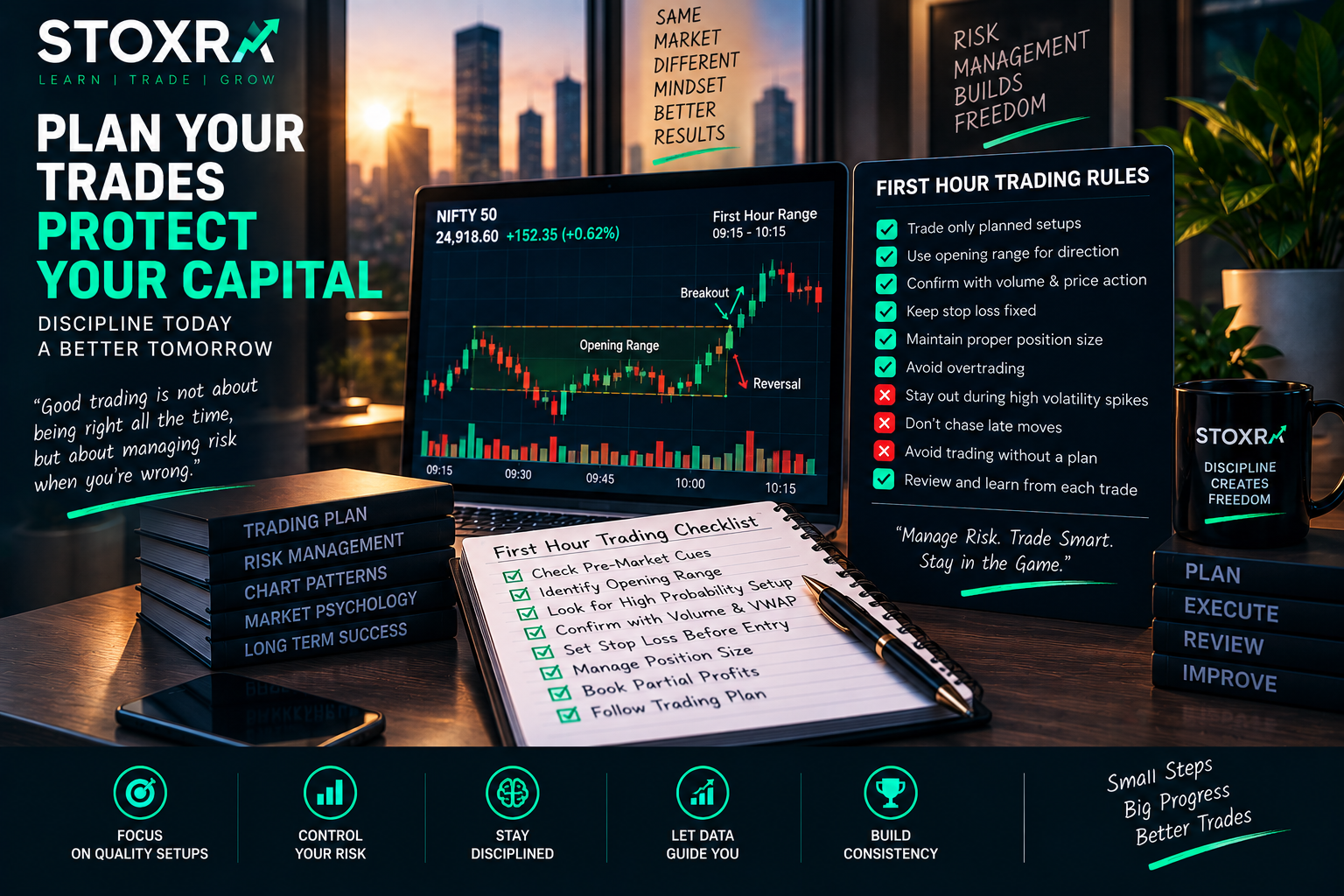
Risk management is essential because the first hour can produce rapid price changes. Before entering, determine the maximum acceptable loss, logical invalidation level and position size. For additional context, see intraday risk management for beginners.
A technically attractive stock is not automatically a suitable trade. If the stop required by the structure is too wide for the planned risk, the trader can reduce size or skip the trade.
How to Define a Logical Stop-Loss
A stop-loss should be connected to the reason for entering the trade. It can be placed beyond a structural invalidation area according to the strategy. The purpose is to define where the original idea is no longer valid.
Avoid moving the stop farther away simply because the market is approaching it. Doing so can change the original risk and make the trade inconsistent with the plan.
Position Sizing for First-Hour Trades
Position size should be adjusted to the distance between the entry and the logical invalidation point and to the amount of risk the trader is prepared to accept. A wider stop generally requires a smaller position if the risk amount remains fixed. For additional context, see position sizing for intraday trading.
This approach prevents the trader from choosing a large position first and then forcing the stop into an unrealistic location.
Plan the Exit Before Entry
An entry plan is incomplete without an exit plan. Before entering, consider where the trade may be reduced, where the setup becomes invalid and how profits or losses will be managed according to the strategy.
The exit method can be fixed-target based, structure based, trailing or another predefined approach. The important requirement is that the method is decided before emotions become involved.
Think About Risk-to-Reward
Risk-to-reward analysis can help determine whether the potential opportunity is worth considering. A theoretical reward that sits directly behind a major resistance area may not be realistic even if the mathematical ratio looks attractive. For additional context, see how much money to risk in options trading.
Consider actual market structure, volatility, liquidity and the distance to opposing levels. Risk-to-reward should support decision-making rather than become a justification for every trade.
When Should You Avoid First-Hour Trading?
There are many situations where waiting is more appropriate than trading. Examples include unclear structure, insufficient liquidity, extreme volatility, a move that is already extended, conflicting market conditions or an inability to define the risk.
No-Trade Rule
If the setup cannot be explained clearly, the invalidation level is uncertain or the required position size would exceed the risk plan, do not force the trade. A disciplined trader treats no-trade conditions as part of the strategy.
Common Mistake: Chasing the Opening Move
A sharp opening move can create fear of missing out. Traders may enter after the stock has already moved a large distance, leaving little room for a logical stop and increasing the probability of an emotionally driven entry.
Common Mistake: Trading Every Breakout
Price can cross a level without creating a sustained breakout. Trading every crossing can generate many low-quality positions. Confirmation rules should separate a valid setup from ordinary market noise.
Common Mistake: Ignoring Liquidity and Slippage
Expected entry and actual execution can differ, especially during fast conditions. A strategy should account for practical execution rather than assuming that every order will fill exactly where the trader expects.
Common Mistake: Moving the Stop After Entry
Moving a stop away from the invalidation point because a trader does not want to accept the planned loss changes the original risk. If the setup is invalid, the predefined plan should take priority over emotional discomfort.
Common Mistake: Revenge Trading After a Loss
A first-hour loss can create an urge to recover immediately. Taking an unrelated trade to recover the loss can turn one controlled outcome into a series of uncontrolled decisions. A daily loss limit can help create a hard boundary.
Use a Daily Loss Limit
A daily loss limit defines the maximum amount of risk or capital loss the trader is prepared to accept in one session. The specific limit should come from the trader's own risk-management framework. For additional context, see daily loss limit for intraday trading.
The important principle is consistency. The limit should not be increased during the session simply because the trader wants another opportunity to recover a previous loss.
How to Handle a Failed Trade
A failed trade should be treated as information rather than a reason to immediately reverse direction. Review what the original setup required, whether the rules were followed and whether the failure came from the market or from execution.
A losing trade can still be a good process decision if it followed the strategy and controlled risk. Conversely, a profitable trade can still be a poor process decision if it violated the rules.
How to Use the First Hour for Observation
Even when you do not trade, the first hour can provide valuable information. Observe which stocks are active, which sectors are strong, whether the market is trending or ranging and how price behaves around key levels. For additional context, see how to start algorithmic trading in India.
This observational approach can be especially useful for traders developing a new strategy. It allows them to study behaviour without automatically converting every observation into a position.
Build a Simple First-Hour Decision Process
For additional context, see AI trading platform guidance from STOXRA.
- Review the broader market before the open.
- Check sectors and relevant catalysts.
- Shortlist liquid candidates.
- Mark previous-day and pre-market reference levels.
- Observe the opening range.
- Wait for structure to develop.
- Compare price behaviour with volume.
- Define the setup and confirmation.
- Define invalidation and position size.
- Enter only when the complete plan is satisfied.
- Manage the position according to the written rules.
- Review the result after the session.
First-Hour Trading Routine Before the Open
A consistent routine can include reviewing major overnight developments, checking the market index environment, scanning sectors, identifying stocks with relevant catalysts, and marking important chart levels.
Write down the most important candidates rather than keeping every possible stock in view. For each candidate, identify the scenario that would make it interesting and the condition that would invalidate the idea.
First-Hour Routine at the Opening Bell
At the opening bell, focus on observation. Compare the opening price with the previous close and watch how price behaves around the levels prepared before the session. Avoid changing the entire plan because of one fast candle.
The goal is to collect enough information to determine whether a setup is developing. Patience can be a competitive advantage when the market is moving quickly.
First-Hour Routine After the Opening Range Forms
Once the predefined range has formed, compare its high and low with other important levels. Observe whether price is consolidating, breaking, rejecting or trending. Then evaluate volume and broader market context.
At this point, the trader should have a clearer understanding of whether the original watchlist candidates are still relevant. Remove candidates that no longer meet the criteria.
First-Hour Routine Before Entry
Before placing an order, perform a final checklist. Confirm the setup, entry condition, invalidation, position size, exit method and acceptable risk. If one of the critical components is missing, wait.
First-Hour Routine During the Trade
Once the trade is active, avoid turning every small price movement into a new decision. Follow the management rules that were defined before entry. If the market reaches the invalidation level, accept the planned outcome rather than changing the risk to avoid a loss.
First-Hour Routine After the Trade
Record the trade soon after it ends. Note the setup, market context, entry, stop, size, exit and whether the rules were followed. A journal should record process quality as well as financial outcome.
How to Journal First-Hour Trades
A useful journal can include the date, stock, opening condition, catalyst, market context, key levels, setup, confirmation, entry, invalidation, position size, exit and final result. Add a short note about the psychological state if emotions affected execution. For additional context, see how algorithmic trading bots work in India.
After enough observations, patterns may become visible. A trader may discover that certain setups perform better in trending markets, while other setups work poorly when the first hour is extremely volatile.
Review Strategy Performance Over a Sample
Do not evaluate a first-hour strategy using one trade. Review a meaningful sample and separate setup quality from execution quality. Ask whether the setup appeared as defined, whether the risk was controlled and whether the trade followed the rules. For additional context, see how algorithmic trading works in India.
Backtest Before Increasing Risk
Historical testing or paper trading can help a trader understand how a first-hour method behaves across different sessions. Include trending, ranging, volatile and event-driven conditions in the review. For additional context, see STOXRA Learn trading academy.
Backtesting does not guarantee future performance. Its purpose is to test whether the rules are sufficiently clear and to understand their historical behaviour before taking larger real-world risk.
Why Discipline Matters More Than Prediction
First-hour trading can make prediction feel especially important because price moves rapidly. However, no trader can know every outcome in advance. A disciplined process focuses on what can be controlled: selection, entry conditions, position size, stop placement, exit rules and daily risk. For additional context, see algorithmic trading vs manual trading.
How to Improve the Strategy Over Time
For additional context, see how AI is transforming stock market trading in India.
- Record every eligible setup, not only trades taken.
- Compare setup results across market conditions.
- Review whether volume added useful confirmation.
- Study false breakouts separately from valid breakouts.
- Check whether position size remained consistent with risk.
- Identify recurring execution mistakes.
- Change one rule at a time when testing improvements.
First-Hour Checklist for Intraday Traders
- Market context reviewed before the open.
- Sector context checked.
- Relevant company and market news checked.
- Liquid candidates selected.
- Previous-day high and low marked.
- Previous close marked.
- Opening range defined using a consistent rule.
- Volume evaluated in context.
- Price structure identified.
- Important support and resistance marked.
- Entry trigger defined.
- Confirmation defined.
- Invalidation defined.
- Position size defined from risk.
- Exit plan prepared.
- Daily loss limit respected.
- No-trade condition understood.
Frequently Asked Questions
Is the first hour always the best time to trade?
No. The first hour can have strong activity, but it can also have fast reversals and higher execution risk. Whether it is suitable depends on the trader's strategy, experience and risk-management process.
Should beginners trade immediately after the market opens?
Not necessarily. Beginners can first learn to observe opening behaviour, mark levels and practise a defined process before risking capital.
What is an opening range?
An opening range is a predefined early-session price range. Its high and low can be used as reference points for analysing potential breakouts, breakdowns and range behaviour.
Can an opening-range breakout guarantee profit?
No. Breakouts can fail. A trader should define confirmation, invalidation, position size and exit rules before entering.
Should VWAP be used during the first hour?
VWAP can provide useful intraday context for traders whose strategy includes it, but it should not be treated as a standalone guaranteed trading signal.
How does news affect the first hour?
News can increase attention, volume and volatility. The market response may still differ from the apparent meaning of the headline, so price behaviour and risk should be evaluated.
What should I do if the first-hour setup is unclear?
Wait or skip the trade. Not trading is a valid decision when the setup, confirmation or risk cannot be defined clearly.
How much should I risk on a first-hour trade?
There is no universal amount. Risk should come from the trader's own predefined risk-management plan and should remain consistent with position size and the logical invalidation level.
Conclusion
Learning how to trade the first hour of market open is not simply about finding the fastest-moving stock. It is about understanding the information contained in the opening session and converting that information into a structured decision process. Prepare before the market opens, identify liquid candidates, mark previous-day levels, understand the opening range, observe volume and price structure, and consider the broader market, sector and news environment.
The first hour can produce attractive opportunities, but it can also produce false breakouts, sudden reversals and difficult execution. A disciplined trader therefore treats entry and non-entry as equally valid decisions. If the setup is unclear or the risk cannot be controlled, waiting is part of the strategy.
The most important improvement comes from consistency. Use the same definitions, document the same information, control risk before entry and review a meaningful sample of results. Over time, this process can help a trader understand which first-hour conditions fit the strategy and which should be avoided.
Final Key Takeaway
Prepare before the open, observe before acting, wait for confirmation, size the position around risk, respect invalidation and accept no-trade situations. The goal is not to trade the first hour simply because it is active. The goal is to participate only when the market creates a setup that fits a disciplined, tested plan.
CTA — Continue Learning
Continue learning with STOXRA's practical intraday trading education, including stock selection, watchlist building and structured trading preparation.
Next Step: Explore Intraday Stock Selection Guide →
Disclaimer
This article is provided for educational and informational purposes only. It does not constitute investment advice, financial advice, trading advice or a recommendation to buy or sell any security, stock, option, derivative or other financial instrument.
Intraday trading involves market risk and can result in losses. Readers should conduct their own research, understand the risks involved and consider consulting a qualified financial professional where appropriate before making trading or investment decisions.