How to Use a Watchlist for Intraday Trading
Learn how to create an effective intraday trading watchlist, filter stocks, identify setups, use alerts and manage risk before entering a trade.
How to Use a Watchlist for Intraday Trading
An intraday trading watchlist is a focused collection of stocks or other tradable instruments that a trader plans to monitor during a market session. Instead of trying to follow the entire market at once, a watchlist helps narrow attention to candidates that meet predefined conditions such as liquidity, volume, volatility, catalysts, market context and technical structure.
For beginners, the purpose of a watchlist is not to create more trades. It is to create better focus. A stock can appear attractive on a scanner, move sharply during the session or become popular because of news, but none of those facts alone creates a valid trade. The trader still needs a defined setup, confirmation, risk limit and exit plan.
A well-organized watchlist therefore sits between market scanning and execution. It records why a stock is being watched, what level matters, what condition could trigger a setup and what event would invalidate the idea. This structure can reduce impulsive decisions and make the trading process easier to review.
What Is an Intraday Trading Watchlist?
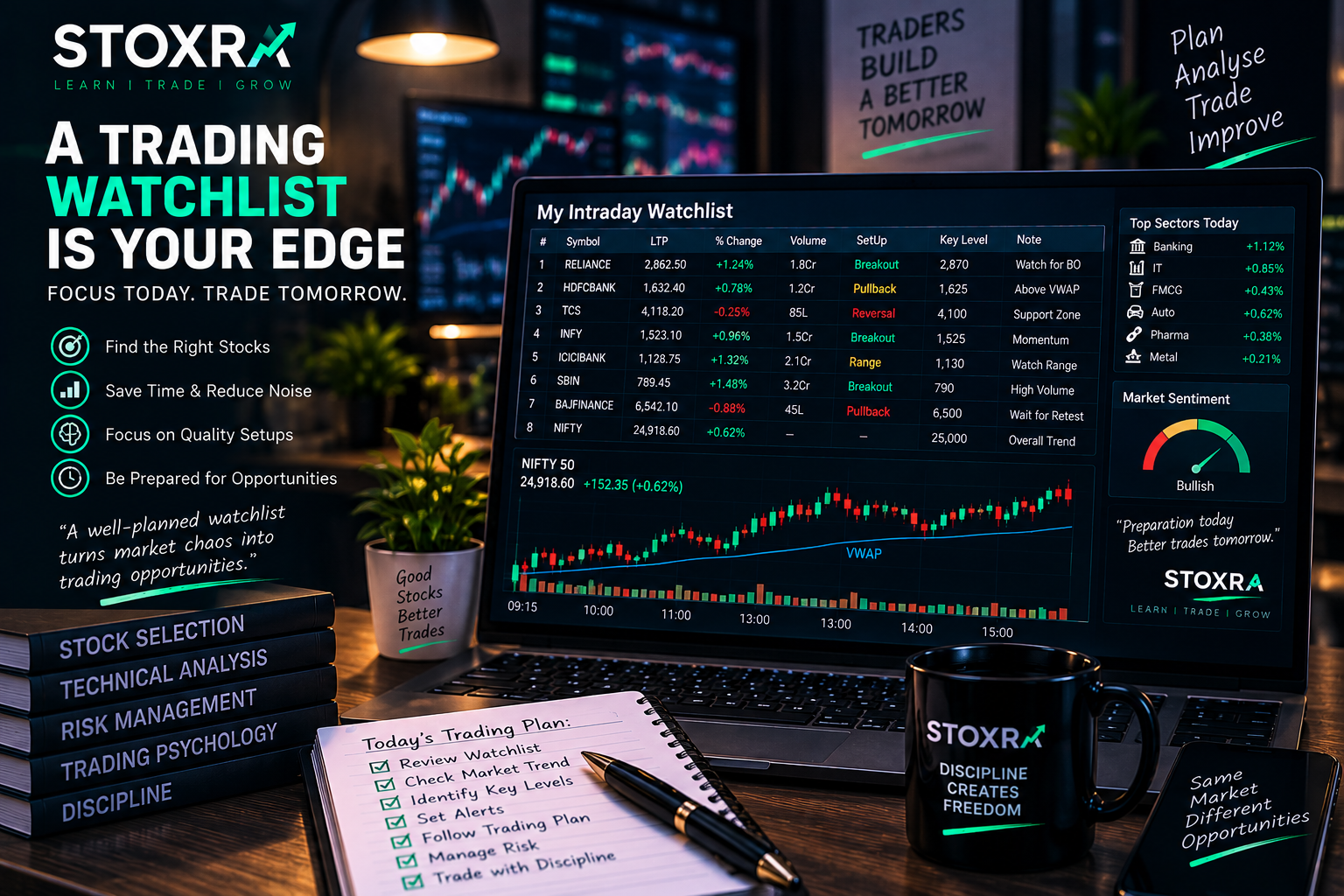
A watchlist is a shortlist of market candidates selected for active observation. It is different from a portfolio because the names on it do not necessarily represent long-term holdings. It is also different from a stock screener because the screener normally searches a larger universe, while the watchlist is the smaller group that deserves closer attention. For related reading, see What Is Technical Analysis In Stock Trading.
The information included should be useful for the strategy. A trader may track symbol, price change, volume, relative volume, gap percentage, sector, catalyst, previous-day levels, support, resistance, VWAP relationship, setup type, trigger, invalidation and status.
The exact columns are less important than consistency. If a field does not help the trader make or review a decision, it may add noise rather than value.
Why a Watchlist Matters for Intraday Traders
Intraday markets can move quickly, especially around the opening session and major news events. Without preparation, traders may jump from one chart to another, chase sudden price movement or spend valuable time searching for a new opportunity while the market is already moving.
A focused watchlist creates a smaller decision universe. The trader can concentrate on whether the selected candidate is actually behaving according to the plan.
- Reduces the number of charts that require constant attention.
- Creates a repeatable process for selecting candidates.
- Makes important technical levels easier to prepare in advance.
- Helps separate observation from actual trade execution.
- Makes post-market review more structured.
- Can reduce impulsive decisions caused by constant market scanning.
Key Takeaway
A watchlist is a filtering tool, not a guaranteed trading signal. The goal is to identify candidates worth monitoring and then wait for a complete setup.
Watchlist vs Stock Screener
A stock screener and a watchlist perform related but different jobs. A screener can scan a broad universe for conditions such as unusual volume, price movement, liquidity or technical characteristics. The watchlist then narrows the results to candidates that fit the trader's actual strategy.
For example, a trader may screen for liquid stocks with unusual participation. After reviewing the results, the trader can remove stocks with poor structure, excessive spread, unsuitable volatility or unclear catalysts. The remaining names become the focused watchlist.
This two-step process prevents the mistake of treating every scanner result as a trading opportunity.
How Many Stocks Should Be on an Intraday Watchlist?
There is no universal number. The appropriate list size depends on the trader's experience, screen setup, strategy, timeframe and ability to monitor several charts without losing focus.
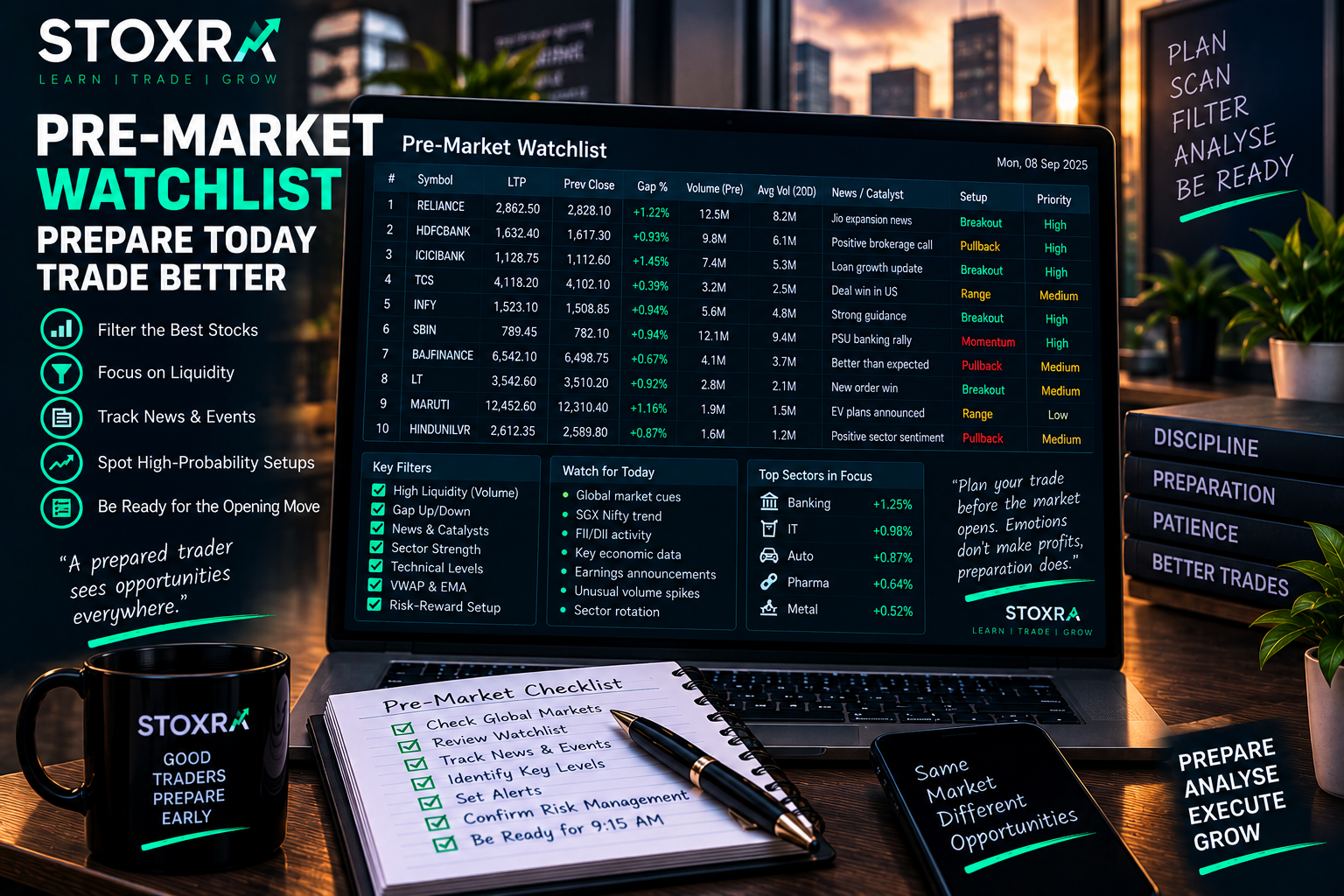
A beginner may start with a broader candidate pool before the open and then narrow it to a smaller primary list. An illustrative workflow might be 20 to 30 scanned candidates, approximately 8 to 12 reviewed closely and three to five primary candidates. These numbers are examples, not rules.
The useful test is whether the trader can explain why each primary candidate is present, what level matters and what condition would make the setup valid or invalid. For related reading, see How To Avoid Overtrading Intraday Trading.
The First Filter: Liquidity
Liquidity should be considered early because the ability to enter and exit a position matters as much as the theoretical setup. Thinly traded instruments may have wider spreads, abrupt price changes and less predictable execution.
Liquidity should also be judged relative to intended position size. A stock may appear sufficiently active for a very small trade but become less suitable when the order size is larger.
Do not select a stock only because its price is low or because it is moving rapidly. The quality of the trading environment matters more than the appearance of opportunity.
Pro Tip
Evaluate liquidity together with spread, normal trading activity, intended position size and the strategy's execution requirements. A visually active chart does not automatically mean practical execution.
The Second Filter: Volume and Relative Volume
Volume provides information about trading activity. Relative volume can help compare current participation with a reference level, making unusual activity easier to notice. For related reading, see Volatility Opportunities Smart Traders.
Volume is most useful when combined with price behavior. A large increase in volume during a clean breakout can tell a different story from large volume during a sharp rejection. The number itself does not determine direction.
A watchlist can therefore record both volume information and the interpretation of price behavior. Examples include volume expansion near resistance, high-volume rejection, breakout candidate or unusual activity without a defined setup.
The Third Filter: Volatility
Intraday traders generally need enough movement for a strategy to function, but excessive volatility can make stops, position sizing and execution difficult.
A stock with very little movement may not provide sufficient opportunity after costs and risk are considered. A stock with extremely fast movement may require a stop that is too wide for the trader's risk model.
The right question is not which stock has the highest volatility. The better question is whether the stock's typical movement is compatible with the planned entry, stop, target and position size. For related reading, see Actuaries Act Data Science Risk Management.
The Fourth Filter: Catalyst and News
A catalyst can explain why a stock has become active. Earnings, company announcements, sector developments, regulatory information, management commentary and broader economic events can all change participation. For related reading, see Q4 Earnings Key Trading Signals.
A catalyst can justify monitoring a stock, but it does not guarantee direction. News can create continuation, reversal, a gap, a range or unusually unpredictable conditions.
Record the catalyst briefly. The purpose of the watchlist is to provide context, not to become a complete news database.
Market and Sector Context
Individual stocks operate within a broader market environment. Index direction, sector strength and market-wide volatility can influence the quality of intraday setups. For related reading, see Sensex Nifty Market Opening Trends.
A stock showing relative strength while its sector is also strong may deserve closer attention than an isolated mover with no supporting context. Similarly, a weak stock in a weak sector may be relevant for a downside strategy.
Market context should remain a filter rather than an automatic trade signal. The stock still needs a valid setup and a defined risk plan.
Build the Pre-Market Candidate Pool
Preparation before the open can reduce the amount of searching required during the most active part of the session. Start with the market universe that normally fits the strategy, then identify unusual price movement, gaps, volume changes, catalysts and important technical levels.
The purpose is not to predict exactly what will happen. Instead, prepare conditional scenarios. For example, a candidate may be watched above a resistance level if confirmation appears, while a separate invalidation condition tells the trader when the original idea should be abandoned.
Writing conditions before the session can make it easier to distinguish a planned setup from an emotional reaction. For related reading, see How To Follow Trading Plan Without Breaking Rules.
Rank Candidates Before the Market Opens
Not every candidate deserves equal attention. Ranking can help identify primary and secondary names.
A simple ranking framework may consider liquidity, volume, catalyst relevance, trend clarity, technical levels, market alignment and risk compatibility. The score is a prioritization tool, not a prediction of success.
A lower-ranked stock can become important later if its setup improves. A highly ranked candidate can also be removed if the setup becomes invalid.
Create Useful Watchlist Columns
A watchlist should show information that can change a trading decision. Useful fields may include symbol, sector, percentage change, volume, relative volume, gap, catalyst, previous close, previous-day high, previous-day low, support, resistance, VWAP status, setup, trigger, risk and status. For a broader technology context, see STOXRA AI Trading Platform India.
Avoid filling the screen with every available indicator. More data does not automatically mean better decisions.
A compact example is: Symbol | Sector | Change | Volume | Catalyst | Key Level | Setup | Trigger | Risk | Status.
Mark Previous-Day High, Low and Close
Previous-day high, low and close are common reference points for intraday preparation. Marking these levels before the session can make the chart easier to interpret when price begins moving quickly.
These levels are areas of interest, not guaranteed turning points. Price can break through them, reject them or move around them depending on market conditions. For related reading, see Support Resistance Option Chain Data.
Keeping these references consistent across candidates can improve comparison between stocks.
Use the Opening Range
The opening range can provide a reference for the first part of an intraday session. The exact period used depends on the trader's method. For related reading, see Best Intraday Trading Indicators Used By Professional Traders In India 2026.
Once the range is defined, the high and low can be monitored for acceptance, rejection, breakout, retest and failed-breakout behavior.
The watchlist can record whether the stock remains inside the range, tests one boundary, breaks through it or returns back inside. The opening range itself is not a guaranteed trading signal.
Use VWAP as a Context Filter
VWAP can act as an intraday reference for evaluating price relative to a volume-weighted average. Some traders monitor whether price is above or below VWAP, while others study reclaim and rejection behavior.
A simple watchlist status such as Above VWAP, Below VWAP, Reclaiming VWAP or Rejecting VWAP can make comparison between candidates easier.
VWAP should be treated as context rather than a guaranteed buy or sell signal. For related reading, see VWAP Trading Strategy Beginners India Intraday.
Identify the Setup Type
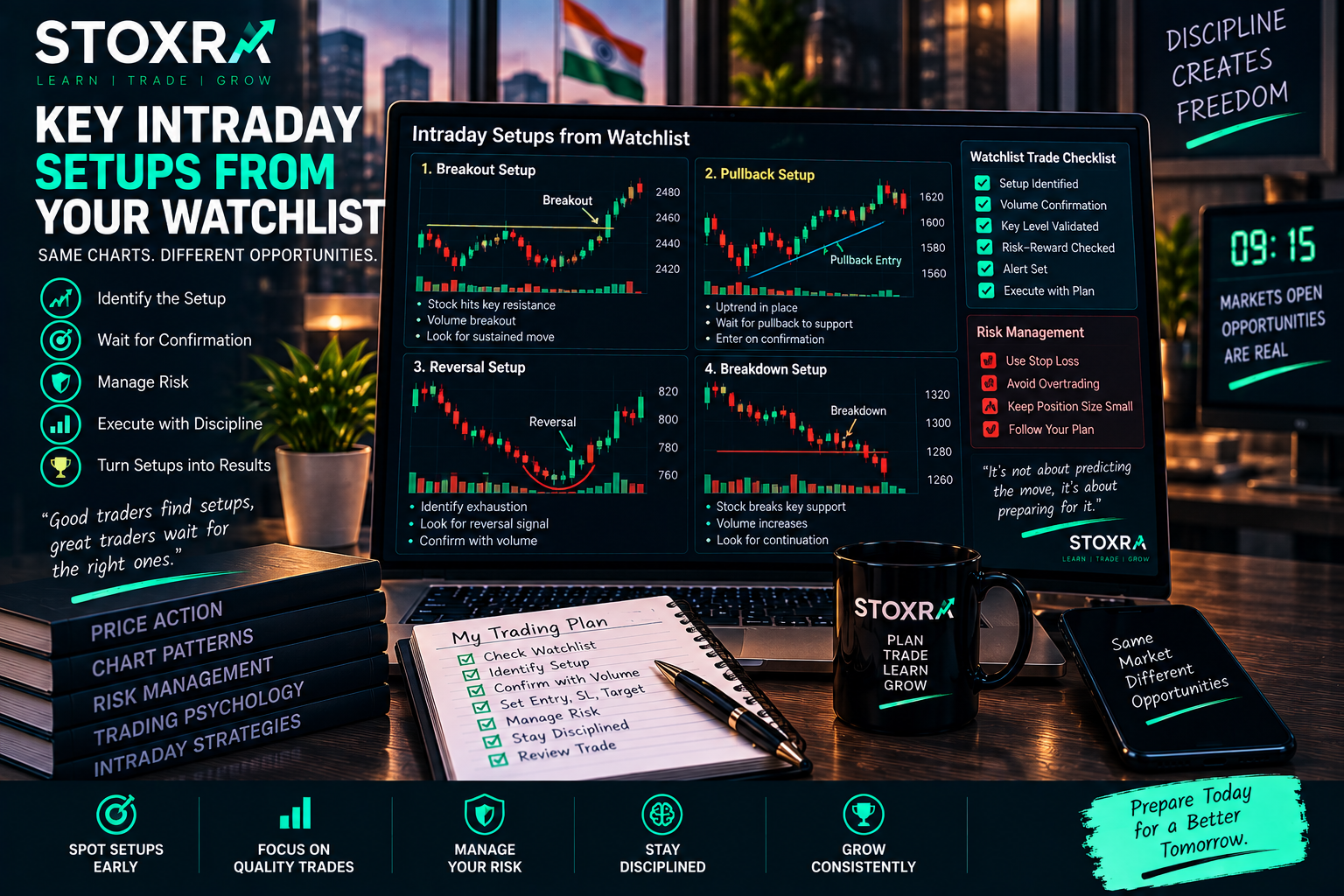
Every active candidate should have a reason for observation. Common intraday categories include breakout, breakdown, pullback, trend continuation, reversal, range expansion and failed breakout. For related reading, see How Algorithmic Trading Bots Work In India.
Naming the setup forces the trader to describe a condition rather than a feeling. Instead of saying that a stock looks strong, the trader can specify that it is a breakout candidate above a particular level with a required confirmation.
If the setup cannot be described clearly, the stock can remain in the observation group rather than being promoted to an execution candidate.
Breakout Watchlist Candidates
For a breakout candidate, identify the level that matters and define what confirmation should look like. The level could be a previous high, consolidation boundary, opening-range high or another relevant technical area.
The watchlist should also contain an invalidation condition because breakouts can fail. This keeps the trader aware of risk rather than focusing only on the expected direction.
Avoid chasing an extended move after the original entry condition has already passed. A retest or a completely new setup may be more appropriate if the strategy supports it.
Breakout Preparation Rule
Define the breakout level, confirmation condition, invalidation point and maximum acceptable risk before considering execution.
Breakdown Watchlist Candidates
A breakdown candidate is monitored around a support area or another level where weakness could become meaningful. Confirmation may include price acceptance below the level, participation, retest behavior or another predefined condition.
A temporary breach is not automatically a clean breakdown. The watchlist should distinguish between a possible breakdown, confirmed breakdown and failed breakdown.
The risk principle remains the same: define invalidation before entry and do not widen the planned risk simply because price moves against the idea.
Pullback and Trend-Continuation Candidates
A pullback can provide an opportunity to observe whether a previous trend remains intact after an initial directional move. Instead of chasing the first impulse, a trader can monitor whether price reacts at a meaningful area.
The watchlist can record trend direction, pullback area, confirmation trigger and invalidation point.
A pullback is not automatically a continuation. The required confirmation still needs to appear before execution.
Reversal Candidates
Reversal setups require caution because a strong trend can continue for longer than expected. A stock appearing extended does not by itself create a reversal signal.
A reversal candidate becomes more useful when a predefined condition such as rejection, failed continuation, level break or reclaim appears.
If that condition does not develop, the stock should remain a watch rather than becoming a forced trade.
How to Use Alerts Without Overtrading
Price alerts can reduce the need to stare at every chart. Useful alerts can be placed near planned trigger levels, important support or resistance, VWAP conditions or opening-range boundaries.
An alert should bring the trader back to the checklist. It should not automatically create an order. For related reading, see How Much Money Risk Options Trading.
Too many alerts can produce the same distraction as too many stocks. Use alerts only for conditions that matter to the strategy. For related reading, see AI Trading Platform Guide.
Separate Watch, Setup and Trade Status
A useful watchlist can use simple status labels. Watch means the candidate is interesting but has no complete setup. Setup means conditions are developing. Triggered means the predefined entry condition has occurred. Invalidated means the original thesis no longer applies.
These labels create a visible difference between observation and action. They also make the post-session review easier.
Status changes should be based on predefined conditions rather than the emotional desire to trade.
Risk Management Starts in the Watchlist
Risk management should begin before an order is placed. If a stock's normal movement makes the required stop incompatible with the trader's risk model, it may not belong in the active list. For related reading, see Intraday Risk Management Beginners India.
For every potential trade, identify the entry condition, invalidation point, position-size limit and exit logic.
Important Risk Reminder
A catalyst, high volume or strong price movement does not justify unlimited risk. The candidate must still fit the predefined position-size and loss limits.
Fast markets can produce slippage and execution differences. A planned stop should be understood as part of a risk framework, not as a guarantee of an exact fill.
No-Trade Rule
Do not promote a watchlist candidate to a trade when the setup, trigger, invalidation point, liquidity or risk limit is unclear. Staying out is a valid decision when the checklist is incomplete.
Position Sizing and Watchlist Selection
Position size should be linked to the distance between the intended entry and the logical stop. A stock can look attractive but become unsuitable if the stop required by the structure is too wide for the account's risk limit. For related reading, see Position Sizing Intraday Trading Beginners.
A simplified educational concept is: Position Size = Maximum Acceptable Trade Risk ÷ Risk Per Share.
For example, if the maximum planned trade risk were ₹1,000 and the planned risk per share were ₹20, the theoretical position size would be 50 shares before considering brokerage, taxes, slippage and other costs.
The calculation is a framework, not a guarantee of actual loss or execution.
When to Remove a Stock From the Watchlist
A stock should be downgraded or removed when the reason for monitoring it disappears. Examples include a broken setup, unsuitable liquidity, a major market-context change, an unexpected event, excessive movement away from the planned entry or a risk profile that no longer fits the strategy.
Removing a candidate is part of disciplined filtering. Keeping invalidated names active can encourage confirmation bias because the trader may continue searching for reasons to enter.
Common Watchlist Mistakes
1. Creating an Extremely Large List
A list containing dozens or hundreds of active candidates may look comprehensive but can become difficult to monitor. The trader may end up reacting to whichever chart moves most visibly.
2. Selecting Only the Biggest Movers
Large percentage changes can attract attention, but a large move does not automatically mean a clean setup. Liquidity, structure, volatility and risk still matter.
3. Adding Every News-Driven Stock
News can explain activity but can also create unpredictable conditions. The catalyst should be considered alongside execution quality and the actual setup.
4. Using Too Many Indicators
A crowded chart can make the decision process slower. Indicators should support a defined framework rather than replace one.
5. Chasing After the Trigger Has Passed
If the planned entry has already moved far away, forcing an entry can produce a poor risk-reward profile. Waiting for a new setup can be more disciplined.
6. Keeping Invalidated Candidates Active
When the original thesis fails, the candidate should be clearly marked so that the trader does not unconsciously keep searching for confirmation.
How Beginners Can Build a Simple Daily Routine
Before the market opens, review the broad market, identify active sectors, scan for candidates and note important catalysts. Mark previous-day levels and identify potential setups.
During the opening phase, observe how the candidates behave rather than forcing immediate entries. Remove weak candidates and promote only those that meet the predefined conditions.
As the session develops, update status labels, monitor important levels and verify risk before execution.
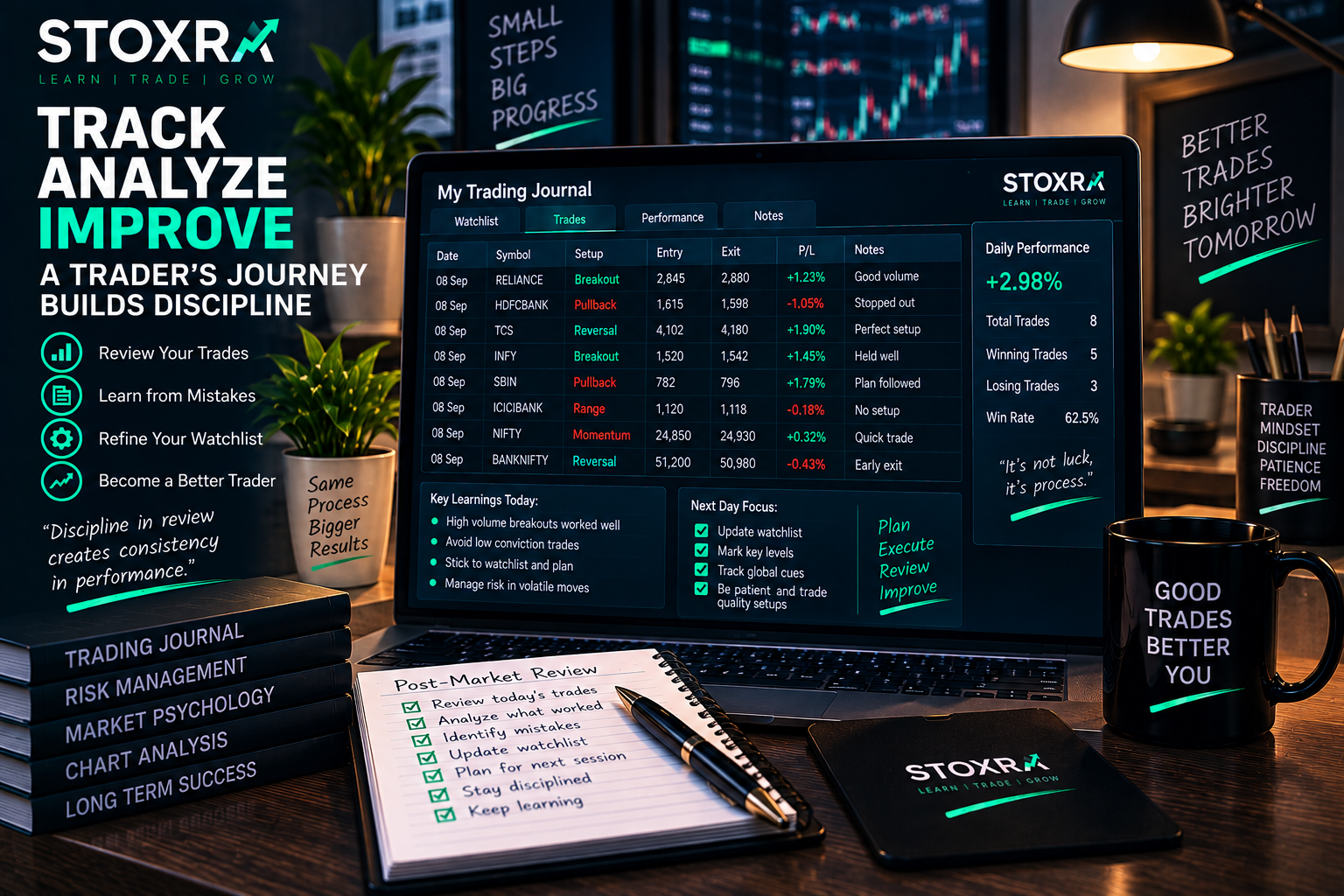
After the market closes, review both trades and candidates that were not traded. This helps distinguish a poor trade from a good decision to stay out. For related reading, see Daily Loss Limit Intraday Trading Beginners.
Watchlist Review and Trading Journal
A journal can record why a stock was selected, what setup was expected, what actually happened, whether the trigger occurred, how the market behaved and whether the trader followed the plan. For related reading, see STOXRA Learn.
Over a meaningful sample, this record can reveal which filters are useful and which create unnecessary noise.
Do not redesign the watchlist after every winning or losing trade. Process improvements are more reliable when they are based on repeated observations.
A Practical Intraday Watchlist Example
Imagine a trader beginning the morning with 25 liquid candidates. After reviewing catalysts, sector participation and unusual activity, the group is reduced to 12. Technical levels and risk compatibility reduce it further to eight.
Four candidates become the primary list and four remain secondary. During the opening phase, one candidate loses its important level and is marked invalidated. Two remain in setup-forming status. Another reaches the level but does not produce the required confirmation.
Later, one primary candidate develops the complete setup. The trader executes according to the predefined risk plan. The other candidates are not traded.
This illustrates an important point: a successful watchlist does not need every stock to produce a trade. Its value comes from organizing attention and making the decision to trade or not trade more systematic.
How to Improve Watchlist Quality Over Time
Review which filters appeared in your strongest setups and which appeared repeatedly in weak or avoidable trades. Useful review categories include liquidity, volume, catalyst, sector, technical level, time of day, setup type and execution quality. For related reading, see How AI Is Transforming Stock Market Trading India.
Make changes gradually. Adding many filters at once makes it difficult to determine which change actually improved the process.
The best watchlist is usually simple enough to understand quickly and detailed enough to support consistent decisions.
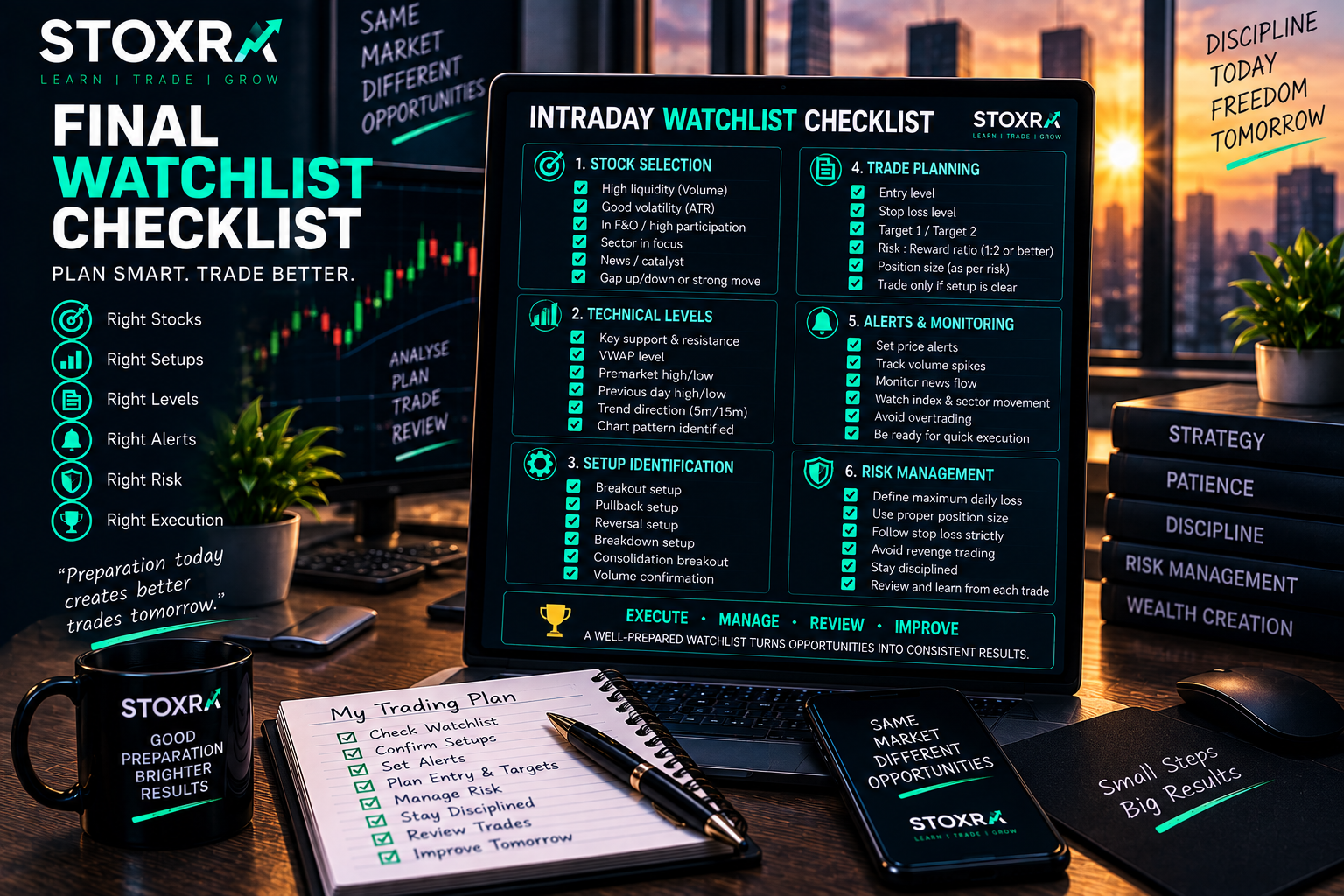
A Complete Intraday Watchlist Checklist
- Is the broader market context understood?
- Which sectors show meaningful strength or weakness?
- Does the candidate meet the required liquidity standard?
- Is participation or volume relevant to the setup?
- Is the volatility compatible with the strategy?
- Is there a clear catalyst or reason for unusual activity?
- Are previous-day high, low and close marked?
- Are important support and resistance levels marked?
- What is the setup type?
- What exact condition would trigger the setup?
- What condition would invalidate it?
- Where is the logical stop?
- What position size is compatible with the risk limit?
- What is the planned exit logic?
- Has the original setup already moved too far to chase?
Final Watchlist Review Before Execution
Before entering a trade, pause and confirm that the candidate still satisfies the original selection criteria. Check whether the market context has changed, whether the setup remains valid, whether the trigger actually occurred and whether the stop and position size still fit the plan.
This final review is particularly important during fast market conditions. A watchlist should make execution more disciplined, not create pressure to trade simply because a stock has reached the top of the list. For related reading, see West Asia Conflict Economic Risks RBI Bulletin.
Execution Checklist
Confirm setup, trigger, invalidation, stop, position size and exit logic before execution.
If any essential condition is missing, keep the candidate in observation status rather than forcing a trade.
Key Takeaway
Key Takeaway
A strong intraday watchlist is not the list with the most stocks. It is the list that produces the clearest decisions.
Start with liquidity and participation, add catalysts and market context, mark important levels, classify the setup, define the trigger and invalidation point, and keep risk visible before execution.
The objective is not to trade every candidate. The objective is to recognize when a candidate genuinely fits the plan and to remain comfortable doing nothing when it does not.
Frequently Asked Questions
What is the main purpose of an intraday watchlist?
Its main purpose is to narrow the market into a manageable group of candidates that deserve focused observation based on predefined criteria.
How many stocks should a beginner keep on a watchlist?
There is no fixed number. Beginners may benefit from a smaller focused list that they can monitor properly rather than a large list that creates information overload.
Should every stock on the watchlist be traded?
No. A watchlist identifies candidates. A trade should only be considered when the candidate meets the predefined conditions of the strategy.
What filters are useful for an intraday watchlist?
Liquidity, volume, volatility, catalysts, market and sector context, price structure, key levels and risk compatibility are useful starting filters.
Is high volume enough to select an intraday stock?
No. High volume indicates participation but does not guarantee direction or a valid setup. It should be evaluated with price action, structure and risk.
Can VWAP be used as a watchlist filter?
Yes. VWAP can provide intraday context, such as whether price is above, below, reclaiming or rejecting the reference. It should not be treated as a guaranteed signal.
When should a stock be removed from the watchlist?
It should be downgraded or removed when the original reason for monitoring it is invalidated or when its liquidity, structure or risk profile no longer fits the plan.
Can a watchlist guarantee intraday profits?
No. A watchlist can improve organization and consistency, but it cannot remove market uncertainty or guarantee returns.
Conclusion
Learning how to use a watchlist for intraday trading is about building a repeatable process rather than searching for a perfect list of stocks. Begin with a broad scan, apply liquidity and activity filters, review catalysts and sector context, mark important technical levels and reduce the market to a small number of candidates.
The watchlist should guide observation instead of forcing action. Breakouts, breakdowns, pullbacks, reversals and continuation setups should be considered only when the conditions defined by the strategy appear.
Risk should remain visible from selection through execution. Before a candidate becomes a trade, the trader should know the trigger, invalidation point, position-size limit and exit logic. After the session, reviewing both traded and untraded candidates can show whether the selection process is actually helping.
CTA — Continue Learning
Want to continue building your intraday trading knowledge? Explore the STOXRA guide on the first hour of market open.
CTA: Continue Learning — How to Trade the First Hour of Market Open →
Disclaimer
This article is provided for educational and informational purposes only. It does not constitute investment advice, financial advice, trading advice or a recommendation to buy or sell any security, stock, option, derivative or other financial instrument.
Intraday trading involves market risk and can result in losses. Readers should conduct their own research, understand the risks involved and consider consulting a qualified financial professional where appropriate before making trading or investment decisions.