In the Money vs Out of the Money Options Explained
Learn the difference between in-the-money (ITM), at-the-money (ATM) and out-of-the-money (OTM) options with simple call and put examples, intrinsic value, premiums, breakeven and risk.
Start Here: Stoxra Options & Trading Resources
If you have ever opened an option chain and wondered why one strike is called ITM, another is ATM, and another is OTM, you are looking at the concept of moneyness. Moneyness tells you how an option's strike price compares with the current price of the underlying asset.
It sounds simple, but understanding it properly matters because moneyness affects an option's intrinsic value, premium, breakeven, probability profile and sensitivity to the underlying market. A common beginner mistake is to assume that a cheaper OTM option is automatically a better opportunity. It is not.
In this guide, we will break down In the Money (ITM), At the Money (ATM) and Out of the Money (OTM) options using simple call and put examples. We will also connect moneyness with option Greeks, time decay, implied volatility, option-chain analysis and risk management.
1. What Does “Moneyness” Mean in Options?
Moneyness is simply a way of describing where an option sits relative to the current market price of its underlying asset.
Suppose a stock is trading at ₹1,000. An option with a strike of ₹900, ₹1,000 or ₹1,100 will have a different moneyness classification depending on whether it is a call or a put.
ITM
In the Money. The option currently has intrinsic value.
ATM
At the Money. The strike is approximately equal to the underlying price.
OTM
Out of the Money. The option currently has no intrinsic value.
The important part is that the classification is different for calls and puts. This is where many beginners get confused.
2. ITM vs OTM for Call Options
A call option generally benefits when the underlying price rises. Therefore, a call becomes more valuable when the spot price moves above its strike price.
| Call Type | Relationship | Intrinsic Value |
|---|---|---|
| ITM Call | Spot Price > Strike Price | Positive |
| ATM Call | Spot Price ≈ Strike Price | Approximately zero |
| OTM Call | Spot Price < Strike Price | Zero |
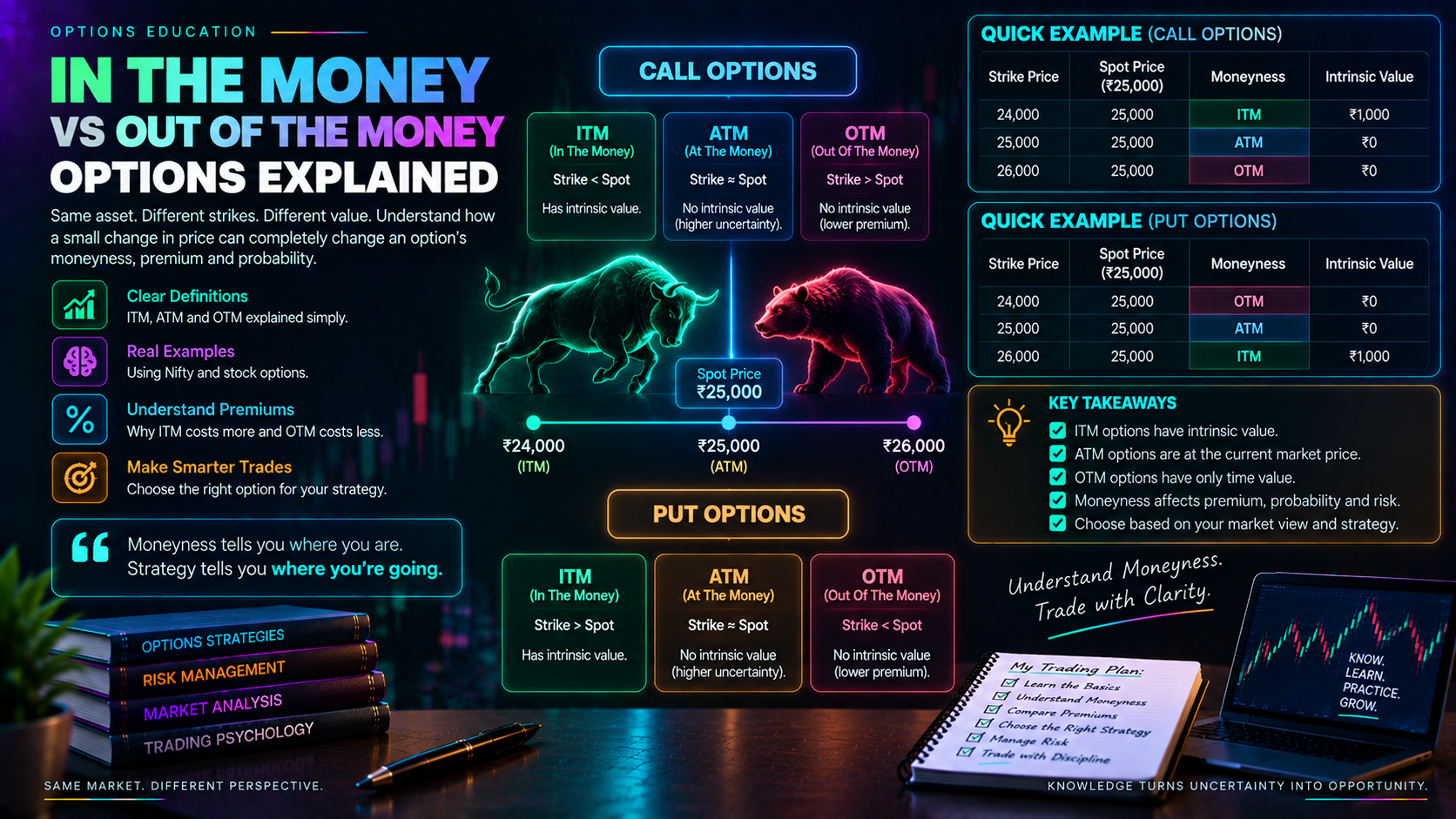
Example: Nifty at ₹25,000
Imagine Nifty is trading around 25,000.
- 24,000 Call → ITM
- 25,000 Call → approximately ATM
- 26,000 Call → OTM
Why? Because a 24,000 call gives the holder the right to buy at 24,000 while the market is at 25,000. That difference creates intrinsic value.
For the hypothetical 24,000 call:
The 26,000 call, however, has no intrinsic value while Nifty is at 25,000.
3. ITM vs OTM for Put Options
Put options work in the opposite direction. A put generally becomes more valuable when the underlying price falls.
| Put Type | Relationship | Intrinsic Value |
|---|---|---|
| ITM Put | Strike Price > Spot Price | Positive |
| ATM Put | Strike Price ≈ Spot Price | Approximately zero |
| OTM Put | Strike Price < Spot Price | Zero |
With Nifty at ₹25,000:
- 26,000 Put → ITM
- 25,000 Put → approximately ATM
- 24,000 Put → OTM
Therefore, a 26,000 put with Nifty at 25,000 has hypothetical intrinsic value of ₹1,000.
4. What Is an ATM Option?
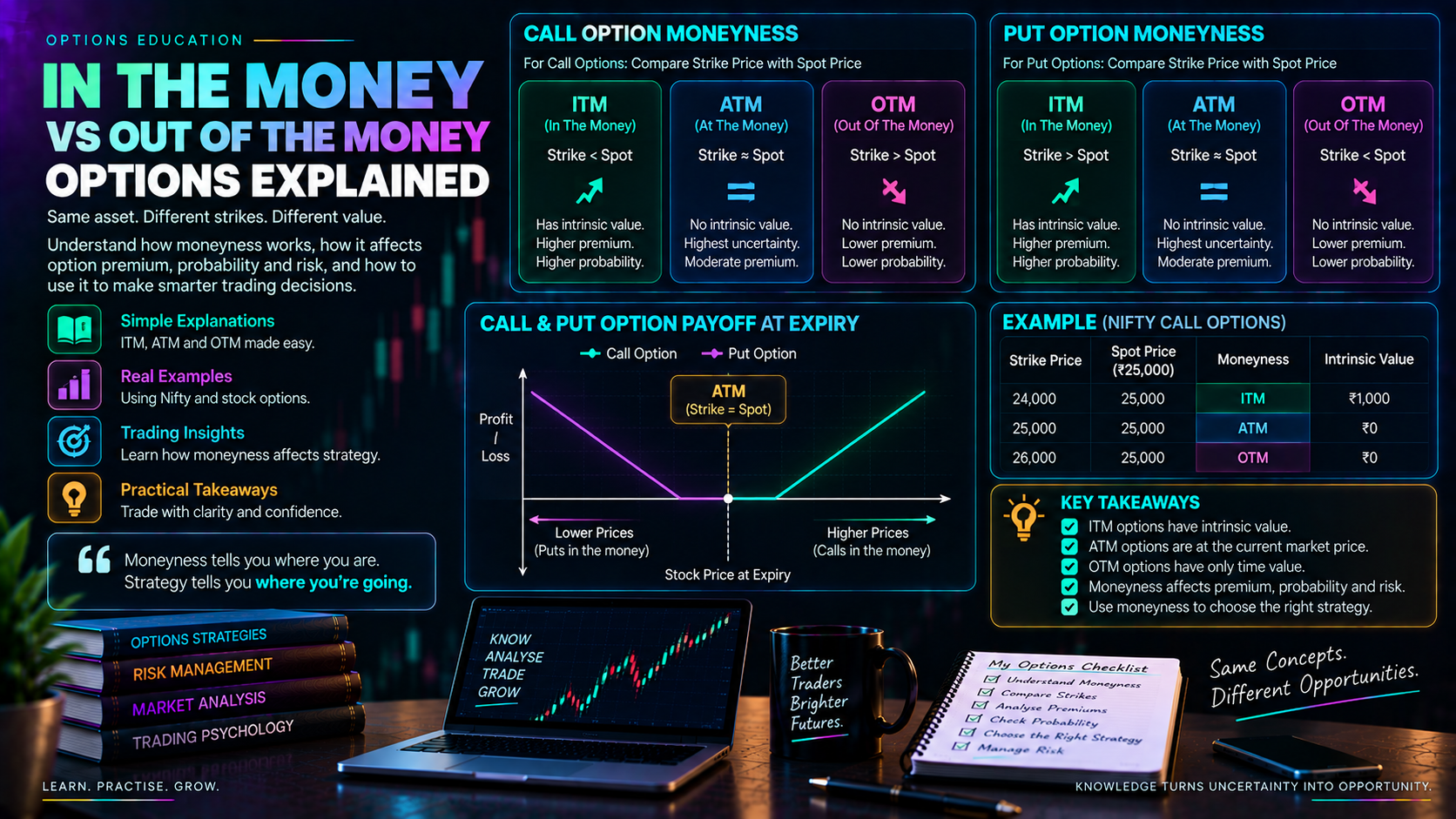
ATM means At the Money. An option is considered ATM when its strike price is approximately equal to the current underlying price.
If Nifty is around 25,000, the 25,000 strike is the obvious ATM reference point. In real markets, the exact ATM strike can depend on the available strike intervals and the underlying's current price.
ATM options are particularly important because several option sensitivities can become significant around this region. For example, gamma is commonly highest near ATM, especially as expiration approaches.
If you want to understand that relationship more deeply, see our guide on how to read Delta, Gamma, Theta and Vega .
5. Intrinsic Value vs Time Value
One of the most important concepts for understanding ITM and OTM options is the difference between intrinsic value and time value.
Intrinsic Value
The amount by which an option is currently in the money.
ITM options have intrinsic value.
Time Value
The part of an option premium beyond its current intrinsic value.
It reflects remaining time and uncertainty, among other factors.
An OTM option has zero intrinsic value, so its premium is entirely composed of time value while it remains OTM.
This is one reason OTM options can appear inexpensive. But remember: cheap premium does not mean cheap risk.
Time value is closely connected with expiration and theta decay . As expiration gets closer, an OTM option can lose value rapidly if the underlying does not move sufficiently in its favor.
6. Why Are OTM Options Cheaper?
OTM options generally have no intrinsic value. Their premium represents the market's pricing of the possibility that the option could become valuable before expiration.
Consider two hypothetical Nifty call options when Nifty is at 25,000:
| Strike | Moneyness | Intrinsic Value | Hypothetical Premium |
|---|---|---|---|
| 24,000 Call | ITM | ₹1,000 | ₹1,150 |
| 25,000 Call | ATM | ₹0 | ₹300 |
| 26,000 Call | OTM | ₹0 | ₹90 |
The numbers above are purely illustrative. They are not market quotes or trade recommendations.
The important lesson is that the ₹90 OTM call is not necessarily “better” than the ₹1,150 ITM call. They represent very different payoff profiles and probabilities.
7. Deep ITM, Near ITM, ATM and Deep OTM
Moneyness is not simply a three-box classification. An option can be slightly ITM or extremely ITM. The same applies to OTM options.
Deep ITM
The underlying is substantially beyond the strike in the option's favorable direction.
Near ITM
The underlying is only moderately beyond the strike.
ATM
Strike and spot are approximately aligned.
Deep OTM
The underlying would need a much larger move for the option to become ITM.
This distinction matters because the further an option moves away from ATM, the different its sensitivity and payoff characteristics can become.
8. ITM vs OTM: Which Has Higher Probability?
In general, an ITM option is closer to or already beyond the strike required for intrinsic value than an OTM option. That often gives an ITM option a more favorable probability profile for finishing ITM than a comparable OTM option.
However, probability should never be treated as a guarantee. Market-implied probabilities can change with volatility, time to expiration, interest rates, dividends and the underlying's price.
Delta is sometimes used as a rough probability proxy in educational discussions, but delta is not literally the probability that an option will finish ITM.
For a deeper understanding, study option Greeks alongside implied volatility .
9. ITM vs OTM and Option Premium
Moneyness is one of several factors that influence an option's premium. Other important inputs include time to expiration and implied volatility.
This means you should not look at strike price in isolation.
| Factor | Why It Matters |
|---|---|
| Moneyness | Determines intrinsic value and position relative to spot. |
| Time to Expiry | More time can provide more opportunity for movement. |
| Implied Volatility | Higher expected uncertainty generally increases option premiums. |
| Underlying Price | Changes the option's moneyness and intrinsic value. |
| Rates / Dividends | Can also affect theoretical option pricing. |
10. How Theta Changes the ITM/OTM Picture
Time is one of the most important forces affecting an option. An option has a finite expiration date, and its remaining time has economic value.
Theta measures the sensitivity of an option's theoretical value to the passage of time, holding other inputs constant.
OTM options can be especially dangerous for short-term buyers because they may need the underlying to make a sufficiently large move before expiration.
If that move does not happen quickly enough, the option can lose a large percentage of its premium.
Read our dedicated guide: What Is Theta Decay in Options Trading?
You can also learn why the final days around expiry can be especially important in how options expiry affects stock prices .
11. ITM, ATM and OTM on the Option Chain
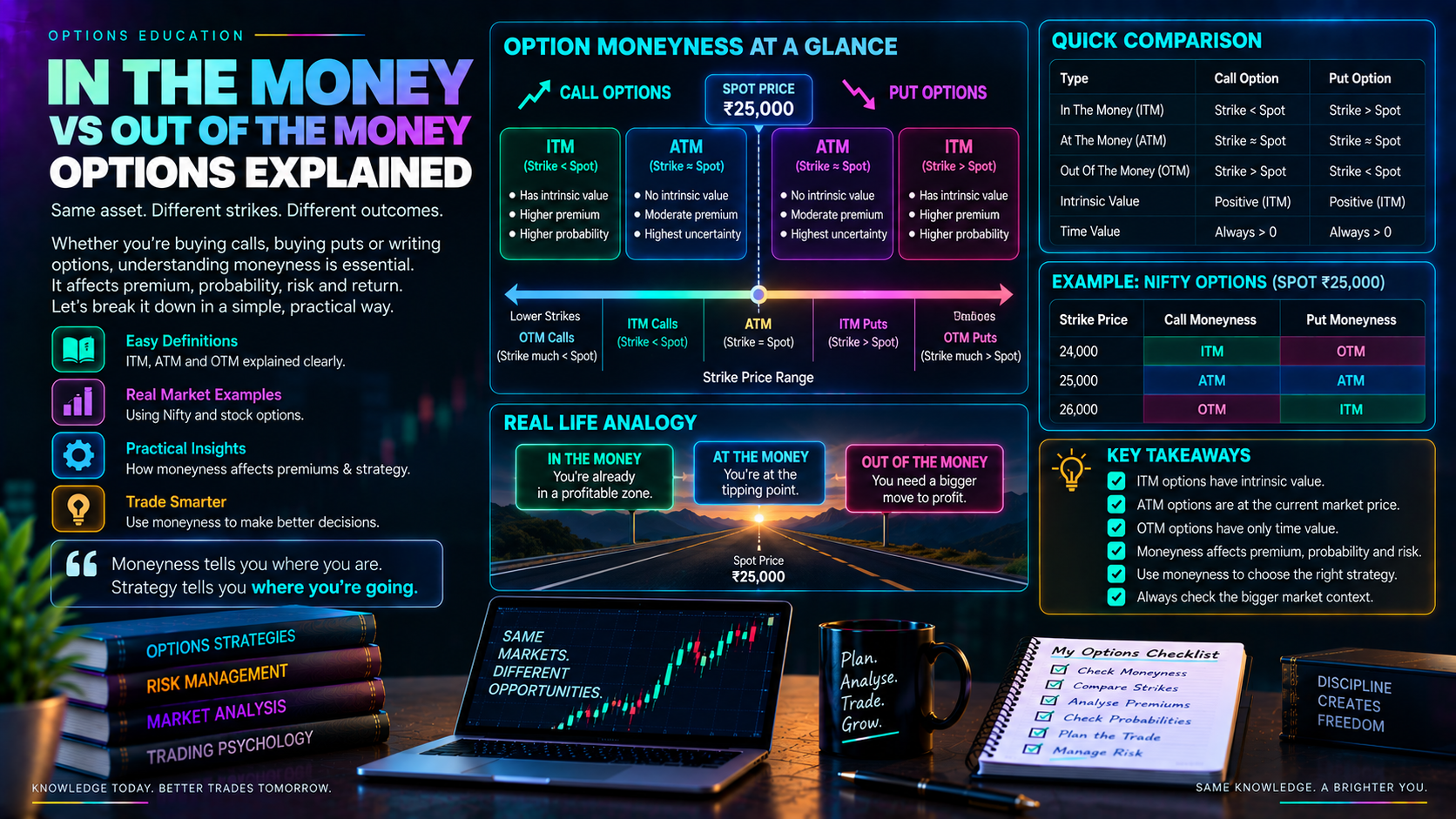
When you open an option chain, you should immediately connect three pieces of information:
- Current underlying or spot price.
- Strike price.
- Whether the call or put is ITM, ATM or OTM.
Once you understand moneyness, option-chain analysis becomes much easier. You can then add open interest, volume, implied volatility and Greeks to the analysis.
Start with our guides on reading the Nifty option chain and using option-chain data for Nifty trading .
For Bank Nifty traders, see how to read the Bank Nifty option chain intraday .
You can then explore Put-Call Ratio , Max Pain and support and resistance using option-chain data .
12. Breakeven: ITM Does Not Automatically Mean Profit
This is another critical distinction.
An option can be ITM and the buyer can still be losing money overall. Why? Because the buyer paid a premium.
Call Option Breakeven
Put Option Breakeven
Consider a hypothetical 25,000 call purchased for ₹200.
The breakeven at expiry would be:
If Nifty is at 25,100 at expiry, the call is technically ITM by ₹100, but the buyer has paid ₹200 for the option. Ignoring transaction costs, that would still represent a ₹100 loss at expiry.
13. Why “Cheap OTM Options” Can Be a Trap
One of the most common beginner errors is scanning an option chain, seeing a ₹20 or ₹30 option and thinking: “This is cheap. If the market moves, I can make 5x.”
The problem is that the market does not owe that option a large move. The underlying must move enough, and often quickly enough, to overcome the option's pricing and time decay.
An OTM option can therefore have a low premium but a very low chance of producing the desired payoff within the remaining time.
This is why position sizing and risk management matter more than simply picking the cheapest strike.
Read: options risk management for beginners and how much money you should risk in options trading .
14. ITM vs OTM for Different Strategies
Moneyness can influence how traders construct strategies, but the right strike depends on the strategy objective.
Buying Calls
Traders may compare ITM, ATM and OTM calls based on cost, delta, probability, leverage and expected movement.
Buying Puts
The same analysis applies to puts, particularly when considering downside protection or bearish exposure.
Vertical Spreads
Different strikes can deliberately combine ITM and OTM options to define risk and reward.
Butterfly Spreads
Multiple strikes are used to create a defined payoff around a targeted price region.
If you want to explore one of those structures, read our butterfly spread guide .
For protective strategies, see Protective Put Strategy Explained .
15. How Greeks Behave Across Moneyness
Moneyness and option Greeks are closely related. Understanding this relationship can help you move beyond simply looking at premium prices.
| Greek | Typical Moneyness Relationship | What It Helps Explain |
|---|---|---|
| Delta | Generally higher magnitude for ITM options | Directional sensitivity |
| Gamma | Often highest near ATM | Change in delta |
| Theta | Often significant near ATM, especially near expiry | Time decay |
| Vega | Often most relevant around ATM for longer-dated options | Volatility sensitivity |
These are general relationships rather than fixed rules. Expiration, volatility and other pricing inputs can materially change the actual Greek values.
For a complete beginner framework, use Stoxra's options Greeks guide .
16. A Simple Nifty Moneyness Example
Assume the Nifty spot price is ₹25,000.
| Strike | Call | Put | Call Intrinsic | Put Intrinsic |
|---|---|---|---|---|
| 24,000 | ITM | OTM | ₹1,000 | ₹0 |
| 25,000 | ATM | ATM | ₹0 | ₹0 |
| 26,000 | OTM | ITM | ₹0 | ₹1,000 |
This table is the easiest way to remember the entire concept.
For calls, lower strikes are more likely to be ITM when spot is fixed. For puts, higher strikes are more likely to be ITM.
Interactive Moneyness Calculator
Enter a spot price and strike price to identify whether the option is ITM, ATM or OTM. This is an educational calculator, not a trading signal.
17. Moneyness Is Not a Trading Signal
This deserves its own section because it is where educational concepts often get misused.
Saying that an option is ITM does not mean “buy it.” Saying that an option is OTM does not mean “avoid it.” Saying that an option is ATM does not mean “best risk/reward.”
Moneyness is a classification. A trading decision requires a broader framework involving market direction, volatility, time horizon, liquidity, risk tolerance, position size, strategy construction and exit planning.
Before entering any options trade, understand how to enter an options trade and equally importantly, how to exit without panic .
18. Common ITM and OTM Mistakes Beginners Make
1. “OTM Is Cheap”
Low premium does not mean low risk. The option can still expire worthless.
2. “ITM Means Profit”
An ITM option can still lose money if its intrinsic value does not exceed the premium paid.
3. Ignoring Expiry
The same strike can behave very differently with one day versus several months remaining.
4. Ignoring Volatility
Premium depends on more than strike and spot price.
5. Ignoring Position Size
A correct directional view can still produce unacceptable losses if the position is oversized.
6. Chasing Far OTM Options
Large percentage returns look attractive, but the probability and timing requirements can be demanding.
More beginner mistakes are covered in Options Trading Mistakes Beginners Make and Options Entry and Exit Mistakes .
19. A Better Way to Choose an Option Strike
Instead of starting with “Which option is cheapest?”, start with a structured process.
- Identify the underlying you want to trade.
- Determine the market thesis and expected direction.
- Check the current spot price.
- Compare available strikes and classify them as ITM, ATM or OTM.
- Compare premiums.
- Check implied volatility and liquidity.
- Review Delta, Gamma, Theta and Vega.
- Calculate the potential breakeven.
- Define the maximum acceptable loss.
- Decide the exit before entering.
This process is much stronger than selecting a strike simply because its premium is ₹20, ₹50 or ₹100.
If you need practice before risking capital, explore paper trading vs real trading and paper trading tools for options .
20. ITM vs OTM: Quick Comparison
| Feature | ITM | ATM | OTM |
|---|---|---|---|
| Intrinsic Value | Yes | Approximately zero | No |
| Premium | Generally higher | Moderate | Generally lower |
| Probability Profile | Generally higher chance of finishing ITM | Intermediate | Generally lower chance of finishing ITM |
| Call Relationship | Spot > Strike | Spot ≈ Strike | Spot < Strike |
| Put Relationship | Strike > Spot | Strike ≈ Spot | Strike < Spot |
| Beginner Risk | Not automatically safer | Not automatically best | Can lose entire premium |
21. How Moneyness Fits Into a Complete Trading Plan
Moneyness should be one component of your process, not the entire process.
A complete options plan should answer:
- What is the market thesis?
- What underlying am I trading?
- What is the expected time horizon?
- Which strike makes sense for the strategy?
- How much premium am I paying?
- What is my breakeven?
- What happens if the market moves against me?
- What is my maximum loss?
- When will I exit?
- What happens as expiration approaches?
Stoxra's resources on booking profits , stop losses and identifying strong setups can help turn the theory into a more complete framework.
22. ITM vs OTM Options: The Bottom Line
The difference between ITM and OTM options comes down to the relationship between the strike price and the underlying price.
For calls, a strike below the spot price is ITM, while a strike above the spot price is OTM. For puts, the relationship reverses: a strike above the spot price is ITM, while a strike below the spot price is OTM.
ITM options have intrinsic value. OTM options do not. ATM options sit approximately around the current underlying price.
But the most important lesson is this: moneyness does not tell you whether an option is a good trade.
You must also consider premium, time to expiration, implied volatility, Greeks, liquidity, breakeven, strategy and risk.
Build Your Options Knowledge Before You Risk Capital
Learn option chains, Greeks, volatility, strategies and risk management with Stoxra's educational resources.
Explore Stoxra Learn →Frequently Asked Questions About ITM and OTM Options
What does ITM mean in options?ITM means In the Money. A call is ITM when the spot price is above its strike, while a put is ITM when the spot price is below its strike. An ITM option has intrinsic value.
What does OTM mean in options?OTM means Out of the Money. A call is OTM when the spot price is below its strike, while a put is OTM when the spot price is above its strike. An OTM option has no intrinsic value.
What is an ATM option?ATM means At the Money. It generally refers to an option whose strike price is approximately equal to the underlying's current price.
Are ITM options better than OTM options?Not automatically. ITM and OTM options have different premiums, probabilities, sensitivities and payoff characteristics. The right choice depends on the strategy and risk objective.
Why are OTM options cheaper?OTM options have no intrinsic value. Their premium is based primarily on time value and other pricing factors such as volatility and time remaining until expiration.
Can an ITM option still lose money?Yes. Being ITM does not automatically mean the position is profitable. The option buyer has paid a premium, so the underlying must move far enough for the payoff to exceed that premium at expiration.
What is the intrinsic value of a call?Call intrinsic value is the maximum of spot price minus strike price and zero.
What is the intrinsic value of a put?Put intrinsic value is the maximum of strike price minus spot price and zero.
Does ITM mean the option will make money?No. ITM describes moneyness, not the final profit or loss of a position. Premium paid, transaction costs and the eventual exit price also matter.
Should beginners buy OTM options because they are cheap?Beginners should not assume that a lower premium makes an option attractive. OTM options can expire worthless, and their lower price often comes with a different probability and payoff profile.