Long Straddle vs Short Straddle Explained
Compare long straddle vs short straddle with simple examples. Learn payoff, breakeven, volatility, theta decay, expiry, risk and when each options strategy may fit.
Long Straddle vs Short Straddle Explained
By Krishna Sai Channalli
← Check out the previous blog: What Is Theta Decay in Options Trading?
A straddle is one of the most recognizable options strategies because the same strike price can be used to build two completely opposite positions. A long straddle is designed around the possibility of a large move, while a short straddle generally benefits when the underlying stays relatively stable. Understanding the difference is not about memorising two payoff diagrams. It is about understanding volatility, time, premium, breakeven and risk.
Quick Answer: Long Straddle vs Short Straddle
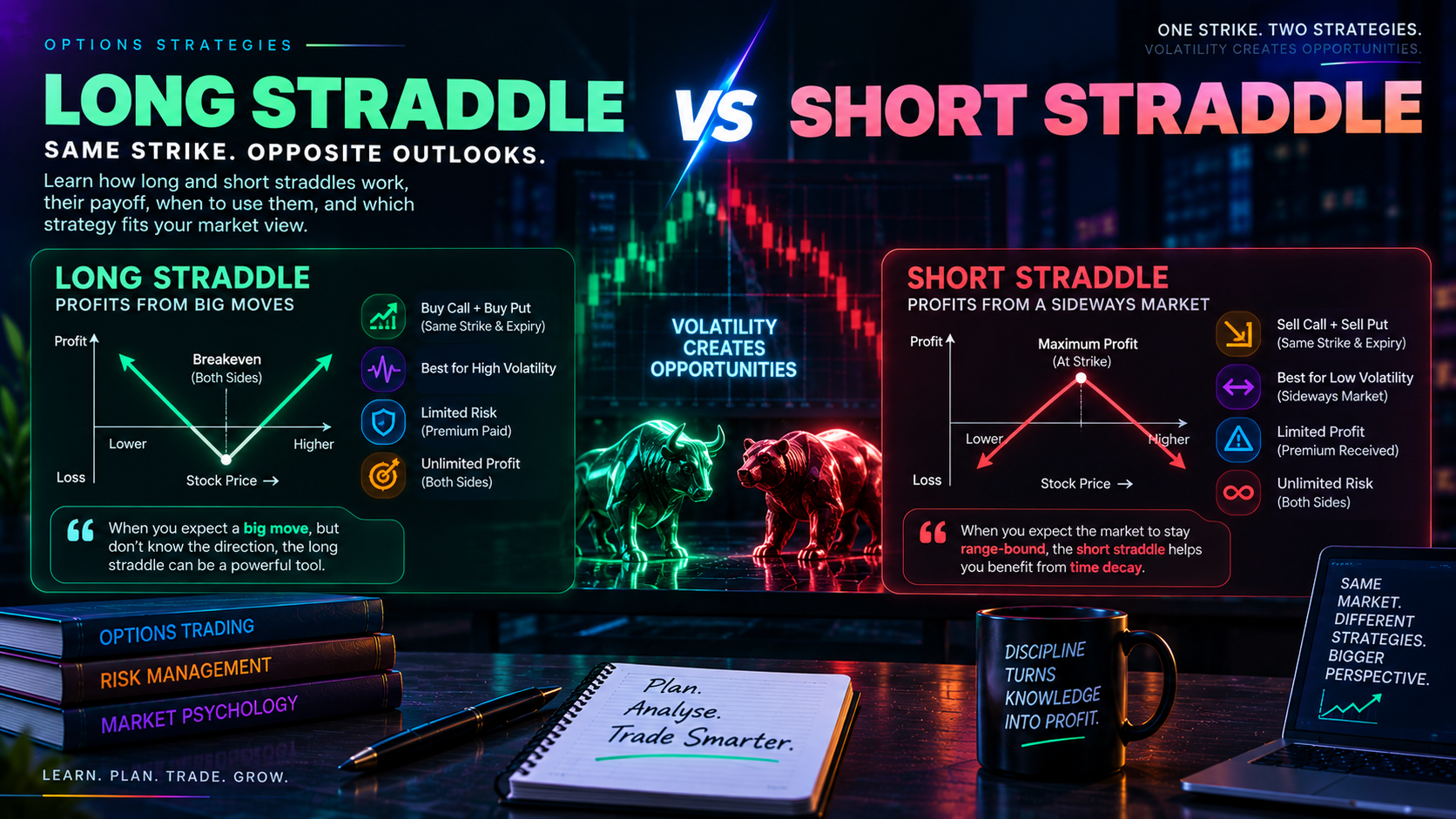
A long straddle means buying a call and a put with the same strike price and expiration. The trader generally wants a large move in either direction. The maximum loss is limited to the premiums paid, ignoring transaction costs.
A short straddle means selling a call and a put with the same strike price and expiration. The trader generally wants the underlying to remain near the strike and benefits from the erosion of extrinsic value, but the position carries substantial risk if the underlying moves sharply.
In simple terms: Long straddle = buy volatility / expect movement. Short straddle = sell volatility / expect stability.
1. What Is a Straddle in Options Trading?
A straddle combines a call option and a put option on the same underlying asset, using the same strike price and the same expiration. The strategy becomes particularly interesting because the trader can structure it either as a long position or a short position.
The structure itself is simple. The difficult part is understanding why someone would want to buy both options or sell both options at the same time.
A long straddle is normally associated with an expectation that the market could make a significant move but that the direction is uncertain. A short straddle takes the opposite view: the trader expects the underlying to remain relatively close to the strike.
Before using either strategy, it helps to understand implied volatility because the price paid or received for the options can have a major influence on the trade's risk and reward.
2. What Is a Long Straddle?
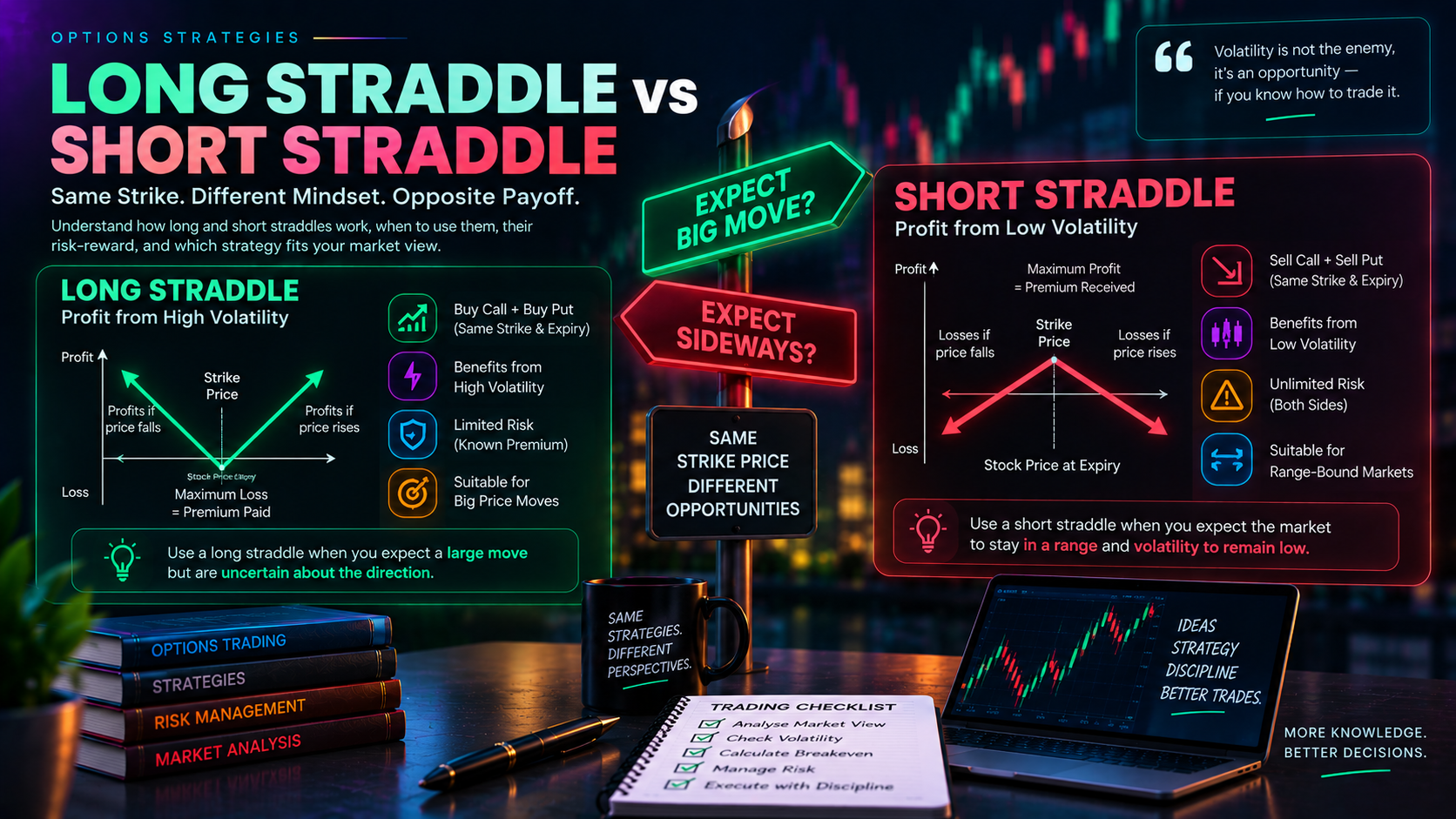
A long straddle consists of:
- Buying one call option.
- Buying one put option.
- Using the same strike price.
- Using the same expiration date.
The strategy does not require the trader to predict whether the market will rise or fall. Instead, the thesis is that the underlying will move sufficiently far away from the strike to overcome the total premium paid.
Long Straddle in One Sentence
Buy a call + buy a put at the same strike and expiry when you expect a significant move but are uncertain about direction.
This makes the long straddle conceptually attractive around situations where uncertainty about the size or direction of a future move is high. However, paying premium for both options means the underlying usually needs to move substantially before the position becomes profitable at expiry.
3. What Is a Short Straddle?
A short straddle reverses the position:
- Sell one call option.
- Sell one put option.
- Use the same strike price.
- Use the same expiration date.
The trader receives the combined premiums when the position is opened. The ideal outcome is for the underlying to remain near the strike so that both options lose value and expire with little or no intrinsic value.
Short Straddle in One Sentence
Sell a call + sell a put at the same strike and expiry when you expect the underlying to remain relatively stable.
But this is where beginners need to stop thinking in terms of "easy premium." A short straddle can have very large losses when the underlying moves strongly.
Positive theta can help the position as time passes, but theta should never be confused with a guarantee of profit. Read our theta decay guide to understand why time affects option premiums.
4. Long Straddle vs Short Straddle: Core Comparison
| Factor | Long Straddle | Short Straddle |
|---|---|---|
| Call | Buy | Sell |
| Put | Buy | Sell |
| Strike | Same | Same |
| Expiry | Same | Same |
| Market expectation | Large move | Limited movement |
| Direction required | Not necessarily | Not necessarily |
| Volatility preference | Higher / rising | Lower / contained |
| Time decay | Generally hurts | Generally helps |
| Maximum loss | Limited to premium paid | Very large / potentially unlimited |
| Maximum profit | Potentially very large | Limited to premium received |
5. How the Long Straddle Payoff Works
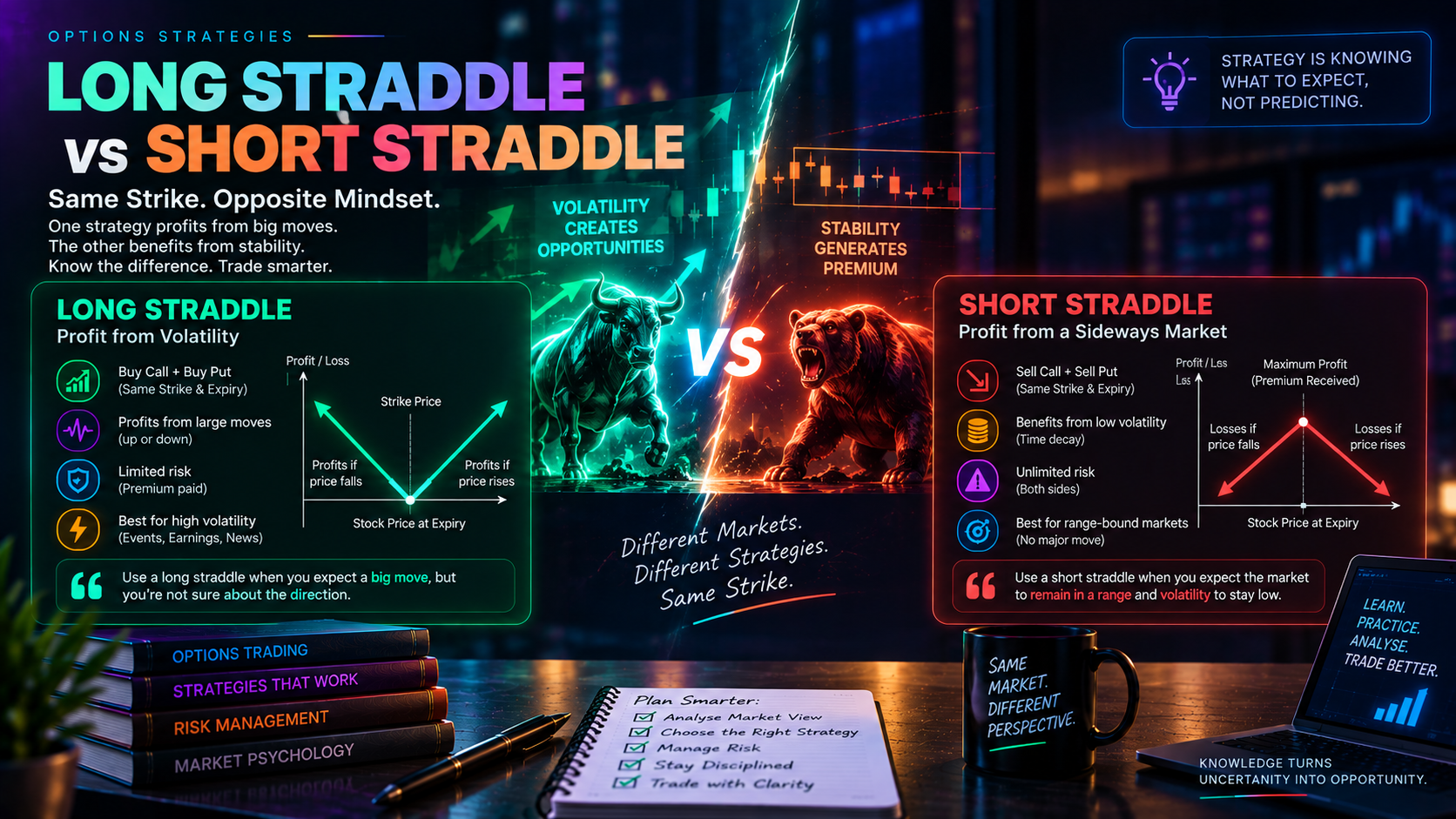
The long straddle creates a V-shaped payoff profile at expiration. The centre of the V corresponds to the strike price.
If the underlying moves sufficiently above the strike, the long call can generate a profit large enough to offset the total premium paid.
If the underlying falls sufficiently below the strike, the long put can generate a profit large enough to offset the premium.
The danger zone for the long straddle is the area around the strike. If the underlying finishes near the strike, both options may have little intrinsic value while the trader has already paid premium for them.
Lower Breakeven = Strike Price − Total Premium Paid
These formulas describe the simplified expiration breakevens and do not account for transaction costs or changes in the position before expiration.
6. How the Short Straddle Payoff Works
The short straddle creates the opposite payoff profile. Instead of a V-shaped structure, its expiration payoff resembles an inverted V.
The trader receives premium from selling the call and put. If the underlying finishes close enough to the strike, both options may expire with little intrinsic value, allowing the trader to retain much or all of the premium before costs.
The problem is what happens outside the profitable range.
- A sharp rise can create substantial losses through the short call.
- A sharp fall can create substantial losses through the short put.
- The maximum profit is limited to the premium received.
- Time decay can help, but it does not eliminate directional risk.
Never treat a short straddle as "free theta." The premium collected is the maximum gross reward, while a large underlying move can create losses that are many times larger.
7. Long Straddle Breakeven Example
Consider a purely illustrative example:
- Underlying price: ₹20,000
- Call strike: ₹20,000
- Call premium: ₹150
- Put premium: ₹150
- Total premium paid: ₹300
Upper Breakeven = ₹20,000 + ₹300 = ₹20,300
At expiration, the simplified long-straddle position needs the underlying to finish above approximately ₹20,300 or below approximately ₹19,700 to generate a gross profit.
If the underlying finishes at ₹20,000, both options can expire worthless and the combined premium of ₹300 becomes the maximum loss, ignoring transaction costs.
This example is intentionally simplified. Real-world option pricing before expiration is influenced by volatility, time, liquidity, interest rates and the underlying's movement.
8. Short Straddle Breakeven Example
Use the same hypothetical numbers:
- Strike price: ₹20,000
- Call premium received: ₹150
- Put premium received: ₹150
- Total premium received: ₹300
The simplified expiration breakevens are again:
Upper Breakeven = ₹20,000 + ₹300 = ₹20,300
The difference is not the breakeven mathematics. The difference is the direction of the payoff.
The long straddle wants the underlying to move beyond those boundaries. The short straddle generally wants the underlying to remain inside them at expiration.
That single distinction explains a large part of the strategic difference.
9. Volatility Is the Real Battleground
Straddles are fundamentally connected to volatility.
A long straddle involves paying premium for both a call and a put. Therefore, the trader needs a sufficiently large move or favourable changes in option pricing to justify the cost.
A short straddle receives premium for both options. The trader benefits when the options do not require significant intrinsic value and their extrinsic value declines.
Long Straddle
The trader generally wants realised movement to be large enough to justify the premium paid. Rising implied volatility can also affect the position positively, although the exact result depends on entry, exit and other variables.
Short Straddle
The trader generally prefers contained movement and stable or declining volatility. A sudden volatility expansion can increase option values and hurt the position.
For a deeper foundation, study implied volatility in options trading before making volatility-based strategy decisions.
10. Theta Decay: Why Time Helps One Side and Hurts the Other
Time is one of the biggest differences between long and short straddles.
When you buy both options, you are paying for time. If the underlying does not move enough before expiration, the extrinsic value of those options can decline.
When you sell both options, time decay can work in your favour because the options you sold can lose extrinsic value.
This does not mean theta is the entire strategy. Delta, gamma, vega, implied volatility and the underlying's movement all matter.
Our detailed theta decay guide explains why time decay can become increasingly important as expiry approaches.
11. What Happens Near Expiry?
Expiry changes the character of a straddle because there is less time left for the underlying to move.
For a long straddle, this can become uncomfortable. If the expected move has not occurred, the position can lose value rapidly as expiration approaches.
For a short straddle, the passage of time can be beneficial if the underlying remains near the strike. However, the remaining risk can become highly sensitive to relatively small underlying movements.
If you are trading around expiry, combine straddle analysis with your understanding of how options expiry affects stock prices rather than looking at premium decay in isolation.
You can also study weekly expiry strategy concepts and option-chain data to build better context.
12. Long Straddle Risk vs Short Straddle Risk
| Risk Area | Long Straddle | Short Straddle |
|---|---|---|
| Premium risk | Premium paid | Premium received |
| Large upside move | Can benefit | Can hurt significantly |
| Large downside move | Can benefit | Can hurt significantly |
| Sideways market | Usually difficult | Generally favourable |
| Time decay | Negative | Positive |
| Maximum reward | Large / potentially substantial | Limited to premium |
| Maximum loss | Limited to premium | Very large / potentially unlimited |
This asymmetry is the reason risk management matters enormously when considering short straddles. Review options risk management for beginners before considering premium-selling strategies.
13. When Might a Long Straddle Make Sense?
A long straddle can conceptually fit a market view where the trader expects a substantial move but has low confidence about direction.
You believe the underlying may move substantially.
You do not want to rely entirely on bullish or bearish direction.
You understand the combined premium required.
You know when the thesis is invalid or the position should close.
A trader should not buy a straddle simply because "something big might happen." The expected move needs to be considered against the premium being paid.
That is where understanding strong options trade setups becomes more useful than simply predicting market direction.
14. When Might a Short Straddle Make Sense?
A short straddle is conceptually suited to a trader who expects the underlying to remain relatively close to the strike and believes the premium collected adequately compensates for the risks being accepted.
This is a much more demanding strategy than simply collecting premium.
Before considering a short straddle, the trader needs to understand:
- Maximum acceptable loss.
- Margin requirements.
- Gap risk.
- Volatility expansion.
- Adjustment rules.
- Position sizing.
- Exit criteria.
A good starting point is the Stoxra guide on how much money to risk in options trading .
15. Long Straddle vs Short Straddle: The Biggest Psychological Difference
The strategies require almost opposite emotional reactions.
Long Straddle Mindset
You accept that time decay may work against you while waiting for the large move you expect.
The challenge is patience without allowing the position to decay indefinitely.
Short Straddle Mindset
You may watch small movements and volatility changes closely because a large move can rapidly damage the position.
The challenge is avoiding the temptation to keep a losing short position simply because theta is still positive.
This is why common options trading mistakes and emotional decision-making can matter just as much as the strategy itself.
16. Common Mistakes With Straddles
Ignoring Premium
A long straddle needs enough movement to overcome the premium paid. A short straddle receives premium but accepts significant risk.
Ignoring Volatility
Entering a straddle without understanding implied volatility can lead to poor expectations about pricing.
Ignoring Expiry
Time remaining changes the behaviour of both strategies and their Greeks.
No Exit Plan
Read how to exit options trades without panic before treating an options position as something that can simply be held until expiry.
Oversizing
A strategy with attractive theoretical characteristics can still destroy a trading account if position size is inappropriate.
17. Long Straddle vs Short Straddle Around Major Events
Major market events can create uncertainty about future movement. Traders sometimes consider straddle structures when they expect a meaningful change in volatility or price.
But there is a major complication: option premiums may already reflect elevated expectations before the event.
Therefore, simply saying "an event is coming, so buy a straddle" is incomplete.
The trader needs to compare the expected movement with the premium embedded in the options and consider what happens to implied volatility after the event.
A large underlying move does not automatically guarantee that a long straddle will be profitable if the move was already priced aggressively into the options.
18. Should Beginners Trade a Straddle?
Learning the strategy and trading the strategy are two different things.
Beginners should first understand the payoff structure, breakevens, Greeks, volatility and risk before considering live execution.
A useful progression is:
- Learn the structure.
- Calculate theoretical breakevens.
- Study historical examples.
- Paper trade the strategy.
- Record how volatility changes affected the position.
- Review outcomes before risking real capital.
If you are still deciding between simulation and live trading, read paper trading vs real trading and best paper trading options resources .
Straddle Breakeven Calculator
Enter a strike price and the premiums of the call and put. This calculator estimates the simplified expiration breakevens for both a long and short straddle.
Educational calculator only. It shows simplified expiration breakevens and does not predict actual option prices, intraday P&L, volatility changes, liquidity, margin requirements or transaction costs.
19. A Better Way to Compare the Two Strategies
Instead of asking which strategy is "better," ask which strategy is consistent with the market condition you actually expect.
| Your Expectation | Conceptually Fits | Why |
|---|---|---|
| Large move upward or downward | Long Straddle | Can benefit from a sufficiently large move either way |
| Underlying stays near strike | Short Straddle | Both sold options can lose intrinsic value and time value |
| Volatility expected to rise | Generally favours long volatility exposure | Long options can benefit from volatility expansion |
| Volatility expected to remain contained | Generally favours short volatility exposure | Premium decay can benefit the seller |
| Very limited risk tolerance | Long straddle has defined premium risk | Maximum loss is the premium paid |
Notice that the table does not say one strategy always wins. The strategy needs to match the underlying assumptions.
20. How Option Chain Data Can Improve Your Analysis
A straddle should not be analyzed in a vacuum.
The option chain can provide useful information about available strikes, premiums and open interest. That information can help you understand the structure of the market you are analyzing.
Learn how to read option-chain data for trading before trying to interpret open-interest numbers without context.
You can also study AI and option-chain heatmaps for another perspective on how market data can be organized.
Tools such as a stock screener can also help with the broader research process, but no screener or indicator should be treated as a substitute for understanding the strategy itself.
21. Risk Management Rules for Straddles
Strategy selection comes after risk selection.
Before entering a straddle, define:
- Maximum capital allocated to the position.
- Maximum acceptable loss.
- Planned entry conditions.
- Planned exit conditions.
- Time-based exit.
- What happens if implied volatility changes sharply.
- What happens if the underlying breaks the expected range.
For practical guidance, combine this article with stop-loss concepts for options trading and when to book options trading profits .
Do not let a positive theta number convince you to ignore a growing directional loss. A few units of daily time decay cannot automatically compensate for a large move against a short straddle.
22. Long Straddle vs Short Straddle: Final Verdict
The long and short straddle are mirror-image strategies with completely different risk profiles.
The long straddle buys both a call and a put at the same strike and expiry. It generally benefits when the underlying makes a sufficiently large move in either direction. Its biggest enemy is often the combination of premium paid and time passing without enough movement.
The short straddle sells both options at the same strike and expiry. It generally benefits when the underlying remains relatively close to the strike and option premiums decline. Its major danger is a large move in either direction.
Therefore, the correct question is not: "Which straddle is better?"
The better question is: "What market behaviour am I expecting, and which risk profile matches that expectation?"
Once you understand that distinction, straddles become much easier to analyze.
Build Your Options Knowledge Before Taking Risk
Long and short straddles are only two structures in the wider options landscape. Continue learning about volatility, option chains, risk management and strategy construction before applying derivatives concepts with real capital.
Explore Stoxra Learning →Frequently Asked Questions
A long straddle involves buying a call and a put with the same strike price and expiration. It is generally used when a trader expects a significant move but is uncertain about direction.
What is a short straddle?A short straddle involves selling a call and a put with the same strike price and expiration. It generally benefits when the underlying remains relatively close to the strike, but it carries substantial risk if the underlying moves sharply.
Which has limited risk: long straddle or short straddle?A long straddle has a defined maximum loss equal to the combined premium paid, ignoring transaction costs. A short straddle can experience very large losses when the underlying makes a substantial move.
When is a long straddle generally used?A long straddle is generally considered when a trader expects a large move but does not have enough confidence to choose between bullish and bearish direction.
When is a short straddle generally used?A short straddle is generally considered when the trader expects the underlying to remain within a relatively narrow range and believes the premium received adequately compensates for the risk.
Does theta help a short straddle?Generally, yes. The passage of time can reduce the extrinsic value of the options sold in a short straddle. However, theta is only one factor, and a large price movement can create losses much larger than the daily benefit from time decay.
Can a long straddle lose money even if the market moves?Yes. The move may be too small or occur too slowly to overcome the combined premiums paid. Changes in implied volatility and other pricing variables can also affect the result.
Is a short straddle suitable for beginners?Beginners should understand the substantial risk of short options before considering a short straddle. Learning the payoff structure and paper trading the strategy can be useful before considering live execution.