Protective Put Strategy Explained
Learn the protective put strategy with simple examples covering put options, strike prices, premiums, breakeven, downside protection, profit potential and key risks.
Protective Put Strategy Explained
Learn how a protective put can help investors protect an existing stock position against a major downside move while keeping the potential to participate in future upside.
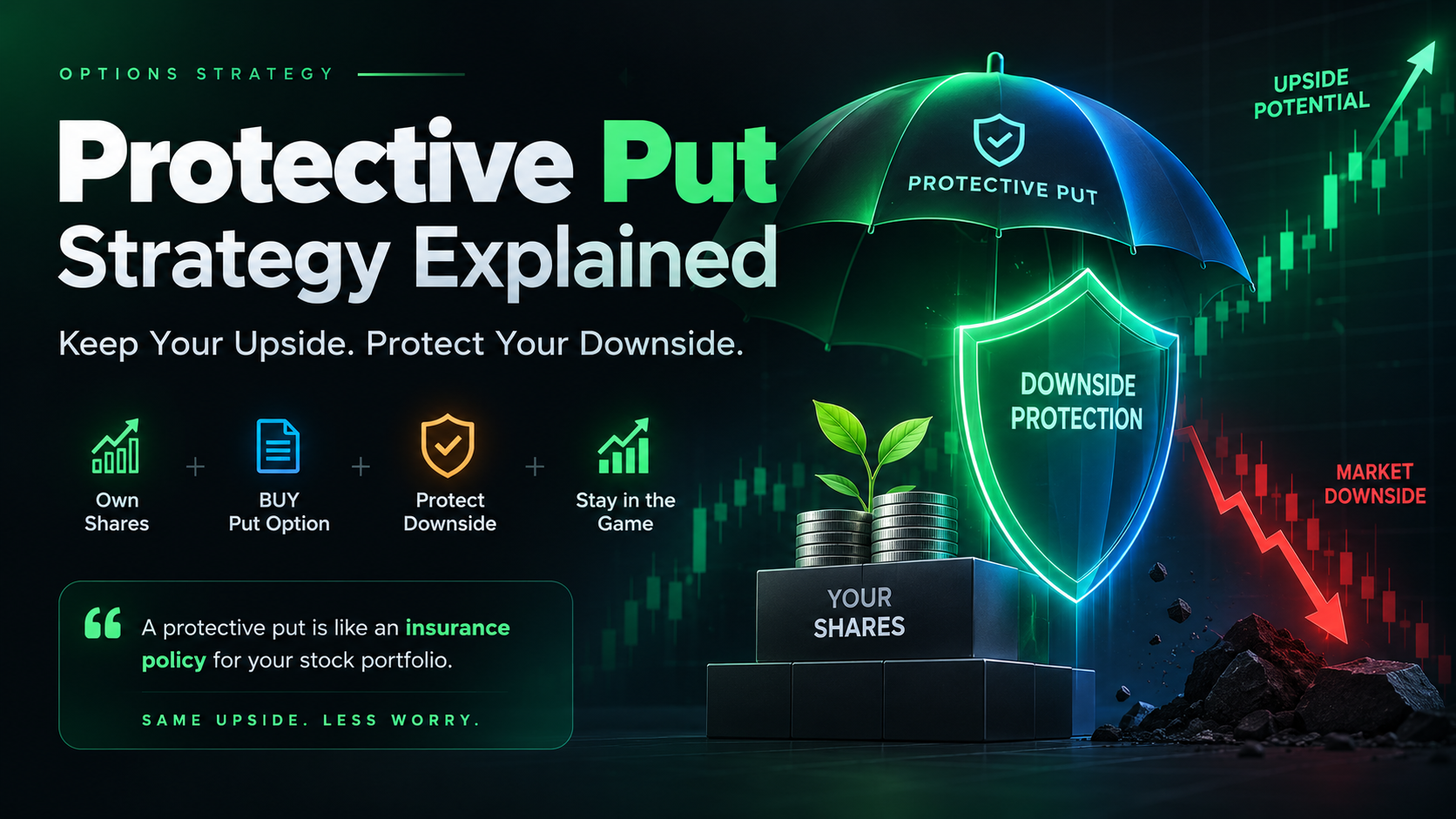
Protective put strategy: A protective put combines ownership of an underlying asset with the purchase of a put option. The stock provides upside exposure, while the put can provide a defined layer of downside protection below its strike price.
If you are learning options from scratch, it helps to understand the basics of options risk management before using a hedge such as a protective put.
Quick Answer
A protective put is created by buying the underlying asset and buying a put option on that asset.
If the stock rises, you continue participating in the upside. If the stock falls below the put strike, the put can increase in value and offset part of the decline in the underlying.
Protective Put = Long Stock + Long PutBest For
- Existing stock holders
- Investors expecting uncertainty
- Defined downside protection
- Maintaining upside exposure
What Is a Protective Put Strategy?
A protective put is an options strategy used to reduce the downside risk of an existing stock position. Instead of selling the stock because you are worried about a potential decline, you keep the stock and purchase a put option.
A put option gives the buyer the right, but not the obligation, to sell the underlying at the specified strike price according to the contract terms. Because you are buying the put, you pay an upfront premium.
The basic idea is simple: keep the investment and buy protection against a large decline.
Before building this type of position, beginners should also understand how to enter an options trade and what factors should be checked before placing the order.
Think of a protective put as a risk-management layer around an existing position. You pay a premium for protection, but unlike a covered call, the strategy does not cap the stock's upside.

How Does a Protective Put Work?
Suppose you own shares of a company and the stock is trading at ₹1,000. You remain positive about the company over the long term, but you are concerned that the stock could experience a sharp decline in the next few months.
Instead of immediately selling your shares, you could purchase a put option with a strike price of ₹950. Assume the put premium is ₹30 per share.
This is where understanding the role of implied volatility in options becomes important. Option premiums are influenced by several factors, and volatility can materially affect the cost of protection.
| Component | Example | Role |
|---|---|---|
| Stock price | ₹1,000 | Existing position |
| Put strike | ₹950 | Protection level |
| Put premium | ₹30 | Cost of protection |
| Effective breakeven | ₹1,030 | Stock price + premium |
If the stock rises substantially, your shares can continue to appreciate. The main drag on the position is the ₹30 premium paid for the put.
If the stock falls significantly below ₹950, the put can become increasingly valuable and can offset losses on the shares, subject to the option's terms, expiry, liquidity and other factors.
Traders who are still learning the mechanics should also understand how to read an option chain before selecting a strike.
Protective Put Example
Let's make the strategy easier to understand with a simplified one-share example.
Assume you purchase a stock at ₹1,000 and simultaneously buy a ₹950 put for ₹30. Your total economic cost becomes ₹1,030 per share before transaction costs and taxes.
| Input | Value |
|---|---|
| Stock purchase price | ₹1,000 |
| Put strike price | ₹950 |
| Put premium | ₹30 |
| Total initial economic cost | ₹1,030 |
| Approximate maximum loss | ₹80 |
The simplified maximum-loss calculation is:
Maximum Loss ≈ Stock Price + Put Premium − Put StrikeTherefore:
₹1,000 + ₹30 − ₹950 = ₹80This simplified example assumes the stock falls to or below the strike and ignores transaction costs, taxes and other practical considerations.
Position sizing still matters. Our guide on how much money to risk in options trading can help put the position into a broader risk-management framework.
The put does not make the stock position risk-free. You have paid a premium, and the stock can decline before the protection becomes fully effective. The exact outcome depends on the strike, premium, expiry, contract specifications and market conditions.
Protective Put Payoff: What Happens at Different Prices?
The easiest way to understand the strategy is to examine what happens at different stock prices at expiry.
| Stock at Expiry | Stock Position | Put Position | Overall Effect |
|---|---|---|---|
| ₹1,200 | Large gain | Put may expire worthless | Upside remains |
| ₹1,050 | Gain | Put may expire worthless | Mostly stock-driven |
| ₹1,000 | Near flat | Premium is a cost | Position may show a loss after premium |
| ₹950 | Moderate decline | Put reaches strike | Protection begins to matter |
| ₹800 | Large decline | Put gains intrinsic value | Downside substantially offset |
The key feature is the asymmetric payoff. Above the strike, the stock can continue participating in upside. Below the strike, the put can increasingly offset the stock's losses.
This is also why understanding disciplined options exits matters. A hedge should have a defined purpose rather than becoming an excuse to hold an unsuitable position indefinitely.

Maximum Profit, Maximum Loss and Breakeven
Maximum Profit
Unlike a covered call, a protective put does not have a fixed maximum profit because the stock's upside remains open.
If the stock rises significantly, the long stock position can continue increasing in value. The main strategy-specific drag in the simplified model is the premium paid for the put.
Maximum Loss
If the stock collapses below the put strike, the purchased put can offset much of the decline. In a simplified one-share model, maximum loss is approximately:
Stock Purchase Price + Put Premium − Put StrikeBreakeven
Ignoring taxes, transaction costs and changes in option value before expiry, the simple breakeven at expiry is approximately:
Breakeven = Stock Purchase Price + Put PremiumIn our example, the breakeven would be approximately ₹1,030.
Beginners should avoid confusing breakeven with a guaranteed exit price. Real-world trading outcomes can be affected by spreads, liquidity and execution. Our guide to common options entry and exit mistakes covers several of these practical issues.
How to Choose the Put Strike Price
Strike selection is one of the most important decisions in a protective put strategy. A lower strike generally means the protection starts further below the current stock price, while a higher strike can provide stronger protection but usually requires paying a higher premium.
Higher Strike
Provides protection closer to the current stock price but can require a larger premium.
Near-the-Money
Can offer a relatively balanced trade-off between protection and premium cost.
Lower Strike
Can reduce the upfront premium but allows more downside before the protection becomes meaningful.
There is no universally correct strike. The right choice depends on how much downside you are willing to tolerate, how much you are willing to spend on protection and how long you intend to hold the position.
Option-chain analysis can make this decision more structured. Traders can review Bank Nifty option-chain information or study Nifty option-chain analysis when working with index options.
Protective Put vs Covered Call
Protective puts and covered calls are often discussed together because both combine an existing stock position with an option. However, they solve different problems.
If you are comparing this strategy with the covered call strategy , the most important difference is what happens to the option premium and the stock's upside.
| Feature | Protective Put | Covered Call |
|---|---|---|
| Stock position | Long stock | Long stock |
| Option position | Buy put | Sell call |
| Premium | Premium paid | Premium received |
| Downside protection | Yes, below put strike | Limited cushion from premium |
| Upside | Generally remains open | Capped above call strike if assigned |
| Typical objective | Protect downside | Generate premium income |
In simple terms, a protective put is more directly focused on buying protection, while a covered call is focused on collecting premium in exchange for giving up some upside potential.
If you are new to the broader derivatives market, our guide on Nifty vs Bank Nifty options is another useful starting point.
When Should You Consider a Protective Put?
A protective put can make sense when you have a reason to keep the underlying asset but want protection against a defined downside event.
You Still Like the Stock
You want to maintain exposure rather than completely exit the position.
You Expect Volatility
You believe a major move is possible but do not want to abandon the underlying position.
You Need Defined Risk
You want a clearer downside boundary for a particular period.
The important point is that the protective put should be viewed as a risk-management decision rather than simply another way to speculate on an option.
Traders who struggle with identifying a good setup can review how to identify a strong options trade setup before deciding whether a hedge is actually necessary.
When a Protective Put May Not Make Sense
Buying protection has a cost. That cost can become significant if you repeatedly purchase puts that expire without becoming valuable.
- The put premium may be expensive relative to the protection you want.
- Repeatedly buying short-dated puts can create a meaningful drag on returns.
- A very low strike may provide less practical protection than you expect.
- The option can lose value because of time decay.
- Changes in implied volatility can affect the option's market value before expiry.
- Transaction costs, liquidity and bid-ask spreads can affect actual results.
These are exactly the types of issues that make common options trading mistakes worth studying before implementing a new strategy.
Don't ask only, “How much does this put cost?” Ask, “What exact downside am I protecting, for how long, and what percentage of my portfolio does that protection cover?”
Protective Put Risk Management
A protective put can reduce downside risk, but it does not eliminate the need for proper position sizing and risk management.
Before entering the strategy, define the underlying exposure, expiry, strike, premium and maximum acceptable loss.
- Decide how many shares you want to protect.
- Match the option quantity appropriately to the underlying exposure.
- Determine how much downside you can tolerate.
- Compare different strike prices and premiums.
- Check expiry and liquidity.
- Understand the contract's exercise and settlement rules.
- Reassess the hedge if your investment thesis changes.
A written risk plan is much more useful than relying on emotions. Our guide on stop-loss concepts in options trading can help you think about risk before entering a position.
It is also useful to understand when to book profit in options trading because a hedge does not automatically tell you when the broader investment thesis has been achieved.
Protective Put Calculator
Use this simplified calculator to estimate the approximate breakeven and maximum loss of a protective put. It is an educational model and does not account for taxes, brokerage, slippage, interest, dividends or changes in option value.
Protective Put Calculator
Common Protective Put Mistakes Beginners Make
Understanding the strategy is not enough. Many mistakes happen when traders focus only on the word “protection” and ignore the cost and mechanics of the option.
1. Buying Protection Without a Plan
A put should have a clear purpose. Know what risk you are trying to hedge and for what time period.
2. Ignoring Premium Cost
The premium reduces the position's effective return. Protection is valuable, but it is not free.
3. Choosing a Very Low Strike
A cheap far-out-of-the-money put may appear attractive, but it can leave the position exposed to a large decline before the hedge becomes meaningful.
4. Forgetting Expiry
A put only protects according to its contractual terms and expiry. Once it expires, the protection is gone unless another hedge is established.
5. Assuming the Hedge Guarantees Profit
The purpose of the strategy is risk management. It does not guarantee a positive return.
For more on avoiding poor decisions around entries and exits, read our guide to exiting options trades without panic .
Protective Put vs Simply Selling the Stock
This is one of the most important conceptual questions for a beginner. If you believe the stock may fall heavily, why not simply sell it?
The answer is that selling eliminates both downside exposure and upside exposure. A protective put allows you to continue holding the underlying while purchasing a separate layer of downside protection.
| Approach | Downside | Upside | Position |
|---|---|---|---|
| Hold Stock | Fully exposed | Open | Remain invested |
| Sell Stock | Removed | Removed | Exit position |
| Protective Put | Reduced below strike | Open | Remain invested + hedge |
The decision should also fit into a broader trading process. Understanding support and resistance with option-chain data can provide additional context, although technical levels alone should never be treated as a guarantee of future price movement.
How Protective Puts Fit Into a Broader Options Strategy
A protective put should not be considered in isolation. It sits within a larger framework that includes market direction, volatility, position size, entry timing and risk management.
For example, if you are trading index options, studying Max Pain theory and put-call ratio analysis can help you understand the surrounding options market.
These tools should be treated as supporting information rather than standalone signals. A protective put is fundamentally about managing the risk of an existing position.
Traders interested in combining technology with market research can also explore AI tools for stock-market analysis and learn more about how AI is transforming stock-market trading .
Final Takeaway
The protective put is one of the clearest examples of how options can be used for risk management rather than purely for speculation.
The structure is straightforward: own the stock and buy a put.
The stock gives you continued upside exposure. The put creates a potential downside floor below its strike. The trade-off is the premium you pay for that protection.
For beginners, the most important lesson is not simply memorizing the formula. Understand the relationship between the stock price, put strike, premium, expiry and risk tolerance.
If you want to practise concepts before committing real capital, you can also explore paper trading for options as part of your learning process.
A protective put does not predict the market. It prepares your portfolio for a market move you may not be able to predict. The goal is to define risk without automatically giving up your investment's upside.
Learn Before You Trade
Build your options knowledge with practical guides on entries, exits, risk management, option chains, implied volatility and trading strategies.
Explore Stoxra Learn →Frequently Asked Questions
What is a protective put strategy?A protective put combines ownership of a stock or underlying asset with the purchase of a put option. The put can help reduce downside exposure below its strike price while allowing the investor to retain upside exposure.
Is a protective put the same as insurance?It is often compared with insurance because the investor pays an upfront premium for potential downside protection. However, the exact mechanics depend on the option contract.
What is the maximum loss on a protective put?In a simplified one-share example, maximum loss is approximately the stock purchase price plus the put premium minus the put strike, assuming the stock falls to or below the strike and excluding transaction costs and other factors.
Does a protective put limit upside?No. Buying a put does not create a fixed upside cap on the underlying stock. The investor generally continues participating in upside movements, although the premium paid reduces the overall return.
When should a trader consider a protective put?It can be considered when an investor wants to continue holding an underlying asset but wants defined downside protection over a particular period.
What is the biggest disadvantage of a protective put?The biggest trade-off is the premium paid for the put. If the stock does not decline enough for the put to become valuable, the premium can reduce the overall return.