Swing Trading Entry and Exit Rules for Beginners
Learn simple swing trading entry and exit rules for beginners, including how to identify trends, confirm setups, manage risk, set stop losses and plan disciplined exits.
Swing Trading Entry and Exit Rules for Beginners
Swing trading involves holding a position for more than one trading session with the goal of benefiting from a meaningful price movement. Unlike very short-term trading, swing trading gives traders more time to analyse price structure, trends, momentum and market conditions. For related reading, see swing trading technical analysis. For related reading, see VWAP trading strategy. For related reading, see Q4 earnings trading signals.
For beginners, one of the most important parts of swing trading is having clear entry and exit rules before placing a trade.
Without predefined rules, traders may enter too early, hold losing positions for too long or exit profitable trades based on emotion.
A structured process can help traders make more consistent decisions while keeping risk under control.
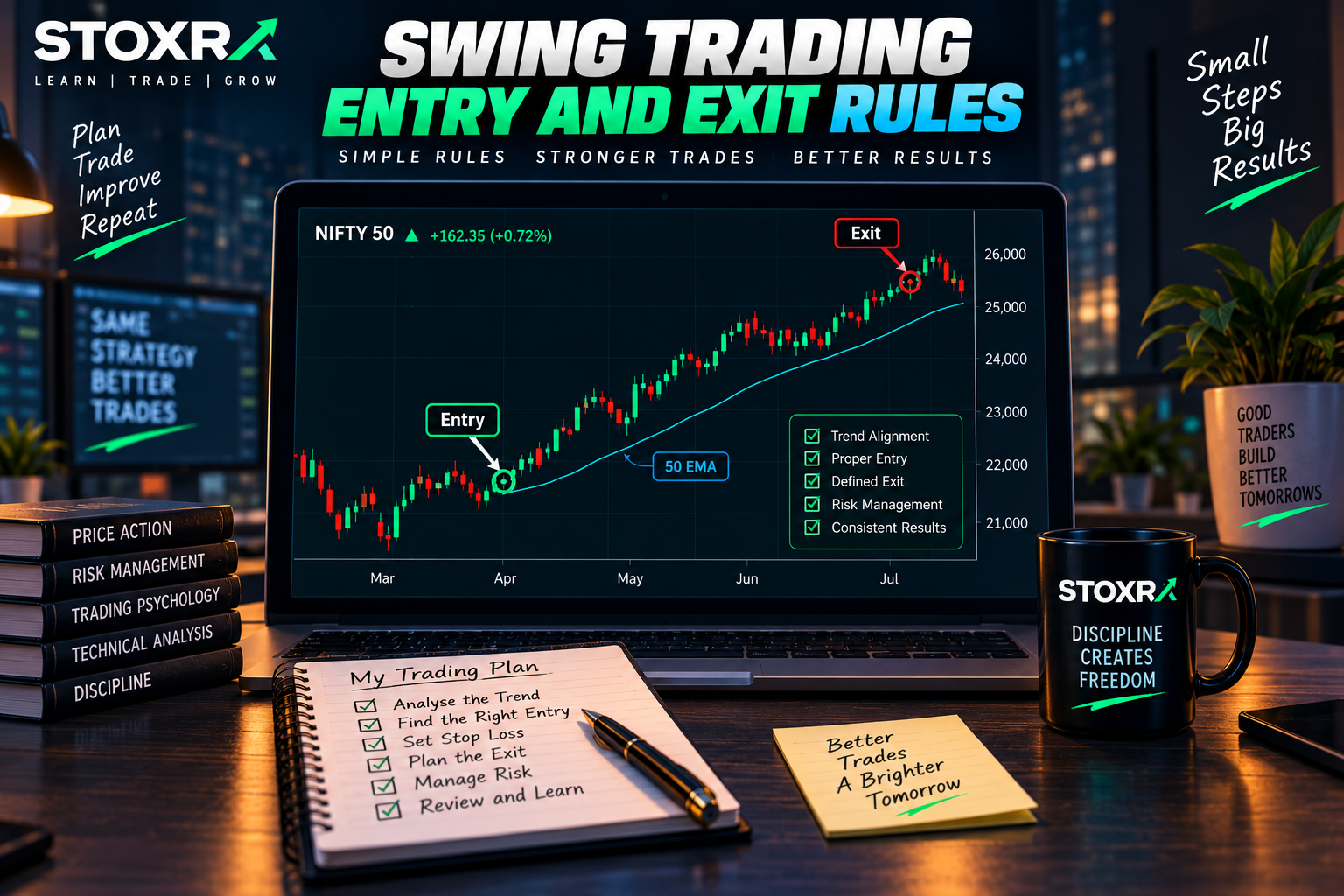
What Is Swing Trading?
Swing trading is a trading approach that attempts to capture price movements over a period ranging from several sessions to potentially several weeks.
Swing traders generally focus on market trends, price patterns, support and resistance, momentum and other technical factors when evaluating potential setups.
The exact holding period varies according to the trading strategy and market conditions.
Swing Trading vs Intraday Trading
Intraday traders generally open and close positions within the same trading session, while swing traders may hold positions overnight and attempt to capture a larger price movement.
Because swing positions can remain open overnight, traders also need to consider gap risk, overnight news and changes in market conditions.
Why Entry and Exit Rules Matter
A trading plan should define what conditions must exist before a trade is entered and what conditions will cause the position to be closed.
This can reduce the influence of emotions such as fear, greed and impatience.
- Creates a structured decision-making process.
- Helps control risk before entering a trade.
- Reduces impulsive trading decisions.
- Makes performance easier to review.
- Helps traders maintain consistency.
How Beginners Can Find a Swing Trading Setup
Before thinking about entry price, a trader should first determine whether the market provides a setup that fits the trading plan.
1. Identify the Broader Trend
Start by examining the overall direction of the stock or index.
A rising sequence of higher highs and higher lows may indicate an upward trend, while lower highs and lower lows may indicate a downward trend.
Moving averages can also be used as one additional tool for studying trend direction. For related reading, see 100-day moving average.
Read more about the 100-Day Moving Average to understand how moving averages can be used in technical analysis.
2. Identify Support and Resistance
Support and resistance levels can help traders identify areas where price has previously reacted. For related reading, see support and resistance levels.
These levels are not guaranteed turning points. Price can break through them when market conditions change.
3. Look for a Clear Price Structure
A potential swing setup should have a logical structure that explains why the trade may have an opportunity.
Examples include breakouts, pullbacks, trend continuation patterns and reversals around important price levels. For related reading, see best chart patterns for swing trading.
4. Check Momentum and Volume
Momentum indicators and volume can provide additional information about the strength of a price movement. For related reading, see best intraday trading indicators.
Traders should avoid treating any single indicator as a guaranteed signal.
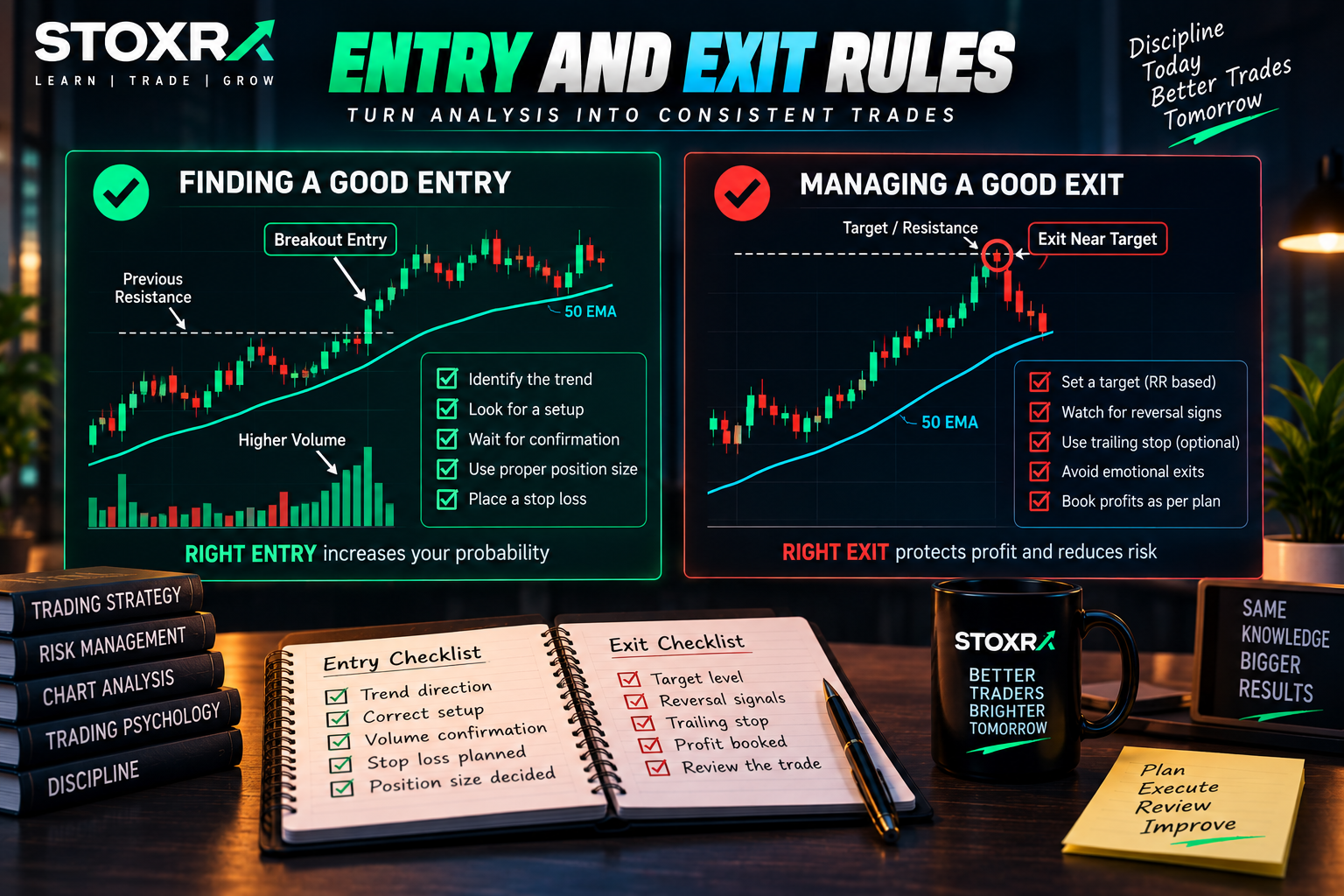
Entry Rules for Swing Trading Beginners
Rule 1: Enter Only When the Setup Is Clear
Beginners should avoid entering a trade simply because a stock has moved sharply or because they are afraid of missing an opportunity.
The setup should match predefined conditions in the trading plan.
Rule 2: Wait for Confirmation
Confirmation can come from price action, a breakout, a support or resistance reaction, volume or another predefined technical condition.
Waiting for confirmation may reduce the number of trades, but the goal should be to improve trade quality rather than maximise trade frequency.
Rule 3: Avoid Chasing Price
When a stock moves rapidly, beginners may feel pressure to enter immediately.
Chasing a price after a large move can result in an unfavourable entry and poor risk-reward conditions.
If the original setup has already moved too far, waiting for another opportunity may be more appropriate.
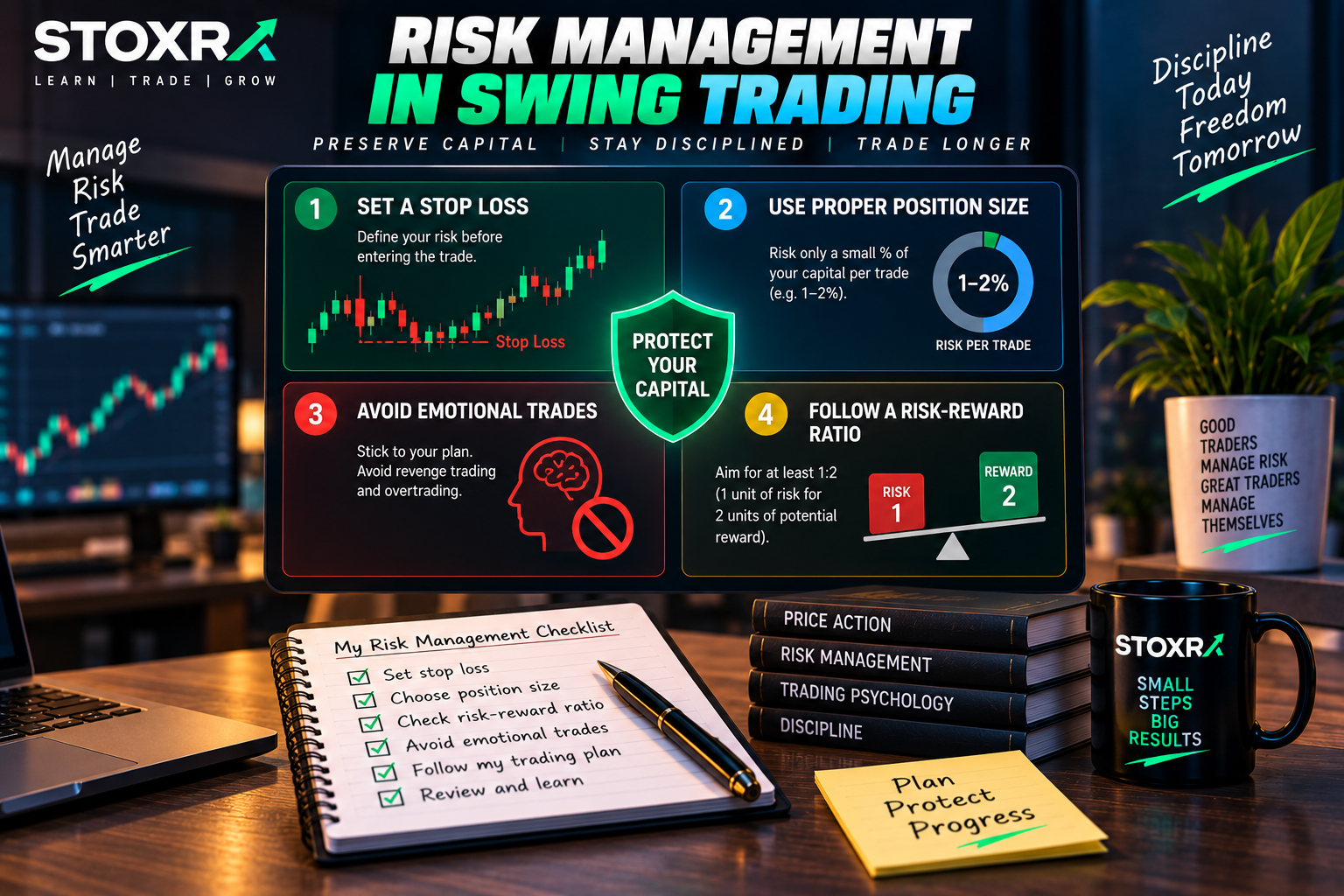
Rule 4: Define Risk Before Entry
The maximum acceptable loss should be considered before opening the position.
This helps determine an appropriate position size and exit level.
Stop-Loss Rules for Swing Trading
A stop-loss can help limit losses if a trade moves against the original trading thesis. For related reading, see intraday risk management for beginners.
For a swing trade, the stop-loss should be based on the structure and volatility of the setup rather than an arbitrary number.
Common Stop-Loss Approaches
- Below a relevant support level for a long position.
- Above a relevant resistance level for a short position.
- Beyond a technical invalidation point.
- Based on volatility when appropriate.
Important Risk Reminder
A stop-loss can help manage risk, but it cannot guarantee execution at the exact selected price. Gaps, liquidity conditions and fast-moving markets can affect the actual exit price.
How to Set a Swing Trading Profit Target
A profit target defines the price or condition at which a trader plans to take profits. For related reading, see position sizing in intraday trading.
Targets can be based on technical levels, previous highs or lows, resistance, support, trend structure or a predefined risk-reward framework.
The target should be considered before entering the trade rather than decided emotionally after the position becomes profitable.
Example Risk-Reward Framework
Suppose a trader identifies a potential entry at ₹500 and determines that the setup becomes invalid below ₹480.
The planned risk is ₹20 per share. For related reading, see how much money to risk in options trading.
If the trader uses a theoretical 2:1 reward-to-risk framework, a target could be considered around ₹540, assuming the market structure supports such a target.
This is only an educational example. Actual position sizing and target selection should reflect the specific setup and risk tolerance.
Exit Rules for Swing Trading Beginners
Exit Rule 1: Exit When the Trade Thesis Is Invalidated
If the price action invalidates the reason for entering the trade, the trader should follow the predefined exit plan rather than holding the position simply because a loss has occurred.
Exit Rule 2: Take Profit at a Predefined Level
Traders can use predefined targets when the strategy calls for them. This can reduce emotional decisions after a position becomes profitable.
Exit Rule 3: Consider a Trailing Exit
In a strong trend, some traders may use a trailing stop or another systematic exit method to attempt to remain in the trade while the trend continues.
A trailing method should be defined before the trade rather than adjusted randomly based on emotion.
Exit Rule 4: Exit When Market Conditions Change
A trade setup may become less attractive if the broader market changes, volatility increases sharply or the original technical structure breaks.
Traders should include these possibilities in their trading plan.
Position Sizing for Swing Trading
Position sizing determines how much capital is exposed to a trade. For related reading, see daily loss limit for intraday trading.
A beginner should not determine position size simply by asking how many shares can be purchased with available capital.
The potential loss if the stop-loss is reached should also be considered.
Basic Position-Sizing Concept
Position Size = Maximum Acceptable Trade Risk ÷ Risk Per Share
For example, if the planned maximum loss is ₹1,000 and the difference between entry and stop-loss is ₹20 per share, the theoretical position size would be 50 shares.
This simplified example does not account for brokerage, taxes, slippage or other transaction costs.
Risk Management Rules for Beginners
- Define risk before entering every trade.
- Avoid risking an excessive portion of the trading account on one idea.
- Use position sizing appropriate to the stop-loss distance.
- Avoid excessive leverage.
- Do not increase position size simply to recover a previous loss.
- Keep a record of trades and review performance regularly.
Trading Psychology and Swing Trading
Trading psychology can have a major influence on whether a trader follows an entry and exit plan. For related reading, see how to start algorithmic trading in India.
Fear can cause traders to exit too early, while greed can encourage them to hold a position beyond the original plan.
FOMO can also cause traders to enter after a major move has already occurred. For related reading, see how to avoid overtrading in intraday trading.
Learn more about How FOMO Leads to Trading Mistakes .
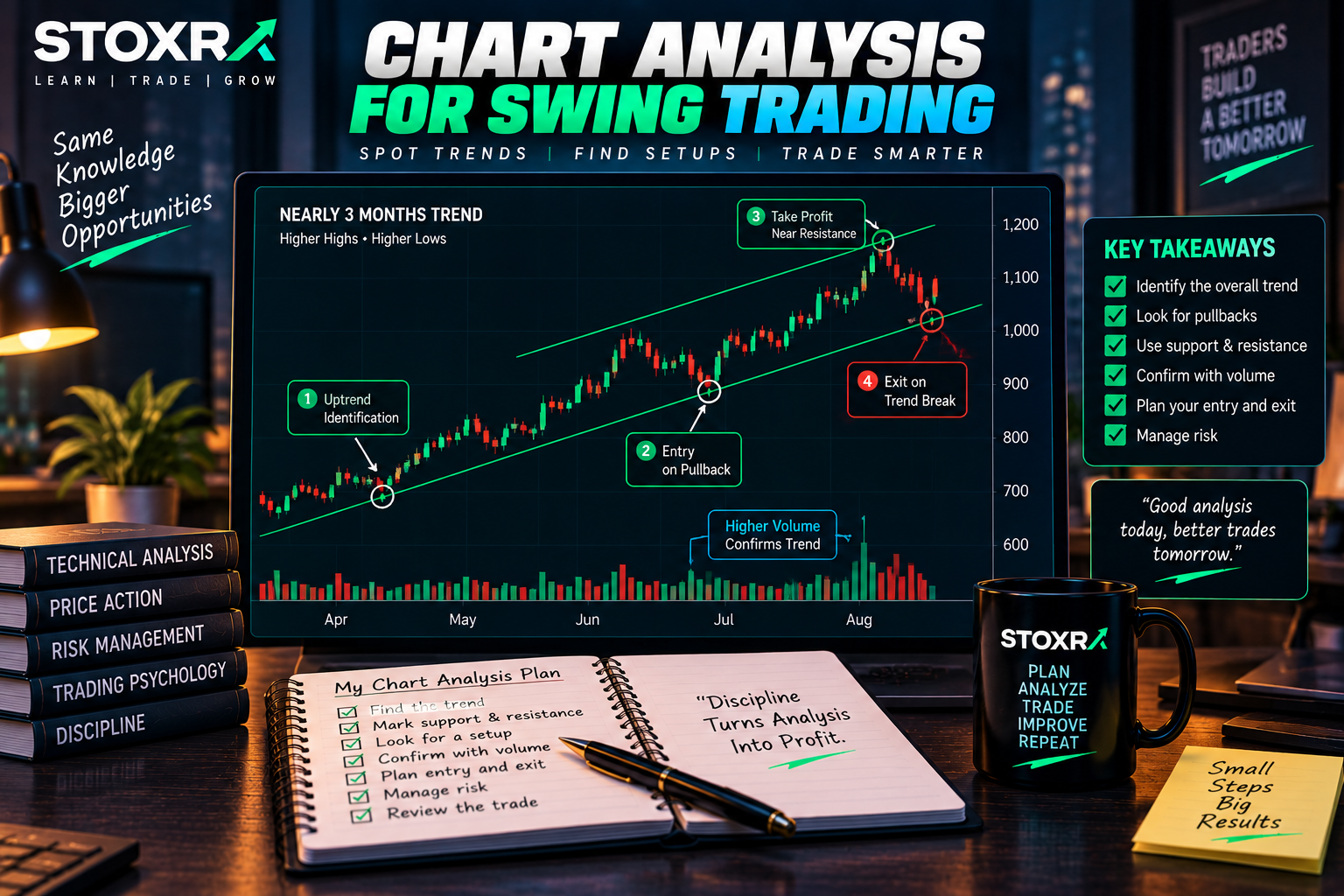
A Simple Swing Trading Entry Checklist
- Is the broader trend clear?
- Is there a valid technical setup?
- Is the entry price reasonable?
- Has the setup received sufficient confirmation?
- Where is the stop-loss?
- What is the planned target?
- Is the potential reward reasonable compared with the risk?
- Is the position size appropriate?
- Are there important upcoming events or risks?
A Simple Swing Trading Exit Checklist
- Has the original trade thesis been invalidated?
- Has the planned target been reached?
- Has the trend changed?
- Has important support or resistance been broken?
- Has the risk-reward profile changed?
- Is the exit based on the trading plan rather than emotion?
Common Swing Trading Mistakes Beginners Should Avoid
1. Entering Without a Plan
Buying or selling first and deciding what to do later can lead to inconsistent decisions.
2. Moving the Stop-Loss After a Loss
Moving a stop-loss farther away simply because the trader does not want to accept a loss can increase the potential downside.
3. Taking Profits Too Quickly
Exiting every profitable position immediately can prevent a strategy from capturing larger planned moves.
4. Holding a Losing Trade Too Long
A losing trade should not automatically become an investment simply because the price moved against the original plan.
5. Overtrading
More trades do not necessarily mean better results. Beginners should focus on finding setups that match their strategy.
6. Ignoring the Broader Market
Individual stocks can be influenced by broader index movements, sector trends and major market events.
How to Improve Swing Trading Over Time
Improvement comes from reviewing the process rather than focusing only on whether individual trades made or lost money. For related reading, see STOXRA Learn.
- Record every trade.
- Note the reason for entering.
- Record the planned stop-loss and target.
- Compare planned risk with actual risk.
- Review whether the trading rules were followed.
- Identify repeated mistakes.
- Test changes before applying them consistently.
Using Technical Analysis for Swing Trading
Technical analysis can provide a framework for identifying potential swing setups. For related reading, see AI trading platform guide. For related reading, see STOXRA AI trading platform.
Traders may examine moving averages, support and resistance, chart patterns, momentum indicators, volume and price action. For related reading, see how AI is transforming stock market trading in India.
No individual tool should be treated as a guaranteed prediction.
For additional technical analysis education, see:
- What Is the 100-Day Moving Average and How to Use It
- Best Chart Patterns for Swing Trading
Swing Trading and Market Conditions
A strategy that performs well in a trending market may behave differently when the market becomes range-bound.
Beginners should therefore understand the conditions under which their trading strategy is designed to operate.
Strong trends, sideways markets, high-volatility periods and sudden news events can all affect swing trading setups. For related reading, see open interest in intraday Nifty trading. For related reading, see STOXRA market-opening analysis. For broader event-risk context, see STOXRA economic-risk analysis.
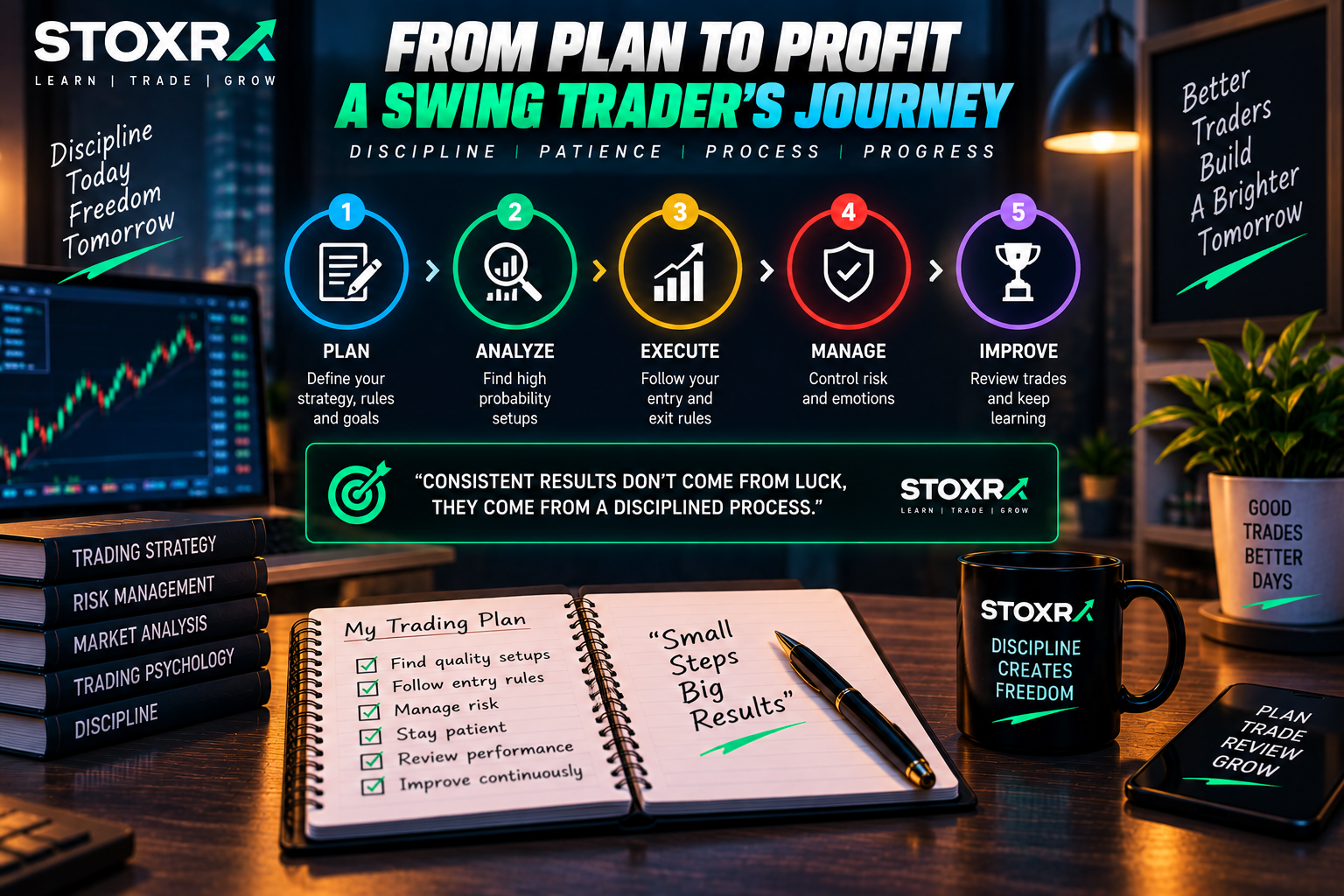
Key Takeaway
Successful swing trading is not simply about finding the right stock. It is about having a clear process for entering, managing and exiting trades.
Beginners should identify the broader trend, wait for a valid setup, confirm the entry, define the stop-loss, calculate an appropriate position size and establish a realistic exit plan before entering a trade.
Traders should also avoid chasing prices, overtrading, moving stop-losses emotionally or holding losing positions without a valid reason.
A consistent trading process does not eliminate losses, but it can help traders understand their risk and make decisions more systematically.
Frequently Asked Questions
What is the best entry rule for swing trading?
There is no single entry rule that works for every market. Beginners can start by identifying the broader trend, finding a defined setup and waiting for confirmation before entering.
Where should a swing trader place a stop-loss?
A stop-loss can be placed at a technical level where the original trade thesis would be considered invalid. The exact level should also be consistent with the trader's risk tolerance and position size.
How do swing traders decide when to exit?
Traders may exit when the original thesis is invalidated, a predefined target is reached, the trend changes or another condition in their trading plan occurs.
How long should a swing trade be held?
There is no universal holding period. Swing trades can last from several sessions to several weeks depending on the strategy, price movement and market conditions.
Is swing trading suitable for beginners?
Beginners can study swing trading, but they should understand market risk, position sizing and the possibility of losses before using real capital.
Should beginners use a profit target?
A predefined profit target can help create a structured exit plan. However, the target should be based on the trading strategy and market structure rather than an arbitrary number.
Can technical indicators guarantee swing trading profits?
No. Technical indicators are analytical tools and cannot guarantee future price movements or trading profits.
Conclusion
Clear entry and exit rules can make swing trading more structured, especially for beginners who are still developing their trading process.
A practical approach starts with identifying the broader market trend and then looking for a clearly defined setup.
Before entering, traders should know the entry conditions, stop-loss, position size and potential exit plan.
Once a position is open, decisions should be based on the predefined trading process rather than fear, greed or the desire to recover a previous loss.
Swing trading involves uncertainty, and even well-planned setups can fail. Good risk management therefore remains just as important as technical analysis.
Over time, keeping a trading journal and reviewing both successful and unsuccessful trades can help traders identify weaknesses and improve their process.
The objective is not to win every trade. The objective is to develop a repeatable approach in which potential opportunities are evaluated carefully and risk is managed before capital is committed.
Explore More Trading Insights
Want to strengthen your trading knowledge? Continue learning with STOXRA through practical articles and market education.
Disclaimer
This article is provided for educational and informational purposes only. It does not constitute investment advice, financial advice, trading advice or a recommendation to buy or sell any security, stock, option, derivative or other financial instrument.
Swing trading involves market risk and can result in losses. Stop-loss orders do not guarantee execution at a specific price, particularly during gaps or rapidly changing market conditions. Readers should conduct their own research, understand the risks involved and consider consulting a qualified financial professional where appropriate before making trading or investment decisions.