What Is a Circuit Limit?
A beginner-friendly guide explaining what a circuit limit is, how upper and lower price bands work, ₹ examples, and why circuit limits matter when trading Indian stocks.
What Is a Circuit Limit? Meaning, Upper & Lower Circuits
A circuit limit is a predefined boundary that restricts how far the price of a security can move during a trading session. In simple terms, it acts like a speed limit for price movement.
Beginner Trading Education • Educational examples only
Circuit Limit: Simple Definition
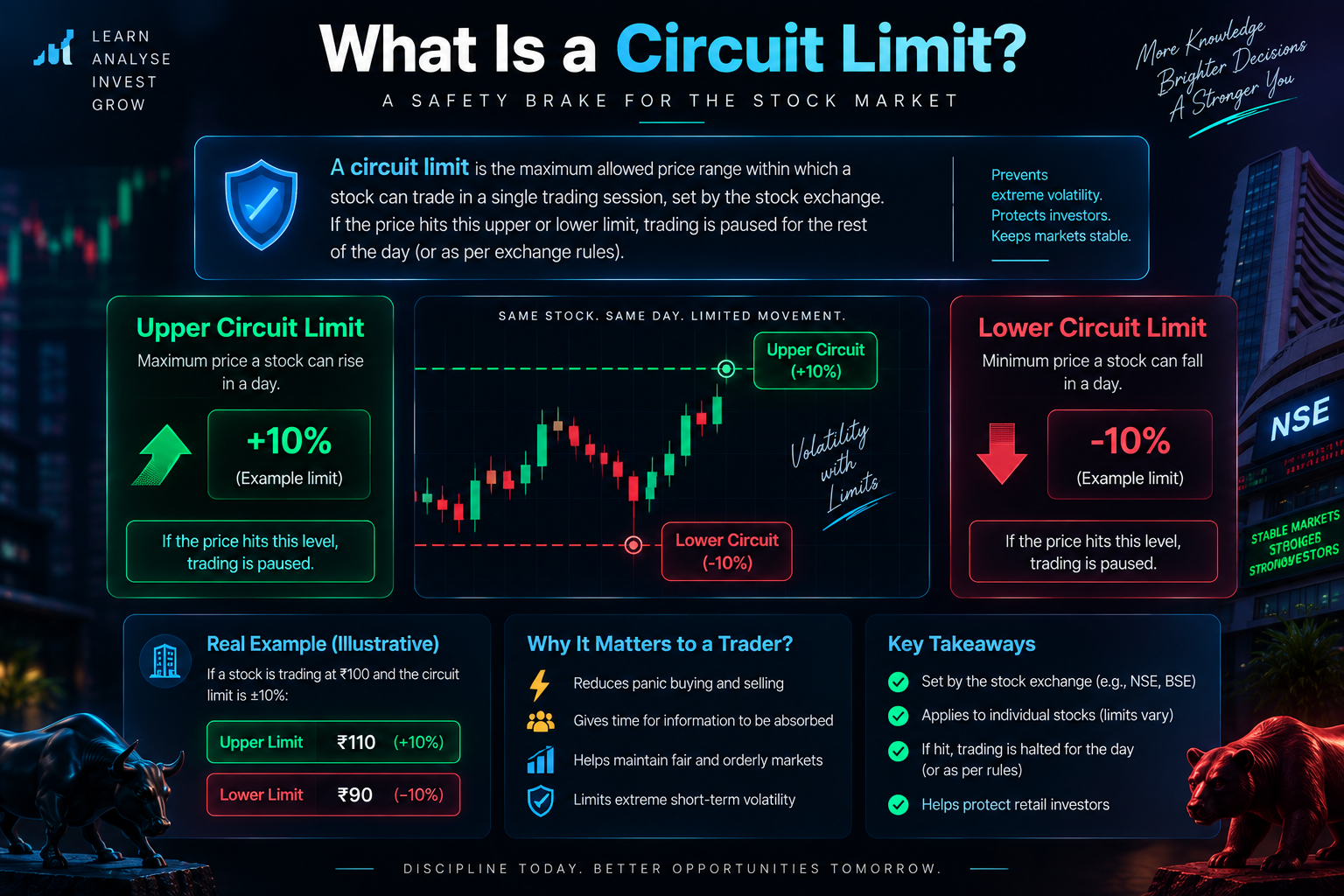
A circuit limit is a price movement boundary placed on a security to help control extreme short-term volatility. Depending on the security and exchange rules, the permitted range may be expressed as a percentage of the previous closing price. For example, if a stock closed at ₹100 and has a ±10% price band, its illustrative upper boundary is ₹110 and its lower boundary is ₹90. The NSE describes price bands as the range within which a security can move and states that a 10% band represents movement of ±10% from the previous day's close. (market volatility) (exchange and market rules)
For a trader, this matters because a stock near its upper or lower limit can behave differently from a normally trading stock. Entering or exiting at the desired price may become difficult when orders are heavily one-sided. Circuit limits should therefore be understood alongside market capitalization, stock market terminology, price bands and order execution. (trading discipline)
How Does a Circuit Limit Work?
Think of a circuit limit as a boundary around a stock's allowed price movement for a trading session. The reference price is commonly the previous closing price, although the exact exchange mechanism can depend on the security and market segment.
Suppose a hypothetical stock closed yesterday at ₹100 and has a 10% price band. The simple calculation is:
Lower limit = ₹100 − (₹100 × 10%) = ₹90
This does not mean the stock is worth ₹110 or ₹90. It simply describes the permitted trading range under the assumed band. The circuit limit is therefore a market-control mechanism, not a valuation measure.
NSE lists several daily price-band categories. These include 2%, 5%, 10% and 20% bands. Securities with derivative products can have different treatment under the exchange's rules.
Upper Circuit vs Lower Circuit
🟢 Upper Circuit
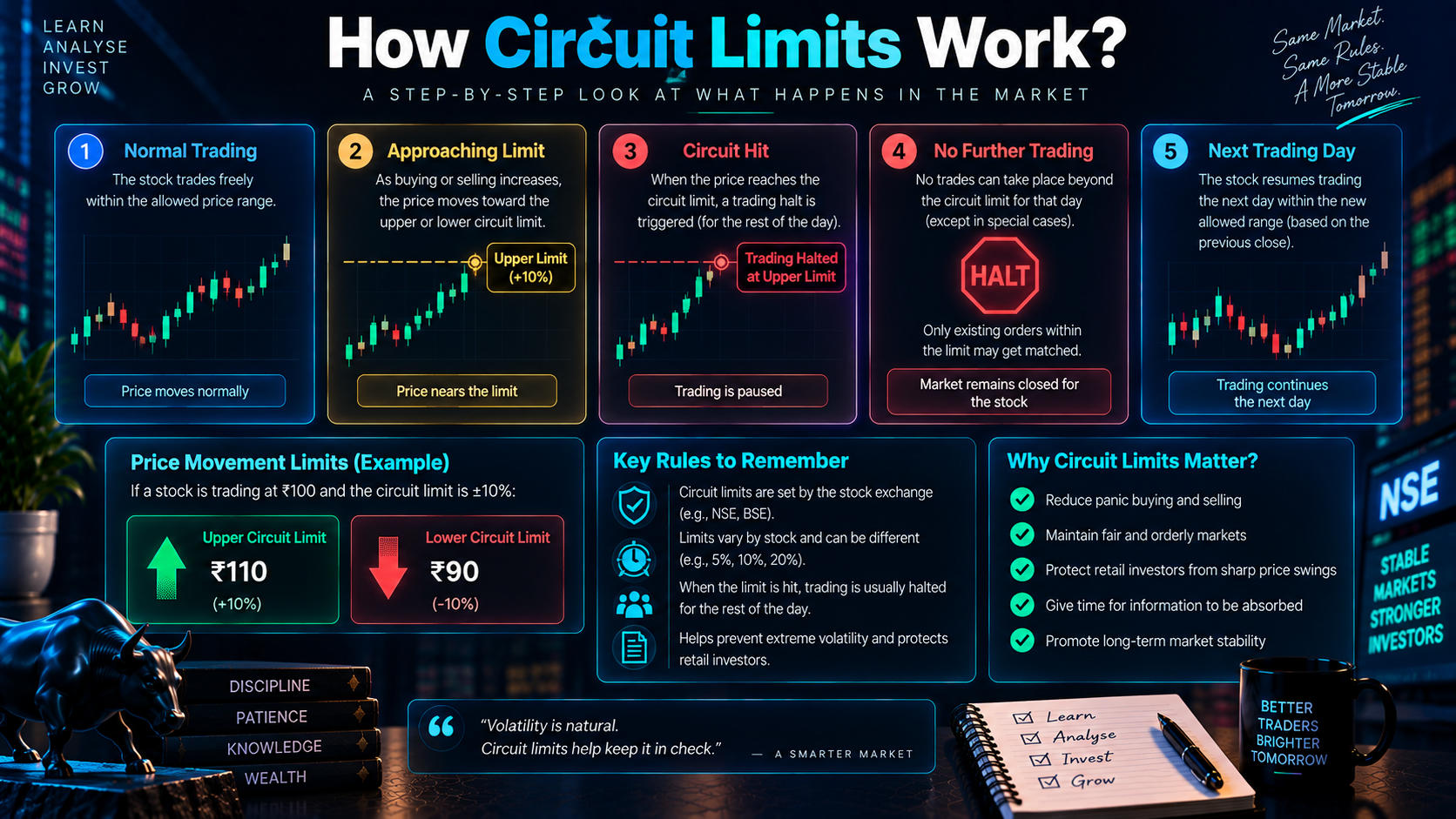
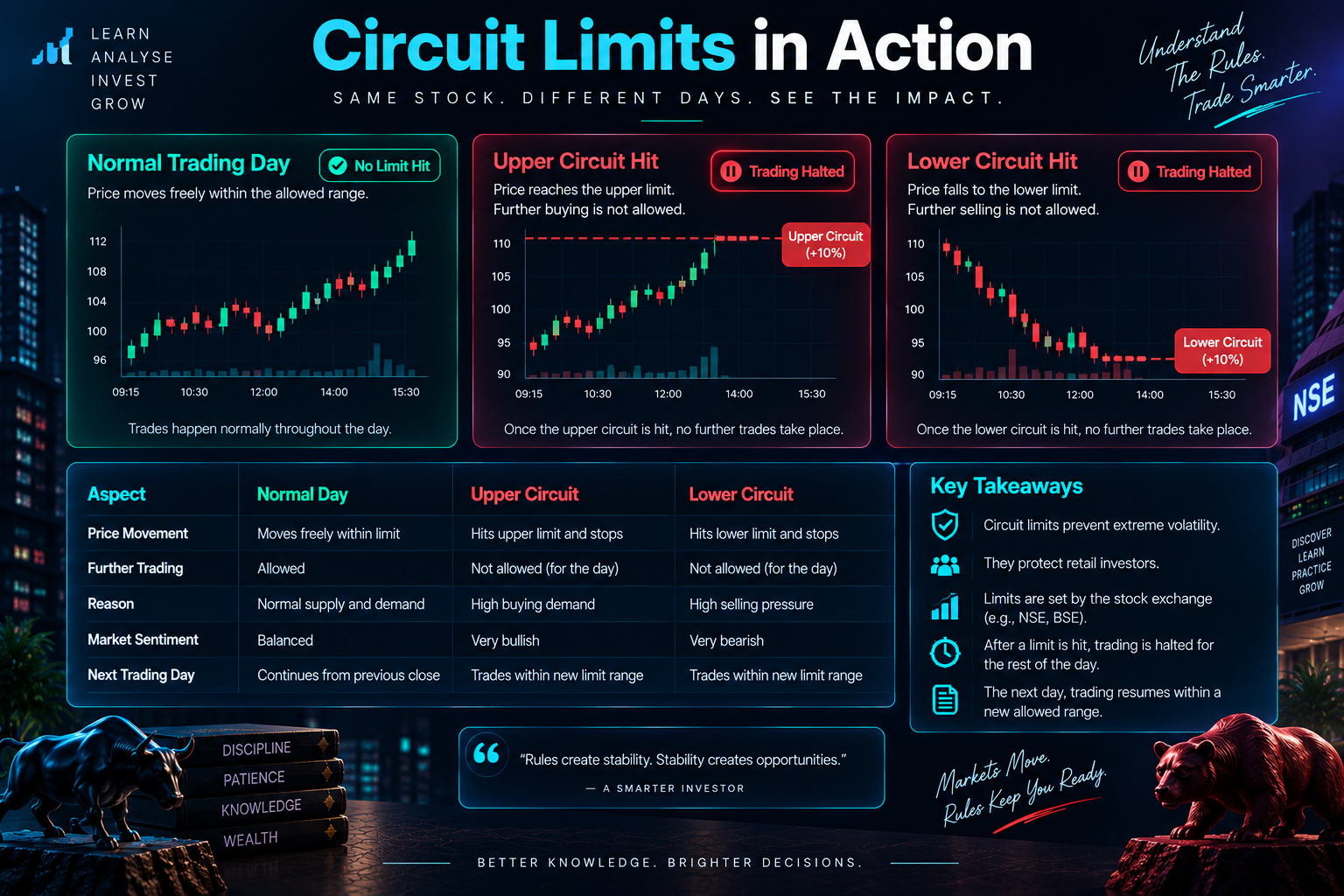
The upper circuit represents the upper end of the permitted price range. It is commonly associated with strong buying pressure. When demand is much stronger than available selling interest, the stock can move toward its upper boundary.
🔴 Lower Circuit
The lower circuit represents the lower end of the permitted range. It is commonly associated with strong selling pressure. When sellers dominate available buyers, the stock can move toward its lower boundary.
🟡 Price Band
The price band is the range between the upper and lower permitted prices. It is a rule governing price movement, not a prediction about where the stock should trade.
A Realistic Example Using ₹100
Consider a hypothetical company whose stock closed at ₹100. Assume the exchange has assigned a 10% price band for this example.
| Calculation | Result |
|---|---|
| Previous close | ₹100 |
| Assumed price band | 10% |
| Upper boundary | ₹110 |
| Lower boundary | ₹90 |
| Illustrative movement | ₹90–₹110 |
If buyers push the stock toward ₹110, the stock is approaching its upper price boundary. If selling pressure pushes it toward ₹90, it is approaching its lower boundary.
The important point is that hitting the boundary does not mean there is automatically a guaranteed trade at that price. Execution still depends on orders available in the market and the exchange's matching rules.
What Happens When a Stock Hits Its Upper Circuit?
Imagine that a stock is trading around ₹108 while its illustrative upper boundary is ₹110. Buyers continue placing orders and the price reaches ₹110.
At that point, the stock cannot simply continue moving above the applicable upper boundary under the same price-band conditions. If buying demand remains extremely high while sellers are scarce, the order book can become heavily one-sided.
This creates a situation traders commonly describe as being “locked in upper circuit.” A trader wanting to buy may find that there are many buyers but very few willing sellers. A market order therefore does not magically create a seller.
This is why seeing a stock at an upper circuit should not automatically be interpreted as “buy now.” A price limit is a trading constraint, not proof that the company's intrinsic value has suddenly increased.
What Happens When a Stock Hits Its Lower Circuit?
The opposite situation can happen when selling pressure dominates.
Suppose the same hypothetical stock has a lower boundary of ₹90. If negative news causes aggressive selling, the price may fall toward ₹90. Once the applicable lower price boundary is reached, orders cannot simply execute at prices below that boundary under the same conditions. (market news)
If there are thousands of sellers and very few buyers, the stock may become heavily one-sided at the lower boundary.
For an investor already holding the stock, this can be uncomfortable because placing a sell order does not guarantee an immediate exit. There must be a counterparty willing to buy within the permitted trading range.
Are Circuit Limits the Same as Market-Wide Circuit Breakers?
No. This is one of the most important distinctions a beginner should understand.
An individual security's price band controls the permitted movement of that security. A market-wide circuit breaker, on the other hand, is an index-based mechanism designed to halt trading across the market when major benchmark indices move by specified percentages.
NSE states that its index-based market-wide circuit breaker system operates at 10%, 15% and 20% movements in either direction.
These thresholds do not mean every individual stock has a 10%, 15% or 20% circuit limit.
| Feature | Security Price Band | Market-Wide Circuit Breaker |
|---|---|---|
| Applies to | Individual security | Broad market |
| Reference | Security price / applicable exchange rule | Major market index movement |
| Purpose | Control extreme movement in a security | Pause trading during extreme market-wide moves |
| Example | Hypothetical ±10% | 10%, 15%, 20% index triggers |
| Effect | Constrains applicable security price movement | Can produce coordinated market trading halts |
NSE's official circuit-breaker framework specifies coordinated trading halts in equity and equity derivative markets when the market-wide thresholds are triggered.
Why Do Exchanges Use Circuit Limits?
Financial markets naturally experience volatility. Prices can react to earnings announcements, corporate actions and economic releases.
A price-band framework can help prevent uncontrolled movement from becoming immediately disorderly.
The goal is not to prevent prices from ever rising or falling sharply. Instead, these mechanisms create structured boundaries around extreme movements.
This matters to retail traders. An inexperienced trader may see a stock rising rapidly and assume the price will keep rising.
Circuit limits therefore belong in the same basic risk-management conversation as trading plans, trading discipline and paper trading. (paper trading)
Do Circuit Limits Mean a Stock Is Safe?
Absolutely not.
This is a common beginner misconception. A circuit limit does not mean that a stock is fundamentally strong, cheap, expensive, safe or guaranteed to recover.
A stock can hit an upper circuit because of intense demand, speculation, news, momentum or other market forces. A stock can hit a lower circuit because of negative information, panic, poor liquidity or heavy selling. (liquidity when finding swing-trading stocks)
The circuit is a market mechanism. It is not an investment recommendation.
If you want to understand whether a company is financially attractive, you need to study other information such as revenue, earnings, valuation, debt, cash flow, competitive position and corporate announcements.
You can begin with stock market basics, then learn stock screening and eventually develop a structured approach to technical and fundamental analysis.
Circuit Limit vs Stop-Loss
A circuit limit and a stop-loss are completely different.
A stop-loss is an order or trading instruction designed to limit a trader's loss by attempting to exit a position when a specified trigger is reached.
A circuit limit is an exchange-level price movement restriction.
| Term | Meaning |
|---|---|
| Circuit limit | Exchange-defined boundary on permitted price movement. |
| Stop-loss | Trader-defined risk-management instruction. |
| Limit order | Order specifying the maximum buy price or minimum sell price acceptable to the trader. |
| Market order | Order intended to execute at available market prices. |
Understanding the difference between these terms is essential before moving into more advanced topics such as trading signals, algorithmic strategies or derivatives.
Circuit Limit vs Limit Order
The word “limit” can cause confusion because both concepts use it.
A limit order is an instruction from a trader. For example, you might place a buy limit order at ₹100, telling the system that you do not want to pay more than ₹100 for the order.
A circuit limit is an exchange-level restriction on how far the security can move within the applicable framework.
A limit order does not guarantee execution. Likewise, a circuit limit does not guarantee that your order will execute at the boundary.
Why Circuit Limits Matter to Swing Traders
Swing traders need to pay attention to circuit limits. Their strategy depends on entering and exiting positions over multiple sessions.
Suppose a trader buys a small-cap stock expecting a breakout. The stock unexpectedly hits a lower circuit after negative news.
The trader may have a predefined stop-loss. However, execution can become difficult when the market is one-sided and buyers are scarce.
This is one reason a trading plan should consider:
- Liquidity and average trading volume
- Position size
- Potential overnight news risk
- Price-band structure
- Bid-ask conditions
- Corporate announcements
- Maximum acceptable portfolio risk
For additional swing-trading education, see how to find swing-trading stocks and how to screen stocks for swing setups.
Interactive Circuit Limit Calculator
Calculate an Illustrative Price Band
Enter a previous closing price and an assumed percentage band. The calculator shows the corresponding upper and lower boundaries.
Enter values or choose a quick band. Results update instantly.
This is an educational calculator. It does not determine the actual price band of a particular security.
What Should a Beginner Do When a Stock Is Near a Circuit?
Do not make a decision solely because the stock is close to its upper or lower limit.
1. Check the reason for the move
Look for company announcements, earnings, corporate actions, regulatory disclosures or credible market news. Do not assume that a price spike itself is the reason to buy.
2. Check liquidity
A stock with thin liquidity can behave very differently from a highly traded large-cap stock. A trader may find it harder to enter or exit efficiently.
3. Check your position size
Never allow one speculative position to create disproportionate portfolio risk. Position sizing becomes especially important when execution may become difficult.
4. Avoid chasing the upper circuit
An upper circuit can create fear of missing out. But buying solely because many people are buying is not a trading strategy.
5. Do not panic-sell solely because of a lower circuit
A lower circuit is information about price movement and market conditions, not a complete fundamental analysis of the business. Review the reason for the move and your original thesis.
Common Beginner Mistakes About Circuit Limits
❌ “Upper circuit means buy.”
Wrong. It only means the price has reached or approached an applicable upper boundary. It does not establish fair value.
❌ “Lower circuit means guaranteed selling.”
Wrong. Execution requires a willing counterparty and available matching orders.
❌ “Every circuit stops the whole market.”
Wrong. Individual security price bands and market-wide circuit breakers are different mechanisms.
How NSE Price Bands Differ Across Securities
NSE's published price-band framework includes different daily bands, including 2%, 5%, 10% and 20% categories. It also states that securities with derivative products do not have the same fixed daily price-band treatment; the exchange can use a dynamic price band based on its criteria.
This is why traders should not assume that every stock has the same circuit percentage.
Before trading a particular security, check the applicable exchange information.
For official market information, traders can refer to NSE, BSE and SEBI.
How Circuit Limits Fit Into the Bigger Trading Picture
Circuit limits are only one part of understanding market structure.
A beginner can progressively learn how a Demat account works, what a trading account does, how market capitalization works, and how corporate actions such as a stock split, bonus share and dividend can affect the information visible on a trading platform.
After the foundation is clear, traders can move into paper trading, stock screeners, trading plans, backtesting and eventually more advanced approaches.
Circuit limits become much easier to understand once you see them as one component of the broader order-execution and risk-management system.
Key Takeaways
- A circuit limit is an exchange-defined boundary that restricts how far a security can move within the applicable trading framework.
- An upper circuit marks the top of the applicable price band; a lower circuit marks the bottom.
- Reaching a circuit price does not guarantee that a buy or sell order will execute.
- Individual security price bands are different from market-wide circuit breakers, which are index-based mechanisms.
- Traders should consider liquidity, position size, order-book conditions, news and risk management rather than treating a circuit as a buy or sell signal.
Frequently Asked Questions
What is a circuit limit in the stock market?
A circuit limit is a predefined boundary that restricts how far a security's price can move under the applicable exchange rules during a trading session.
What is an upper circuit?
An upper circuit is the upper end of an applicable price band. Strong buying demand can push a security toward this boundary.
What is a lower circuit?
A lower circuit is the lower end of an applicable price band. Strong selling pressure can push a security toward this boundary.
Can I buy a stock at the upper circuit?
You can place an eligible order, but execution is not guaranteed. If sellers are insufficient, your buy order may remain unexecuted.
Can I sell a stock at the lower circuit?
Execution is not guaranteed. If there are insufficient buyers, a sell order can remain pending even when the displayed price is at the lower boundary.
Is a circuit limit the same as a stop-loss?
No. A circuit limit is an exchange-level price restriction. A stop-loss is a trader's risk-management order or instruction. (risk planning)
Does an upper circuit mean the stock is fundamentally strong?
No. Price movement can reflect demand, news, sentiment, speculation, liquidity and many other factors. A circuit limit is not a valuation indicator.
Does every Indian stock have the same circuit limit?
No. Applicable price-band rules can vary by security and market segment. NSE publishes different price-band categories and special treatment for securities with derivatives.
Useful Learning Resources
- NSE — Equity Market Circuit Breakers
- NSE — Equity Market Price Bands
- SEBI — Securities and Exchange Board of India
- Stock Market Basics for Beginners
- Stock Market Terminology
- Stock Market Rules
- How to Create a Trading Plan
- How to Screen Stocks for Swing Trading
- Paper Trading vs Real Trading
- How Stock Screeners Work
- Demat Account
- Trading Account
- Dividend
Final Takeaway
A circuit limit is a market-structure rule that places a boundary on price movement.
For a hypothetical ₹100 stock with a 10% band, the boundaries would be ₹110 and ₹90.
Execution is never guaranteed simply because a circuit price is displayed.
Most importantly, do not confuse an individual stock's price band with a market-wide circuit breaker.
This is separate from security-level price bands.
Understand circuit limits together with price bands, order types, liquidity and risk management.
Build Your Trading Knowledge Before Risking Capital
Circuit limits are just one part of becoming a disciplined trader. Learn the fundamentals, practise strategies, understand risk and build a repeatable process before putting real money at risk.
Explore More Stoxra Trading Guides →Educational content only. Examples in this article are illustrative and do not constitute investment advice. Exchange rules, price bands and market mechanisms can change; always verify the applicable rules and security-specific information from the relevant exchange and regulator before trading.
Written by Krishna Sai Channalli.