What Is a Dividend?
A dividend is a payment made by a company to eligible shareholders, usually from profits or distributable reserves. Learn how dividends work, understand dividend per share, important dates, dividend yield, and why dividends matter to traders and investors.
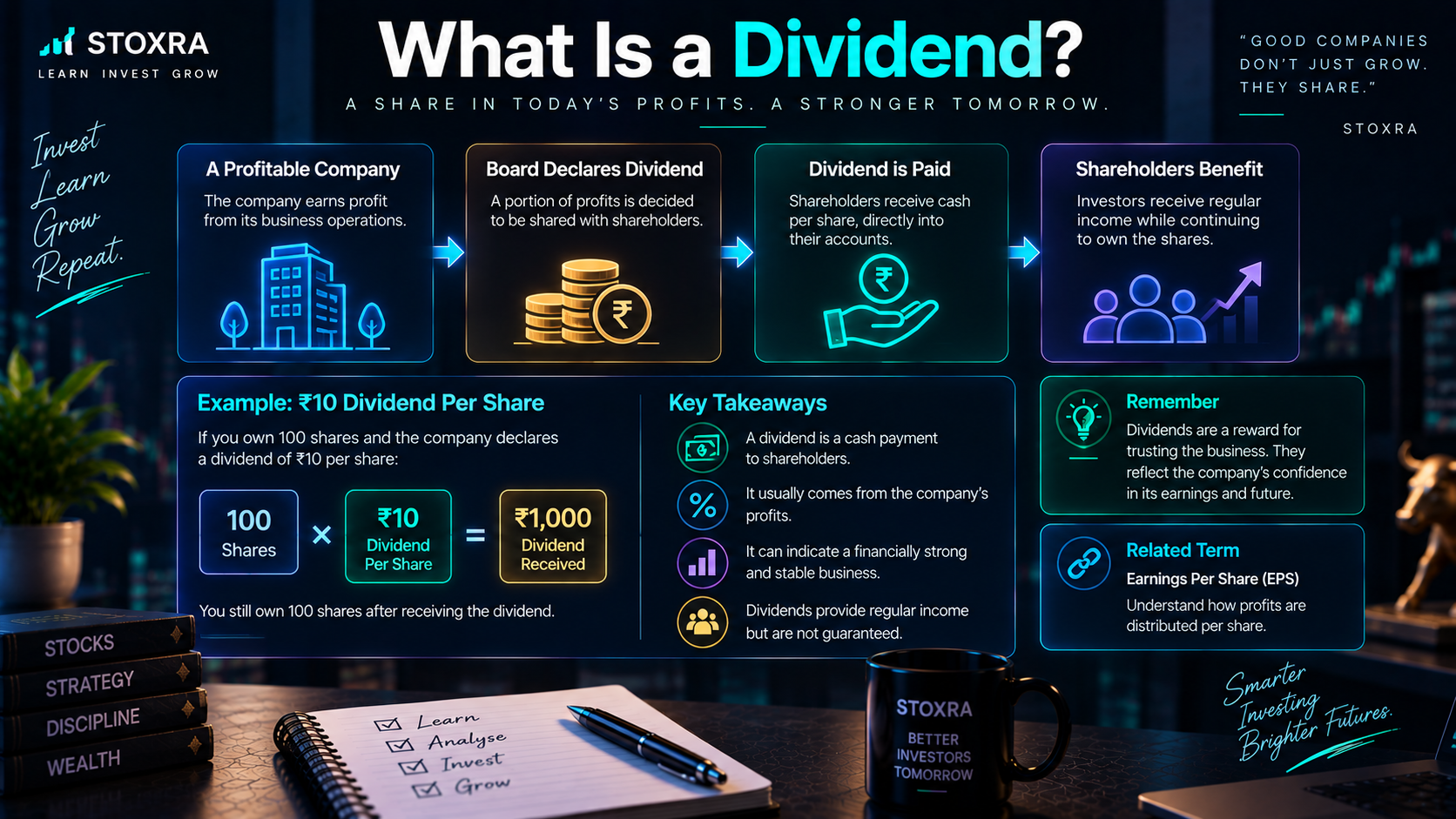
Dividend concept illustration. Internship Program Examples shown are educational and are not live market data.
Key Takeaways
- A dividend is a cash distribution to eligible shareholders, usually stated per share.
- Dividend per share, dividend yield, and payout ratio measure different things.
- Ex-dividend and record dates matter for eligibility, so verify the official corporate-action notice.
- A high dividend yield does not automatically mean a stock is safer or better.
- Dividend analysis should be combined with earnings, cash flow, valuation, risk, and total return.
What Is a Dividend?
A dividend is money distributed by a company to its eligible shareholders. Is AI Trading Legal in India When a company declares a dividend of ₹10 per share, an investor holding 100 eligible shares would receive ₹1,000, before considering any applicable taxes or other circumstances.
Dividends are one potential component of the return from owning shares. Leaderboard The other major component is capital appreciation, which occurs when the market value of a security increases.
Learn how company size fits into this return picture with market capitalization.
SEBI's investor education material defines a dividend as a payment made to shareholders, generally from company profit after tax, while noting that companies can retain part of their profits as reserves. Stoxra Learn (Trading Academy)
A dividend is normally quoted on a per-share basis. Legal / Compliance For example, if a company declares ₹10 per share and you own 200 eligible shares, the basic dividend calculation is:
Dividends are not guaranteed. Privacy Policy A company may choose to retain earnings for expansion, debt reduction, acquisitions, working capital or other purposes instead of distributing them.
For beginners, this is one of the core ideas covered in stock market basics .
For beginners, dividends are easier to understand alongside market capitalization and stock-market terminology .
A Simple Dividend Example
Consider a hypothetical company that declares a dividend of ₹10 per share.
| Investor | Shares Held | Dividend / Share | Dividend Received |
|---|---|---|---|
| Investor A | 50 | ₹10 | ₹500 |
| Investor B | 100 | ₹10 | ₹1,000 |
| Investor C | 500 | ₹10 | ₹5,000 |
The calculation is simple: multiply the number of eligible shares by the dividend declared per share. Terms (Legal)
How Does a Dividend Work?
01 · Company Generates Earnings
A company operates its business and may generate profits that can potentially be distributed or retained. Market News Hub
02 · Dividend Is Declared
The company announces the dividend amount per share and the relevant corporate-action details. Paper Trading vs Real Trading
03 · Eligibility Is Determined
The applicable record-date and exchange process determines which shareholders are entitled to receive the declared dividend. Partner Program
04 · Dividend Is Paid
Eligible shareholders receive the dividend through the applicable payment process, generally linked to their registered bank details. SAC Hub
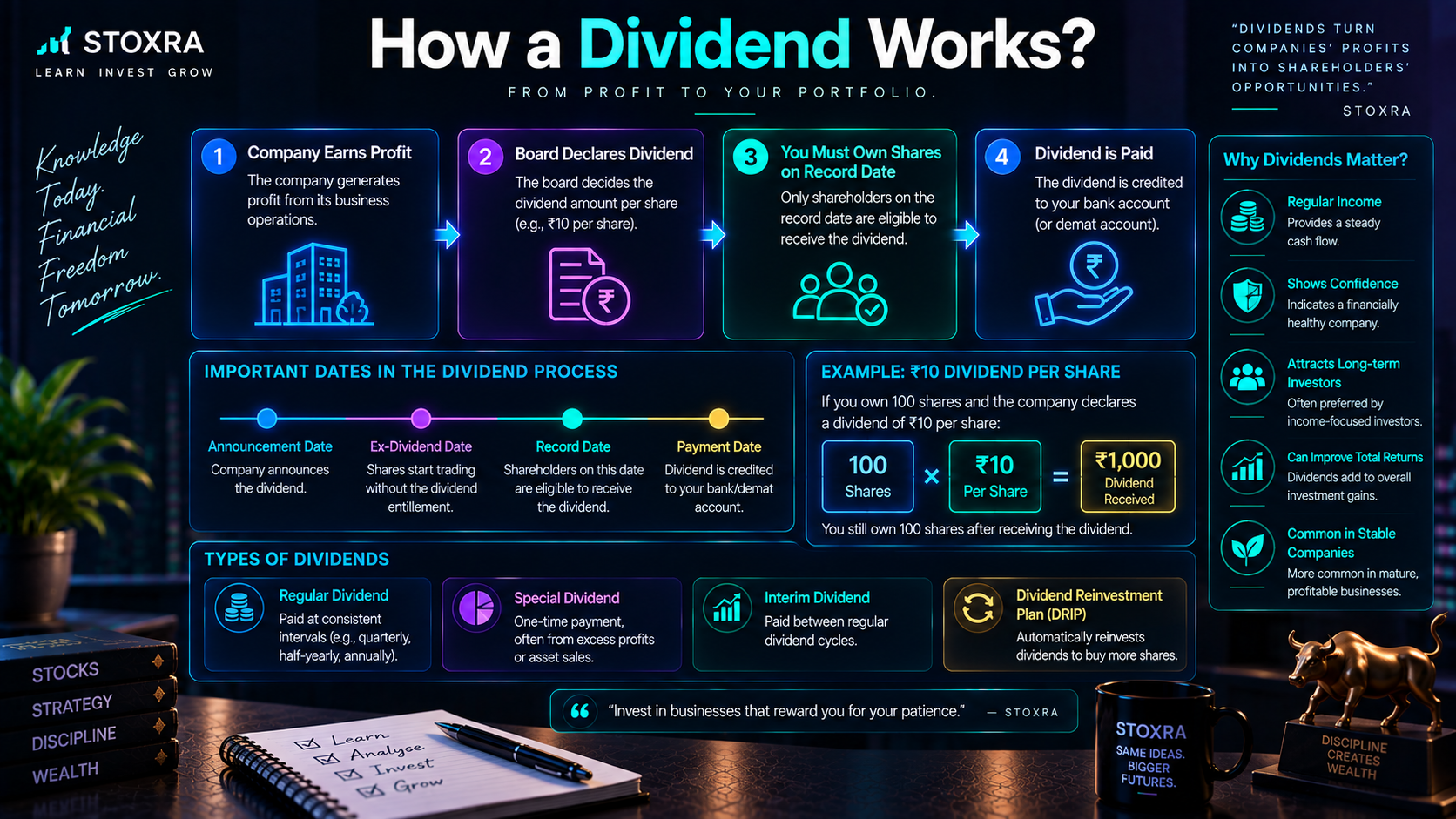
Dividend workflow and key dates. SAC Clubs Date mechanics can vary by market rules and the specific corporate action.
What Is Dividend Per Share?
Dividend per share (DPS) is the amount of dividend declared for each eligible share.
For example, if a company distributes ₹10 crore across 1 crore eligible shares, the dividend works out to ₹10 per share. SAC Constitution
DPS is useful because it allows investors to calculate the expected cash distribution from their holdings.
The mechanics are easier to place in context after understanding a Demat account .
If you own 1,000 shares and the dividend is ₹12 per share:
This is the basic gross dividend calculation before considering any applicable tax treatment. SAC Events
What Is Dividend Yield?
Dividend yield compares the dividend per share with the market price of the share.
Start with the broader stock market basics .
Suppose a company pays ₹3 per share and its market price is ₹30. SAC FAQ The dividend yield would be:
SEBI investor material uses this same type of example to distinguish dividend yield from the dividend rate calculated against a share's face value.
A high dividend yield should not automatically be interpreted as a superior investment. SAC Gallery Yield can rise because the dividend increased, because the share price fell, or because of a combination of factors.
Avoiding this mistake is part of disciplined stock market rules .
Dividend vs Dividend Yield
| Concept | Meaning | Simple Example |
|---|---|---|
| Dividend | Cash distribution to eligible shareholders | ₹10 per share |
| Dividend Per Share | Dividend amount assigned to each share | ₹10 |
| Dividend Yield | Dividend relative to market price | ₹10 ÷ ₹200 = 5% |
Important Dividend Dates
Understanding dividend dates is essential for traders because owning a stock at the wrong point in the corporate-action timeline can affect eligibility. SAC Leaderboard
These dates should be understood alongside how a trading account.
Announcement Date
The company announces the dividend and relevant corporate-action information.
Ex-Dividend Date
From the ex-dividend date, shares trade without entitlement to the declared dividend under the applicable market settlement framework. SAC Partner Colleges
Record Date
The company uses the record-date process to determine the shareholders entitled to the dividend. SAC Rewards
Payment Date
The dividend is paid or credited to eligible shareholders according to the applicable process. StoxraHack
NSE's investor material explains the relationship between cum-dividend, ex-dividend, record and payment dates. Terms
NSE's corporate-action pages also publish dividend announcements, record dates and ex-dates for listed securities. Tools Index
What Is the Record Date?
The record date is the date used to identify shareholders who are eligible for a declared corporate action such as a dividend. Upgrade / Pricing
Use the official framework together with Stoxra's corporate-action basics .
When a company announces a dividend, investors should check the official exchange and company announcement for the precise record date rather than relying on social-media posts or informal messages. What Is AI Trading
SEBI's listing framework specifically covers record dates for dividend, bonus and other corporate actions and requires listed entities to give advance notice to the stock exchanges. World News
What Is an Ex-Dividend Date?
The ex-dividend date is the date from which the stock trades without entitlement to the declared dividend under the applicable settlement framework. Tool Page
Pair date awareness with a clear trading plan .
NSE's investor material explains that the ex-dividend date is connected to the record date and that the share price can be adjusted for the dividend payout. Existing Blog Post
This is particularly important for short-term traders because buying solely because a dividend is approaching does not automatically create a risk-free profit opportunity. Existing Blog Post
Why Does a Dividend Matter to a Trader?
Dividends matter because they affect the total-return picture of a stock. Existing Blog Post A trader or investor looking only at the share-price chart can overlook cash distributions received during the holding period.
Total-return analysis benefits from understanding market capitalization .
Income Component
Dividends can provide cash income while an investor continues to own the shares.
Total Return
Investment performance can include both capital appreciation and dividends received.
Business Quality Signal
A consistent dividend history can provide useful information about capital allocation, but it does not prove that a company is financially superior. Existing Blog Post
Corporate-Action Awareness
Traders need to understand dividend dates to interpret price movements correctly.
Do Dividends Mean a Company Is Strong?
Not necessarily.
Compare companies systematically with stock screening .
A dividend can be one useful piece of information about how a company allocates capital, but it should not be treated as a standalone measure of business quality. Existing Blog Post
A company might retain most of its earnings because it has attractive expansion opportunities. Existing Blog Post Another company might distribute a large percentage of earnings because it has fewer profitable reinvestment opportunities.
Therefore, a trader should examine earnings, cash flows, debt, profitability, valuation, competitive position and growth prospects alongside the dividend. Existing Blog Post
Dividend vs Capital Appreciation
Stock-market returns can come from more than one source.
Beginners can practise separating income from price movement with paper trading .
| Return Type | How It Works | Example |
|---|---|---|
| Dividend Income | Cash distributed to eligible shareholders | ₹10 dividend per share |
| Capital Appreciation | Share price increases after purchase | ₹200 → ₹250 |
| Total Return | Combines relevant income and price movement | Price gain + dividends |
SEBI investor education material similarly distinguishes regular income such as dividends from capital appreciation. Existing Blog Post
Types of Dividends
Final Dividend
A dividend associated with the company's annual financial results and approved through the applicable corporate process. Existing Blog Post
Interim Dividend
A dividend declared during the financial year rather than being solely associated with the final annual distribution. Existing Blog Post
Special Dividend
An additional or one-off distribution that is separate from a company's regular dividend pattern. Existing Blog Post
Regular Dividend
A recurring distribution pattern that a company may maintain when supported by its financial position and policy. Existing Blog Post
Dividend Calculator
Calculate Your Dividend
Enter the number of shares and dividend per share to calculate an illustrative gross dividend amount.
Dividend vs Bonus Share
Dividends and bonus shares are both corporate actions that can benefit existing shareholders, but they work very differently. Existing Blog Post
Compare the two corporate actions in Stoxra's bonus share guide .
| Feature | Dividend | Bonus Share |
|---|---|---|
| What you receive | Cash payment | Additional shares |
| Share count | Normally unchanged | Increases |
| Cash received | Yes | No purchase consideration for the bonus shares |
| Main concept | Distribution of cash | Distribution through additional shares |
If you want to understand the second concept in detail, read What Is a Bonus Share?
Dividend vs Stock Split
A dividend distributes cash, while a stock split changes the number of units into which the company's existing equity is divided. Existing Blog Post
The related corporate action is explained in the stock split guide .
| Feature | Dividend | Stock Split |
|---|---|---|
| Investor receives | Cash | More shares through the split adjustment |
| Purpose | Distribute cash | Change share denomination/share count |
| Share price | Can adjust around the ex-dividend process | Adjusted according to split ratio |
Continue with Stoxra's stock split guide to understand that corporate action separately.
What Traders Should Check Before Buying for a Dividend
Buying a stock only because a dividend is approaching can be misleading. Existing Blog Post A disciplined trader should consider the entire setup.
Put the checklist into a repeatable trading plan .
- Dividend per share
- Dividend yield
- Company earnings and cash flow
- Dividend history
- Record date
- Ex-dividend date
- Current valuation
- Price trend
- Sector conditions
- Potential tax implications
- Overall risk and position size
The dividend itself should be only one part of the analysis. Existing Blog Post Stoxra's trading-plan guide can help put individual corporate actions into a broader decision-making framework.
Common Dividend Mistakes Beginners Make
1. Chasing a High Yield
A very high yield can sometimes result from a falling share price, not from a stronger business or a permanently higher dividend. Existing Blog Post
More beginner guidance is available in Stoxra's expert trading tips .
2. Ignoring the Ex-Date
Dividend eligibility depends on the applicable settlement and corporate-action dates.
3. Treating Dividends as Guaranteed
Companies can change their dividend policies and future distributions are not guaranteed.
4. Ignoring Total Return
A dividend should be considered together with share-price movement, rather than viewed in isolation. Existing Blog Post
5. Confusing Dividend Rate With Yield
Dividend rate can refer to the dividend relative to face value, while dividend yield compares the dividend with market price. Existing Blog Post
6. Assuming Every Dividend Is Regular
Some distributions are interim, final, special or otherwise dependent on the company's policy and financial position. Existing Blog Post
Does a Dividend Make a Stock Bullish?
Not automatically.
Do not treat automated signals as a shortcut; learn to evaluate AI trading signals .
A dividend announcement can influence investor sentiment, but it does not guarantee future share-price appreciation. Existing Blog Post
Price behaviour should be studied with basic technical analysis .
A company can have an attractive dividend while its share price declines. Existing Blog Post Conversely, a company that pays little or no dividend can deliver strong capital appreciation if it reinvests successfully and grows its earnings.
The right question is therefore not simply: "Does this stock pay dividends?"
A disciplined approach starts with a written trading plan framework .
A better question is: "Is the company's overall return potential appropriate for my strategy and risk tolerance?" Existing Blog Post
Dividends and Earnings Per Share
Dividends are closely connected to company earnings, making Earnings Per Share (EPS) an important related concept. Existing Blog Post
EPS measures the earnings attributable to each share. Existing Blog Post Dividend per share measures the amount distributed to shareholders for each eligible share.
| Metric | What It Measures |
|---|---|
| EPS | Earnings attributable to each share |
| DPS | Dividend distributed per share |
| Dividend Yield | Dividend relative to market price |
Understanding these metrics together can help traders avoid evaluating a dividend in isolation. Existing Blog Post
These concepts also fit into the wider stock-market terminology .
Dividend Payout Ratio
Another useful concept is the dividend payout ratio. Existing Blog Post It indicates how much of a company's earnings are being distributed as dividends relative to the earnings available for the calculation.
Systematic traders can also study AI algorithmic trading .
For example, if EPS is ₹50 and dividend per share is ₹20:
This does not automatically tell you whether a stock is attractive. The sustainability of earnings, cash flows, debt, growth opportunities and company policy still matter.
Systematic strategy research can be explored through backtesting .
Frequently Asked Questions
A dividend is money distributed by a company to eligible shareholders, generally from profits or other permitted distributable amounts.
What is dividend per share?Dividend per share is the amount of dividend declared for each eligible share.
What is dividend yield?Dividend yield compares dividend per share with the market price of the share and is generally expressed as a percentage.
What is the record date for a dividend?The record date is used to determine which shareholders are eligible to receive the declared dividend.
What is the ex-dividend date?The ex-dividend date is the date from which shares trade without entitlement to the declared dividend under the applicable settlement framework.
Are dividends guaranteed?No. Future dividend payments depend on the company's financial position, policy and applicable corporate and regulatory processes.
Does a dividend guarantee profit?No. A dividend can provide income, but the share price can fall and the overall investment can still produce a negative return.
Is dividend the same as bonus share?No. A dividend is generally a cash distribution, while a bonus issue provides additional shares to eligible shareholders.
Understand the Payout Before You Chase the Yield
A dividend can be useful income, but smart trading requires looking beyond one corporate action. Understand the business, valuation, earnings, risk and total-return picture before making a decision.
Explore Stoxra Stock Screener →Disclaimer: This article is for educational purposes only and does not constitute investment, trading, tax or financial advice. Dividend amounts, dates, eligibility, tax treatment and corporate-action procedures can vary. Always verify the official company and exchange announcement before making an investment decision.