What Is a Large Cap Stock?
Learn what a large-cap stock means, how SEBI/AMFI classify large-cap companies in India, why traders watch them, real examples, benefits, risks, and how large caps compare with mid- and small-cap stocks.
What Is a Large Cap Stock?
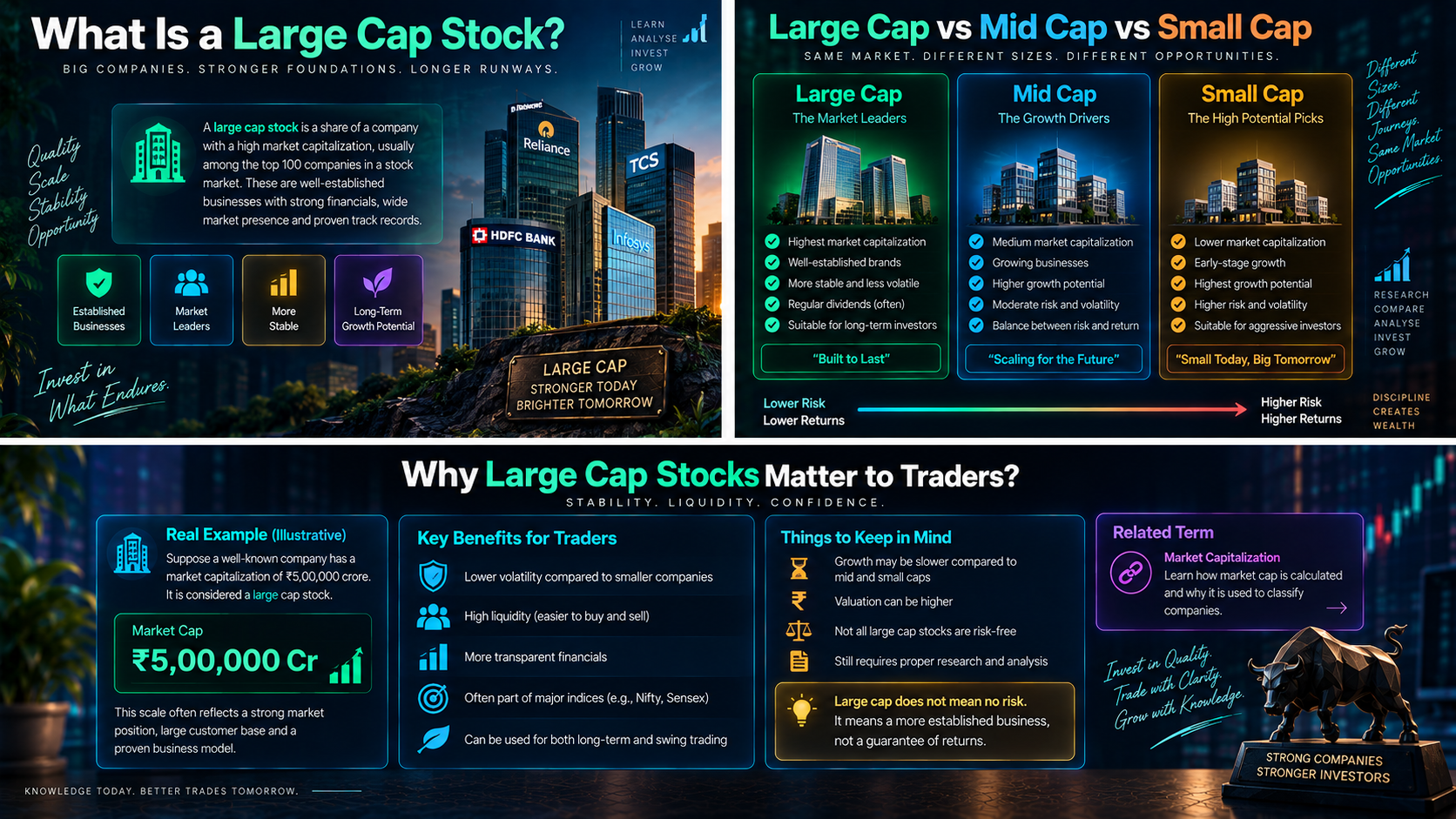
A large-cap stock represents a company with a very large market capitalization. In India, the standardized SEBI/AMFI classification places the top 100 companies by full market capitalization in the large-cap category.
By Krishna Sai Channalli • Stock Market Education • No live market data used
Large Cap Stock: Simple Definition
A large-cap stock is a share of a company that belongs to the large-cap segment based on its market capitalization. In the standardized Indian classification used for mutual-fund categorization, large-cap companies are ranked 1st to 100th by full market capitalization. Companies ranked 101st to 250th are mid-cap, while companies ranked 251st onward are small-cap. AMFI publishes the applicable stock categorization list using data from Indian stock exchanges. (AMFI)
In simple language, large-cap companies are generally among the biggest listed businesses in the market. They may have established operations, substantial revenues, recognizable brands, broad investor coverage and significant trading activity. A practical Indian example is Tata Consultancy Services (TCS), a major listed company that has appeared among the constituents of the Nifty 50. The exact classification of any company can change as market capitalizations and official classification lists are updated.
For a trader, large-cap status matters because size can influence liquidity, volatility, institutional participation and how a stock behaves during market-wide events. It does not, however, mean that the stock is guaranteed to rise or that the company is automatically a good investment. For a related guide, see Stoxra.
What Does “Large Cap” Actually Mean?
The word “cap” is short for capitalization. In the stock market, market capitalization is broadly calculated by multiplying a company's share price by the number of outstanding shares.
The market-cap idea becomes easier to apply when you also understand technical analysis in stock trading, especially when size is used as a screening filter.
For example, if a hypothetical company has 100 crore outstanding shares and its share price is ₹500, its market capitalization would be:
The important point is that there is no single permanent rupee number that automatically makes every company a large-cap stock. The classification is relative to the market and, under the Indian standardized framework, is determined by ranking companies by full market capitalization. For a related guide, see Stoxra Learn.
That distinction is extremely important for beginners. A company could become larger or smaller relative to other listed companies over time. Therefore, saying “a company has a market capitalization of ₹X, so it must always be large cap” is an oversimplification.
You can learn the underlying concept in more detail in our guide to market capitalization.
How Are Large Cap Stocks Classified in India?
SEBI introduced a standardized classification framework to create greater consistency in the investment universe used by equity mutual funds. AMFI prepares the corresponding stock list based on the prescribed methodology and exchange data. For a related guide, see Stoxra Stock Screener.
| Category | Market-Cap Ranking | General Meaning |
|---|---|---|
| Large Cap | 1st–100th | Largest companies by full market capitalization |
| Mid Cap | 101st–250th | Companies below the large-cap group |
| Small Cap | 251st onward | Companies below the mid-cap group |
This classification is based on full market capitalization, not simply the price of one share. A ₹5,000 stock is not automatically larger than a ₹500 stock. The number of outstanding shares matters just as much.
AMFI also maintains historical classification lists, meaning investors should use the applicable list for the relevant period rather than assuming that a company's category can never change. (AMFI stock categorization)
Large Cap vs Mid Cap vs Small Cap
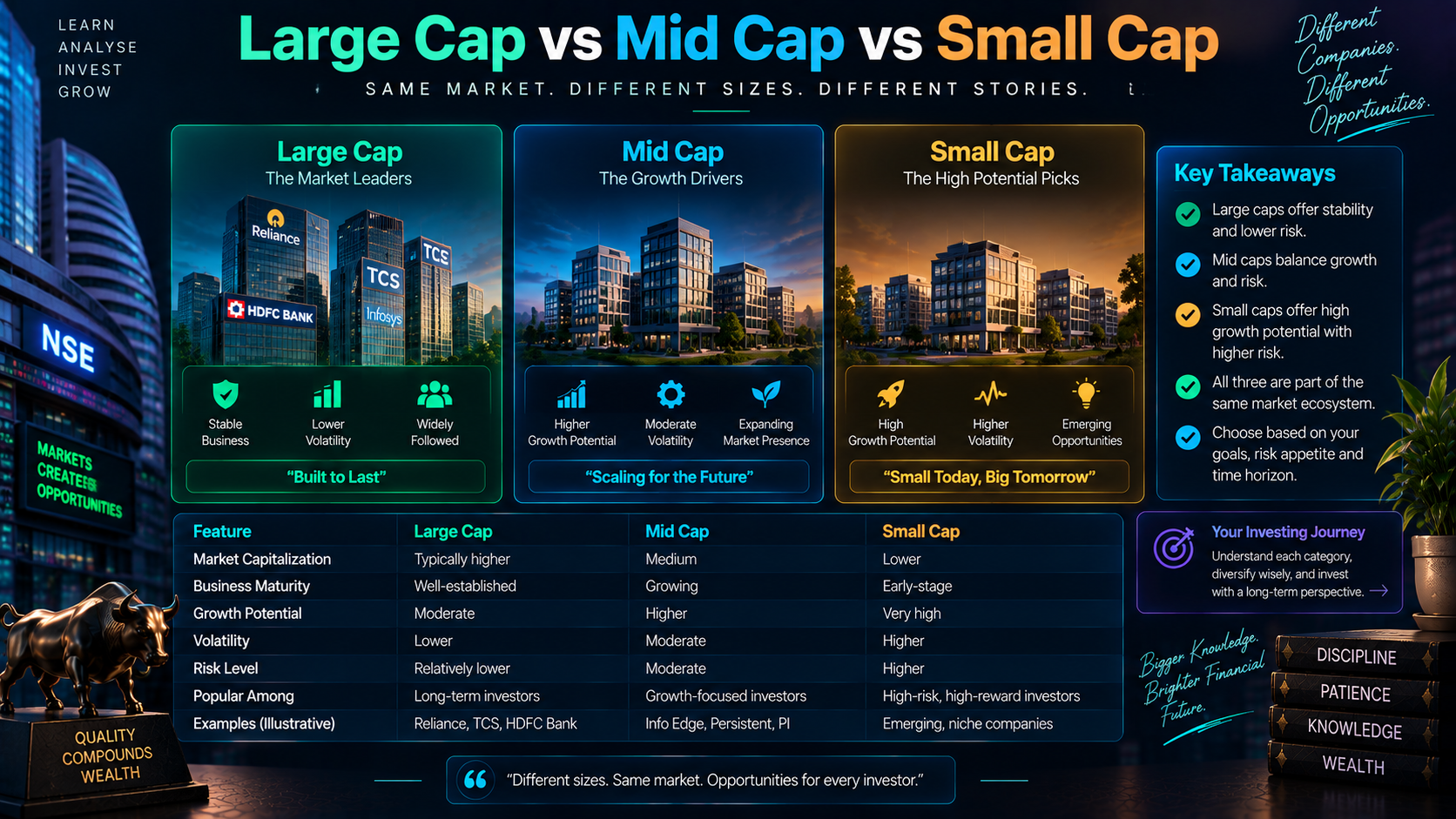
🟢 Large Cap
The largest companies by the standardized market-cap ranking. They are often established businesses with substantial market presence and significant investor coverage. For a related guide, see Stoxra Market News.
🔵 Mid Cap
Companies ranked below the large-cap group and above the small-cap group. They can provide a different balance between established scale and growth potential.
🟡 Small Cap
Companies ranked 251st onward under the standardized framework. They can have significant growth potential but may also experience greater volatility and liquidity risk.
The classification itself does not tell you which category will produce the highest return. It simply gives you a useful way to understand the relative size of companies in the listed market. For a related guide, see Stoxra Blog.
Real Example: Tata Consultancy Services
A useful real-world example for understanding large-cap companies is Tata Consultancy Services (TCS). TCS is one of India's major listed technology businesses and has been a constituent of the Nifty 50. NSE corporate filings identify TCS as Tata Consultancy Services Limited, with the NSE symbol TCS. ()
NSE's published Nifty 50 material has included TCS among the index constituents, alongside other very large Indian companies such as HDFC Bank, Reliance Industries, Infosys and others. ()
The purpose of this example is not to say that every Nifty 50 company is permanently classified as large cap. Rather, it demonstrates the type of large, established listed business that beginners commonly associate with the large-cap segment.
Why Does Large Cap Status Matter to Traders?
Large-cap stocks are important to traders because company size often interacts with liquidity, volatility, institutional ownership, analyst coverage and index participation. For a related guide, see stock market basics for beginners.
This does not mean that every large-cap stock behaves in exactly the same way. A large technology company, bank, energy company and consumer company can have completely different business models and price patterns.
However, large-cap stocks are often among the most closely followed securities in the market. That can make them relevant for both long-term investors and active traders.
💧 Liquidity
Many large companies have substantial trading activity, which can make entering and exiting positions easier than in thinly traded securities. For a related guide, see the stock market basics guide.
📊 Market Coverage
Large companies are often followed by analysts, institutions, financial media and professional investors.
🏛️ Index Exposure
Many major large companies are represented in broad market indices, making them relevant to index-linked funds and market benchmarks.
Why Are Large Cap Stocks Often Considered More Stable?
Large-cap stocks are often described as relatively stable because their underlying companies tend to have greater scale and established business operations. For a related guide, see stock market terminology.
A large company may have multiple products, business segments, geographic markets, customers and sources of revenue. That diversification can sometimes reduce the impact of a single business problem compared with a smaller company that depends heavily on one product or market.
But “more stable” does not mean “stable every day.”
Large-cap stocks can still fall sharply during recessions, earnings disappointments, regulatory problems, major geopolitical events, sector-wide shocks or broad market sell-offs.
For example, a major bank can still experience a significant decline if investors become concerned about asset quality or economic growth. A large technology company can fall when earnings expectations change. A major energy company can be affected by commodity prices and global demand. For a related guide, see mutual funds vs stocks.
So large-cap classification should be treated as a size characteristic, not as a promise of low risk.
Large Cap Does Not Mean Risk-Free
One of the biggest beginner mistakes is assuming that large companies cannot experience major drawdowns.
Risk management matters more than the large-cap label; see how to manage losses in intraday trading for a practical risk-first framework.
Large companies can decline because their valuations become too expensive, earnings weaken, competitive conditions change, interest rates move, regulation changes or investors collectively reduce risk. For a related guide, see types of mutual funds.
A large-cap company can also become less attractive if its growth slows while its valuation remains extremely high.
That is why investors should combine company size with other analysis rather than using the large-cap label as the entire investment thesis.
Large Cap Stocks and Liquidity
Liquidity refers broadly to how easily an asset can be bought or sold without causing a large price impact. For a related guide, see what a mutual fund is.
Large-cap stocks often attract significant trading interest, which can contribute to stronger liquidity. This is one reason active traders may prefer highly liquid securities when implementing strategies that require efficient entries and exits.
NSE's broad-market index framework specifically emphasizes liquid stocks in major indices. Its Nifty 100 is designed around the largest companies by full market capitalization, while major broad-market indices use defined methodologies to represent the market. ()
Liquidity should still be checked at the individual-stock level. A stock being large does not mean that every trading session will have identical liquidity conditions. For a related guide, see mutual-fund mistakes.
Large Cap Stocks and Market Indices
Large-cap companies are closely connected with major Indian indices.
The Nifty 100, for example, represents the top 100 companies based on full market capitalization from the Nifty 500 and is intended to measure the performance of large market-capitalization companies. (NSE Nifty 100)
This makes the Nifty 100 useful for understanding how a broad group of large companies behaves, rather than focusing on a single stock.
The Nifty LargeMidcap 250 combines 100 large-cap and 150 mid-cap companies, illustrating another way market indices can be constructed around market-cap segments. ()
Interactive Large Cap Market Capitalization Calculator
Calculate Market Capitalization
Enter a hypothetical share price and number of outstanding shares. The calculator estimates the company's market capitalization. Remember: the calculated market cap alone does not determine whether a company is large cap; the company's rank relative to other companies matters. For a related guide, see common stock-market mistakes.
Educational calculation only. Large-cap classification requires comparison with the applicable official market-cap ranking.
Large Cap vs Enterprise Value
Market capitalization should not be confused with enterprise value.
Market capitalization focuses on the market value of the company's equity. Enterprise value considers equity value alongside factors such as debt and cash. For a related guide, see stock-market rules.
That distinction becomes useful when comparing companies with different capital structures. Two companies can have similar market capitalizations but different debt levels and therefore different enterprise values.
For beginners, the first step is understanding market capitalization. Once that is clear, enterprise value becomes a useful next concept.
Large Cap vs Stock Price: What Beginners Get Wrong
A company's share price does not tell you whether it is large cap. For a related guide, see technical analysis in stock trading.
Imagine Company A has 10 crore shares trading at ₹2,000 each:
Now imagine Company B has 1,000 crore shares trading at ₹100 each:
Company B has the lower share price but the much larger market capitalization. For a related guide, see intraday trading indicators.
This is why comparing share prices alone can be misleading. The number of shares outstanding matters.
Large Cap Stocks for Long-Term Investors
Large-cap stocks are often used as core holdings because investors may value the scale and established nature of the underlying companies.
For a broader beginner foundation, compare this concept with mutual funds vs stocks for beginners before deciding how company size fits your investing approach.
Some large companies also have long histories of paying dividends, although dividend payments are never guaranteed and should not be assumed simply because a company is large. For a related guide, see candlestick patterns.
Investors should still evaluate:
- Revenue growth
- Profitability
- Cash flow
- Debt levels
- Return on capital
- Competitive advantages
- Valuation
- Management quality
- Industry outlook
- Future earnings expectations
A strong company can still be a poor investment if purchased at an unjustifiably high valuation.
Large Cap Stocks for Traders
Traders may use large-cap stocks for very different reasons from long-term investors.
For a practical paper-trading starting point, see the best paper trading platform guide and compare it with the broader paper-trading resources already linked below.For a related guide, see VWAP trading.
If you practise first, the paper-trading P&L guide explains how simulated results are calculated and why they should not be treated as live profits.
Traders who want a more systematic approach can review how to follow a trading plan without breaking rules before turning a large-cap screen into actual trades.
A swing trader might look for a technical breakout. A momentum trader might focus on volume and price action. A positional trader might combine technical structure with fundamental catalysts. For a related guide, see position sizing.
The large-cap label itself does not create a trading setup.
Instead, traders can use large-cap status as a filter and then examine price structure, volume, volatility, support and resistance, earnings events and broader market conditions.
Useful related resources include screening stocks for swing trading, understanding stock screeners and creating a trading plan.
Advantages of Large Cap Stocks
1. Established Businesses
Many large-cap companies have long operating histories, established products and substantial customer bases. For a related guide, see intraday risk management.
2. Potentially Better Liquidity
Large companies often attract substantial market participation, which can support more active trading.
3. Greater Visibility
Large companies are frequently covered by analysts, institutions and financial media.
4. Index Representation
Many large-cap companies appear in important market indices, increasing their relevance to index-linked portfolios.
5. Business Diversification
Large enterprises may operate across multiple products, markets or business segments. For a related guide, see trading discipline.
6. Useful Portfolio Core
Some investors use large-cap exposure as a core allocation, depending on their objectives and risk tolerance.
Risks of Large Cap Stocks
Large-cap status should never be treated as a risk-free label.
If automation is part of your plan, the risks of algo trading in India covers technology, volatility, execution and strategy risks.For a related guide, see trading psychology.
- Valuation risk: A great company can still be overpriced.
- Market risk: Large caps can fall during broad market sell-offs.
- Sector risk: A dominant company can still be exposed to a weak industry.
- Growth risk: Mature companies may grow more slowly than smaller businesses.
- Regulatory risk: Large businesses can be affected by government and regulatory decisions.
- Competition: Market leadership can change over time.
- Execution risk: Large scale does not eliminate management mistakes.
Therefore, large-cap classification should be one input in your analysis rather than the final answer.
Can a Large Cap Become a Mid Cap?
Yes, classification is not permanently attached to a company.
Because the classification is based on relative market capitalization, a company can move up or down the ranking as its market value changes relative to other listed companies. For a related guide, see a trading journal.
For example, if a company's market capitalization declines significantly while other companies grow rapidly, its ranking can fall. Conversely, a company that grows faster than its peers can move upward.
This is another reason investors should use the applicable official classification list rather than relying on an old label.
AMFI publishes periodic categorization information for large-, mid- and small-cap stocks. (AMFI categorization) For a related guide, see following a trading plan.
Large Cap Does Not Mean High Dividend
Another common misconception is that every large-cap company pays a large dividend.
Dividend policy depends on the company's profitability, cash requirements, growth opportunities, capital-allocation decisions and board-approved distributions.
Some large companies may distribute significant cash to shareholders. Others may retain more earnings to fund expansion, acquisitions, technology or other investments.
If you want to understand dividends, see what a dividend is and our broader stock-market learning resources. For a related guide, see AI in stock-market trading.
Large Cap and Market Volatility
Large-cap stocks are sometimes perceived as less volatile than smaller companies, but volatility varies by stock and market conditions.
A large company can experience rapid price movement after earnings, major announcements, regulatory developments or unexpected macroeconomic events.
During broad market stress, even highly liquid large-cap stocks can decline quickly because institutional and retail investors may reduce exposure simultaneously. For a related guide, see AI tools for stock-market analysis.
For traders, this means large-cap status should be combined with actual volatility measures and current market structure rather than assumed from the category alone.
How Large Cap Stocks Fit Into a Beginner's Learning Path
A beginner does not need to jump directly into complex strategies.
Start by understanding the difference between a Demat account and a trading account. Then learn fundamental concepts such as market capitalization, face value, stock splits, bonus shares, dividends and circuit limits. For a related guide, see AI trading strategies.
Once those concepts are clear, move into practical skills such as stock-market basics, trading terminology, market rules and reading market news.
After that foundation, paper trading can help you practise without immediately putting capital at risk. See paper trading vs demo trading, paper trading vs real trading and paper-trading platforms.
Large Cap Stocks and Fundamental Analysis
Large-cap companies can be particularly useful for learning fundamental analysis because many publish extensive financial information and receive substantial analyst coverage.
Backtesting is another useful research step; this step-by-step backtesting guide explains why historical testing is evidence rather than a guarantee.For a related guide, see the AI trading platform guide.
A beginner can study:
- Quarterly revenue
- Operating profit
- Net profit
- Earnings per share
- Debt and interest costs
- Free cash flow
- Return on equity
- Return on capital employed
- Profit margins
- Valuation ratios
However, more information does not automatically make a stock a good investment. Analysis still requires interpretation.
Large Cap Stocks and Technical Analysis
Technical traders can also use large-cap stocks because their trading activity often creates extensive price and volume histories.
You can also compare systematic approaches in Stoxra’s algorithmic trading strategies guide before treating automation as a shortcut.For a related guide, see AI trading platforms.
If you are curious about automation, how algorithmic trading bots work in the Indian market explains the workflow from data to execution.
For technology-assisted research, Stoxra also covers AI tools for stock-market analysis in India and how they can support screening and research.
Common technical inputs include:
- Support and resistance
- Moving averages
- Volume
- Breakouts
- Trend structure
- Relative strength
- Volatility
- Chart patterns
Technical analysis should not be confused with certainty. A breakout can fail, a trend can reverse and unexpected news can invalidate a setup. For a related guide, see paper trading vs real trading.
If you are exploring this area, see how AI identifies chart patterns and how AI is changing algorithmic trading.
Large Cap vs Mid Cap vs Small Cap: Practical Comparison
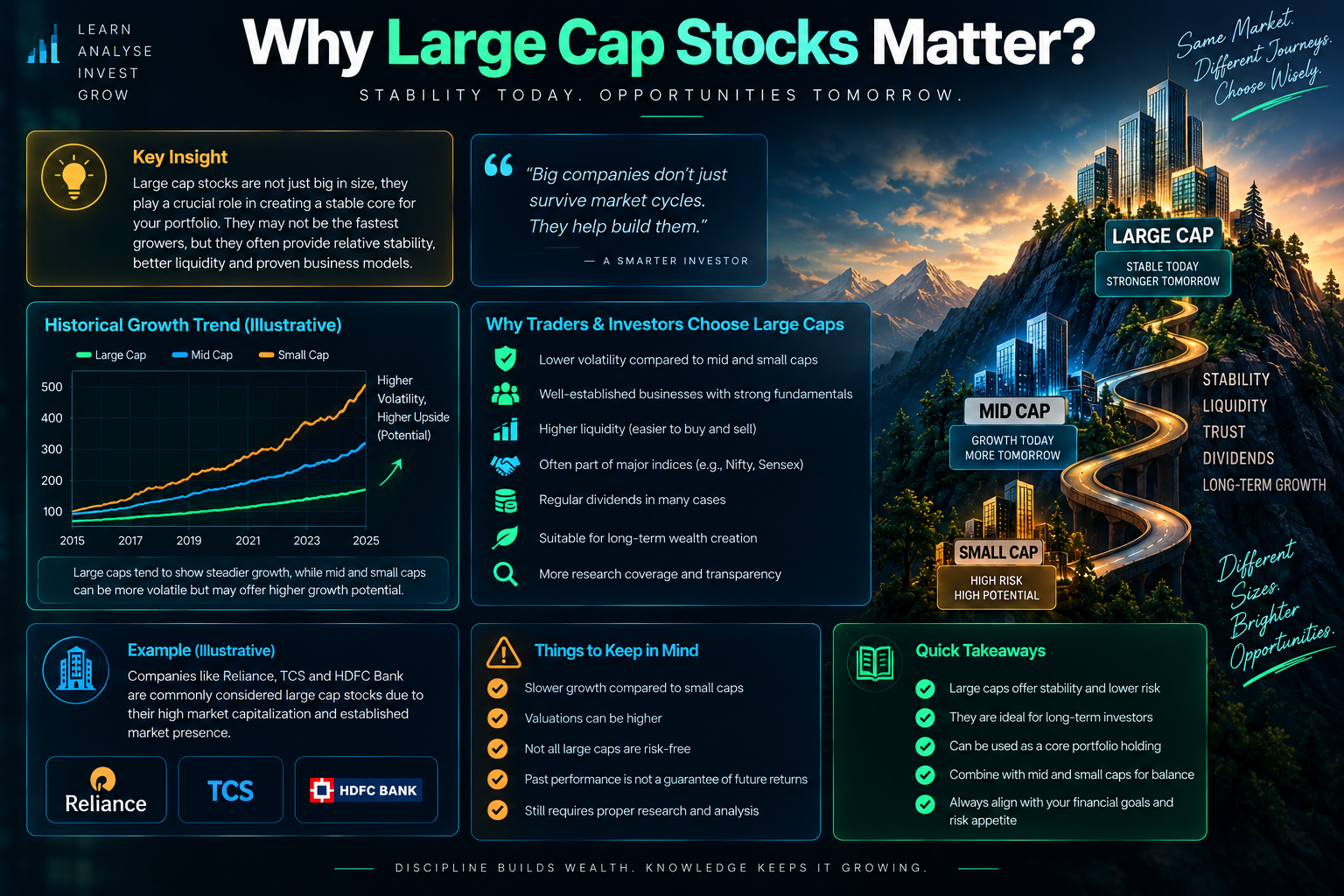
| Factor | Large Cap | Mid Cap | Small Cap |
|---|---|---|---|
| Market-cap rank | 1–100 | 101–250 | 251 onward |
| Business maturity | Often established | Often developing | Can include younger/smaller businesses |
| Typical liquidity | Often higher | Variable | Can be lower |
| Growth potential | Can be moderate | Can be higher | Can be higher but uncertain |
| Volatility | Can be relatively lower | Can be moderate | Can be higher |
| Research coverage | Often extensive | Moderate to extensive | Can be more limited |
These are broad tendencies rather than guarantees. Individual companies can behave very differently from the average characteristics associated with their category.
Common Beginner Mistakes
❌ “Large cap means no risk.”
Large companies can still experience significant declines, valuation problems and business disruptions. For a related guide, see paper trading vs demo trading.
Before moving from research to automation, read what algorithmic trading means in simple terms and understand the rule-based workflow first.
❌ “High share price means large cap.”
Market capitalization depends on both share price and the number of outstanding shares.
❌ “Large cap always grows slowly.”
Growth rates vary significantly between companies and industries.
❌ “Every Nifty stock is permanently large cap.”
Indices and market-cap classifications use methodologies and can change over time. For a related guide, see how paper trading helps beginners.
❌ “Large cap means buy.”
The category describes company size. It does not provide an entry signal.
❌ “Market cap alone is enough.”
Valuation, earnings, debt, cash flow, competition and business quality still matter.
Where to Verify Large Cap Information
If you want to know whether a company currently qualifies as a large-cap stock, do not rely on an old article, social-media post, screenshot or random stock list. Market-cap rankings can change, so the safest approach is to check current information from official sources.
SEBI
SEBI is India's securities-market regulator. Its investor resources help explain market rules, investor protection and regulatory concepts.
Verify with SEBI →AMFI
AMFI publishes the stock categorisation information used for the standardized large-cap, mid-cap and small-cap framework. Check the applicable list when classification accuracy matters.
Check AMFI Categorisation →NSE
NSE provides market data, index information and exchange resources. Its Nifty index pages are useful when checking index composition and methodology.
Explore NSE →BSE
BSE provides exchange information, listed-company data and market resources. It is another primary source to consult when researching an Indian listed company.
Explore BSE →What exactly should you verify?
- Current market-cap ranking: Large-cap classification is based on relative ranking, not a fixed share-price threshold.
- Full market capitalization: Check the measure used by the applicable classification methodology.
- Classification period: Make sure the list you are viewing applies to the period you are analysing.
- Index methodology: If you are checking Nifty 100 or another index, read the index's own methodology rather than assuming index membership and large-cap classification are identical.
- Company information: Cross-check important financial and corporate information with exchange filings or company disclosures.
You can also use Stoxra's Stock Screener as a research starting point, then verify important classification and company information against current primary sources.
Useful Stock-Market Learning Resources
- Stock Market Basics for Beginners in India
- Stock Market Terminology for Beginners
- Stock Market Rules Every Beginner Should Know
- How to Create a Trading Plan
- Expert Tips for New Traders
- How to Screen Stocks for Swing Trading
- How Stock Screeners Work
- How to Find Swing Trading Stocks
- Paper Trading vs Demo Trading
- Paper Trading vs Real Trading
- Best Paper Trading Platforms
- Paper Trading Apps for Options
- Stocks vs Options for Beginners
- How to Choose a Trading Mentor Safely
- How to Read Market News Like a Trader
- How AI Is Transforming Stock-Market Trading
- AI and Algorithmic Trading Strategies
- AI Chart Pattern Recognition
- Evaluating AI Trading Signals
- What Is Backtesting?
- AI Trading Platforms in India
- What Is a Demat Account?
- What Is a Trading Account?
- What Is Market Capitalization?
- What Is a Stock Split?
- What Is a Bonus Share?
- What Is a Dividend?
- What Is Face Value?
- What Is a Circuit Limit?
- Stock-Market Learning Hub
- All Trading & Investing Articles
- What Is Market Capitalization
- What Is a Demat Account
- What Is a Stock Split
- Technical Analysis in Stock Trading
- How to Follow a Trading Plan
- Paper Trading P&L
- AI Tools for Stock Analysis
- How Algorithmic Trading Bots Work
- What Is Algorithmic Trading
- How to Backtest a Trading Strategy
- Risks of Algo Trading
Frequently Asked Questions
What is a large cap stock?
Under the standardized Indian SEBI/AMFI classification, a large-cap company is ranked from 1st to 100th by full market capitalization.
What is the difference between large cap, mid cap and small cap?
Large-cap companies occupy ranks 1–100, mid-cap companies ranks 101–250 and small-cap companies rank 251 onward by full market capitalization under the standardized classification.
Are large cap stocks safer?
They can have characteristics such as greater scale, established operations and higher liquidity, but they are not risk-free. Large-cap stocks can still experience major declines. For a related guide, see free trading tools.
Are large cap stocks good for beginners?
They can be useful for learning because many are widely followed and have substantial public information, but whether a particular stock is suitable depends on valuation, risk tolerance, financial goals and investment horizon.
Is market capitalization the same as company value?
Market capitalization represents the market value of the company's equity. Enterprise value is a different measure that considers equity value alongside debt and cash.
Can a company move from large cap to mid cap?
Yes. Because the classification depends on relative market-cap ranking, a company's category can change when its market capitalization changes relative to other companies. For a related guide, see algorithmic trading strategies.
Does a high share price mean a company is large cap?
No. Market capitalization depends on share price and the number of outstanding shares. A company with a lower share price can have a much larger market capitalization if it has many more shares outstanding.
More Questions Beginners Ask About Large Cap Stocks
How often should I verify whether a stock is large cap?
Recheck the applicable classification whenever you are making a current investment decision, especially after major market-cap changes or when using an older classification list.
Is every Nifty 100 company automatically a large-cap stock?
Nifty 100 membership and the standardized large-cap classification are related but should not be treated as identical rules. Check the relevant index methodology and the applicable market-cap categorisation separately.
Can a large-cap stock become a mid-cap stock?
Yes. Because the category depends on relative market-cap ranking, a company's classification can change as its market capitalization changes relative to other companies.
Where can I check a company's market capitalization?
You can use exchange information, company disclosures and reputable market data platforms as starting points. For classification decisions, verify the applicable methodology and current official categorisation.
Does a large-cap stock have to pay dividends?
No. Company size does not determine dividend policy. Dividend decisions depend on profitability, cash requirements, growth opportunities and capital-allocation choices.
Are large-cap stocks suitable for short-term trading?
They can be used for short-term strategies, but the large-cap label alone is not a trading signal. Traders should still evaluate liquidity, volume, volatility, price structure, catalysts and risk.
What is more important than the large-cap label?
The answer depends on your objective, but valuation, earnings, cash flow, debt, business quality, liquidity, competitive position and risk management are all important inputs.
Final Takeaway
A large-cap stock is a stock belonging to one of the largest companies in the market by market capitalization. In India's standardized SEBI/AMFI framework, the large-cap category consists of the 1st to 100th companies by full market capitalization.
That definition is simple, but the investing implications are more nuanced. Large-cap companies often have substantial scale, established businesses, significant market participation and strong visibility. These characteristics can make them useful for both investors and traders.
But size is not the same as quality, and quality is not the same as value. A large company can be expensive, overvalued, poorly managed or exposed to a declining industry. Likewise, a smaller company can sometimes grow much faster. For a related guide, see how algorithmic trading works.
For traders, large-cap status can be a useful filter when combined with liquidity, price action, volume and a defined trading plan. For investors, it can help structure a portfolio around companies with substantial market presence while still requiring careful fundamental and valuation analysis.
The most important lesson is this: large cap describes size; it does not predict returns.
Build Your Market Knowledge Before Risking Capital
Understand market capitalization, company size, valuation, risk and trading mechanics before making decisions with real money.
Explore Stoxra Stock Screener →Educational content only. This article is not investment advice. Market-cap classifications can change as companies move in the ranking, and investors should verify the applicable classification from current official sources before making investment decisions.
Written by Krishna Sai Channalli.
Key Takeaways
- Large-cap classification is based on relative market-cap ranking, not share price alone.
- Large-cap stocks can offer scale and liquidity advantages but are not risk-free.
- Use company size as one filter alongside valuation, fundamentals, liquidity, technical structure and risk management.
- Classification can change as relative market capitalizations change.
Pro Tip
Use large-cap status as a starting filter, then verify the current classification and build the rest of your decision around a defined process and risk limit.