What Is a Trading Account?
A trading account is the account you use to place buy and sell orders in the securities market. Learn what a trading account does, how it connects with your bank and Demat accounts, how orders reach the exchange, and what beginners should understand before trading.
- A trading account is the transaction layer used to place and manage market orders through a broker.
- Your bank account handles funds, the trading account handles orders, and the Demat account primarily holds eligible securities electronically.
- Market and limit orders have different execution and price trade-offs, so beginners should understand the instruction before using it.
- Brokerage is only one part of trading cost; taxes, exchange charges, depository charges and other fees can also matter.
- Opening an account gives market access, not a trading edge. Learn risk management and practise before risking meaningful capital.
What Is a Trading Account?
A trading account is an account opened with a stock broker that allows an investor or trader to place buy and sell orders in the securities market.
In simple terms, think of it as the transaction interface between you and the market. When you open a broker's application, search for a company, choose a quantity, select an order type and press Buy or Sell, you are using the trading infrastructure associated with your trading account.
SEBI defines a trading account as an account opened by a SEBI-registered stock broker in the name of an investor for trading in securities. See SEBI's explanation of investor accounts .
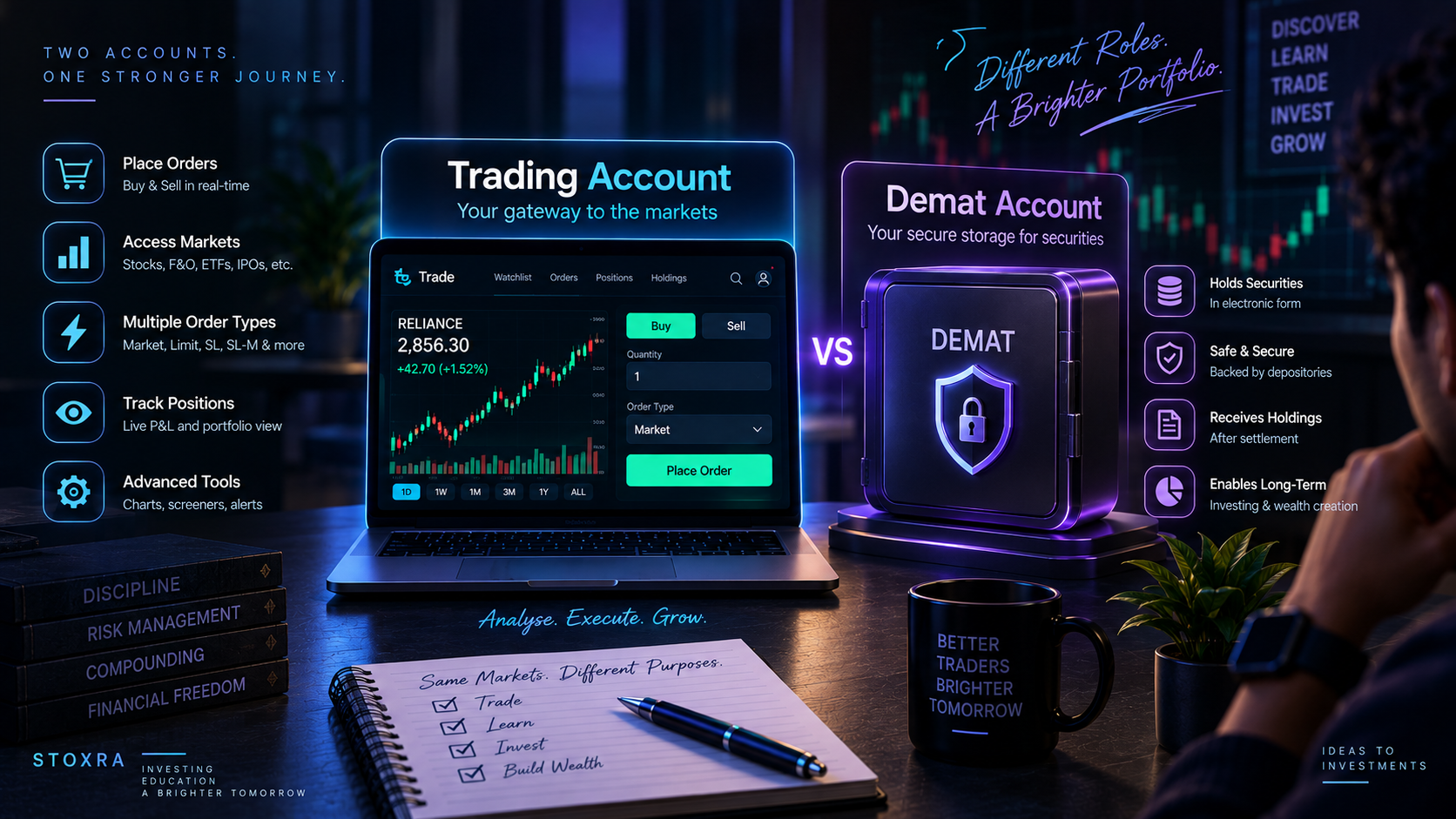
The trading account should not be confused with the Demat account . The trading account is primarily concerned with transactions; the Demat account is primarily concerned with holding eligible securities electronically.
Trading account = transact.
Demat account = hold eligible securities.
Bank account = move money.
Why Do You Need a Trading Account?
A stock exchange is not simply a website where an individual investor logs in and manually buys shares. Market participation involves a regulated network of brokers, exchanges, clearing corporations, depositories and other intermediaries.
For an individual investor, the stock broker provides the practical interface through which orders can be submitted to the market.
NSE's investor education material explains that investors who want to buy shares should approach a SEBI-registered broker and complete the required registration and KYC process. .
The important point is that a trading account gives you the ability to interact with market infrastructure through your broker. It does not give you a profitable strategy, remove market risk or guarantee that an order will make money.
That distinction matters. Beginners sometimes treat opening an account as the difficult part of trading. It isn't. Opening an account is administrative. Learning how to make and manage decisions is the difficult part.
How Does a Trading Account Work?
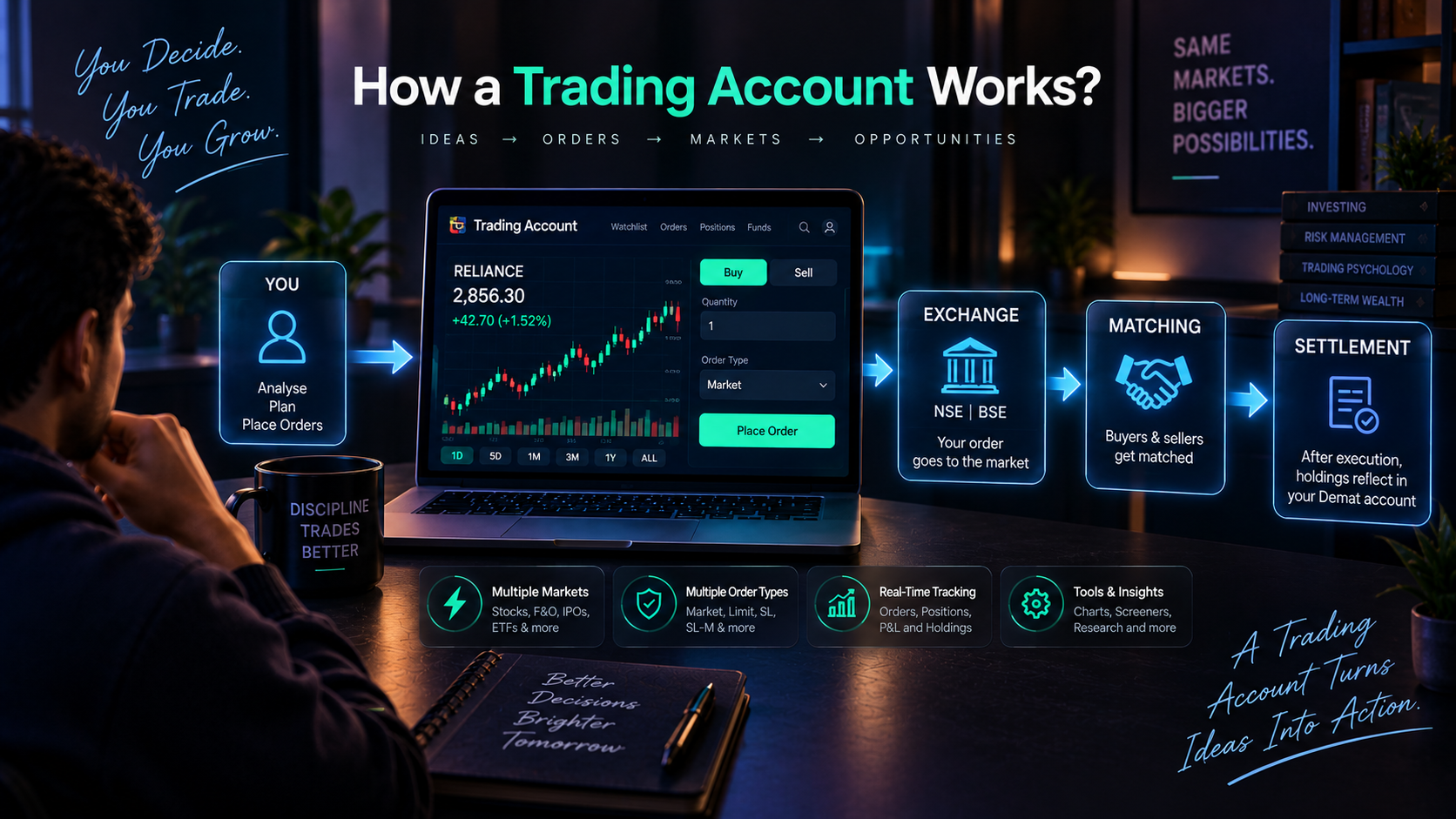
Imagine that you have analysed a company and decided that you want to buy 10 shares. You open your broker's platform, search for the stock, enter the quantity and select an order type.
When you submit the order, your broker sends the instruction through the relevant market infrastructure. The exchange then processes the order according to its matching rules.
A simplified workflow looks like this:
You analyse
You decide what you want to trade and define your entry, exit and risk conditions.
You place an order
Your trading account and broker interface are used to submit the buy or sell instruction.
The order reaches the market
The broker routes the order to the relevant exchange infrastructure according to the applicable process.
Orders are matched
Buy and sell orders are matched according to price-time priority and the rules of the relevant market.
Trade and settlement follow
Once executed, the transaction goes through the applicable clearing and settlement process.
The exact mechanics differ depending on the security, market segment, order and product. This is why serious traders eventually need to understand more than just the Buy button.
You can build that foundation with .
Trading Account vs Demat Account
This is the distinction every beginner should understand before placing a live trade.
| Feature | Trading Account | Demat Account |
|---|---|---|
| Main purpose | Place and manage buy/sell orders | Hold eligible securities electronically |
| Opened with | Stock broker | Depository Participant |
| Simple analogy | Transaction counter | Digital securities storage |
| Primary action | Buy / sell / manage orders | Hold / transfer eligible securities |
| Example | Submitting a buy order for 10 shares | Holding those shares electronically after settlement |
SEBI's investor FAQ makes the distinction directly: a Demat account is used for holding and transferring securities, while a trading account is opened with a stock broker for trading in securities. Read the SEBI FAQ .
If you want the Demat side explained independently, read .
Trading Account, Demat Account and Bank Account Together
The easiest way to understand the full system is to think of three different jobs.
Bank Account — Money
Used for applicable movement of funds associated with your trading activity.
Trading Account — Orders
Used to place buy and sell instructions through your broker.
Demat Account — Holdings
Used to maintain eligible securities in electronic form.
NSE describes the trading account as a bridge between the bank and Demat account in the investor workflow. .
Once you understand these roles, the stock-market workflow becomes considerably less confusing.
What Is a Broker's Role?
A stock broker is the intermediary through which investors can access the securities market. Your trading account is normally opened through that broker.
A broker may provide a web application, mobile application, desktop platform, APIs, research tools, charts, screeners and other services. However, the quality of the interface should not be confused with the quality of your trading decisions. how stock screeners work .
NSE recommends that investors select a SEBI-registered broker and complete the appropriate account-opening and KYC process. Check NSE's first-time investor information .
You should also understand what services you are paying for. Some brokers compete heavily on pricing, while others offer broader research, advisory or platform features.
Do not choose a broker solely because an influencer says it is the "best broker." Your requirements matter more than someone else's referral arrangement.
Common Types of Trading Orders
Having a trading account is not enough. You need to understand the instruction you are sending through it.
Market Order
A market order tells the system that you want to buy or sell at the best available prices according to the applicable market conditions. Execution and price certainty are different concepts, especially in fast-moving or less-liquid markets.
Limit Order
A limit order specifies the price at which you are willing to buy or sell, subject to the order being matched. A limit price can provide price control, but it does not guarantee execution.
Stop-Loss Orders
Stop-based orders can be used as part of a risk-management plan. Beginners should understand exactly how their chosen order type works before relying on it during a fast market.
Intraday vs Delivery
A trading account can be used for different market activities, depending on the products and permissions enabled by the broker. Intraday trading generally involves opening and closing a position during the trading session, while delivery-oriented equity investing involves securities being settled into the investor's holdings.
Learn more about terminology through Stoxra's stock market terminology guide .
Trading Order Decision Helper
This simple educational tool helps you understand the basic difference between common order intentions. It does not provide investment advice and does not use live market data.
How Much Does a Trading Account Cost?
There is no single universal cost for every trading account. Charges depend on the broker, account structure, services used and the applicable transaction and regulatory charges.
Before opening an account, read the broker's current pricing document rather than relying on an old comparison article.
Depending on the provider and activity, you may encounter items such as:
- Account-opening charges.
- Brokerage.
- Demat maintenance charges.
- Exchange-related charges.
- Taxes and statutory charges.
- Depository participant charges.
- Specific transaction or service fees.
The important lesson is that "zero brokerage" does not necessarily mean "zero cost." A trade can involve several different charges depending on the product and transaction.
If you are comparing brokers, evaluate the complete cost structure, platform reliability, customer service, security and features rather than focusing on one headline number. .
Compare total trading costs, not just brokerage. A low headline brokerage rate can still sit alongside other transaction, statutory or account-related charges. Read the broker's current pricing schedule before comparing platforms.
Trading Account vs Investing: They Are Not the Same Mindset
The same trading account can be used to access different market activities, but your decision framework should depend on what you are actually trying to do.
An investor may be studying a company's business, financial statements, competitive position and long-term valuation.
A trader may instead focus on price behaviour, liquidity, volatility, technical structure, catalysts and predefined risk. technical analysis volume analysis .
Neither approach is automatically superior. The problem occurs when people mix them without realising it.
For example, buying a stock because of a short-term chart setup and then calling it a "long-term investment" only after the price falls is not a strategy. It is a rationalisation.
Your trading account will execute either approach. It cannot tell whether your original reasoning was good.
Before live trading, read Stoxra's guide to creating a trading plan .
Common Trading Account Mistakes Beginners Make
1. Confusing the Trading Account With the Demat Account
This is the foundational mistake. The trading account is primarily for market transactions; the Demat account is primarily for electronic securities holding.
2. Thinking the App Is the Market
Your broker's app is only your interface. Behind it are exchanges, brokers, clearing infrastructure, depositories and regulatory systems.
3. Using Market Orders Without Understanding Execution
"Market price" does not mean a guaranteed exact price. Fast-moving or illiquid securities can behave differently from what a beginner expects.
4. Trading Before Learning Risk Management
The ability to place a trade in seconds can create the illusion that trading itself is easy. It isn't. Risk management should come before strategy complexity.
5. Treating Leverage as Free Money
Margin and leverage can increase exposure, but they can also increase losses. A larger position does not create a better trade.
6. Following Telegram or WhatsApp Tips Blindly
A trading account makes it easy to act on a tip. That is exactly why you need rules that stop you from acting impulsively.
For a more complete set of beginner rules, read Stoxra's stock market rules for beginners .
Should You Start Trading Immediately After Opening an Account?
No.
This is where beginners often make an expensive mistake. Opening a trading account gives you the ability to trade. It does not mean you have developed the ability to trade well.
Before using real money, you should understand at least:
- How market and limit orders work.
- How position sizing affects risk.
- What stop-losses actually do.
- How brokerage and taxes affect returns.
- The difference between investing and trading.
- How volatility affects execution.
- Why leverage can magnify losses.
- How to keep a trading journal.
If you cannot explain why you entered a trade before placing it, you are not ready to increase your size.
A much better approach is to practise first. Stoxra's paper trading vs demo trading guide explains the difference between simulated practice and live trading. paper trading vs real trading .
What Is the Best Way to Learn Trading?
Do not start by collecting indicators.
That is one of the most common beginner traps. A chart full of moving averages, oscillators and signals can look sophisticated while hiding the fact that you have no defined risk framework.
Start with market structure and basic terminology. Then learn order types. Then learn risk management. Then choose one simple strategy and test it repeatedly.
A sensible learning sequence is:
Learn the market
Understand exchanges, securities, orders, liquidity and settlement.
Learn risk
Define how much you can lose before thinking about how much you can make.
Build one setup
Use one understandable trading idea instead of ten random indicators.
Practise
Use paper trading to collect evidence before risking meaningful capital.
Review
Track mistakes, risk, execution and strategy performance rather than only looking at profit.
You can also read Stoxra's expert tips for new traders and compare paper-trading approaches .
Trading Account Security Matters
Your trading account gives access to a financial transaction system, so basic security should be treated seriously.
Use strong passwords and available authentication mechanisms. Never share OTPs, PINs or login credentials. Be suspicious of messages claiming to be broker support and asking you to transfer money or disclose credentials.
SEBI Investor specifically publishes investor-awareness material covering fake trading apps, "stock market guru" scams, pump-and-dump schemes and other risks. Visit SEBI Investor .
If an unknown person promises guaranteed returns, guaranteed intraday profits or a secret trading system that cannot lose, stop and verify before sending money.
The safest trading account is not the one with the most buttons. It is the one you use with appropriate security and disciplined decision making.
Trading Account and F&O: Why Beginners Need Extra Caution
A trading account can provide access to more than ordinary equity transactions depending on your broker and permissions. Derivatives such as futures and options introduce additional complexity.
Futures and options involve leverage, margin requirements, expiry, volatility and product-specific behaviour. That makes them fundamentally different from simply buying a share and holding it.
The fact that your broker lets you activate a segment does not mean you should trade it.
If you are still learning what a market order and limit order do, you should not be rushing into leveraged derivatives.
Start with before moving into more advanced screening and trading concepts .
Frequently Asked Questions
What is a trading account in simple words?
A trading account is an account opened with a stock broker that lets you place and manage buy and sell orders in the securities market.
Is a trading account the same as a Demat account?
No. The trading account is primarily used to transact, while the Demat account is primarily used to hold eligible securities electronically.
Who opens a trading account?
A trading account is opened with a stock broker. Investors should verify the broker's applicable registration and regulatory status.
Can I have multiple trading accounts?
Investors may have multiple accounts subject to applicable rules and account arrangements. If you do, understand the additional costs and administrative complexity before opening accounts unnecessarily.
Do I need a trading account to hold shares?
The trading account and Demat account perform different functions. Eligible securities are held electronically through the Demat infrastructure, while the trading account is used for market transactions.
Does a trading account guarantee profits?
No. A trading account provides access to market infrastructure. It does not provide a profitable strategy or guarantee returns.
Can beginners use a trading account?
Yes, but beginners should learn market mechanics and risk management before using meaningful amounts of real money. .
What is a broker?
A broker is an intermediary that provides investors access to securities-market trading infrastructure and related services.
Don't Let Your First Trade Be Your First Lesson
A trading account makes execution easy. That is exactly why you should learn the mechanics before you start clicking Buy and Sell.
Build your knowledge, practise your strategy and understand risk before putting meaningful capital on the line.
``` Explore Stoxra Stock Screener → ```The Bottom Line
A trading account is the account through which you interact with the securities market to place and manage buy and sell orders. It is normally provided by a stock broker and forms one part of the broader market-access system.
The easiest way to remember its role is to separate the jobs: your bank account handles money, your trading account handles orders, and your Demat account handles eligible securities holdings.
That distinction sounds simple, but it prevents one of the most common beginner misunderstandings in the market.
More importantly, opening a trading account is not the same as learning how to trade. Your broker can give you charts, screeners, alerts and fast order execution. None of those tools can compensate for poor risk management or impulsive decision-making.
Learn the market mechanics first. Understand order types. Build a trading plan. Practise with simulated capital. Track your decisions. Only then consider increasing your exposure to real money.
A trading account gives you access to the market. It does not give you an edge in the market. Your edge has to come from knowledge, discipline, testing and responsible risk management.