What Is an Order Book?
Understand what an order book is, how bids and asks work, what the bid-ask spread means, how orders are matched, and why traders use market depth.
What Is an Order Book?
An order book is the market's live view of outstanding buy and sell orders, showing where traders are willing to transact and how much quantity is available at different price levels.
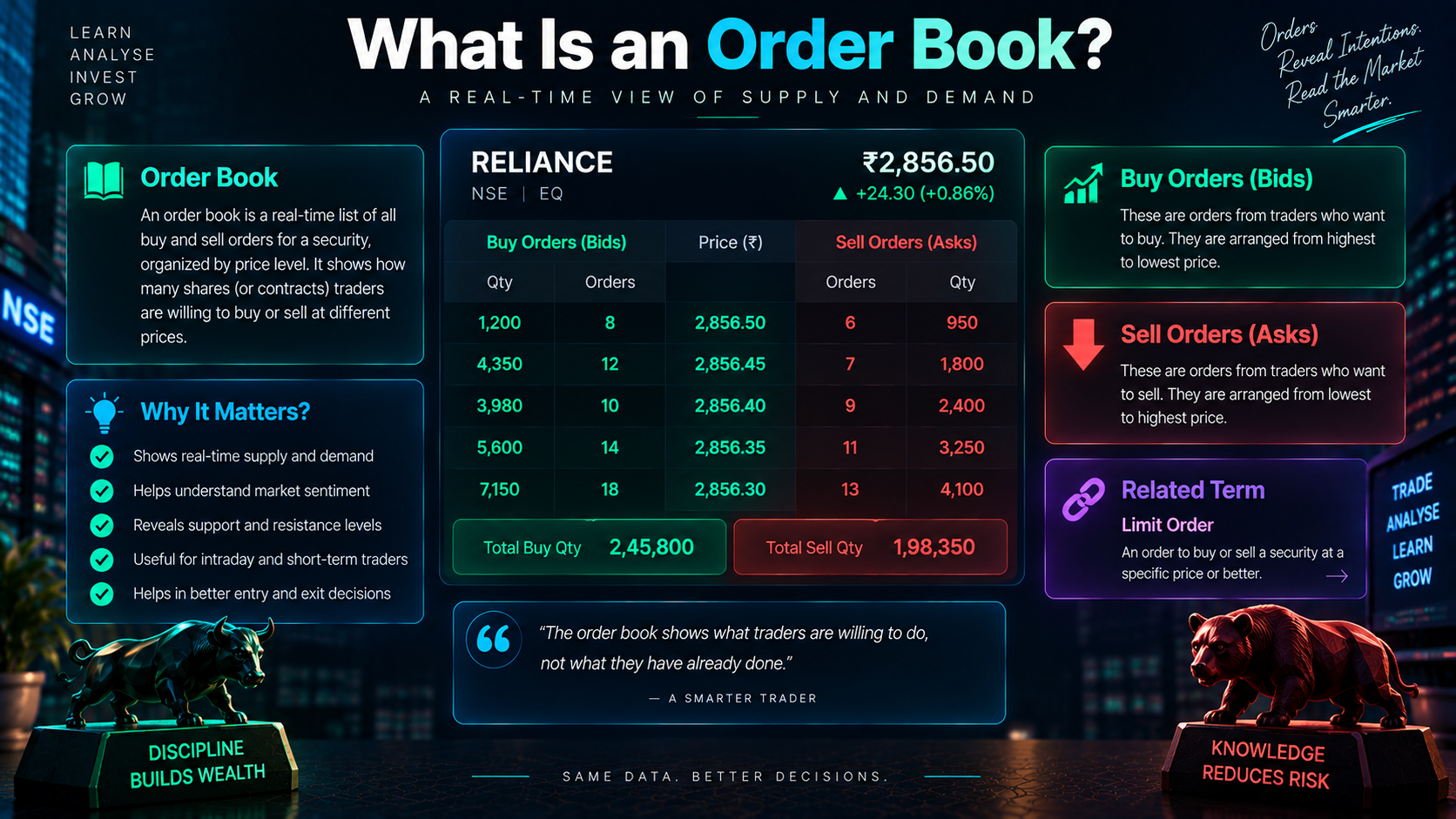
Illustrative order-book example. Prices and quantities shown are hypothetical and are not live market data.
- An order book shows outstanding buy and sell orders at different price levels.
- The best bid is the highest displayed buy price; the best ask is the lowest displayed sell price.
- The bid-ask spread is the difference between the best ask and best bid.
- Market depth helps show visible liquidity across multiple price levels.
- An order book describes current displayed orders; it does not guarantee future price direction.
What Is an Order Book?
An order book is a structured list of outstanding orders waiting to be matched in a financial market. In an electronic stock market, it provides a view of the prices and quantities at which market participants are currently willing to buy or sell. If terms such as bid, ask and spread are new, the Stock Market Terminology for Beginners. For a wider foundation, see the Stock Market Basics for Beginners in India.
The simplest way to picture an order book is as two queues facing each other. On one side are buyers saying, "I am willing to buy this many shares at this price." On the other side are sellers saying, "I am willing to sell this many shares at this price."
The buy side is normally called the bid side, while the sell side is called the ask or offer side. The highest bid and lowest ask are particularly important because they are the prices closest to an immediately executable transaction.
An order book should not be confused with a list of completed trades. It primarily shows outstanding orders and market intentions. An order can remain in the book, be matched, be modified or be cancelled depending on its type and market rules. That distinction is one of the most important things a beginner should understand.
How an Order Book Looks
Imagine a hypothetical stock trading around ₹1,000. The following simplified order book is deliberately illustrative rather than a live quote. For a broader introduction to how Indian markets work, see the Paper Trading vs Real Trading.
| BUY ORDERS / BIDS | PRICE | SELL ORDERS / ASKS | ||
|---|---|---|---|---|
| Quantity | Orders | ₹ | Orders | Quantity |
| 8,000 | 22 | 1,000.00 | 18 | 7,500 |
| 12,500 | 31 | 999.90 | 25 | 10,200 |
| 17,000 | 39 | 999.80 | 30 | 14,700 |
| 21,500 | 44 | 999.70 | 37 | 19,800 |
In this simplified example, ₹1,000 is the highest displayed bid and the nearest sell price would be the lowest displayed ask above it. The difference between those two prices is the bid-ask spread.
Real trading platforms can display considerably more levels, order counts, quantities and other information. The exact presentation varies by broker, exchange interface and market segment, but the underlying concepts remain similar.
Bid, Ask and Bid-Ask Spread Explained
What Is a Bid?
A bid is a buy order or quoted buying price. If a trader places a limit order saying they are willing to buy shares at ₹995, that order can join the bid side of the book if it is not immediately matched. The basic vocabulary behind this relationship is covered in the Stock Market Rules Every Beginner Trader Should Know.
The best bid is the highest active buying price available in the displayed order book. From the buyer's perspective, a higher bid generally represents a greater willingness to pay.
What Is an Ask?
An ask is a sell order or quoted selling price. If a trader is willing to sell at ₹1,005, that order can appear on the ask side until it is matched or otherwise removed.
The best ask is the lowest active selling price. A buyer looking for immediate execution generally interacts with available sell-side liquidity.
What Is the Bid-Ask Spread?
The bid-ask spread is the numerical difference between the best ask and best bid.
Suppose the best bid is ₹999 and the best ask is ₹1,001.
Spread = ₹1,001 − ₹999 = ₹2
A smaller spread can indicate that buyers and sellers are relatively close in their current quoted prices. A wider spread means there is a larger gap between the two sides. Spread is one component traders consider when thinking about transaction costs and liquidity.
For a beginner, this is a useful connection to remember: order book → bid and ask → spread → liquidity and execution.
How Does an Order Book Work?
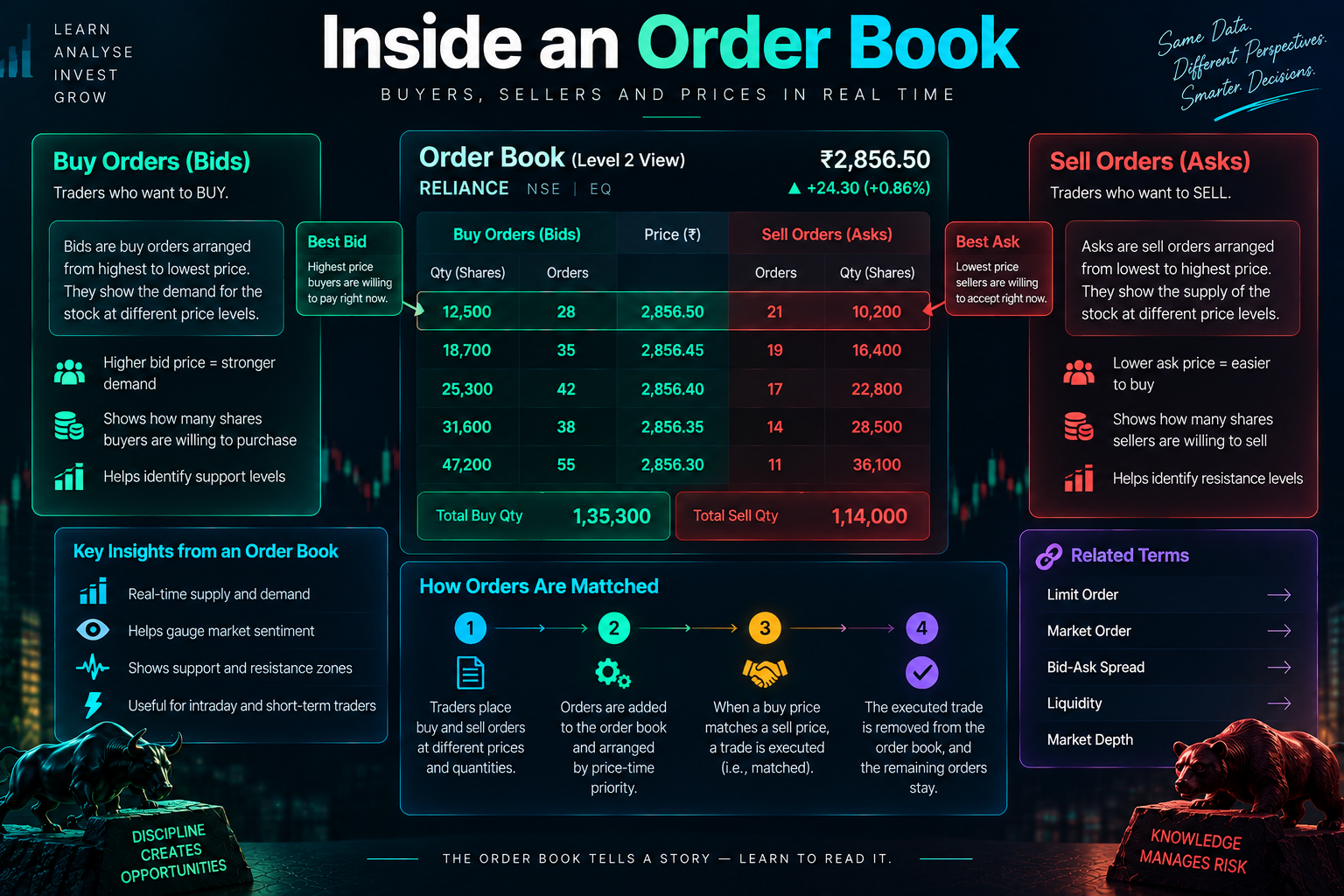
The order book connects buy-side and sell-side instructions and organizes unmatched orders according to market rules. Illustration only. For a practical view of trading rules that affect order handling, see Paper Trading Vs Demo Trading Beginners Guide.
The trader specifies what they want to buy or sell, along with quantity and, depending on the order type, a price or execution condition.
If the order does not immediately match another compatible order, it can remain in the relevant order book.
When buying and selling conditions are compatible, the exchange's matching mechanism can execute the available quantity.
Executed quantity is removed from the outstanding order book while any remaining unmatched quantity can continue to exist subject to the order's conditions.
On NSE's electronic trading system, orders that do not find a match are stored in books and organized according to price-time priority. Best price receives priority, and among orders at the same price, the earlier order receives priority.
What Is Price-Time Priority?
Price-time priority is one of the key mechanics behind an electronic order book. It answers a practical question: if many traders are waiting to buy or sell, which order gets matched first? The price-action context can be extended with What Is Technical Analysis in Stock Trading.
The first consideration is price. A more competitive price gets priority. On the buy side, a higher bid is generally better for matching than a lower bid. On the sell side, a lower ask is generally better than a higher ask.
If two orders have the same price, time becomes the next consideration. The order that entered earlier gets priority over a later order at that same price, subject to the applicable market rules.
Order Book vs Trade Book
| Order Book | Trade Book |
|---|---|
| Shows outstanding orders waiting to be matched. | Shows orders that have actually resulted in executions. |
| Contains buying and selling intentions. | Contains completed transaction information. |
| Can change as orders are added, modified or cancelled. | Records executed trades according to the trading system. |
| Useful for observing available quoted liquidity. | Useful for reviewing what was actually executed. |
This distinction matters because seeing a large order in the order book does not mean that the order will definitely trade. An outstanding order is not the same thing as a completed transaction. For another beginner-friendly market concept, see Candlestick Patterns for Beginner Traders.
Order Book vs Market Depth
The terms order book and market depth are closely related but are not always used in exactly the same way. Chart-based context can be studied through Best Intraday Trading Indicators.
An order book is the underlying collection of outstanding buy and sell orders. Market depth is commonly used to describe the amount of available liquidity at different price levels, often displayed as multiple bid and ask levels.
For example, a trading platform might show five or ten bid levels and five or ten ask levels. Looking across those levels gives the trader a deeper picture than looking only at the best bid and best ask.
However, depth should not automatically be interpreted as a prediction of where the stock price will go. Orders can change, disappear or be executed. The order book describes current orders; it does not provide certainty about future prices.
Why Do Traders Look at an Order Book?
1. To Understand Quoted Liquidity
The visible quantities at different prices can help a trader understand how much quoted buying or selling interest is available around the current market. Traders comparing intraday signals can also review VWAP Trading Strategy. Risk should stay central; see Intraday Risk Management.
2. To Observe the Spread
The best bid and best ask immediately show the quoted spread. Traders can compare that spread across securities or market conditions when thinking about execution.
3. To Understand Market Depth
Multiple price levels reveal more information than a single last-traded price. A deeper book can show quantities waiting above and below the current trading area.
4. To Plan Limit Orders
A trader using a limit order can use the displayed bid and ask levels as one piece of information when deciding where to place the order.
5. To Think About Execution
An order book can help explain why a market order may execute across more than one price level when there is insufficient quantity available at the first level. This is one reason execution price and displayed last price should not be treated as identical concepts.
Order Book Example: A Hypothetical ₹4,000 Stock
Consider a hypothetical stock trading around ₹4,000. The visible order book might show a best bid of ₹3,998 and a best ask of ₹4,000. Position sizing is another useful execution discipline; see Position Sizing for Intraday Trading.
Best bid: ₹3,998
Best ask: ₹4,000
Bid-ask spread: ₹2
Suppose you want to buy using a limit order at ₹3,998. You are saying that you are willing to buy at ₹3,998 or better under the applicable order rules. If sufficient selling interest does not meet your order at that price, your order may remain waiting in the book rather than executing immediately.
Now imagine a seller becomes willing to transact at a compatible price. The matching system may execute the available quantity. If only part of your desired quantity can be matched, the remaining quantity can continue to wait, subject to the order's conditions.
This is why the order book is best understood as a constantly changing queue of instructions rather than a guaranteed forecast of the next stock price.
Market Orders and Limit Orders
Two basic order types make the order-book concept easier to understand. A related risk-control concept is the Daily Loss Limit in Intraday Trading.
Market Order
A market order generally prioritizes execution rather than specifying a particular limit price. It interacts with available liquidity on the opposite side of the book.
If available quantity at the first price level is insufficient for the entire order, the order can interact with additional available levels, depending on market rules and conditions. Therefore, a market order should not be interpreted as a promise to receive exactly the last displayed price.
Limit Order
A limit order specifies the price condition at which the trader is willing to buy or sell. The advantage is greater price control, but execution is not guaranteed.
What Does a Large Order in the Order Book Mean?
Suppose you see a very large buy quantity at a particular price. It may represent substantial visible buying interest at that level. Likewise, a large sell quantity may represent substantial visible selling interest. Execution discipline is closely connected with Trading Discipline for Beginners.
But there is a critical warning: a large visible order is not guaranteed support or resistance.
The order can be reduced, cancelled, modified or executed. It can also represent only part of the broader market activity. Therefore, traders should avoid assuming that a large displayed quantity automatically means the price will reverse or hold there.
This is especially important for beginners who see colorful depth screens and interpret every large number as a prediction. The order book is information about orders, not a crystal ball.
Order Book Imbalance
Some traders compare the visible buy-side quantity with the visible sell-side quantity. If there is considerably more displayed buying quantity than selling quantity, they may describe the book as having a positive buy-side imbalance. The opposite situation can be described as sell-side imbalance. Trader behaviour can affect how visible depth is interpreted; see Trading Psychology for Beginners.
An imbalance can be interesting, but it should not be treated as a standalone buy or sell signal. Visible depth can change rapidly, and the displayed book may not capture every source of market information or future order flow.
A better approach is to treat order-book imbalance as one contextual input alongside price action, volume, liquidity, news, risk limits and the trader's broader strategy.
Interactive Order Book Simulator
Order Book Spread & Imbalance Calculator
Enter a hypothetical best bid, best ask and visible quantities. The tool calculates the spread, midpoint and buy/sell depth imbalance. Consistency matters when practising market mechanics; see How to Stay Consistent in Trading. A written process can make practice more disciplined; see How to Follow a Trading Plan.
Visible buy quantity is greater than visible sell quantity in this example. This is descriptive, not a guaranteed directional signal.
How the Calculator Works
The spread is calculated as: Best Ask − Best Bid. Avoiding rule-breaking is part of interpreting any trading signal responsibly; see Why Beginner Traders Break Strategy Rules.
The midpoint is: (Best Bid + Best Ask) ÷ 2.
A simple visible-depth imbalance can be calculated as: (Buy Quantity − Sell Quantity) ÷ (Buy Quantity + Sell Quantity) × 100.
For example, if visible buy quantity is 12,000 shares and visible sell quantity is 9,000 shares, the simple imbalance is 14.29% toward the buy side. Again, this number describes the entered hypothetical data; it does not predict what the market will do next.
What an Order Book Does NOT Tell You
Compare the order book with price action, volume, spread and your risk rules instead of treating one large bid or ask as a guaranteed signal.
An order book is useful, but it has clear limitations. Beginners can also review common errors in the Stock Market Mistakes Beginners Make.
- It does not guarantee the next price movement.
- It does not guarantee that every displayed order will execute.
- It does not replace fundamental analysis.
- It does not replace a trading plan or risk-management rules.
- It does not mean a large bid is guaranteed support.
- It does not mean a large ask is guaranteed resistance.
- It does not show completed trades in the same way as a trade book.
Order Book and Liquidity
Liquidity is one of the most important ideas connected to order books. In simple terms, liquidity describes how easily an asset can be bought or sold without causing a large price impact. Overtrading can undermine otherwise useful market information; see How to Avoid Overtrading in Intraday Trading.
An electronic limit order book contributes to market liquidity because outstanding orders provide potential counterparties for incoming orders. When sufficient quantity is available close to the current market price, execution can be easier than in a thin market where only small quantities are available.
This is also why traders should not judge liquidity only by looking at a stock's last traded price. The order book, trading activity, spread and available quantity can all provide useful context.
Order Book and Slippage
Slippage refers broadly to the difference between an expected execution price and the actual execution price. It can become particularly relevant when the desired quantity is large compared with the available liquidity at the best price levels. A low-risk way to observe execution is to How to Start Paper Trading in India.
Imagine that the best available selling quantity is only 100 shares at ₹1,000, while you want to buy 1,000 shares using an order that prioritizes immediate execution. The remaining quantity may need to interact with additional price levels if available.
That simplified example shows why the order book matters: execution depends not only on the headline stock price but also on the available counterparties and quantities at different levels.
Order Book vs Chart: What Is the Difference?
| Order Book | Price Chart |
|---|---|
| Focuses on outstanding buy and sell orders. | Shows historical or current price movement over time. |
| Shows price levels and visible quantities. | Shows open, high, low, close and other chart information. |
| Useful for understanding quoted liquidity and execution. | Useful for studying trends, patterns and historical price behavior. |
| Can change rapidly as orders change. | Historical candles remain fixed once the period closes. |
Experienced traders may use both. The chart helps provide broader price context, while the order book can provide additional information about current displayed orders and execution conditions. Paper practice can help you compare what the chart shows with what execution might feel like; see How Paper Trading Helps Beginners.
Why Beginners Often Misread Order Books
The biggest mistake is treating every visible number as a prediction. A beginner might see a large bid and conclude, "The stock cannot fall below this level." That conclusion is too strong. You can build structured practice around Paper Trading Strategies for Beginners.
Another common mistake is confusing the last traded price with the best bid or best ask. These values can be related but represent different pieces of market information.
A third mistake is assuming that more displayed quantity automatically means better trading opportunity. Large quantities can simply indicate that many orders are waiting at a particular price. The trader still needs to consider execution, risk, strategy and the wider market.
The best way to learn order books is to observe them alongside actual price movement and paper trading rather than immediately risking capital.
How to Learn Order Books Without Using Real Money
Start by learning basic terms such as bid, ask, spread, market order and limit order. Then understand the broader stock market basics for beginners in India. A beginner-friendly paper-trading platform comparison is available in Best Paper Trading App for Beginners. For another platform-focused reference, see Best Paper Trading Platform in India. Options learners can also compare Best Paper Trading App for Options Trading.
After that, practise identifying the best bid, best ask and spread on a simulated or paper-trading environment. You can also learn about paper trading versus real trading before putting capital at risk.
Once you are comfortable with order mechanics, build a written trading plan that defines your entry, exit, risk and position-sizing rules.
Useful Resources for Learning More
For official Indian-market information, the NSE, BSE, SEBI, SEBI Investor, CDSL, NSDL and AMFI are useful starting points. Improving simulated execution is covered in How to Improve Paper Trading Results. For the role of automation and rule-based systems, see Homepage. A broader beginner guide is Stoxra Blog.
The NSE's equity trading system explains how orders are stored and prioritized. The NSE impact-cost resource also provides useful context around electronic limit order books, liquidity and bid-ask spreads.
You can also explore the NSE pre-open session, closing auction session, Limit Price Protection FAQs, equity market price bands and market circuit breakers.
For broader market education, useful NSE resources include How to Invest in the Capital Market, Getting Started as a First-Time Investor, Opening an Account, Be a Smart Investor, Investor Rights, Fraud Dos and Don'ts and Taxation and Charges.
Continue Your Stock-Market Learning
If you are building your fundamentals, continue with the stock market terminology guide. You can then learn what a Demat account is, understand important stock-market rules, and explore paper trading and demo trading. If you want to understand automated workflows further, see Stoxra Learn. You can also compare human judgement and automation in Stoxra Stock Screener. For a broader platform overview, visit Market News Hub.
If you are interested in stock selection, explore how to screen stocks for swing-trading setups and how stock screeners work. For execution discipline, see expert tips for new traders and how to read market news like a trader.
You can also learn about finding swing-trading stocks, stocks versus options, choosing a trading mentor safely, and practising before real trading.
Frequently Asked Questions
What is an order book?
An order book is a collection of outstanding buy and sell orders organized by price. It shows displayed market interest at different price levels.
What is a bid in an order book?
A bid is a buy-side price at which a market participant is willing to buy, subject to the order's conditions.
What is an ask?
An ask is a sell-side price at which a participant is willing to sell, subject to the order's conditions.
What is the best bid?
The best bid is the highest displayed buying price in the relevant order book.
What is the best ask?
The best ask is the lowest displayed selling price in the relevant order book.
What is the bid-ask spread?
The bid-ask spread is the difference between the best ask and the best bid.
Does an order book predict stock prices?
No. An order book provides information about outstanding orders and displayed liquidity, but it does not guarantee future price direction.
What is market depth?
Market depth generally refers to the amount of buy and sell liquidity available across multiple price levels in an order book.
Is a large bid guaranteed support?
No. A displayed bid can be modified, cancelled or executed, so it should not automatically be treated as guaranteed support.
Is a limit order guaranteed to execute?
No. A limit order provides price conditions, but execution depends on whether compatible orders become available under the applicable market rules.
The Bottom Line
An order book is one of the clearest windows into the mechanics of electronic trading. It organizes outstanding bids and asks, shows available quantities at different price levels and helps explain how orders can become executed trades. The wider Stoxra learning hub is available through the AI Trading Platform in India. For a broader introduction to systematic strategy design, see Algorithmic Trading Strategies for Beginners.
The most important concepts to remember are simple: the best bid is the highest displayed buy price, the best ask is the lowest displayed sell price, and the bid-ask spread is the difference between them. Order books also help explain liquidity, market depth, execution and price-time priority.
But the order book should never be treated as a guaranteed prediction engine. Displayed orders are intentions, not promises about where the market will go. Use the order book as one piece of market information and combine it with a well-defined strategy, appropriate risk management and disciplined execution.
Learn Order Books Before You Risk Money
Build your understanding of the order book, bids, asks, spreads, market depth and execution before committing real capital.
Explore More Trading & Investing Guides →