What Is Market Capitalization?
Market capitalization is the total market value of a company's outstanding shares. Learn how market cap is calculated, what large-cap, mid-cap and small-cap mean, why traders use market cap, and why it should never be used alone to judge a stock.
What Is Market Capitalization?
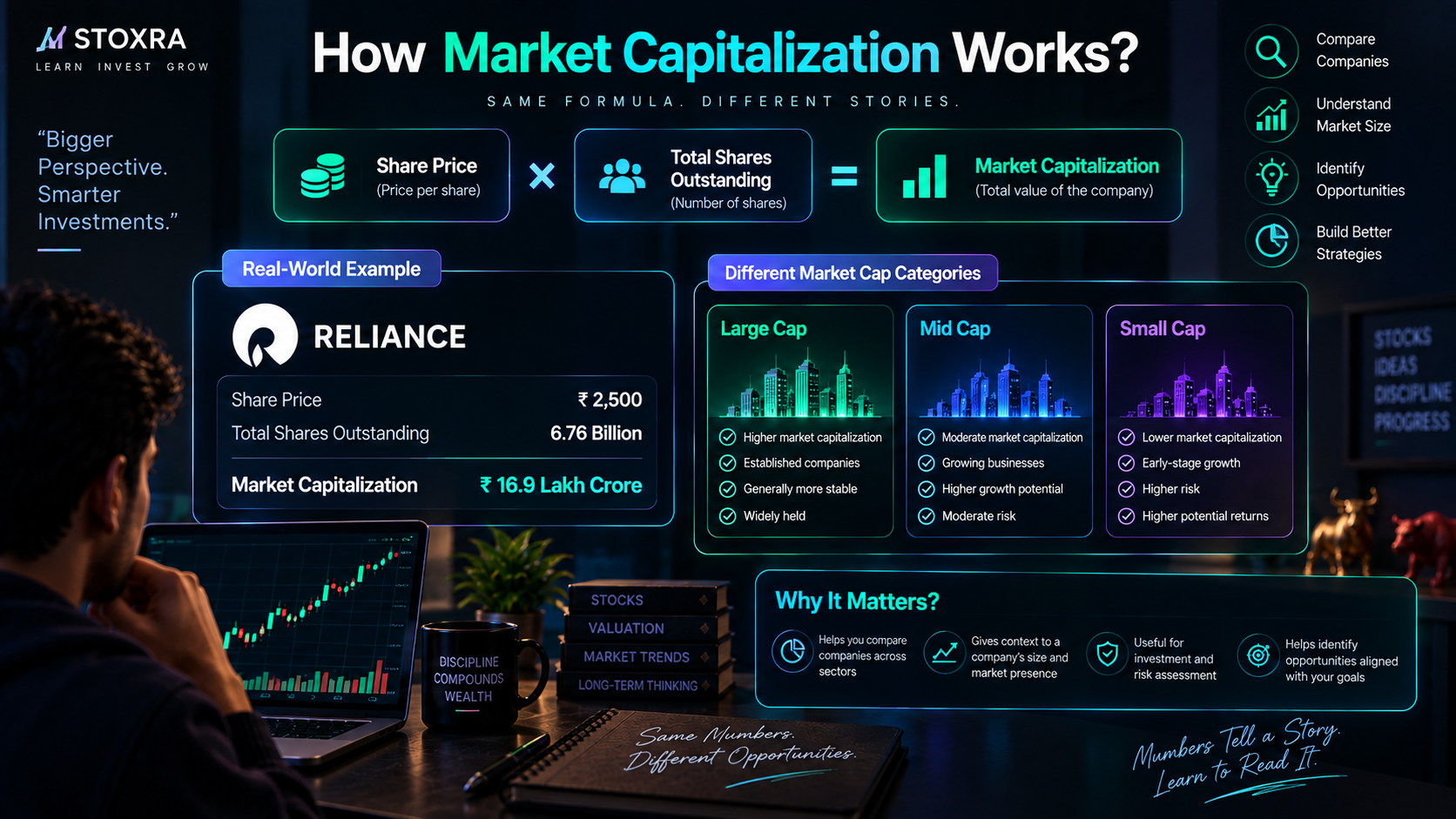
Market capitalization, commonly called market cap, is the market value of a publicly traded company's outstanding shares.
The idea is straightforward. If a company's shares are trading at a particular price, and you know how many shares are outstanding, you can multiply the two numbers to estimate the company's equity market value. For a broader foundation, read Stoxra's stock market basics guide before moving into valuation metrics.
Market capitalization tells you how large a company is in market-value terms. It does not tell you whether the company is good, bad, cheap, expensive or guaranteed to grow. Blog Index
NSE's investor education material defines market capitalization as the market value of a quoted company, calculated by multiplying its current market price by the number of shares in issue. Read the NSE Basics of Financial Markets material .
Stoxra market news can add useful context.SEBI also describes market capitalization as the total value of a publicly traded company's outstanding shares. See SEBI's market-capitalization reference .
If you are still learning basic stock-market vocabulary, start with Stoxra's stock market terminology guide .
What Is the Market Capitalization Formula?
This is the basic formula. Both variables matter.
Suppose a fictional company has:
The calculation is:
₹250 × 20,000,000 = ₹5,000,000,000
That is ₹500 crore.
Notice what happened: the company's share price alone did not tell us its size. A stock trading at ₹2,000 can have a smaller market cap than a stock trading at ₹200 if the first company has dramatically fewer shares outstanding. Tools Index
This is one of the most important reasons Beginners should also review common stock-market mistakes. beginners should stop using share price as a shortcut for company size. If you are building a stock-selection process, learn how stock screeners work so price is not your only filter.
A ₹50 stock is not automatically "cheaper" than a ₹500 stock. Share price alone tells you very little about whether a company is cheap or expensive. What Is Technical Analysis In Stock Tading A Complete Beginn
When comparing two stocks, ignore the share price at first. Start with market capitalization, shares outstanding and the business itself. What Is Technical Analysis In Stock Trading
Why Does Market Capitalization Matter?
Market cap matters because it provides a fast way to compare the relative market size of publicly traded companies. Beginners can also review Stoxra's stock market terminology guide for related concepts.
Imagine two companies operating in the same sector. One has a market capitalization of ₹10,000 crore and the other has ₹500 crore. Even before analysing their financial statements, you know that the market currently values the equity of the first company at a much larger scale. Decode Nifty Options How AI OI Heatmaps Simplify Trading
This does not automatically mean the first company is better. If you are comparing instruments, see whether beginners should start with stocks or options. It simply gives you a useful starting point for analysis.
Market capitalization can help traders and investors:
- Compare companies by relative size.
- Build stock screens.
- Group companies into size categories.
- Understand index construction.
- Compare companies within an industry.
- Identify whether a company is relatively large or small.
- Understand portfolio exposure to different company-size segments.
SEBI's investor education material encourages investors to conduct proper due diligence rather than relying on a single metric. Stoxra's trading-plan guide.
That is exactly how market cap should be used: as a filter and context metric, not as a complete investment thesis. How To Read Bank Nifty Option Chain Intraday
Large Cap vs Mid Cap vs Small Cap
You will hear investors and financial media frequently describe stocks as large cap, mid cap or small cap.
These terms describe company size based on market capitalization rankings. However, the exact classification depends on the framework being used. How To Read Option Chain Data For Nifty
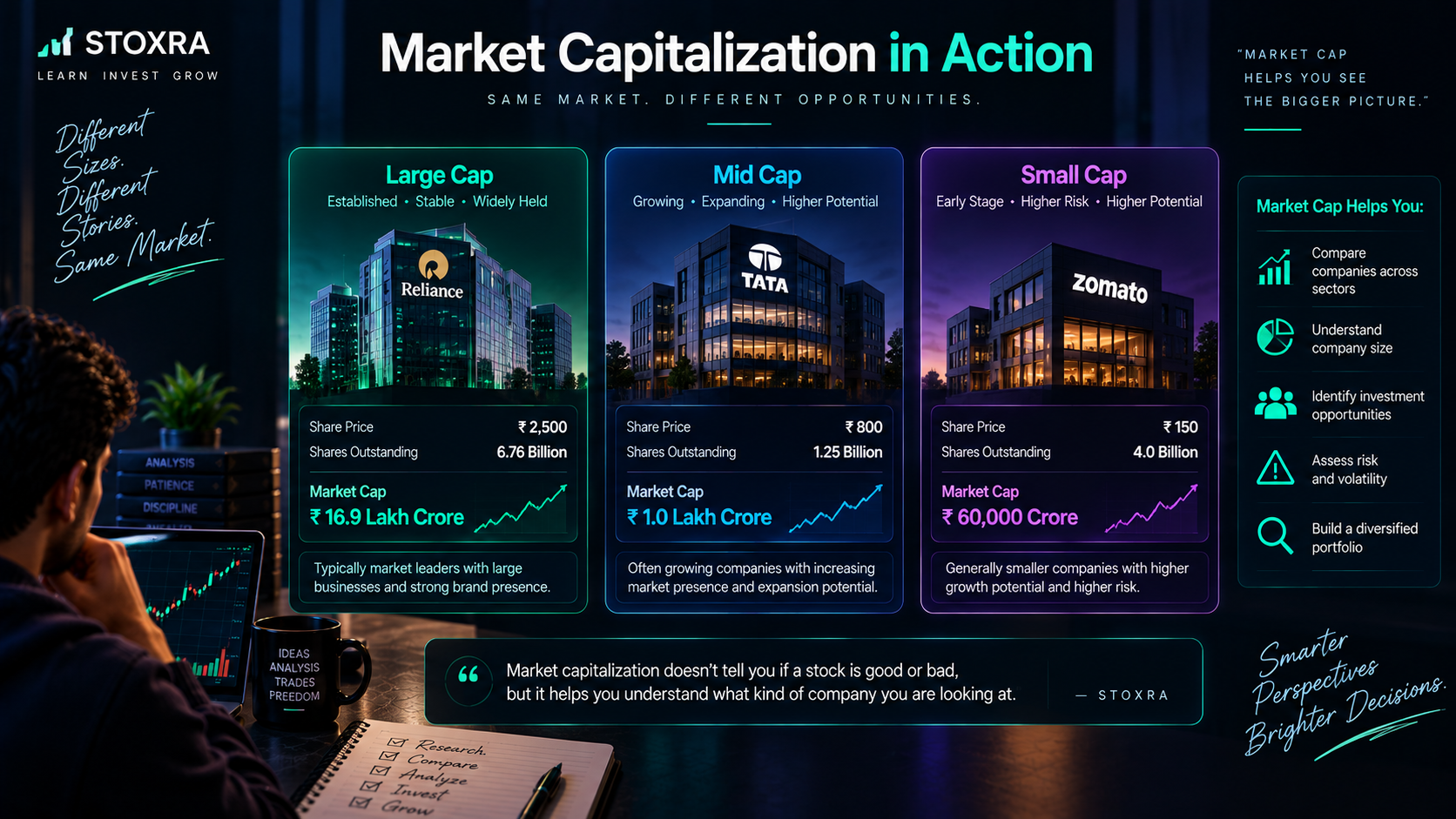
Under the SEBI framework used for equity mutual-fund categorisation, large-cap companies are the first 100 companies by full market capitalization, mid-cap companies are ranked 101st to 250th, and small-cap companies are ranked 251st onward. See AMFI's current categorisation resource .
| Category | SEBI/AMFI framework | General interpretation |
|---|---|---|
| Large Cap | 1st–100th by full market capitalization | Generally larger, more established listed companies. |
| Mid Cap | 101st–250th | Companies between the largest and smaller segments. |
| Small Cap | 251st onward | Smaller companies that can have different growth and risk characteristics. |
These categories should not be interpreted as guaranteed risk levels. For risk context, read intraday risk management. A large-cap company can experience a severe decline, while a small-cap company can become a major business over time. For index context, see how the Nifty 50 works and what the Nifty Next 50 represents.
NSE maintains a range of broad-market indices covering large, mid, small and micro-cap segments. Stoxra's Nifty 50 guide.
Market Cap Example: Why Share Price Can Mislead You
Consider two fictional companies.
1 million shares outstanding.
100 million shares outstanding.
Company B has the higher market capitalization.
Company A's market cap is:
₹1,000 × 1,000,000 = ₹1,000,000,000
Company B's market cap is:
₹100 × 100,000,000 = ₹10,000,000,000
So Company B has a market cap ten times larger even though its share price is one-tenth of Company A's.
This is why comparing stocks purely by their displayed price is fundamentally flawed.
If you want to learn how to compare companies more intelligently, explore how stock screeners work .
Market Capitalization vs Enterprise Value
Market capitalization and enterprise value are related, but they are not the same metric.
Market cap primarily represents the market value of a company's equity. Enterprise value attempts to capture the value of the operating business by considering equity value alongside relevant debt and cash adjustments. How To Read Option Chain Data For Nifty Trading
A simplified conceptual formula is:
Actual calculations can require additional adjustments.
Why does this distinction matter?
Suppose Company A and Company B both have a market cap of ₹10,000 crore. If Company A has very little debt and Company B has substantial debt, the two businesses can have very different enterprise values. How To Use PCR Nifty Options Trading
This is why analysts sometimes use valuation measures A related risk concept is position sizing for beginners. such as EV/EBITDA rather than relying only on market cap. If you are comparing company value with operating metrics, review Stoxra's enterprise value guide.
NSE's financial-modelling material covers valuation approaches including market-cap-to-sales and EV/EBITDA. Stoxra's enterprise-value guide.
Related concept: Enterprise Value .
Market Cap Is Not the Same as Valuation
This distinction is where many beginner explanations go wrong. Your decision process should also account for trading psychology for beginners.
Market capitalization tells you the current market value of the company's outstanding equity. It does not tell you whether the stock is fairly priced. Max Pain Theory Nifty Options Trading
A ₹50,000 crore company can be undervalued, fairly valued or overvalued depending on its earnings, cash flows, growth prospects, balance sheet, competitive position and the price investors are willing to pay. Nifty Option Chain Analysis Weekly Expiry Strategy
Consider a fictional company with:
- Market cap of ₹50,000 crore.
- Very high debt.
- Declining revenue.
- Weak cash flow.
- A falling competitive position.
Its large market cap does not magically make it a good investment.
Conversely, a smaller company may have attractive growth prospects but also much higher uncertainty.
SEBI's investor education resources recommend analysing business fundamentals, financial statements, valuation metrics and risk rather than relying on isolated signals. Stoxra's technical-analysis guide.
Market cap answers "How large is the company's equity market value?" It does not answer "Is this stock a good buy?" Nifty Vs Bank Nifty Options Beginners India
Why Traders Care About Market Capitalization
Traders may use market capitalization as one input Consistency matters too; see trading discipline for beginners. when narrowing the universe of stocks they want to study.
For example, a trader building a screening strategy You can practise these filters using paper-trading platforms in India. might choose to focus on larger companies because they want a particular combination of market size and liquidity.
Another trader might specifically search for smaller companies because they are interested in higher-growth businesses or stronger price movement. Open Interest Intraday Trading Nifty
But market cap should not be confused with liquidity. For a practical routine, read how beginners can stay consistent.
A company can have a large market cap while its shares have different trading characteristics from another company of similar size. Traders should also consider traded volume, bid-ask spreads, free float and market participation. Our guide on volume analysis explains why participation matters alongside price.
NSE explains that free-float market capitalization adjusts full market capitalization based on the portion of shares actually available for trading, reducing the influence of large strategic holdings that are not generally available in the market. Stoxra's market-index guide.
This is especially important when you move from basic company-size analysis into understanding stock indices.
For example, NSE's Nifty Total Market Index uses free-float market capitalization for stock weights. Stoxra's Nifty 50 guide.
Interactive Market Cap Calculator
Want to see exactly how market capitalization changes when share price or shares outstanding change? Use the calculator below. Best AI Tools Stock Market Analysis India
Market Capitalization Calculator
Enter a hypothetical share price and number of outstanding shares. The calculator works entirely in your browser and does not use live market data. How AI Is Transforming Stock Market Trading India
Common Market Capitalization Mistakes
1. Thinking a Low Share Price Means a Small Company
Share price and company size are different concepts. Always look at shares outstanding and market capitalization before comparing stock prices. Stock Market Basics For Beginners India
2. Thinking a High Market Cap Means a Good Investment
Market cap measures size, not investment quality. You still need to analyse earnings, debt, cash flow, valuation and business fundamentals. Stock Market Basics For Beginners India Guide
3. Treating Large Cap as "Low Risk"
Large companies can still fall sharply. Company size can influence risk characteristics, but it does not eliminate market risk. Stock Market Mistakes Beginners India
4. Ignoring Free Float
Full market capitalization and free-float market capitalization serve different purposes. This matters particularly when analysing stock-index construction. Stock Market Rules Every Beginner Trader India
5. Using Market Cap as Your Only Filter
Market cap is useful for narrowing a universe. It is not a complete stock-selection strategy.
6. Assuming Small Cap Automatically Means High Growth
Smaller companies may have greater room to grow, but they can also face weaker balance sheets, lower liquidity, intense competition and higher business uncertainty. Stock Market Terminology Beginners India
If you are building a screening process, For a practical stock-selection angle, read how to find swing-trading stocks. read Stoxra's stock-screening guide rather than relying on market cap alone.
How Should a Beginner Use Market Cap?
The best approach is to use market capitalization as the Before committing capital, learn how paper trading helps beginners. first layer of analysis, not the final decision. Before risking capital, For related context, see what a stock split changes. consider paper trading vs real trading and building a trading plan.
paper trading vs real trading can add useful context.Start with company size
Use market cap to understand where the company sits relative to other listed businesses.
Check the business
Understand what the company actually sells You can also review paper-trading strategies., how it makes money and what drives its growth.
Study financials For improving practice results, see how to improve paper-trading results.
Look at revenue, profitability, cash flow, debt and capital efficiency.
Study valuation For a technology angle, read how AI identifies chart patterns.
Compare price with earnings, sales, book value or other relevant valuation measures.
Assess risk You can explore top AI trading platforms in India as another research resource.
Consider volatility, liquidity, leverage, competition and your own risk tolerance.
SEBI's investor education resources similarly emphasise understanding the business, financial health, competitors, price, volume and valuation before investing. Stoxra's trading-plan guide.
Key Takeaways
- Market capitalization measures a company's equity market value, not whether the stock is cheap or expensive.
- The basic market capitalization formula is current share price multiplied by shares outstanding.
- Large-cap, mid-cap and small-cap labels depend on the classification framework being used.
- Market cap is useful for screening and comparison, but serious analysis also needs financials, valuation, liquidity and risk.
- Free-float market capitalization matters when studying index construction and investable market exposure.
Frequently Asked Questions
What is market capitalization in simple words?
Market capitalization is the market value of a company's outstanding shares. It is commonly calculated as share price multiplied by shares outstanding. Top AI Trading Strategies Indian Stock Market 2026
What is the market cap formula?
The basic formula is: Market Cap = Current Share Price × Shares Outstanding.
Does market cap change every day?
Yes. Because share prices move during market trading, the market capitalization of a listed company can change as its market price changes. When To Book Profit Options Trading
Does a high market cap mean a company is safe?
No. A large market cap indicates a large market value of equity, but it does not eliminate business, valuation or market risk. Homepage
What is a large-cap stock?
In the SEBI/AMFI framework for equity mutual-fund categorisation, large-cap companies are the first 100 companies by full market capitalization. AI Trading Platform (Stoxra)
What is a mid-cap stock?
Under the same framework, mid-cap companies are ranked from 101st to 250th by full market capitalization.
What is a small-cap stock?
Under that framework, small-cap companies are ranked 251st onward by full market capitalization.
Is market cap the same as company valuation?
Not exactly. Market cap is the market value of outstanding equity. Broader valuation analysis can include earnings, cash flows, debt, cash, enterprise value and other factors. AI vs Manual Trading
What is free-float market capitalization?
Free-float market capitalization adjusts a company's full market capitalization based on shares considered available for trading. It is widely used in index methodologies. Automated Trading Software India
Can market cap be used for stock screening?
Yes. Market cap is a useful screening criterion, but it should normally be combined with financial, valuation, liquidity and risk analysis. Stoxra Learn (Trading Academy)
Know the Size Before You Analyse the Stock
Market capitalization is a starting point, not a buy signal. Use it to understand company size, then go deeper into business quality, financials, valuation and risk. Paper Trading vs Real Trading
Explore Stoxra Stock Screener →The Bottom Line
Market capitalization is one of the simplest and most useful concepts in stock-market analysis. At its core, it measures the market value of a company's outstanding shares.
The basic calculation is: share price × shares outstanding.
That simple equation explains why a company's share price alone cannot tell you how large the business is. The number of shares outstanding matters just as much.
Market cap is useful for comparing companies, building stock screens Compare approaches with AI vs manual trading., understanding large-cap, mid-cap and small-cap segments and analysing market indices. It can help traders quickly narrow the universe of stocks they want to investigate.
But it should never be treated as a complete valuation metric. Large does not automatically mean good, and small does not automatically mean high growth.
A serious analysis should move from market cap into the business, financial statements, cash flows, debt, profitability, valuation, liquidity, competitive position and risk. You can strengthen that process with Continue learning on Stoxra Learn. Stoxra's technical-analysis guide alongside fundamental research.
Market cap tells you how large the market values a company's equity. It does not tell you what that equity is worth to you.