What Is Theta Decay in Options Trading?
Learn what theta decay is in options trading, how time value erodes option premiums, why decay accelerates near expiry, and how buyers and sellers can manage theta risk.
What Is Theta Decay in Options Trading?
By Krishna Sai Channalli
← Check out the previous blog: How Options Expiry Affects Stock Prices
If you buy an option and the underlying barely moves, you may watch your premium shrink even though your market direction is still correct. That invisible pressure is where theta becomes important. Theta decay explains how the passage of time can reduce an option's extrinsic value, why the effect usually becomes more noticeable near expiry, and why option buyers and sellers experience time differently.
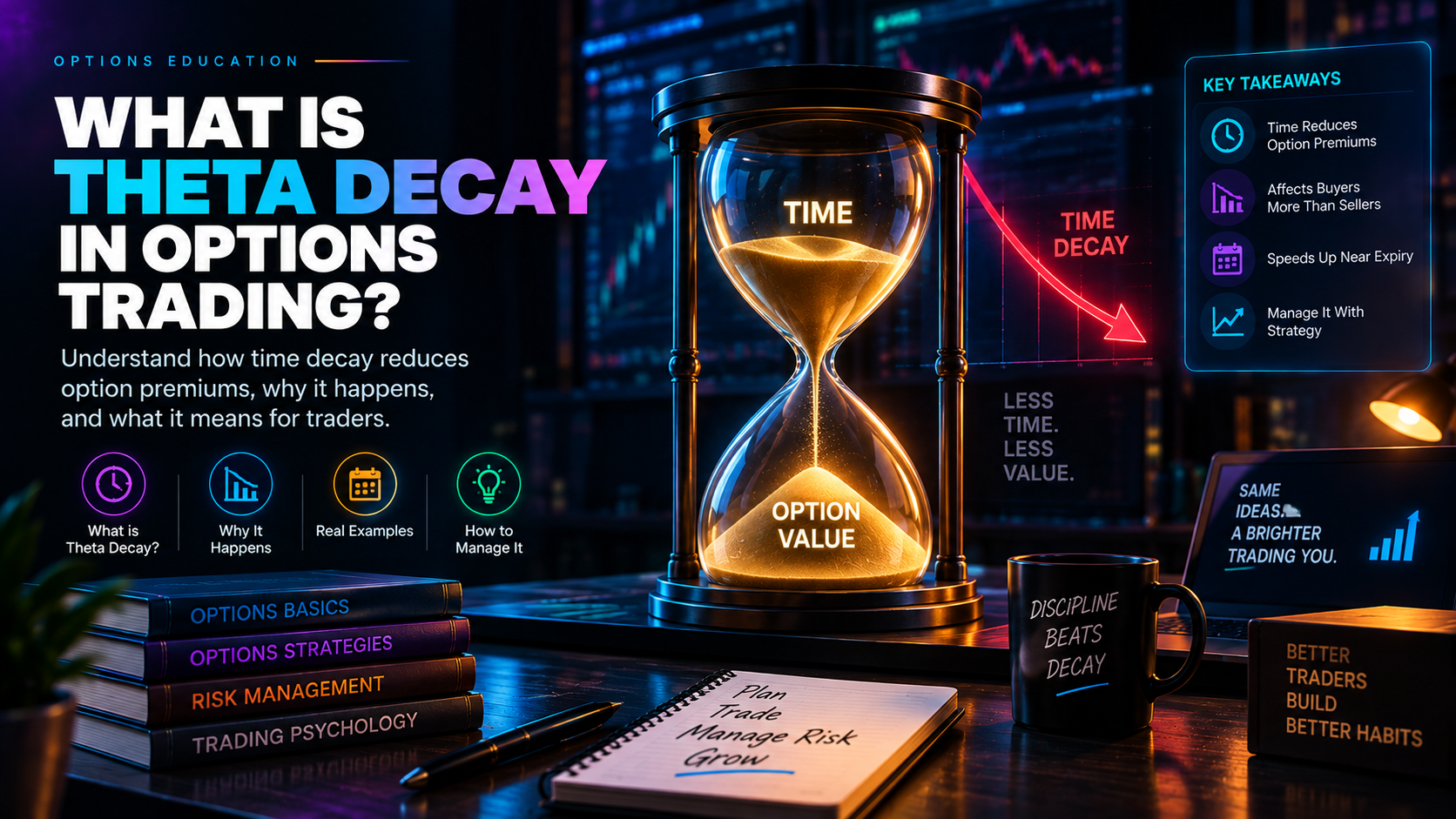
Quick Answer: What Is Theta Decay?
Theta decay is the effect of time passing on an option's extrinsic or time value. All else being equal, an option generally becomes less valuable as it gets closer to expiration because there is less time available for the underlying asset to make a favourable move.
For a long call or long put, theta is generally negative. That means the passage of time works against the position if other pricing variables do not compensate for the loss. For an option seller, theta is generally positive, but that does not mean selling options is automatically easy or low risk.
1. Why Does Time Have a Price in Options?
An option is different from simply buying or selling a stock because the contract has a limited lifespan. A stock can theoretically be held indefinitely, while an option has a defined expiration date.
Imagine a call option that gives you the right to buy an asset at a particular strike price. If the underlying is not currently above the strike, the option may still have value because there is time left for the underlying to move.
That possibility has economic value. As the expiration date gets closer, the amount of time available for that favourable move gets smaller.
This is one reason understanding options expiry is essential before trading short-dated contracts.
Time itself is an option-pricing variable. When time disappears, the opportunity for future favourable movement disappears with it.

2. Theta Explained in Simple Terms
Theta is one of the major options Greeks . It measures the sensitivity of an option's theoretical value to the passage of time, assuming other important variables remain unchanged.
In practical trading discussions, theta is often expressed as an approximate change in an option's value for one day passing.
Suppose a call option has a theoretical theta of -₹2. In a simplified example, if everything else stayed constant, the option could lose roughly ₹2 of value over the next day purely because of time passing.
Real markets are not this clean. The underlying price, implied volatility, interest rates and other variables are constantly moving. Therefore, theta should be treated as a sensitivity measure rather than a guaranteed daily premium reduction.
3. Intrinsic Value vs Time Value
To understand theta properly, you need to separate an option premium into two broad components: intrinsic value and extrinsic value.
Intrinsic Value
The amount by which an option is already in-the-money. For a call, this is related to how far the underlying is above the strike. For a put, it is related to how far the underlying is below the strike.
Extrinsic Value
The additional value assigned to the possibility that the option could become more valuable before expiration. This is the part most directly associated with time decay.
A simple conceptual relationship is:
Theta primarily describes the erosion of the option's time-related component. It does not mean the intrinsic value automatically falls every day.
This distinction becomes especially important when studying implied volatility , because changes in implied volatility can increase or decrease an option's premium even while time decay is working in the opposite direction.
4. What Happens to Theta as Expiry Gets Closer?
One of the biggest misunderstandings among beginners is assuming that an option loses exactly the same amount of time value every day. Usually, that is not how option decay behaves.
Theta is generally non-linear. The effect can become much more noticeable as expiration approaches, particularly for options around the at-the-money region.
Consider an illustrative option whose premium behaves like this:
| Time Remaining | Illustrative Premium | Conceptual Observation |
|---|---|---|
| 30 days | ₹100 | Large amount of time remains |
| 15 days | ₹60 | Time value is shrinking |
| 7 days | ₹30 | Decay becomes more noticeable |
| 3 days | ₹15 | Very little time remains |
| Expiry | ₹5 | Only intrinsic value may remain |
These numbers are purely illustrative. Actual option prices do not follow a fixed schedule like this.
If you trade weekly options, this acceleration matters even more because a large percentage of the contract's life may disappear within a few trading sessions.
5. Why Option Buyers Feel Theta So Clearly
Suppose you buy a call option because you believe the underlying will rise. The underlying does not move immediately. You wait.
While you are waiting, the option's expiration clock is moving in the opposite direction.
This creates one of the most frustrating situations for new option traders: the directional prediction can eventually be correct, but the option trade can still lose money.
Why?
- The underlying may move too slowly.
- The move may happen after too much time value has disappeared.
- Implied volatility may fall.
- The option may remain out-of-the-money.
- The eventual move may not be large enough to recover the premium paid.
This is why a trader should not evaluate an options position solely through the question, "Am I right about direction?"
You also need to ask whether the size and timing of the move justify the premium you paid.
Before entering, it can help to study what makes a strong options trade setup rather than entering simply because a chart looks bullish or bearish.
6. Theta for Option Sellers: Is Positive Theta Free Money?
This is where many beginners make another serious mistake.
Short option positions generally benefit from the passage of time. In simplified terms, if an option loses extrinsic value and you sold that option, the reduction can benefit your position.
But positive theta is not free money.
An option seller accepts other risks. A large move in the underlying, volatility expansion, gap risk or poor position sizing can overwhelm the benefit obtained from time decay.
Long Option
Generally negative theta. Time passing can reduce extrinsic value.
Time is usually a cost.
Short Option
Generally positive theta. Time passing can reduce the value of the option that was sold.
Time can be a benefit.
But the risk profiles are not symmetrical. This is exactly why options risk management should come before chasing premium collection.
7. ATM, ITM and OTM Options Can Have Different Theta Behaviour
Theta does not affect every strike equally. The option's relationship to the underlying price matters.
ATM Options
At-the-money options often contain substantial time value and can experience meaningful theta sensitivity, especially close to expiry.
ITM Options
In-the-money options have intrinsic value in addition to any remaining extrinsic value. Their theta behaviour can therefore differ from ATM and OTM contracts.
OTM Options
Out-of-the-money options may have little or no intrinsic value. Their premium can therefore consist largely of extrinsic value that can disappear by expiry.
This is one reason blindly selecting the cheapest option is dangerous. A low premium does not automatically mean a better trade.
Use the Nifty option chain and understand strike positioning before comparing premiums.
8. Theta Does Not Work Alone
An option's market price is affected by several variables. Theta is important, but isolating it from the rest of the Greeks can produce a misleading picture.
Delta
Describes how sensitive the option price is to a change in the underlying, subject to the assumptions of the pricing model.
Gamma
Describes how quickly delta changes as the underlying price moves. Gamma can become particularly important around expiry.
Vega
Measures sensitivity to changes in implied volatility. A volatility change can offset or amplify the effect of theta.
For example, an option buyer may experience negative theta during the day but still make money because the underlying makes a sufficiently large favourable move or implied volatility rises.
Conversely, an option seller may benefit from theta but suffer a much larger mark-to-market loss because the underlying makes an unexpected move.

9. A Simple Theta Decay Example
Imagine a hypothetical Nifty call option with:
- Option premium: ₹40
- Theoretical theta: -₹2 per day
- Underlying price: unchanged
- Implied volatility: unchanged
- Other variables: unchanged
In a simplified one-day calculation:
After another day, the simplified estimate might become approximately ₹36 if the same theta assumption remained valid.
But there is an important catch: theta itself can change. As expiry approaches, the sensitivity of the option to time can change. The actual option premium can also move because the underlying and implied volatility rarely remain constant.
Never take a displayed theta number and multiply it mechanically across several days as though it were a fixed interest rate. Theta is a model-based sensitivity, not a guaranteed payout or loss.
Theta Decay Estimator
Use this simple educational calculator to estimate the theoretical premium after a chosen number of days if theta remained constant. This is not a market prediction or trading signal.
Educational approximation only. Actual option premiums are affected by the underlying price, implied volatility, gamma, interest rates, dividends, liquidity and other market variables. The calculator assumes theta remains constant, which is generally unrealistic.
10. Theta Decay and Weekly Options
Weekly options can make theta especially important because there is less time between entry and expiration.
A trader buying a weekly option may be paying for a very short window in which the expected move needs to happen. If the move does not occur quickly enough, time value can disappear rapidly.
This is one reason expiry-focused trading requires more discipline than simply predicting whether the market will go up or down.
If you are studying expiry strategies, combine theta analysis with weekly expiry analysis , option-chain information and a predefined risk plan.
You can also understand positioning through Max Pain theory and Put-Call Ratio analysis , but neither should be treated as a guaranteed predictor of price.
11. Theta and Expiry-Day Trading
Expiry day can create an unusually fast-changing options environment. Time remaining becomes extremely small, and small movements in the underlying can have a large effect on option Greeks.
This can create both opportunity and risk.
The mistake is thinking that "faster theta" automatically means "easy profit." It does not.
Short-dated options can experience rapid changes in delta, gamma, implied volatility and liquidity. A position that looks attractive because its premium is falling can still become dangerous if the underlying moves sharply.
For beginners, understanding common options trading mistakes is more useful than memorising a list of expiry-day tricks.
12. Covered Calls and Theta
Theta is also relevant to option strategies rather than only naked long or short options.
In a covered call, an investor owns the underlying and sells a call against it. The sold call can benefit from time decay, although the strategy introduces trade-offs around upside participation and the obligation created by the short call.
If you are unfamiliar with the structure, read the covered call strategy for beginners before thinking about theta as simply "money earned every day."
The actual result depends on the entire position, not one Greek.
13. Protective Puts and Theta
A protective put provides another useful example of the trade-off created by theta.
Buying a put can provide downside protection for an existing position, but that protection comes at a premium. As time passes, the extrinsic portion of that put can decline.
This is why a protective put should be viewed as an insurance-like structure rather than a free hedge.
For a complete explanation, see Protective Put Strategy Explained .
The broader lesson is simple: every options structure has a cost, benefit and trade-off.
14. Five Common Theta Mistakes Beginners Make
Treating an option like a stock and forgetting that expiration is constantly approaching.
Assuming a low premium means low risk or high potential.
Entering very short-dated contracts without understanding rapid theta and gamma changes.
Looking at theta while completely ignoring implied volatility.
Trading Without a Risk Limit
Theta analysis cannot compensate for oversized positions. Read the guide on how much money to risk in options trading before deciding position size.
15. How Should Traders Think About Theta?
Instead of asking, "Is theta high or low?", ask better questions.
- How many days remain until expiration?
- How much of the premium is intrinsic versus extrinsic?
- How large does the underlying move need to be?
- How quickly does that move need to happen?
- What is implied volatility doing?
- What happens if the underlying stays flat?
- What is the maximum acceptable loss?
This changes the conversation from simply "Will the market rise?" to "Does this particular option have enough time and favourable pricing conditions for my thesis to work?"
That is a much stronger way to approach derivatives.
16. A Practical Theta Checklist Before Buying an Option
- Identify the expiry. Know exactly how much time the position has.
- Check the strike. Understand whether the option is ITM, ATM or OTM.
- Check the premium. Do not confuse cheap premium with cheap risk.
- Understand implied volatility. Theta is only one part of the premium equation.
- Define the expected move. Ask whether the underlying can realistically move enough within the remaining time.
- Define your exit. Review how to exit options trades without panic .
- Set risk before entry. Do not create the risk limit after the trade starts losing.
17. Theta Decay Does Not Mean Options Always Go Down
This distinction is important.
Theta describes one sensitivity of option value. It does not mean the market price of an option must decline every day.
Suppose a call option has negative theta. If the underlying suddenly rises significantly, delta and gamma-related effects can increase the option's value much more than the theoretical time decay reduces it.
Likewise, a sharp rise in implied volatility can increase an option's premium.
Therefore, the statement "theta reduces option premium" should always be understood as a controlled-variable concept: holding other important factors constant, the passage of time generally reduces time value.
This is also why learning to read support and resistance alongside option-chain data can be more useful than relying on one Greek in isolation.
18. How Theta Fits Into a Complete Options Workflow
Understand the market context and underlying asset.
Choose strike, expiry and strategy based on a defined thesis.
Define position size, invalidation and maximum acceptable loss.
Monitor price, volatility, Greeks and time remaining.
Stoxra's market screener and trading tools can be useful around the broader research workflow, while paper trading versus real trading can help you test your process before putting capital at risk.
19. Theta vs Direction: Which Matters More?
There is no universal answer because options are multi-variable instruments.
Direction can dominate the result when the underlying makes a large move. Theta can become extremely important when the underlying stays near the same level while expiration approaches.
A useful mental model is:
Large Move + Right Direction
Directional gains may overwhelm the cost of time decay.
Small Move + Slow Timing
Theta can consume a significant portion of extrinsic value.
No Move + Expiry Approaches
Time value can erode substantially, particularly for options with little intrinsic value.
This is why options trading is not simply a directional game. You are trading direction + magnitude + timing + volatility.
20. The Bottom Line on Theta Decay
Theta decay is one of the most important concepts an options beginner can understand because it explains something that ordinary stock trading does not: time can work against your position.
Long options generally carry negative theta because their extrinsic value can decline as expiration approaches. Short options generally have positive theta, but that benefit comes with significant exposure to other risks.
The closer an option gets to expiration, the more carefully you should think about time remaining, strike selection, volatility, expected movement and risk.
Most importantly, theta should never be viewed in isolation. Combine it with delta, gamma, implied volatility, price action, option-chain context and a defined risk plan.
You can be right about direction and still be wrong about the option. In options trading, the move has to be large enough and fast enough to justify the premium and the time you are paying for.
Learn Before You Risk Capital
Theta is only one piece of the options puzzle. Continue learning with Stoxra's education resources, explore market-analysis workflows, and practise your process before treating a strategy as ready for live capital.
Explore Stoxra Learning →Frequently Asked Questions About Theta Decay
Theta decay is the reduction in an option's extrinsic or time value as time passes, assuming other major pricing variables remain unchanged. It is represented by the Greek theta.
Is theta bad for option buyers?Theta is generally a cost for long option positions because the passage of time can reduce extrinsic value. However, a favourable movement in the underlying or a change in implied volatility can offset that effect.
Why does theta decay accelerate near expiry?As expiration approaches, there is less time remaining for the underlying to make a favourable move. The remaining extrinsic value can therefore erode more rapidly, particularly for options near the money.
Can an option buyer be right and still lose money?Yes. The underlying can move in the predicted direction, but if the move is too small, too slow, or offset by changes in implied volatility and other pricing variables, the option position can still lose money.
Does theta stay constant every day?No. Theta is not a fixed interest rate. It can change as time to expiry, strike relationship, implied volatility and other pricing variables change.
Is selling options always better because of positive theta?No. Positive theta can benefit short option positions, but option sellers can face substantial losses from adverse underlying moves, volatility changes and other risks. Positive theta is not free money.
What is the difference between theta and time value?Time value is a component of an option's premium. Theta is a sensitivity that describes how the option's theoretical value changes as time passes. They are related but not the same thing.