How to Read a Cash Flow Statement as a New Investor
Learn how to read a cash flow statement as a new investor, understand operating, investing and financing cash flows, identify common red flags, and use practical cash-flow calculations to evaluate business quality.
Learning how to read a cash flow statement as a new investor is one of the most useful skills you can build when analysing a company. Revenue and profit matter, but they do not always tell the complete story.
A business can report strong earnings while cash generation remains weak. That is why a cash flow statement deserves a place alongside the income statement and balance sheet in your research process.
If you are still building your investing foundation, start with stock market basics for beginners and use Stoxra Learn to strengthen your understanding of financial concepts.
When you open a cash flow statement, first ask: Does the core business generate cash? Then ask where that cash is being invested and how the company is financing itself.
1. What Is a Cash Flow Statement?
A cash flow statement explains how a company's cash position changed during a reporting period. It shows where cash came from, where it was spent and how those movements affected the company's overall cash balance.
Unlike the income statement, which focuses on revenue and accounting profit, cash flow focuses specifically on cash movement. This makes it especially useful when you want to understand whether reported business performance is translating into actual cash generation.
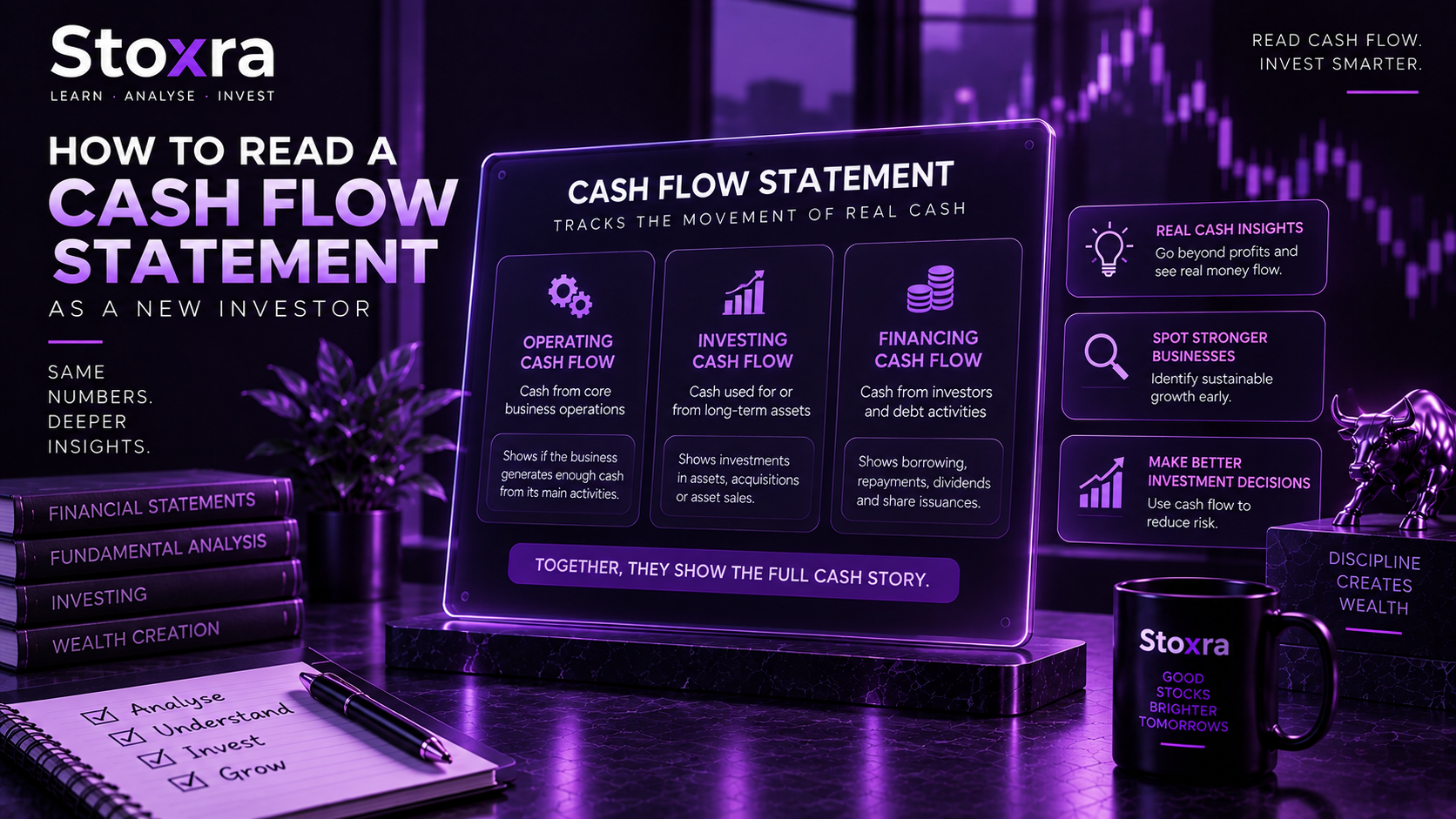
Operating Activities
Cash generated or used by the company's main business operations.
Investing Activities
Cash used for assets, investments, acquisitions and other long-term spending.
Financing Activities
Cash raised from or returned to lenders and shareholders.
These three sections should never be viewed completely independently. Together they tell you how a company generates cash, how it deploys that cash and whether it depends on outside capital.
Once you understand the basic structure, you can use the Stoxra Stock Screener to shortlist companies and then examine the financial statements of the businesses that interest you.
2. Understand Operating, Investing and Financing Cash Flow
Operating Cash Flow
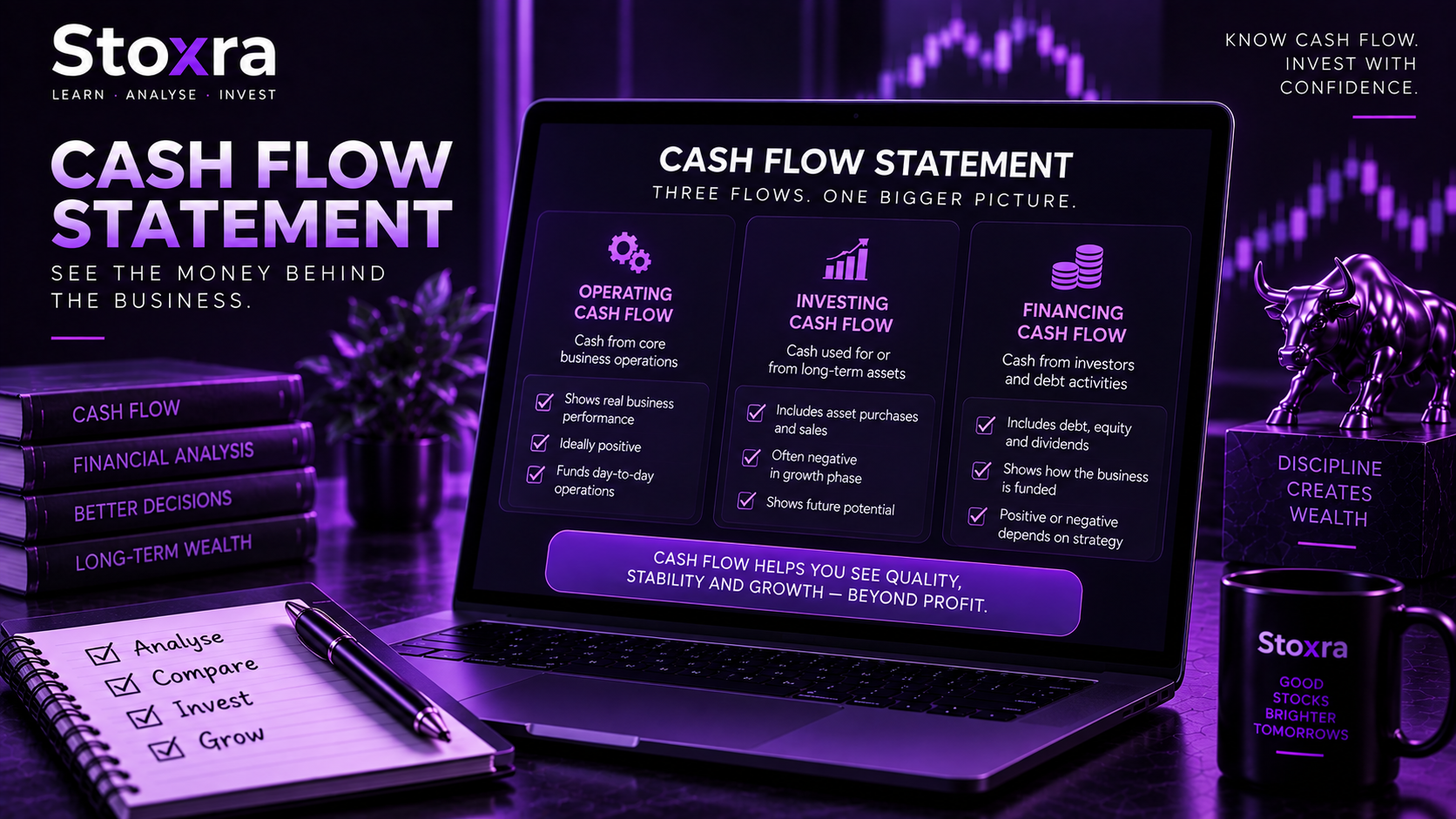
Operating cash flow, or OCF, focuses on cash generated or consumed by the company's normal operations. For many investors, this is the first section worth studying because it provides a direct look at the cash produced by the underlying business.
If profit is increasing while operating cash flow remains weak for a prolonged period, investigate the difference. Receivables, inventory, payables, taxes and other working-capital movements can create differences between accounting profit and cash.
This is closely related to earnings quality . Strong reported earnings are generally more convincing when the business is also converting those earnings into operating cash.
This simple comparison can help you understand how closely cash generation is tracking reported profit. It is a starting point rather than a complete measure of business quality.
Investing Cash Flow
Investing cash flow shows how a company deploys money into long-term assets and investments. Capital expenditure, acquisitions and asset purchases can all create cash outflows.
Negative investing cash flow is not automatically a problem. A company that is expanding its production capacity or investing heavily in technology may naturally spend more cash during its growth phase.
When thinking from a value perspective, it can also help to understand the difference between value investing and trend following . The important question is not just whether cash moved out, but whether the spending makes strategic sense.
Financing Cash Flow
Financing cash flow shows how the business raises and returns capital. This can include borrowing, debt repayment, issuing shares, share buybacks and dividend payments.
A large financing inflow can increase the company's cash balance, but it does not necessarily mean the business itself generated that money. You need to understand whether the company is funding growth through internally generated cash, debt or new equity.
Never classify a cash-flow section as good or bad just because it is positive or negative. Always ask why the cash moved.
3. A Simple Step-by-Step Method for New Investors
You do not need advanced accounting knowledge to start reading cash flow statements. The easiest approach is to follow the same checklist each time.
Step 1: Start With Operating Cash Flow
Look at whether operating cash flow is positive and whether it has remained reasonably consistent. A single quarter can be affected by temporary working-capital movements, so several periods are usually more informative.
Step 2: Compare OCF With Net Profit
Compare the two numbers and investigate large differences. Persistent gaps do not automatically mean something is wrong, but they tell you where to dig deeper.
Step 3: Examine Capital Expenditure
Find out how much the company is reinvesting in its assets and operations. Heavy capital spending may support growth, but it also means more cash is being tied up in the business.
Step 4: Estimate Free Cash Flow
A simple beginner framework is to subtract capital expenditure from operating cash flow. This gives you a rough view of cash remaining after reinvestment.
Step 5: Study Financing
Finally, determine whether the company frequently depends on debt or new equity. Financing can support expansion, but repeated dependence deserves a closer look.
Once you have a repeatable fundamental-analysis process, you can combine it with technical analysis when appropriate. The two approaches answer different questions and should not be treated as substitutes.
You can also practise your research process without risking capital using Stoxra's paper trading resources .
Save the same five questions for every company you analyse. A consistent process makes it much easier to compare businesses over time.
4. Worked Example: Reading the Cash Story
Imagine a company with the following simplified annual figures:
| Cash Flow Item | Amount | What It Suggests |
|---|---|---|
| Operating Cash Flow | ₹1,250 Cr | Core operations generated cash |
| Investing Cash Flow | -₹800 Cr | Significant investment or asset spending |
| Financing Cash Flow | ₹300 Cr | Net financing inflow |
| Net Change in Cash | ₹750 Cr | Cash increased during the period |
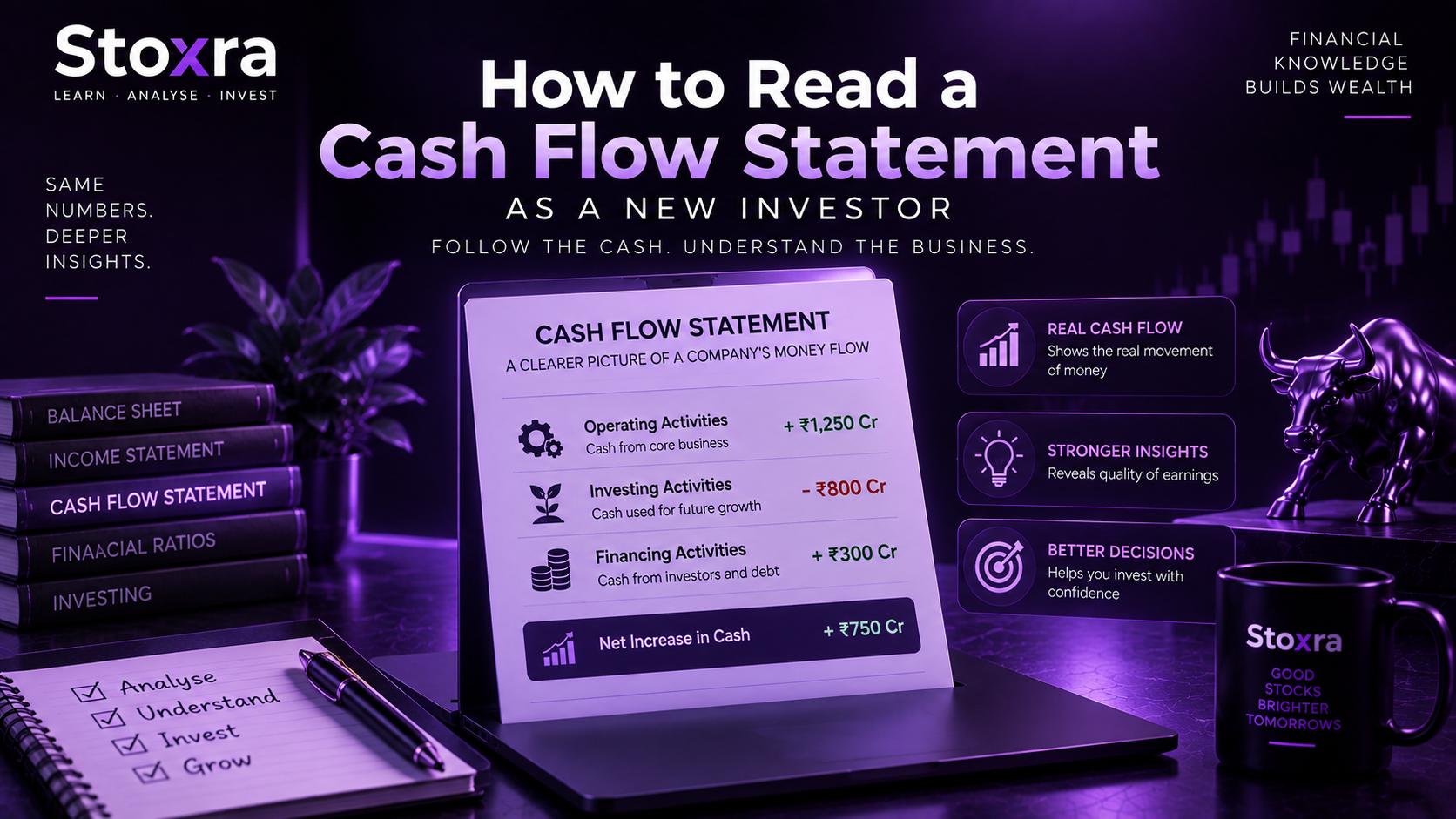
The company generated ₹1,250 crore through operating activities. It then used ₹800 crore in investing activities and received ₹300 crore through financing activities.
If the ₹800 crore investing outflow is treated as capital expenditure for this simplified example, the free cash flow calculation becomes: ₹1,250 crore − ₹800 crore = ₹450 crore.
The next step is to avoid looking at this one year in isolation. Compare the figures across several years and determine whether cash generation is improving, remaining stable or deteriorating.
This becomes even more important when evaluating valuation. Stoxra's discussion of valuation, growth and execution shows why business performance should always be considered alongside what investors are paying for that performance.
5. Red Flags, Ratios and Practical Tools
Cash-flow analysis is most useful when you look for patterns rather than isolated numbers. The following warning signs can help you decide where more research is needed.
Profit Up, OCF Weak
Persistent differences between earnings and operating cash flow deserve closer investigation.
Repeated New Debt
Frequent financing inflows may indicate increasing dependence on external funding.
Heavy Capex
Large investment is not automatically bad, but you should examine whether it creates productive growth.
For additional business context, compare financial analysis with Stoxra's coverage of revenue growth and valuation challenges . A strong cash-flow profile still needs to be assessed alongside the company's growth prospects and valuation.
Operating Cash Conversion
Compare operating cash flow with net profit.
Educational calculation only. Compare the result across multiple periods.
Free Cash Flow
Estimate a simplified free cash flow figure.
This is a simplified educational OCF minus capex calculation.
Cash Flow Health Check
Use the checklist to structure your first review.
SIP Calculator
Explore how regular investing can grow over time.
Use SIP Calculator →Stock Screener
Shortlist companies before deeper fundamental analysis.
Open Stock Screener →Stoxra Learn
Build your financial and investing knowledge step by step.
Explore Stoxra Learn →AI Stock Analysis
Explore AI-powered workflows for stock market research.
Explore AI Tools →Cash flow should strengthen your research, not replace it. Combine it with profitability, balance-sheet strength, valuation, business quality and the company's long-term strategy.
If you want to understand how technology can complement stock research, see Stoxra's AI Trading Platform and What Is AI Trading? .
You can also explore AI trading apps and automated trading and learn about AI trading strategies .
6. FAQs About Reading Cash Flow Statements
Not automatically. You should also examine consistency, quality, working-capital movements and whether the cash generation is sustainable.
Is negative investing cash flow a bad sign?No. A growing company may have negative investing cash flow because it is investing heavily in assets, technology, capacity or acquisitions.
Why can profit be high while cash flow is low?Accounting profit can differ from cash generation because of non-cash items and working-capital movements such as receivables and inventory.
What is free cash flow?A simple beginner framework is operating cash flow minus capital expenditure. It provides a rough view of cash remaining after reinvestment.
How many years of cash flow should I study?Several years are generally more informative than a single reporting period because trends can reveal whether cash generation is improving or weakening.
Can cash flow analysis replace other stock analysis?No. Use cash flow alongside the income statement, balance sheet, valuation, business quality and other relevant research.
For broader market perspective, you can also review Stoxra's Indian equities and valuation coverage and its discussion of market valuations and key support .