What Is a Demat Account?
A Demat account is an electronic account used to hold eligible securities in dematerialised form. Learn how Demat accounts work, how they differ from trading accounts, why investors need them, and what beginners should know before entering the stock market.
What Is a Demat Account?
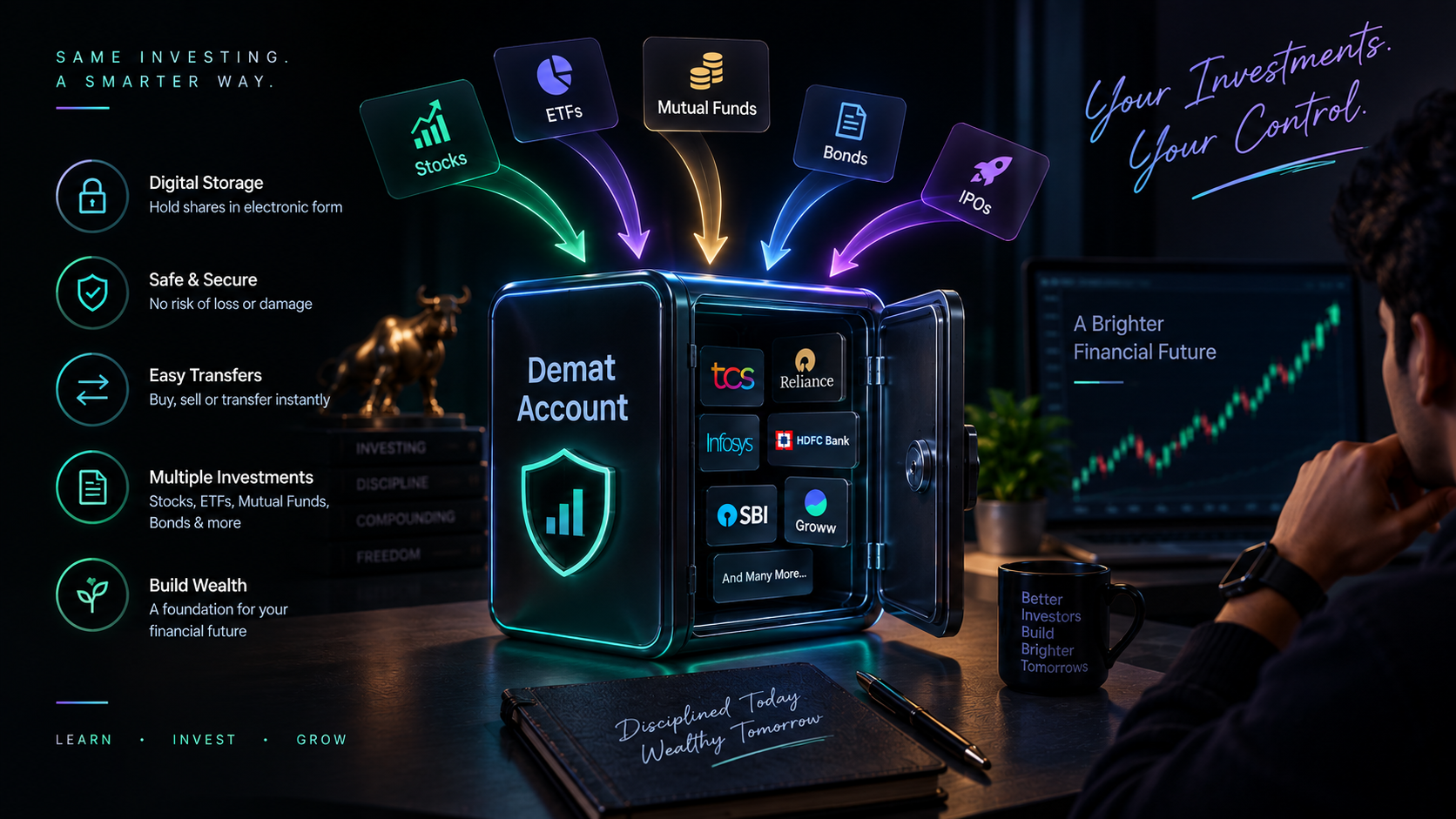
A Demat account is an account used to hold eligible securities in electronic or dematerialised form. “Demat” is short for dematerialised, which refers to converting securities from physical certificates into electronic records.
The simplest mental model is this: if a physical share certificate was once a document representing your holding, a Demat account provides the electronic infrastructure through which eligible securities can be maintained today.
This is an important distinction because a Demat account is not simply another version of your bank account. It is also not the same thing as the account through which you place a stock-market order.
If you are completely new to the market, start with Stoxra's stock market basics guide before moving into more advanced concepts.
A Demat account is primarily about holding eligible securities electronically. A trading account is primarily about placing buy and sell instructions. The two can work together, but they are not the same account or function.
Why Do Demat Accounts Exist?
Before electronic securities systems became standard, investors could receive and maintain physical share certificates. Physical documents created obvious operational problems: they needed to be stored safely, transfers involved paperwork, and certificates could potentially be lost, damaged or forged.
Dematerialisation moved eligible securities into electronic form. This allowed securities markets to maintain ownership records digitally and support electronic transfer and settlement processes.
According to SEBI Investor , depositories provide services including electronic holding, dematerialisation and rematerialisation, transfer and settlement, pledging and corporate-action related services.
India has two central securities depositories: CDSL and NSDL . Investors normally access depository services through a Depository Participant (DP) rather than opening an account directly with a central depository.
SEBI explains the difference between a depository and a Depository Participant in its investor education material. A depository provides the underlying electronic securities infrastructure, while the DP interfaces directly with investors. Read SEBI's depository vs DP explanation .

How Does a Demat Account Work?
Beginners often imagine that one account does everything. In reality, participating in the stock market can involve several connected components.
Bank Account
Your bank account is used for the movement of money associated with your financial transactions, subject to the broker and banking process you use.
Trading Account
Your trading account provides the interface through which you submit buy and sell orders to participate in the market.
Demat Account
Your Demat account is associated with electronically holding eligible securities after the applicable transaction and settlement process.
This three-part model is useful for beginners because it separates money movement, market orders and securities holding.
You can explore more beginner terminology through Stoxra's stock market terminology guide .
Demat Account vs Trading Account
This is probably the most important distinction for someone learning the market for the first time.
| Feature | Demat Account | Trading Account |
|---|---|---|
| Primary role | Electronic holding of eligible securities | Placing buy and sell instructions |
| Simple analogy | Digital storage | Transaction interface |
| After a delivery purchase | Eligible securities can be credited after settlement | The order is submitted and executed through the trading system |
| Main beginner mistake | Thinking it is the same as a trading account | Thinking it directly stores the securities |
The distinction becomes much easier if you remember one sentence: the trading account helps you transact; the Demat account helps maintain eligible securities electronically.
For a broader explanation of the market ecosystem, see Stoxra's beginner Demat account guide and Stoxra's stock market rules guide .
What Happens When You Buy Shares?
Consider a simple example. Suppose you decide to buy shares of a listed company for investment. You open your broker's trading interface, select the security and submit an order.
The order is then handled through the relevant market infrastructure. If it is successfully matched and executed, the transaction proceeds through the applicable settlement process.
For a delivery-oriented purchase, the resulting securities are ultimately credited electronically to the relevant Demat account according to the applicable settlement process.
You place the order
You use the trading interface to submit the buy instruction.
The order is executed
If the order is matched according to market rules, the trade is executed.
Settlement happens
The transaction goes through the applicable clearing and settlement process.
The holding is reflected electronically
For eligible delivery holdings, securities are credited to the relevant Demat account after settlement.
NSE's investor education resources include material covering the process of opening trading and Demat accounts as well as basic market participation. Explore NSE investor education .
Why Does a Demat Account Matter to an Investor?
1. Electronic securities holding
The biggest reason is straightforward: eligible securities can be maintained electronically instead of relying on physical certificates. That makes the ownership record part of the digital market infrastructure.
2. Easier portfolio management
Digital records make it easier for investors to view their holdings, review transactions and keep track of securities associated with their account.
3. Supports modern settlement
Demat infrastructure works with exchanges, clearing systems, depositories, brokers and other intermediaries to support electronic securities settlement.
4. Corporate actions can be processed electronically
Depository infrastructure also supports corporate-action related processes such as eligible dividends, bonus issues, rights issues and stock splits.
SEBI's Investor Charter for Depositories explains the services, rights and responsibilities associated with depository services.
A Demat account gives you the infrastructure to hold securities electronically. It does not tell you which stocks to buy, when to sell or whether an investment will make money. Technology solves access and record-keeping problems; it does not eliminate investment risk.
Dematerialisation: What Does It Actually Mean?
The term dematerialisation sounds complicated, but the underlying idea is simple: converting eligible physical securities into electronic form.
Imagine that an investor owns an old physical share certificate. Instead of continuing to rely on that paper document, the investor can follow the applicable process to have the eligible security dematerialised.
The electronic holding then becomes part of the investor's Demat account through the relevant depository participant.
The opposite concept is called rematerialisation, where eligible securities held electronically are converted back into physical certificates when the applicable rules and process permit it.
SEBI's investor material explains both dematerialisation and rematerialisation as services provided through the depository infrastructure. Read the SEBI depository overview .
What Can a Beginner Do With a Demat Account?
The exact securities and services available to you depend on the product, intermediary and applicable market rules. However, Demat infrastructure is relevant to several common investment activities.
- Holding eligible listed shares electronically.
- Receiving eligible securities after applicable settlement.
- Participating in eligible corporate actions.
- Holding certain other eligible securities electronically.
- Transferring eligible securities through permitted mechanisms.
- Pledging eligible holdings when the relevant facility is available.
A Demat account can also be relevant when receiving shares allotted through an IPO. If you want to understand the IPO process, see Stoxra's guide to applying for an IPO online .
For broader learning, you can also explore Stoxra's paper trading guide before putting real money at risk.
Which Account Does What?
Confused about whether a Demat account, trading account or bank account is involved in an activity? Select what you are trying to do below. This tool is educational and does not use live market data.
Common Demat Account Mistakes Beginners Make
Mistake 1: Thinking Demat and Trading Are the Same
This is the most basic misunderstanding. A Demat account is associated with electronic securities holding, while the trading account is associated with placing market orders.
Mistake 2: Assuming Account Access Means Trading Readiness
Opening an account takes you from “no market access” to “market access.” It does not magically give you a profitable strategy. Understanding risk, position sizing, order types and market behaviour still requires work.
Mistake 3: Starting With Complex Products
Many beginners jump straight from opening an account to intraday trading or derivatives. That is usually a bad learning sequence. Understand the underlying market first.
Mistake 4: Ignoring Charges and Account Terms
Brokerage is not the only consideration. Investors should understand the applicable account charges, transaction costs, taxes, regulatory charges and other terms before trading.
Mistake 5: Treating the Broker App as the Market
A broker's application is an interface. It is not the entire financial market. Behind the interface are exchanges, clearing systems, depositories, banks, regulators and other participants.
If you are moving from account basics into trading, read these stock-market rules for beginners before increasing your risk.
How Should a Beginner Learn Before Using Real Money?
The correct sequence is more important than most beginners realise. Opening an account is easy. Building the judgment required to use it responsibly is harder.
Start with market terminology. Learn what shares, indices, exchanges, orders, settlement, volatility and risk actually mean.
Next, understand the difference between investing and trading. Investing generally involves a longer-term ownership thesis, while trading usually focuses on shorter-term price movement and predefined setups. Neither label automatically makes a decision safe or profitable.
Then learn basic risk management. Understand how much capital you are willing to risk, how position size affects potential losses and why a series of small losses can become significant.
If you want to practise without immediately putting capital at risk, explore paper trading vs demo trading .
You can also explore stock screening for swing trading once you understand the basics.
Learn first. Practise second. Risk real money last. The fact that a Demat account makes investing convenient does not mean you should rush into the market.
Demat Account Costs: What Should You Check?
There is no single universal Demat-account price that applies to every investor. Charges can depend on the intermediary, account type, services used and applicable rules.
Before opening an account, read the broker or DP's current pricing information rather than relying on an old social-media post or a friend's screenshot.
Look for items such as:
- Account-opening charges, if applicable.
- Annual maintenance charges.
- Transaction-related charges.
- Depository participant charges.
- Brokerage and other trading costs.
- Applicable statutory taxes and regulatory charges.
- Charges for specific services or transfers.
SEBI's investor charter also describes investor rights and basic depository services. For example, investors should deal with a SEBI-registered Depository Participant and carefully review documents and authorisations. Review the SEBI Investor Charter .
How to Choose a Demat Account Provider
The cheapest provider is not automatically the best provider. At the same time, paying for a pile of features you never use is also a waste of money.
Beginners should compare the things that actually affect their workflow:
- Regulatory status and intermediary details.
- Transparent pricing.
- Quality of customer support.
- Ease of account management.
- Reliability of the trading platform.
- Access to statements and transaction records.
- Security controls.
- Relevant investment and trading features.
Do not select a provider because an influencer claims it is “the best.” Your needs matter more than somebody else's affiliate link.
The SEBI website provides regulatory and intermediary information that investors can use when checking the market ecosystem.
Security and Safety: What Should You Do?
A Demat account contains information connected with your financial holdings, so basic digital security matters.
Use strong authentication wherever available. Never share passwords, PINs, OTPs or sensitive account credentials with another person. Avoid approving transactions that you did not initiate.
Be especially careful with fake broker support accounts, phishing messages and websites pretending to be financial intermediaries.
SEBI's investor guidance recommends dealing with registered intermediaries and taking care with documents and authorisations. Investors should also maintain records and report discrepancies promptly.
For broader investor-protection information, use SEBI Investor and SEBI SCORES when appropriate.
Do You Need a Demat Account to Learn Trading?
No.
This is worth stating clearly because beginners often think they must open a live account before they can start learning.
You can learn market terminology, understand charts, study company financials, practise order logic and explore trading strategies without immediately committing real capital.
Stoxra's stock-market learning guide can help build the foundation first.
Once you understand the basics, you can explore how stock screeners work or how to screen stocks for swing setups .
If you're interested in technology-driven analysis, explore how AI is changing algorithmic trading and how AI can identify chart patterns .
Frequently Asked Questions
What is a Demat account in simple words?
A Demat account is an account used to maintain eligible securities in electronic or dematerialised form. Think of it as the electronic holding layer for your securities.
Is a Demat account the same as a trading account?
No. A trading account is primarily used to place buy and sell instructions, while a Demat account is associated with holding eligible securities electronically.
Can I have more than one Demat account?
Investors can have more than one Demat account, subject to the applicable rules and account arrangements. SEBI's investor charter states that an investor can open more than one Demat account in the same name with one or multiple DPs.
Do I need a Demat account to apply for an IPO?
A valid Demat account is generally required to receive shares if an IPO application is allotted shares to the investor.
What is dematerialisation?
Dematerialisation is the process of converting eligible physical securities into electronic form.
What is rematerialisation?
Rematerialisation refers to converting eligible securities held in electronic form back into physical certificates through the applicable process.
Does opening a Demat account guarantee profits?
Absolutely not. A Demat account provides market infrastructure and access to electronic holdings. It does not guarantee investment returns.
Should beginners start trading immediately after opening an account?
No. Account access and trading readiness are different things. Beginners should first understand market mechanics, risk, position sizing and the products they intend to trade.
Continue Learning With Stoxra
A Demat account is only the beginning. Use these resources to build your understanding step by step.
- Stoxra Home
- Stoxra Blog
- Demat Account Wiki
- Stock Market Basics
- Stock Market Terminology
- Demat Account Guide
- IPO Guide
- Paper Trading vs Demo Trading
- Stock Market Rules
- Swing Trading Screening
- How Stock Screeners Work
- AI and Algorithmic Trading
- AI Chart Pattern Recognition
- AI Pattern Analysis
- AI Trading Backtesting
- AI Trading Platforms
- AI Market Analysis Tools
- Top AI Trading Platforms
- AI in Stock Market Trading
- AI Portfolio Management
- Evaluating AI Trading Signals
- SEBI
- SEBI Investor
- SEBI Depository Education
- Depository vs DP
- Depository Investor Charter
- SEBI SCORES
- NSE India
- NSE Investor Education
- CDSL
- CDSL Investor Corner
- NSDL
- BSE India
Understand the Market Before You Risk Money
Opening a Demat account is easy. Understanding what you are doing with it is the part that actually matters.
Learn the fundamentals, practise your decision-making and build your market knowledge before increasing your exposure.
Start Learning With Stoxra →The Bottom Line
A Demat account is a fundamental part of India's modern securities infrastructure. In simple terms, it provides the electronic account structure used to maintain eligible securities rather than relying on physical certificates.
The key concept to remember is the difference between the three major pieces involved in a typical investing workflow: your bank account is associated with money movement, your trading account is used to submit market orders, and your Demat account is associated with electronic securities holding.
Once you understand that distinction, many other stock-market concepts become easier to understand. IPOs, delivery investing, settlement, corporate actions, transfers and portfolio management all make more sense when you know where securities are actually maintained.
But do not make the beginner mistake of confusing access with readiness. A Demat account gives you infrastructure. It does not give you a strategy, risk management skills or guaranteed returns.
If you're just starting, learn the market first, practise carefully and only then decide how much real capital you are comfortable putting at risk.
Understand the account. Understand the market. Understand the risk. A Demat account is the beginning of your market journey — not the finish line.