What Is EPS and Why It Matters to Investors?
Learn what EPS means, how Earnings Per Share is calculated, why investors track it, and how to use it alongside valuation, cash flow, and other financial metrics.
What Is EPS and Why It Matters to Investors?
Earnings Per Share is one of the most useful numbers for understanding how much profit a company generates for each share. Learn how to calculate EPS, interpret it, and avoid common mistakes.
What Is EPS?
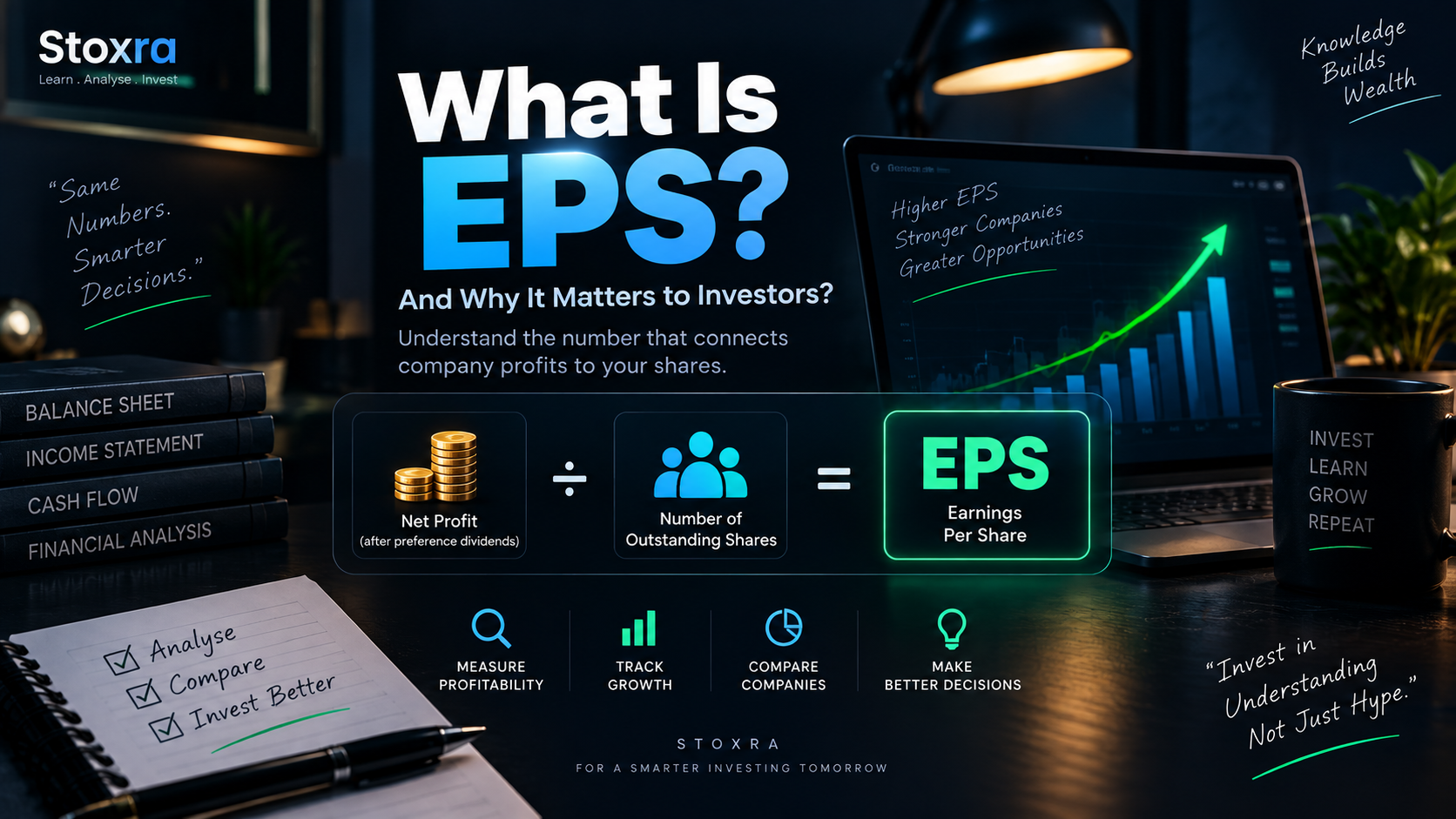
EPS stands for Earnings Per Share. It measures the portion of a company’s net profit attributable to each outstanding equity share.
Investors use EPS to understand how efficiently a company generates profit for its shareholders. It is useful when comparing a company’s profitability across different years or against other companies in the same industry.
For example, if a company reports a profit of ₹100 crore and has 10 crore outstanding shares, its EPS is ₹10. This means the company generated ₹10 in earnings for every outstanding share during that period.
How Is EPS Calculated?
The basic EPS formula is straightforward:
Preference dividends are deducted because basic EPS focuses on earnings available to ordinary equity shareholders. The weighted average number of shares is used because the number of outstanding shares may change during the financial year.
A company reports net profit of ₹500 crore, pays ₹20 crore in preference dividends, and has 100 crore weighted average outstanding shares.
EPS = (₹500 crore − ₹20 crore) ÷ 100 crore
EPS = ₹4.80 per share
Basic EPS vs Diluted EPS
Companies may report both basic EPS and diluted EPS. The difference matters because future share issuance can reduce the earnings attributable to each existing share.
| Metric | Meaning | What It Shows |
|---|---|---|
| Basic EPS | Calculated using current outstanding equity shares. | Current earnings attributable to each ordinary share. |
| Diluted EPS | Considers potential shares from options, warrants, or convertible securities. | A more conservative view of earnings per share. |
If diluted EPS is significantly lower than basic EPS, investors should investigate whether potential dilution could affect future ownership and profitability per share.

Why Does EPS Matter to Investors?
1. It Measures Profitability Per Share
Total profit alone does not tell the complete story. A company may report higher net profit but also issue many new shares. In that case, profit per share may not increase at the same pace.
2. It Helps Track Business Growth
Comparing EPS across several years can help investors identify whether a company’s profitability is improving, declining, or remaining unstable.
A consistent increase in EPS may indicate stronger sales, better margins, improved cost control, or more efficient use of capital. Investors should verify whether the growth comes from sustainable business operations.
3. It Is Used in Valuation
EPS is a key component of the Price-to-Earnings ratio, commonly known as the P/E ratio.
If a stock trades at ₹200 and its EPS is ₹10, its P/E ratio is 20. This means investors are paying ₹20 for every ₹1 of annual earnings.
EPS and P/E should be analysed together. A high EPS does not automatically mean a stock is cheap, and a low P/E does not always mean a stock is attractive.
4. It Helps Compare Similar Companies
EPS can be useful when comparing companies operating in the same industry. Differences in share count, capital structure, accounting policies, and one-time income must still be considered.
What Does Rising or Falling EPS Mean?
| EPS Trend | Possible Interpretation | What to Check |
|---|---|---|
| Rising EPS | Profitability per share may be improving. | Revenue growth, margins, debt, cash flow, and share dilution. |
| Falling EPS | Profitability per share may be weakening. | Lower sales, rising costs, interest expense, or new share issuance. |
| Stable EPS | The business may be generating consistent earnings. | Industry conditions, growth opportunities, and valuation. |
EPS growth should be examined over multiple periods. One quarter of strong EPS may be caused by a tax benefit, asset sale, currency movement, or another temporary event.
How to Read EPS Like a Beginner
- Check the latest EPS: Review the company’s reported basic and diluted EPS.
- Compare it with previous years: Look for consistent growth rather than one unusual increase.
- Compare it with competitors: Use companies from the same sector and business model.
- Study revenue and margins: EPS growth should ideally be supported by operating performance.
- Check the share count: Find out whether new shares have reduced earnings per share.
- Review cash flow: Profit that does not convert into cash deserves closer investigation.
- Compare EPS with valuation: Use the P/E ratio and other valuation measures before making a decision.
For a broader understanding of financial statements, beginners can study the basics of reading a company’s balance sheet.
EPS and Other Important Financial Metrics
EPS should not be used in isolation. A stronger analysis combines it with other financial indicators.
| Metric | What It Measures | Why It Matters |
|---|---|---|
| Revenue Growth | Increase in sales over time. | Shows whether business demand is expanding. |
| Net Profit Margin | Profit as a percentage of revenue. | Shows how much profit the company retains from sales. |
| Return on Equity | Profit generated from shareholders’ equity. | Helps evaluate capital efficiency. |
| Operating Cash Flow | Cash generated from core operations. | Checks whether reported earnings are supported by cash. |
| P/E Ratio | Share price relative to EPS. | Helps assess valuation. |
Investors can also review important stock market terminology to understand how financial ratios work together.
EPS Calculator
Calculate Basic EPS
Enter the net profit, preference dividends, and weighted average number of shares.
Common Mistakes Investors Make With EPS
Only Looking at One Quarter
A single quarter may contain unusual income or expenses. Review annual results and several years of data before forming a conclusion.
Ignoring Share Dilution
A company can increase total profit while EPS remains flat if the number of shares rises significantly.
Assuming High EPS Means a Cheap Stock
EPS is an earnings figure. A stock with high EPS may still be expensive if its share price is much higher relative to earnings.
Ignoring Cash Flow
Accounting profit and actual cash generation are not always the same. Investors should compare EPS with operating cash flow.
Comparing Different Industries Without Context
EPS levels vary widely across sectors. Compare companies with similar business models, capital requirements, and growth expectations.
How EPS Can Be Misleading
EPS can increase because of genuine business growth, but it can also rise because of share buybacks, one-time gains, accounting changes, or a reduction in the share count.
Investors should examine the notes to the financial statements and understand the source of earnings. If EPS rises while revenue, cash flow, or operating profit remains weak, the result may not be sustainable.
Learning how to identify common stock market mistakes can help beginners avoid relying on one financial metric.
EPS in Fundamental Analysis
Fundamental analysis involves studying a company’s financial performance, competitive position, management, valuation, and future prospects. EPS is one part of this process.
A useful analysis asks:
- Is EPS growing consistently?
- Is the growth supported by revenue and operating profit?
- Is the company generating enough cash?
- Is debt affecting future earnings?
- Is the stock reasonably valued relative to its growth?
- Could new shares dilute existing shareholders?
Investors can strengthen their research process by combining EPS analysis with technical analysis and broader market research.

Frequently Asked Questions
What does EPS mean in the stock market?EPS means Earnings Per Share. It shows the amount of profit attributable to each outstanding equity share of a company.
Is a higher EPS always better?Not always. A higher EPS can be positive, but investors should check whether it comes from sustainable business growth, share buybacks, or one-time gains.
What is a good EPS for a company?There is no universal good EPS number. EPS should be compared with the company’s historical performance, industry peers, share price, growth rate, and valuation.
What is the difference between EPS and the P/E ratio?EPS measures earnings per share, while the P/E ratio compares market price per share with EPS. EPS measures profitability; P/E helps evaluate valuation.
Can EPS be negative?Yes. EPS is negative when a company reports a net loss attributable to ordinary shareholders. Negative EPS may indicate financial weakness, although early-stage companies can report losses while investing for growth.
Why can profit rise while EPS falls?EPS can fall when the company issues more shares and the increase in share count is greater than the increase in net profit.
Should beginners use EPS before buying a stock?Beginners can use EPS as one part of their research, but they should also review revenue, cash flow, debt, valuation, industry conditions, and company-specific risks.
Where can I learn more about stock analysis?You can explore Stoxra’s learning resources, stock market basics, and other educational guides before making investment decisions.
The Bottom Line
EPS is a simple but powerful metric that helps investors understand how much profit a company generates for each share. It is useful for tracking profitability, comparing companies, and calculating valuation ratios such as P/E.
However, EPS should never be analysed alone. Combine it with revenue growth, cash flow, debt, margins, share dilution, management quality, and valuation to build a more complete view of a company.