What Is Options Rollover and How Does It Work
Options rollover allows traders to move an existing option position from one expiry to another. Learn how rollover works, why traders use it, its costs, risks and practical considerations.
What Is Options Rollover and How Does It Work?
Options contracts have a defined expiry. As that expiry approaches, traders holding an open position may need to decide whether to close the position, allow it to expire according to the contract terms, or move the position to a later expiry.
Moving an existing options position from one expiry to another is commonly referred to as an options rollover.
This concept is particularly important for traders who have a view that may extend beyond the current expiry. Instead of simply keeping an expiring contract, a trader can close the existing position and establish a new position in a later-expiry contract.
This guide provides a practical options rollover explained overview, including how the process works, why traders use it, potential costs, risks and the factors that should be evaluated before rolling an options position.
Key Takeaway
Options rollover generally means closing an existing option position associated with one expiry and opening a comparable position with a later expiry. It can extend the time available for a trading view, but it does not remove the original trade's risk or guarantee that the new position will be profitable.
What Is Options Rollover?
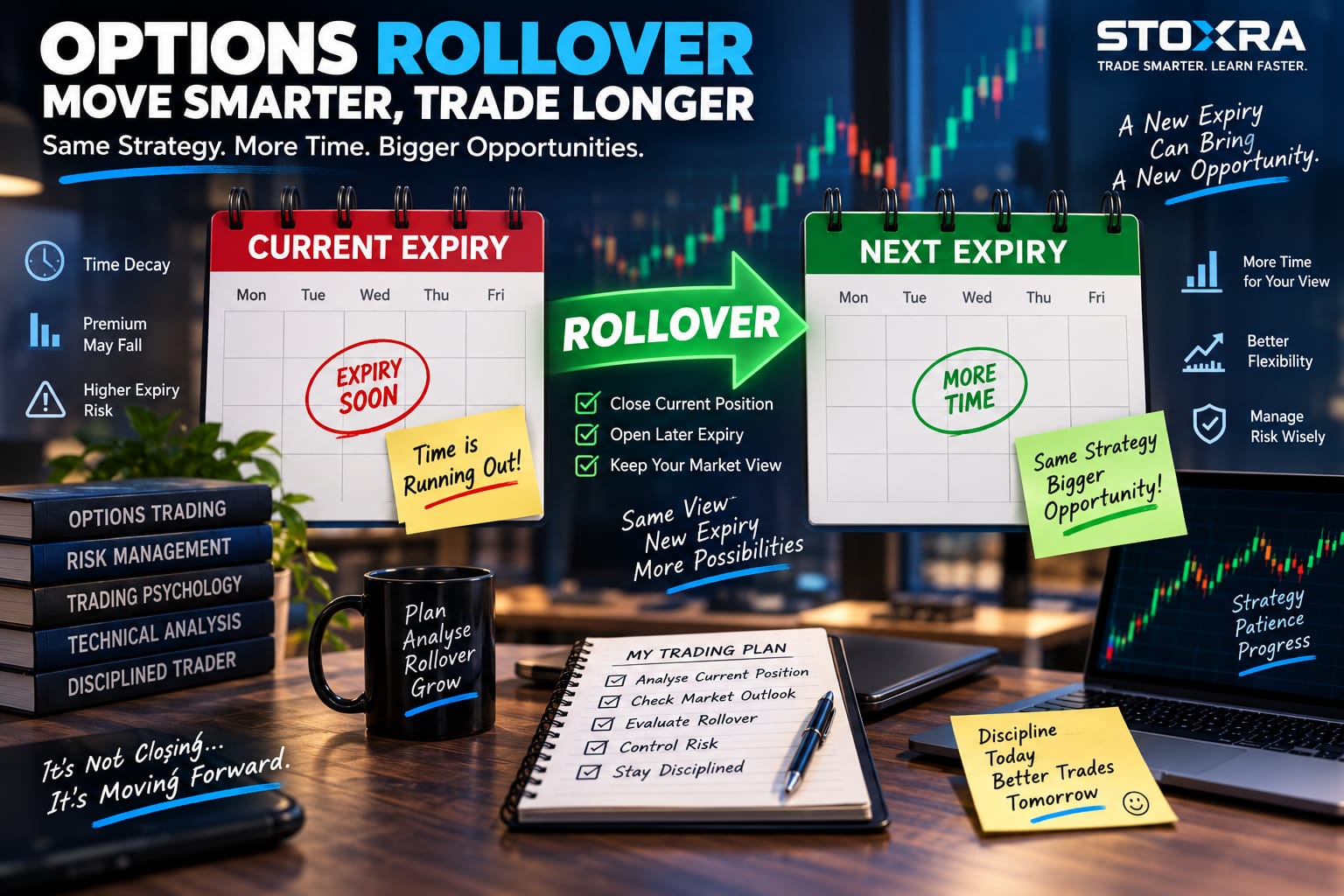
Options rollover is the process of replacing an existing options position that is approaching expiry with a new position having a later expiry.
In practical terms, the trader usually performs two related actions:
- Close the existing option position.
- Open a new option position with a later expiry.
The new contract may have the same strike price, a different strike price, or even a different structure depending on the trader's strategy.
Therefore, rollover does not simply mean “extending” the original contract. The original contract is being closed or reduced, while another contract is established.
Why Do Traders Rollover Options Positions?
Traders may consider an options rollover when their market view remains unchanged but the current contract is approaching expiry.
For example, suppose a trader expects a stock or index to move higher but the current option is close to expiry. If the expected move has not yet occurred, the trader may evaluate whether moving the position to a later expiry is appropriate.
Extend the Time Horizon
A later expiry provides additional time for the underlying asset to potentially move in the expected direction.
Maintain a Market View
A trader may still have the same bullish or bearish thesis but no longer want exposure to the near-expiry contract.
Manage Expiry Risk
Moving away from a near-expiry contract can change the sensitivity and risk profile of the position.
Adjust the Position
During rollover, traders can potentially change strike price, quantity or structure as part of a broader strategy.
How Does Options Rollover Work?
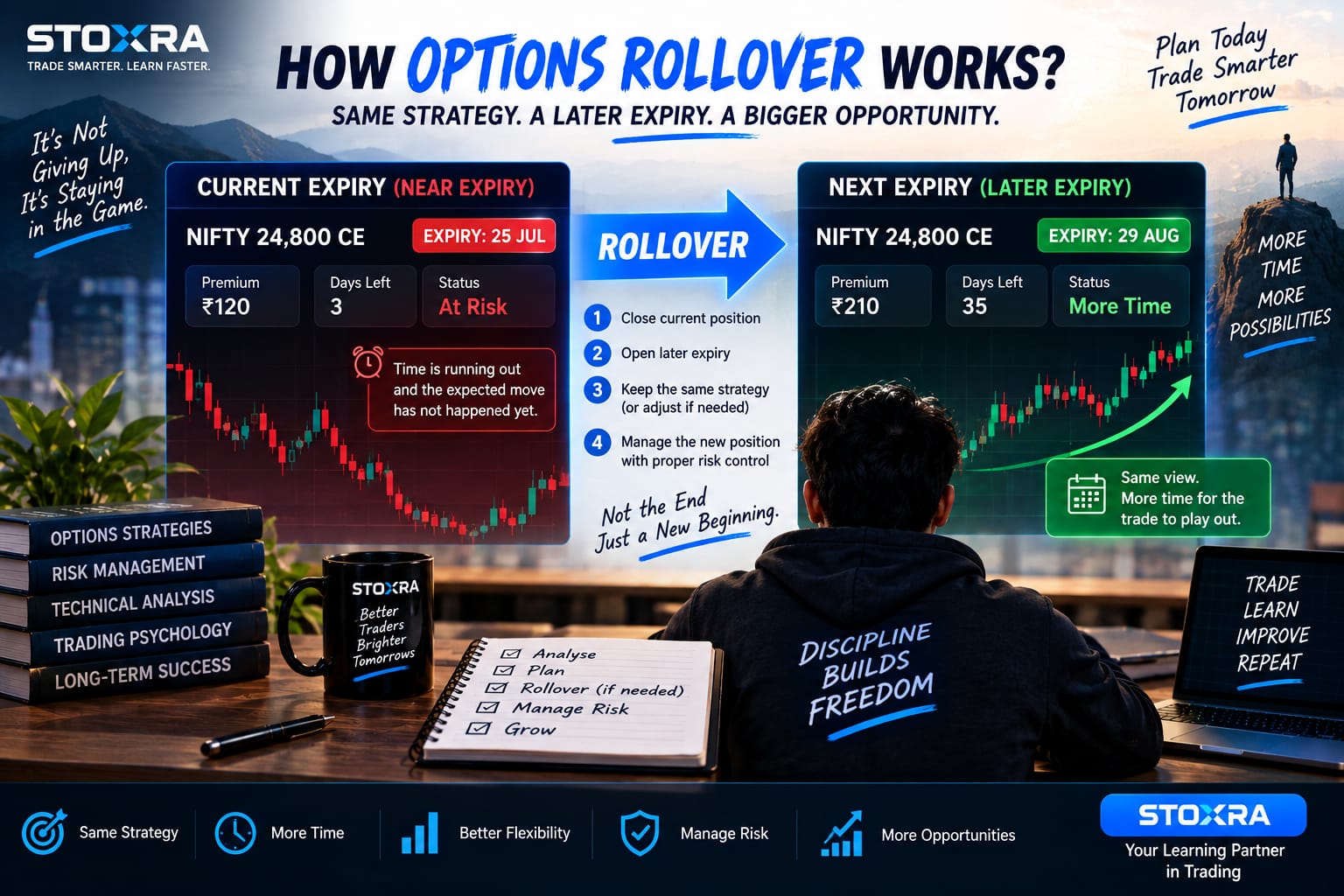
The mechanics can be understood with a simple example.
Imagine a trader holds a call option with a particular strike price and a near-term expiry. The trader originally expected the underlying asset to rise before expiry, but the expected move has taken longer than anticipated.
Instead of keeping the near-expiry option, the trader evaluates a later-expiry option.
If the decision is made to rollover, the trader closes the existing position and enters the later-expiry position.
The new position has its own premium, time value, implied volatility, liquidity and risk characteristics.
This is why traders should analyze the new position independently rather than assuming that the original trade simply continues.
Options Rollover Example
Consider a hypothetical trader who purchases a call option because they expect the underlying asset to rise.
The current expiry is approaching, but the underlying price has not moved as expected.
Instead of automatically holding the option until expiry, the trader compares the current position with a later-expiry contract.
| Stage | Action | What It Means |
|---|---|---|
| 1 | Original position | Trader holds the near-expiry option. |
| 2 | Review | Trader reassesses the market view and current risk. |
| 3 | Close | The original option position is closed or reduced. |
| 4 | Open later expiry | A new option position is established for a later expiry. |
| 5 | Manage | The new position is managed according to its own risk and exit rules. |
What Happens to the Option Premium During a Rollover?
The premium of an option depends on several factors, including the underlying price, strike price, time remaining until expiry, implied volatility and market conditions.
Because a later-expiry option has a different amount of time remaining, its premium can be substantially different from the near-expiry contract.
Therefore, a trader should not assume that the cost of the new option will be similar to the original option.
When evaluating a rollover, the trader should consider both the amount received from closing the original position and the amount required to establish the new position.
Does Rollover Mean the Trader Has Avoided a Loss?
No.
This is one of the most important points when understanding options rollover.
If an existing option position has lost value, moving into another expiry does not erase that loss. The original position has still generated a realized or otherwise accounted-for trading outcome when it is closed.
The new position starts with its own entry price and risk profile.
Important Warning
Rollover should not be used simply to avoid accepting a losing trade. Closing a losing position and immediately opening another contract can create the illusion that the original thesis is still working. The new position should have a fresh, clearly defined rationale.
Options Rollover and Time Decay
Time decay is an important consideration when trading options.
All else being equal, an option's time value generally declines as expiry approaches. This effect can become particularly important for options that are close to expiry.
A later-expiry option has more time remaining, which can change its time value and sensitivity to market movements.
However, buying additional time is not free. The later-expiry contract may require a different premium, and the position can have different exposure to changes in implied volatility and the underlying price.
Traders should therefore understand how options risk management applies to the new position.
Rollover in Call Options vs Put Options
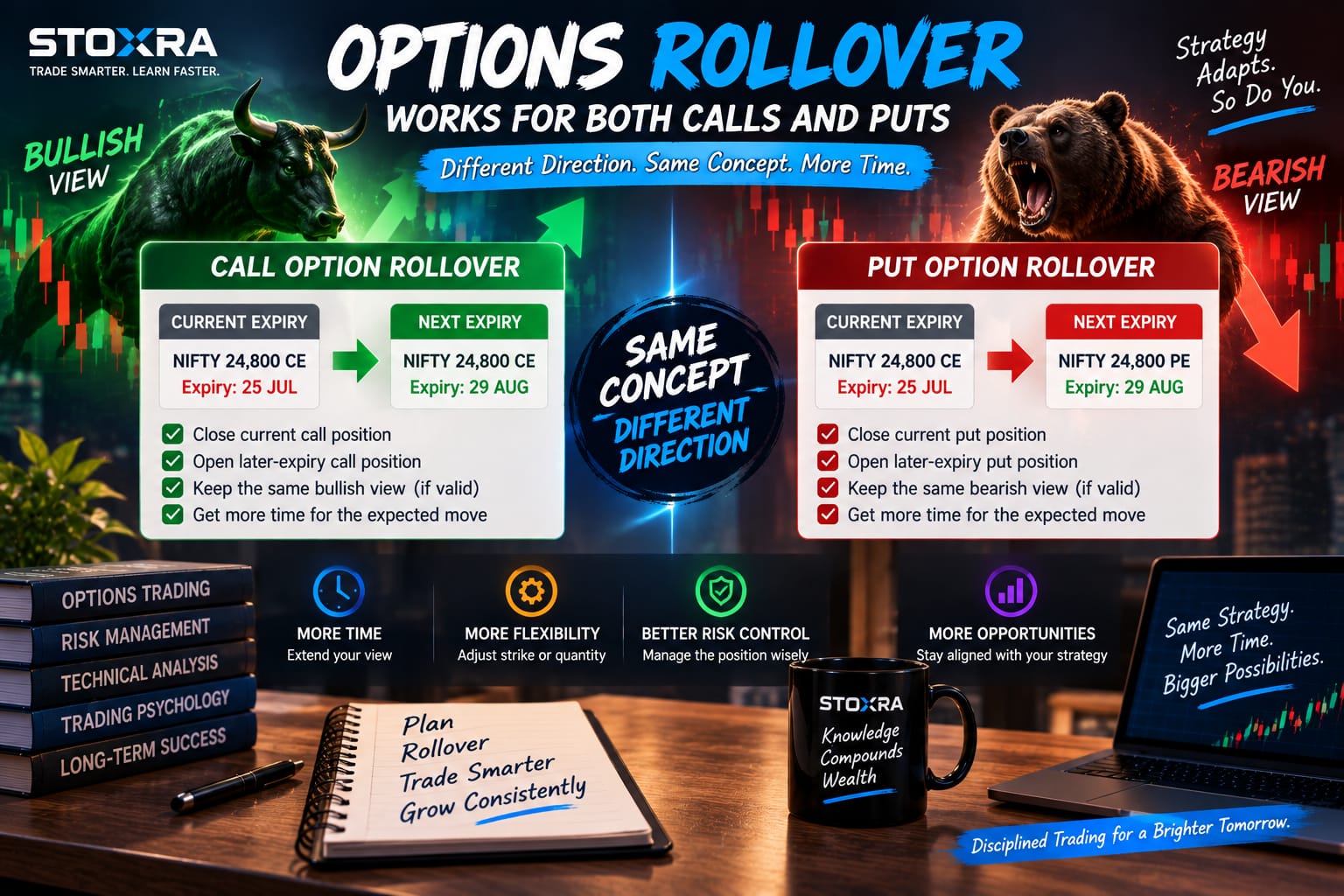
The basic concept of rollover can apply to both call and put positions.
Call Option Rollover
A trader with a bullish view may close a near-expiry call position and establish a later-expiry call position if the bullish thesis remains valid.
Put Option Rollover
A trader with a bearish view may close a near-expiry put position and establish a later-expiry put position when they believe the bearish thesis still has sufficient justification.
The strategy can also be applied to option-selling positions and more complex spreads, but the risk characteristics can be substantially different.
Key Factors to Check Before Rollover
Rollover should be treated as a new trading decision rather than an automatic action.
Before rolling a position, traders can review the following factors:
- Original thesis: Is the reason for the trade still valid?
- Current underlying price: Has the market moved closer to or farther from the expected scenario?
- Time remaining: Is the current expiry creating excessive time pressure?
- New premium: What is the cost or credit associated with the later-expiry contract?
- Liquidity: Are bid-ask spreads reasonable enough for the strategy?
- Implied volatility: Has the volatility environment changed?
- Position size: Is the new quantity appropriate for the account and risk limit?
- Exit plan: When and why will the new position be closed?
Liquidity and Bid-Ask Spread Matter
One practical issue that can be overlooked during rollover is liquidity.
An option may appear attractive based on its quoted premium, but a wide bid-ask spread can increase the effective cost of entering or exiting the position.
This becomes particularly important when moving from one expiry to another because the liquidity profile of the contracts may differ.
Traders should check available market depth, trading activity and bid-ask spreads rather than assuming that every expiry provides identical execution conditions.
Pro Tip
Compare the complete cost and risk profile of the old and new positions before rolling. Do not evaluate a rollover only by looking at the premium of the later-expiry option.
Costs Involved in Options Rollover
Rollover can involve several trading costs. Depending on the broker, exchange and applicable rules, these may include brokerage, transaction-related charges, taxes or other statutory costs.
There is also the impact of bid-ask spreads and execution price.
When a trader closes one position and opens another, the combined execution costs can affect the overall economics of the strategy.
Therefore, rollover should not be considered cost-free simply because the trader continues to hold a similar market view.
Rollover vs Simply Holding Until Expiry
| Rollover | Hold Until Expiry |
|---|---|
| Closes or reduces the current position. | Keeps the current position open. |
| Creates exposure to a later expiry. | Maintains exposure to the existing expiry. |
| May provide additional time for the thesis. | Provides only the remaining time of the current contract. |
| Creates additional execution and transaction considerations. | Avoids the specific rollover transaction but retains expiry-related risks. |
| Requires reassessment of the new contract. | Requires management of the existing contract. |
When Rollover May Make Sense
There is no universal rule that says a trader should or should not rollover an option. The decision depends on the strategy and market conditions.
A rollover may be considered when:
- The original market thesis remains valid.
- The trader still has a defined reason for maintaining exposure.
- The current expiry no longer provides an appropriate time horizon.
- The later expiry has acceptable liquidity.
- The new position fits within the trader's risk limits.
- The expected opportunity justifies the additional cost and risk.
When Rollover May Not Make Sense
Rollover may be inappropriate when the original reason for the trade is no longer valid.
For example, if a trader originally expected a breakout but the underlying has clearly invalidated that setup, moving the position to a later expiry simply to “give it more time” may not solve the underlying problem.
Similarly, if the new option has poor liquidity, an unfavorable risk profile or excessive cost, the rollover may not be attractive.
Rollover Should Not Become a Habit
One of the biggest psychological risks is repeatedly rolling losing positions without reassessing the original thesis.
A trader may think, “I only need a little more time.” After another expiry approaches, the position may be rolled again.
This can turn a short-term trade into an open-ended position without a clearly defined exit plan.
Every rollover should therefore answer a simple question:
Key Takeaway
“If I did not already own this position, would I enter this new contract today based on the current market information?”
Options Rollover and Risk Management
Risk management remains important even when the trader believes the rollover is strategically justified.
The new contract can have different delta, gamma, theta and volatility exposure compared with the original contract. The amount of capital at risk can also change.
Traders should therefore recalculate their risk instead of simply carrying forward the original assumptions.
For broader guidance, see: Intraday Risk Management for Beginners .
Rollover and Position Sizing
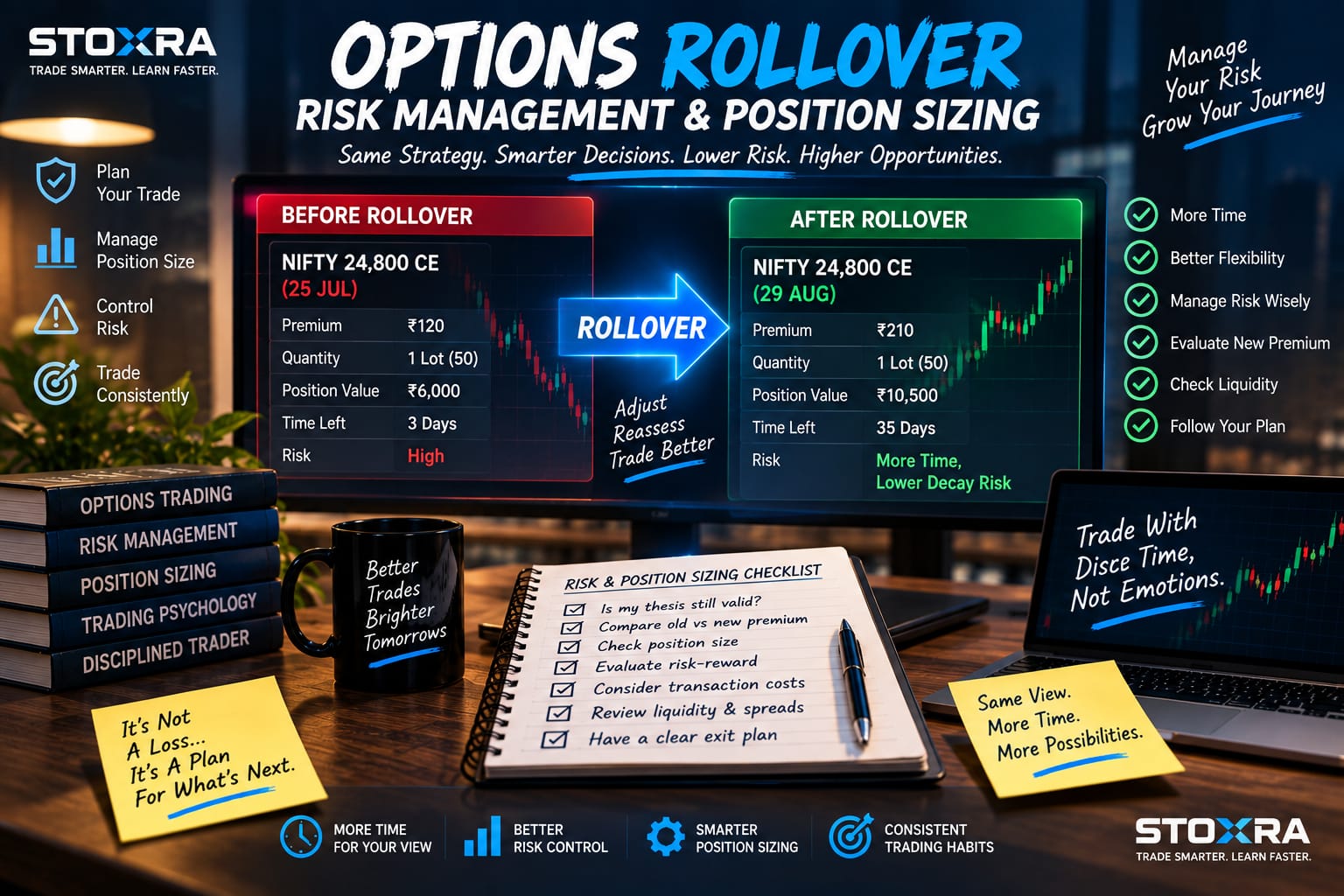
Position sizing becomes especially important when the premium of the new option is different from the old contract.
A trader should not automatically maintain the same number of contracts simply because the position is being rolled.
The new position should be evaluated according to its own maximum acceptable loss, strategy rules and account exposure.
Read more about this concept in Position Sizing for Intraday Trading .
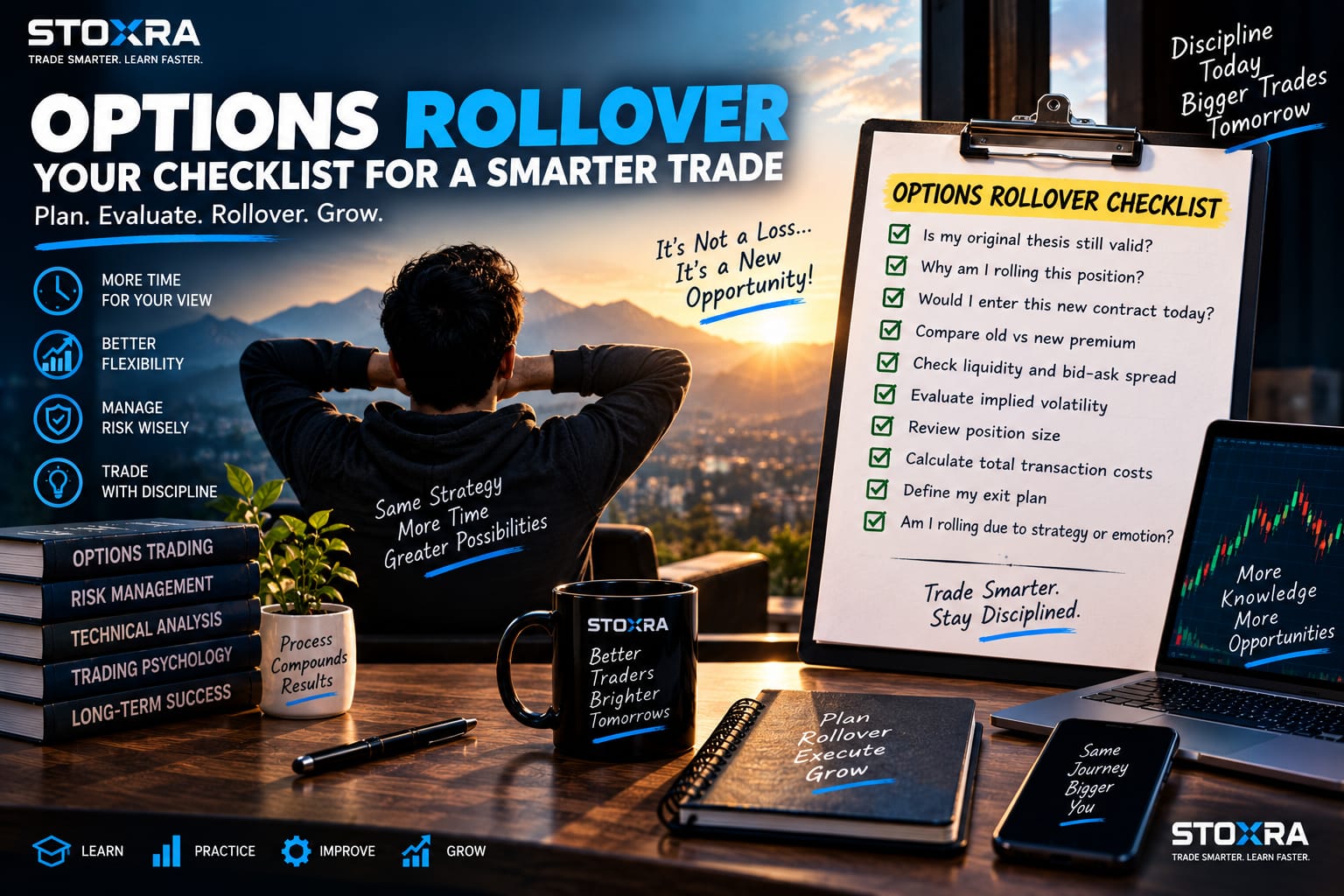
Simple Options Rollover Checklist
- Is my original market thesis still valid?
- Why am I rolling this position?
- Would I enter the new contract if I had no existing position?
- What is the premium of the new contract?
- How liquid is the new expiry?
- What is the bid-ask spread?
- Has implied volatility changed?
- What is the maximum acceptable loss on the new position?
- Does the new position fit my position-sizing rules?
- What is my exit condition?
- What happens if the underlying moves against my thesis?
- Am I rolling because of a strategy or simply because I do not want to accept a loss?
Common Mistakes When Rolling Options
1. Rolling Without Reassessing the Thesis
A trader may assume that because the original idea was good, it remains valid indefinitely. Market conditions can change, so the thesis should be reassessed.
2. Ignoring Transaction Costs
Closing one position and opening another can create additional costs. These should be considered before the rollover.
3. Ignoring Liquidity
A later expiry may have different liquidity and spreads. Poor execution can negatively affect the trade.
4. Increasing Position Size
Traders sometimes increase size after a losing position in an attempt to recover the previous loss. This can significantly increase risk.
5. Treating Rollover as a Guaranteed Recovery
A new expiry does not guarantee that the original market view will eventually become profitable.
Options Rollover vs Rolling an Options Strategy
The term rollover can describe a simple replacement of one expiry with another, but traders may also use rollover as part of a larger options strategy.
For example, a trader may change the strike price while moving to the later expiry. In other situations, multiple option legs may be adjusted together.
These structures can have substantially different risk characteristics from simply replacing one contract with another.
Therefore, traders should understand each leg of the strategy and how the combined position behaves under different market scenarios.
How Beginners Should Think About Options Rollover
Beginners should avoid thinking about rollover as a way to postpone a losing trade.
A better way to think about it is as a new decision involving a new contract.
The key questions are:
- Is the original idea still valid?
- Why is additional time necessary?
- What does the new contract cost?
- What risks does the new position create?
- Where will the new position be exited?
If these questions cannot be answered clearly, the trader may need to reconsider whether the rollover is appropriate.
Frequently Asked Questions About Options Rollover
What is options rollover?
Options rollover generally means closing an existing option position associated with one expiry and opening a new position with a later expiry.
Why do traders rollover options?
Traders may rollover when they still have a market view but believe the current expiry does not provide enough time for that view to play out.
Does rollover remove a trading loss?
No. Closing a losing position does not erase the loss. The new option is a separate position with its own entry price, risk and potential outcome.
Can both call and put options be rolled over?
Yes. The rollover concept can apply to both call and put positions, although the risk characteristics depend on whether the option is bought, sold or used as part of a multi-leg strategy.
Is options rollover profitable?
Rollover itself does not guarantee profit. The result depends on the new position, underlying price movement, volatility, premium, costs and the trader's strategy.
Is rollover the same as extending an option contract?
Not exactly. In a typical rollover, the existing position is closed or reduced and a new position is established in a later expiry. It is not simply an automatic extension of the original contract.
What should I check before rolling an option?
Review the original thesis, new premium, expiry, strike, liquidity, bid-ask spread, implied volatility, position size, transaction costs and exit plan.
Can beginners rollover options?
Beginners should first understand option pricing, expiry, time decay, position sizing and risk management. Rollover should be treated as a new trading decision rather than a method for automatically extending a losing position.
Final Takeaway
Understanding options rollover explained is important for anyone who trades options beyond a single expiry cycle.
At its core, rollover involves closing or reducing an existing position and establishing a new position with a later expiry. Traders may use it when their market thesis remains valid but the current expiry no longer provides an appropriate time horizon.
However, rollover does not remove losses, eliminate risk or guarantee additional time will make a trade profitable. The new position has its own premium, liquidity, volatility exposure, time decay and risk characteristics.
The most disciplined approach is to evaluate every rollover as a fresh decision. If the new trade would not make sense on its own, simply rolling the existing position may not be the right solution.
Learn Options Trading With STOXRA
Explore STOXRA's educational resources to understand options, derivatives, risk management, technical analysis and disciplined trading decisions.
Explore STOXRA