What Is Systematic Portfolio Management?
Learn what systematic portfolio management is, how it works, and how rules, diversification, risk management and rebalancing support disciplined investing.
Managing a portfolio involves more than choosing investments. An investor must decide how much capital to allocate, how much risk to accept, when to review performance and what to do when market conditions change. Without a clear process, these decisions can become inconsistent. A strong market may encourage overconfidence, while a sudden decline may lead to panic selling or unnecessary changes.
Systematic portfolio management addresses this problem by defining the decision-making framework before emotions become involved. The approach can be used by individual investors, professional portfolio managers and technology-assisted investment systems. It does not require every decision to be automated. A human investor can follow a systematic process while still applying judgment within clearly defined limits.
The objective is not to predict every market movement or guarantee a positive return. The objective is to make portfolio decisions more consistent, transparent and aligned with a stated investment goal.
A systematic portfolio follows a documented process for selecting investments, allocating capital, managing risk and reviewing results. It improves consistency, but it does not eliminate market risk or guarantee returns.
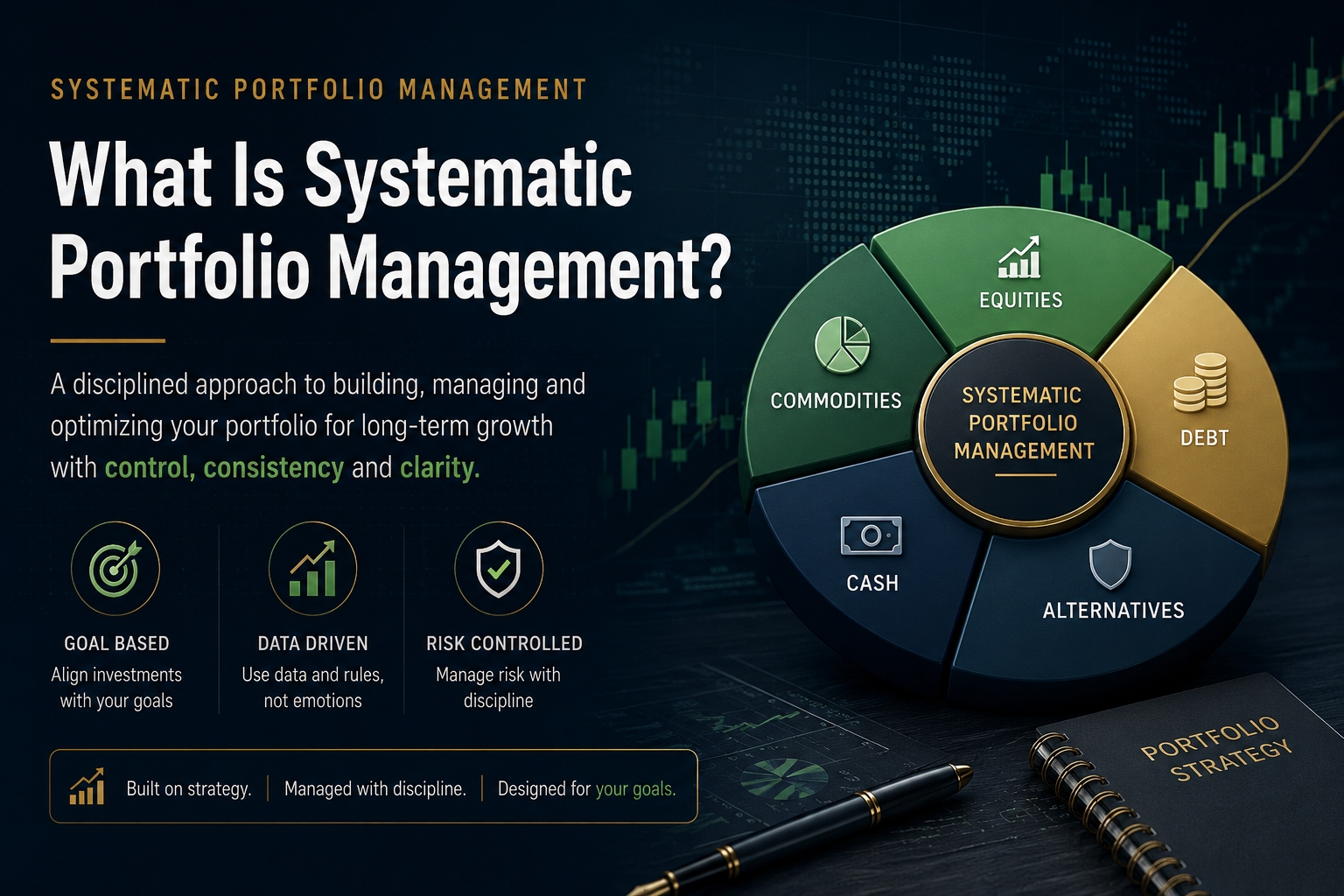
01 • THE FOUNDATION
What Does Systematic Portfolio Management Mean?
Systematic portfolio management means using predefined criteria to guide investment decisions. These criteria may cover the types of assets considered, the conditions required before an investment is added, the maximum allocation to a position, the acceptable level of concentration and the circumstances that require a review.
For example, an investor may decide that no single company should represent more than a specified percentage of the portfolio. The investor may also establish a schedule for reviewing allocations and a rule for rebalancing when an asset class moves materially away from its target weight. These decisions are made in advance rather than during a period of market stress.
The process is closely related to the principles explained in Stoxra’s guide to how algorithmic trading works, although systematic portfolio management is broader. Algorithmic trading usually focuses on executing trades through rules, while systematic portfolio management can include long-term investing, asset allocation, monitoring and manual approval.
Write the rules in plain language. If you cannot explain why an investment is included, how much capital it receives and when it should be reviewed, the process is not yet sufficiently defined.
Systematic does not mean fully automated
A systematic approach can be implemented with a spreadsheet, an investment journal, a portfolio dashboard or specialised software. Automation may reduce repetitive work, but the quality of the outcome still depends on the quality of the rules, data and assumptions. Technology should support a sound process rather than hide an unclear strategy.
02 • THE PROCESS
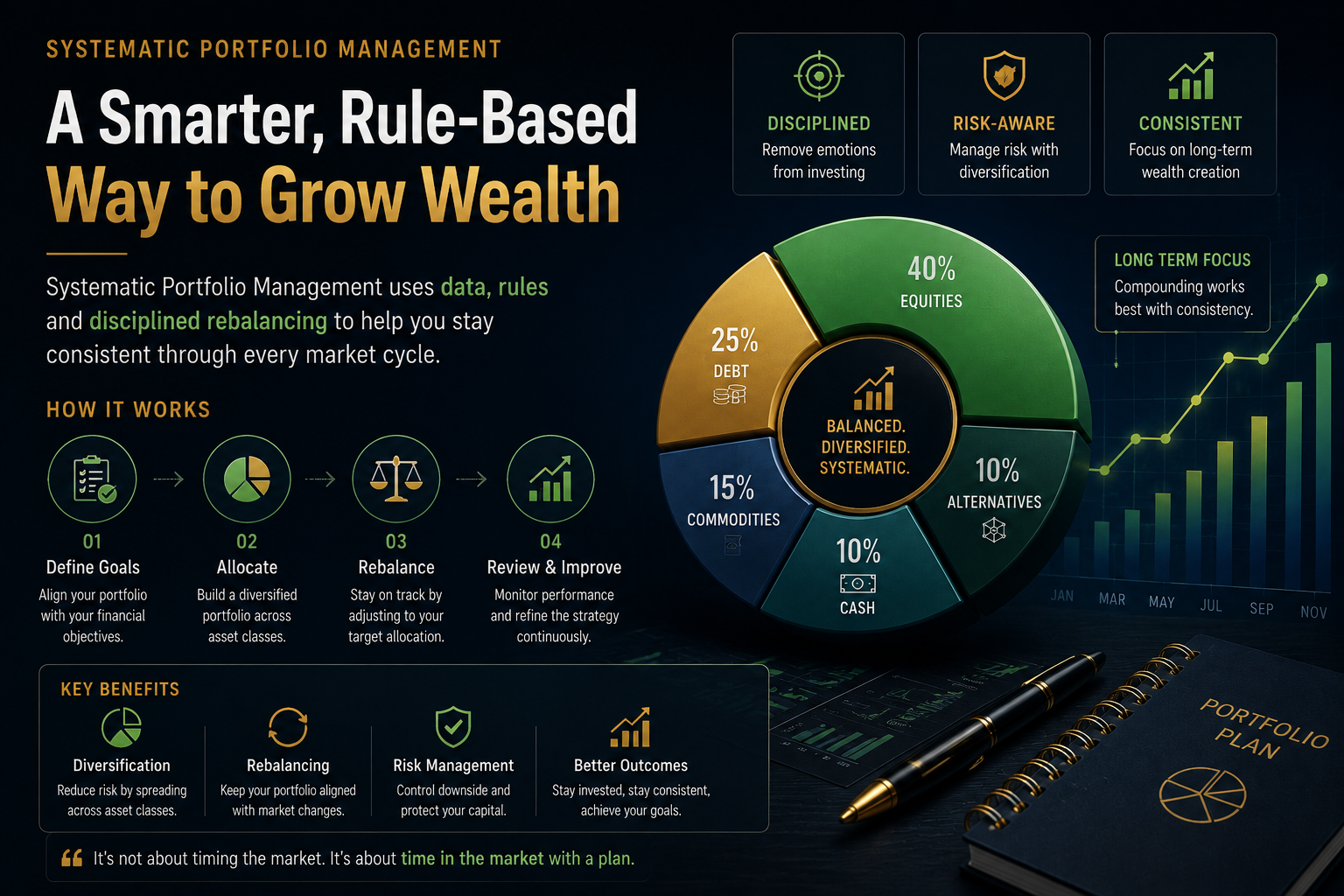
How Systematic Portfolio Management Works
A practical systematic process normally follows a sequence. Each stage supports the next one, and the full framework should remain connected to the portfolio’s objective and risk tolerance.
1. Define the objective
Identify whether the portfolio is designed for long-term growth, income, capital preservation or a combination of goals. Set the time horizon and establish realistic expectations.
2. Set selection criteria
Decide which assets qualify for consideration. Criteria may include financial quality, valuation, momentum, liquidity, diversification or other measurable factors.
3. Establish allocation rules
Define how capital will be distributed across assets, sectors, strategies or instruments. Include concentration limits and position-sizing rules.
4. Monitor the portfolio
Review performance, exposure, costs and changes in the underlying assumptions. Monitoring should follow a schedule rather than happen only after a sharp market move.
5. Rebalance when required
Restore the intended allocation when portfolio weights move beyond predefined limits or when the investment framework changes.
Investors who are also exploring technology-assisted workflows can compare the principles of systematic management with Stoxra’s resources on algorithmic trading strategies for beginners and algorithmic trading software. The central lesson is the same: decisions should be based on a defined process rather than short-term excitement or fear.
The strongest systematic processes are simple enough to follow, specific enough to measure and flexible enough to be reviewed when the underlying assumptions change.
03 • PORTFOLIO DESIGN
Portfolio Construction and Allocation
Portfolio construction is the stage where individual investment ideas are converted into an overall structure. A portfolio may contain equities, bonds, cash, exchange-traded funds, commodities or other permitted instruments. The right mix depends on the investor’s objective, time horizon, liquidity needs and ability to tolerate losses.
Diversification is important because the risk of a portfolio is not determined only by the number of holdings. Several investments may respond to the same economic factor, sector trend or market event. A portfolio containing many highly correlated assets may still be concentrated in one type of risk.
Allocation rules should therefore consider both individual exposure and combined exposure. Position sizing also matters. Even a high-quality investment can create excessive portfolio risk if it receives an unnecessarily large allocation. Stoxra’s educational resource on position sizing explains the broader principle that the strength of an idea and the amount of capital committed to it are separate decisions.
- Set a maximum allocation for individual positions.
- Review exposure to sectors and related assets.
- Keep sufficient liquidity for planned needs.
- Account for transaction costs, taxes and spreads.
- Document the reason for every major allocation decision.
Do not confuse a large number of holdings with true diversification. Review the risks that the holdings share, not only the number of securities in the portfolio.
04 • RISK CONTROL
Risk Management and Rebalancing
Risk management is a central part of systematic portfolio management. A portfolio framework should identify the risks that matter most, including concentration risk, liquidity risk, market risk, currency exposure, leverage and the possibility of permanent capital loss.
Predefined limits can prevent a single position or theme from dominating the portfolio. They can also establish when a portfolio should be reviewed after a large drawdown, a change in investment fundamentals or a significant deviation from the target allocation.
Rebalancing is the process of bringing the portfolio back toward its intended structure. It may be calendar-based, threshold-based or triggered by a specific change in the investment framework. Rebalancing should not be treated as a guarantee of better performance. It is a discipline tool that helps prevent market movements from silently changing the portfolio’s risk profile.
For active traders, the same discipline connects with Stoxra’s guides on intraday risk management, options trading risk management and how much money to risk in options trading.
Risk controls should be decided before a difficult market event. Rules created during panic are more likely to be inconsistent, delayed or influenced by emotion.
05 • IMPLEMENTATION
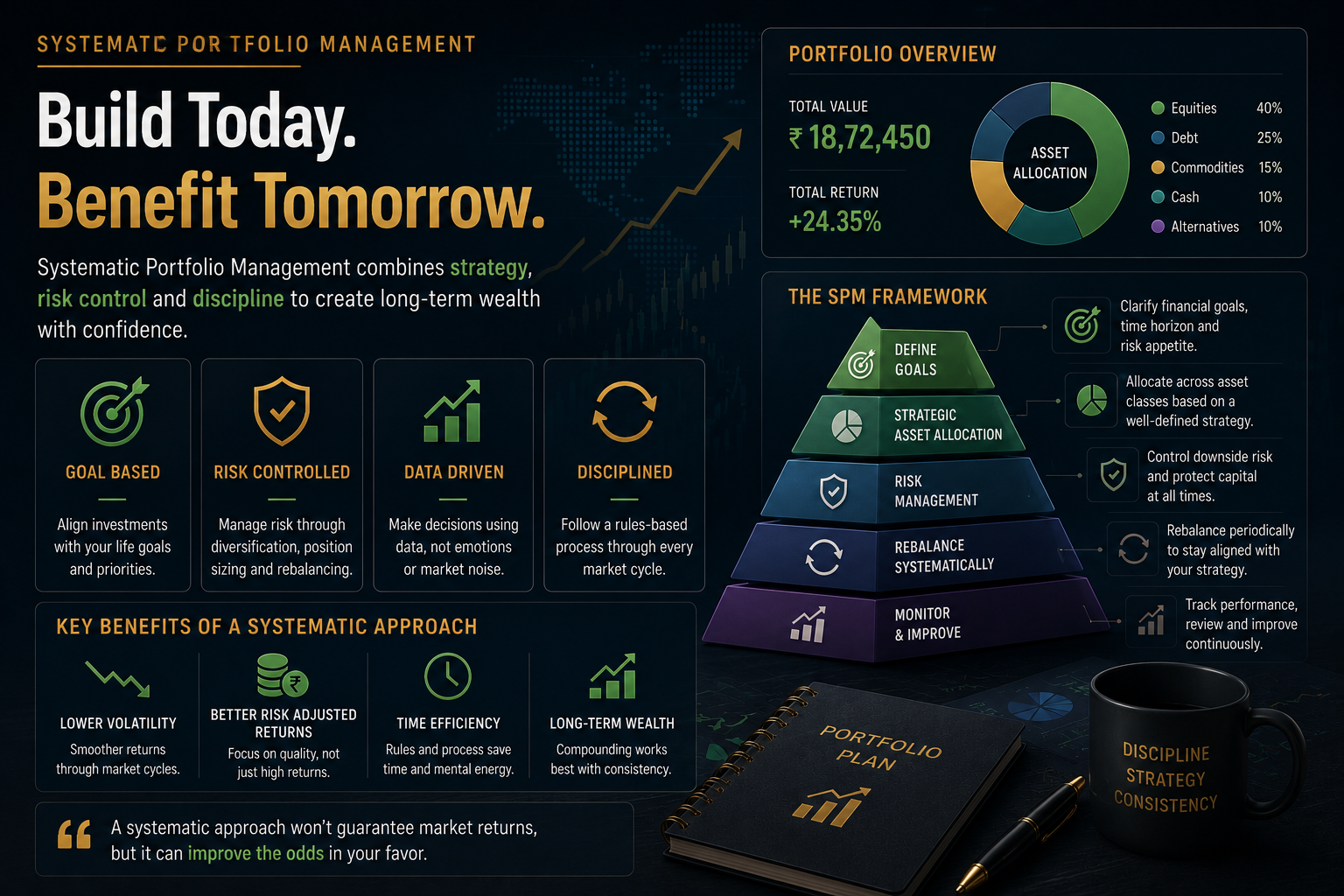
How to Implement and Evaluate a Systematic Portfolio
Implementation begins with documentation. Record the portfolio objective, eligible assets, allocation limits, review frequency, rebalancing triggers and the conditions that would justify a change. This document becomes the reference point for future decisions.
Next, establish a reliable tracking method. A basic spreadsheet can record holdings, purchase prices, current values, allocation percentages, realised gains, unrealised gains, fees and cash balances. More advanced tools can assist with dashboards, alerts, research and portfolio analysis. However, every tool should be checked for data quality and calculation accuracy.
Evaluation should focus on more than headline returns. Review volatility, drawdowns, concentration, turnover, costs, consistency with the objective and the reasons behind major decisions. A portfolio that produces a return by taking unsuitable risk may not be successful for the investor who owns it.
Backtesting and paper trading can help test a process before real capital is committed. Stoxra’s resources on walk-forward testing, paper trading and paper trading versus real trading are useful for understanding the difference between testing a method and applying it under real financial pressure.
Evaluate the process separately from the outcome. A good decision can produce a loss, and a poor decision can produce a profit. Review whether the rule was followed and whether the rule still makes sense.
06 • TOOLS & RESOURCES
Useful Tools for Systematic Portfolio Management
AI Trading Platform
Explore structured market analysis and technology-assisted trading workflows through Stoxra’s AI Trading Platform.
Portfolio Allocation Calculator
Use a portfolio allocation calculator to review how capital is distributed across assets and whether the allocation matches the intended framework.
Explore the Portfolio Allocation CalculatorPosition Sizing Calculator
Estimate an appropriate position size by considering available capital, risk tolerance and the amount exposed to an individual investment.
Explore the Position Sizing CalculatorLearning Resources
Continue learning through Stoxra’s learning resources and stay informed with relevant market news.
Tools are most useful when they make a defined process easier to follow. They should not replace independent review, risk assessment or responsible decision-making.
FAQ
Frequently Asked Questions
Is systematic portfolio management the same as automated investing?
No. Systematic management uses predefined rules. It may be performed manually, with spreadsheets or through automated software.
Does systematic portfolio management guarantee better returns?
No. It cannot remove market uncertainty or guarantee returns. Its main benefit is a more consistent and measurable decision-making process.
How often should a systematic portfolio be reviewed?
The frequency depends on the objective, strategy and risk level. The review schedule should be defined in advance and should not encourage unnecessary trading.
Why is rebalancing important?
Rebalancing helps restore the intended allocation after market movements change portfolio weights and risk exposure.
Can beginners use systematic portfolio management?
Yes. Beginners can start with a simple written framework, diversified allocation, basic tracking and regular reviews before using advanced technology.
FINAL TAKEAWAY
Build the Process Before Making the Decision.
Systematic portfolio management is about creating discipline around investment selection, allocation, risk control, monitoring and review. It does not promise perfect timing or guaranteed profits. Instead, it helps investors understand why decisions are made, identify when the portfolio has moved away from its objective and improve the process over time.
Whether you manage investments manually or use technology-assisted workflows, the foundation remains the same: define the objective, document the rules, control exposure and review results honestly.
Explore Stoxra’s AI Trading Platform →Disclaimer
This article is for educational purposes only and does not constitute financial advice, investment advice or a recommendation to buy or sell any security. Investing and trading involve risk. Past performance does not guarantee future results. Consider your objectives, financial situation and risk tolerance before making investment decisions.