Algorithmic Trading vs Manual Trading: Which Strategy Performs Better?
Algorithmic trading applies predefined rules; manual trading relies on direct judgement. Compare workflow, execution risks, costs, safeguards and a hypothetical example before deciding which approach fits.
STOXRA Editorial research note · Reviewed 23 November 2026 · India · Educational comparison.
Quick answer: Algorithmic trading uses defined software rules to generate signals or place eligible orders; manual trading relies more directly on a trader's real-time judgement and order placement. An algorithm can apply its rules consistently, including mistakes. A manual trader can interpret unusual context but may act inconsistently. Neither approach is inherently more profitable. Results depend on the quality of the trading idea, implementation, costs, risk controls and oversight.
In this comparison
- Side-by-side differences
- One plan, two workflows
- When algorithmic trading helps
- When human judgement helps
- Costs, failure modes and regulation
- A responsible hybrid process
- Which workflow fits?
- FAQs and sources
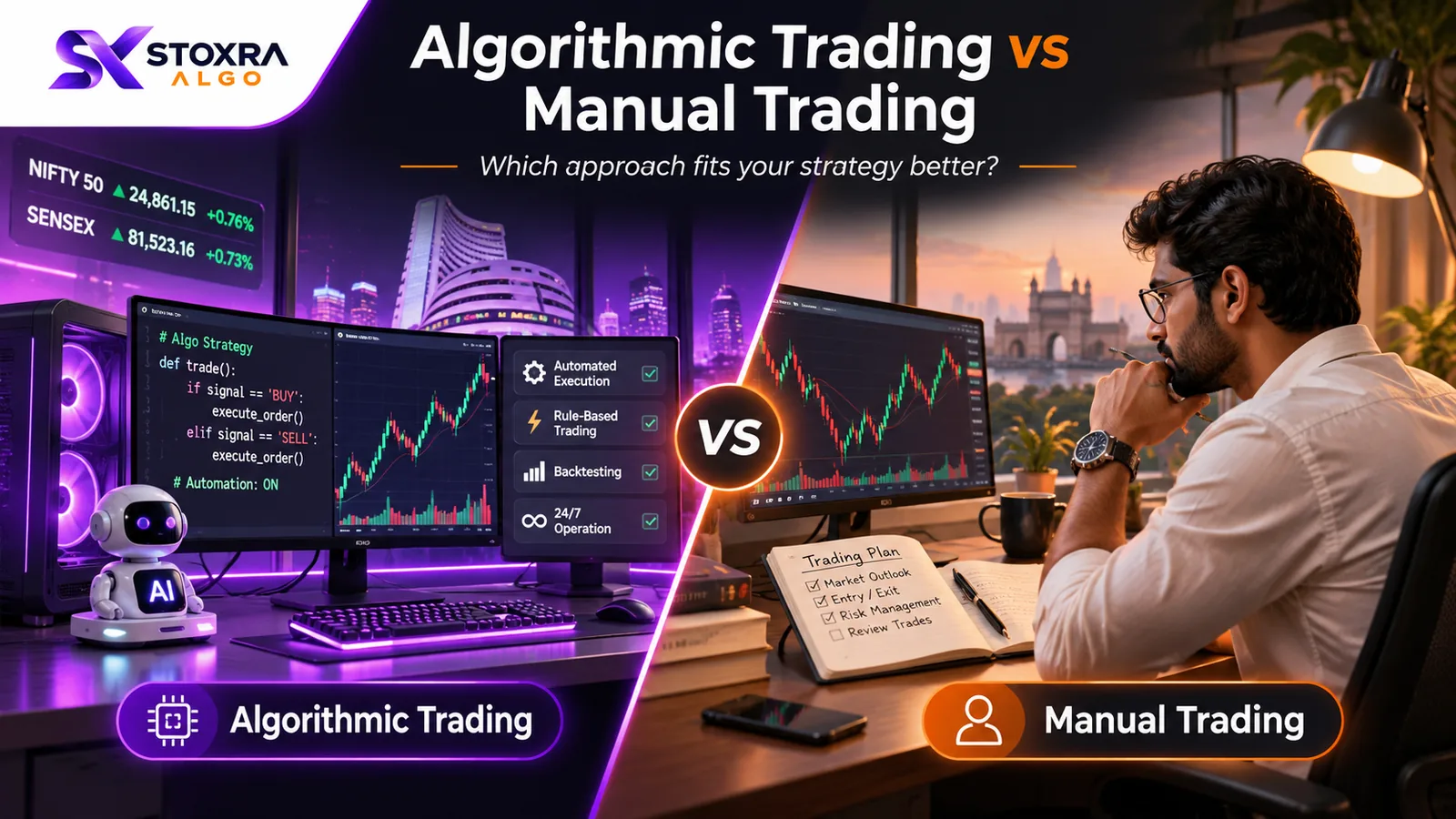
Automation does not make a weak strategy strong
Imagine two traders watching the same price movement. One instructs software to act when a specific set of conditions is met. The other studies the chart, any relevant exchange announcement and the circumstances of the day before placing an order. Both need a valid hypothesis, realistic order assumptions, risk limits and an explanation of when not to trade.
The distinction is how a decision is made and executed, not whether one trader automatically has an edge. A perfectly implemented strategy can still lose money if its assumptions are wrong.
What counts as algorithmic trading?
Broadly, algorithmic trading employs software rules to generate or transmit trading orders when defined conditions are met. The details vary: an alert-only strategy is not the same as automated order execution, and using AI to summarize research is not necessarily algorithmic trading. Live API-based execution may be subject to broker, exchange and regulatory requirements.
What counts as manual trading?
Manual or discretionary trading involves a person choosing and managing orders directly. That does not mean acting without a plan: manual traders can follow strict written rules, use charts and alerts, and maintain systematic journals while retaining control over the final order.
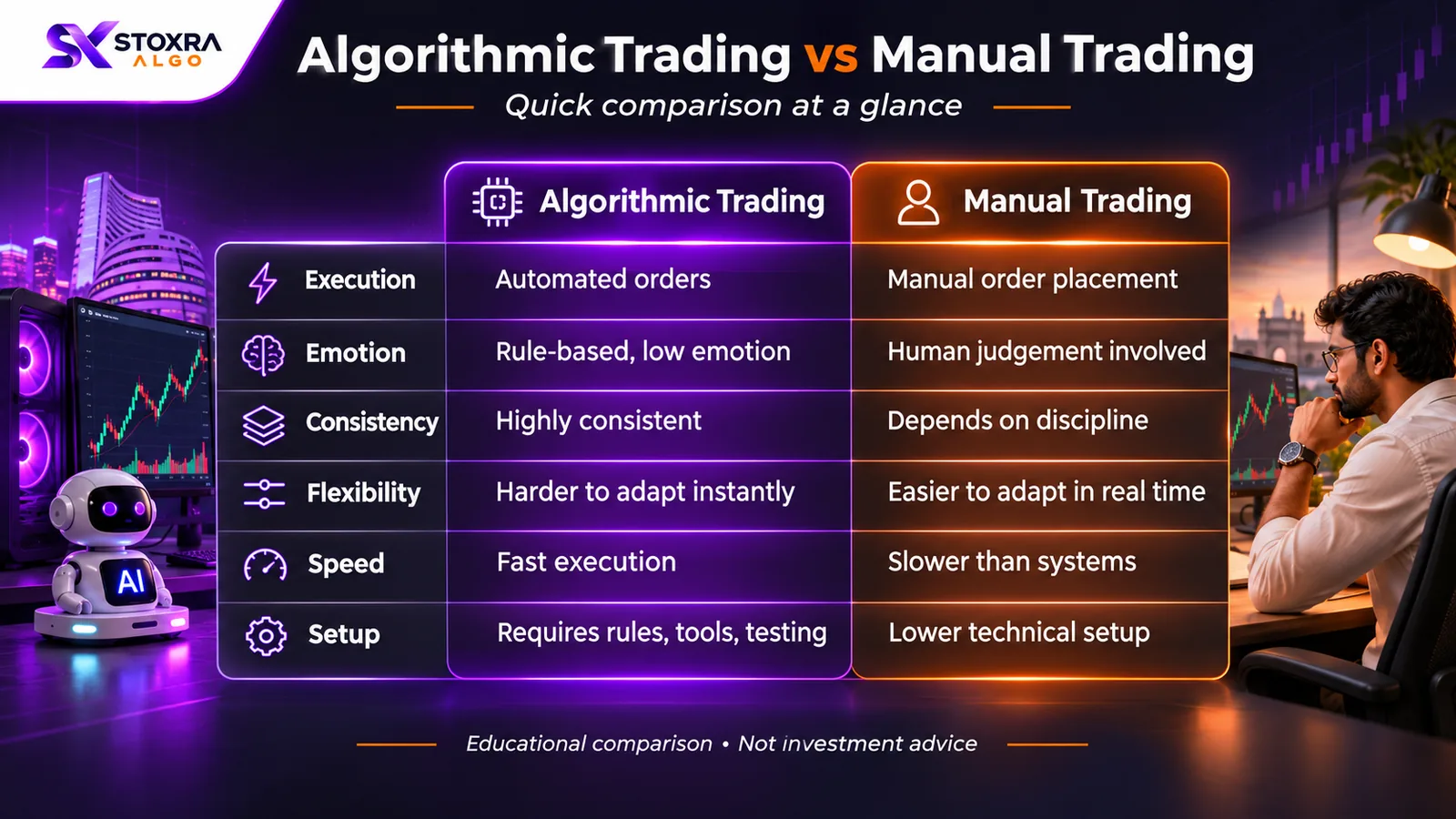
Algorithmic trading vs manual trading: the important differences
This table describes typical process characteristics. It does not report measured returns or win rates, and actual implementations differ.
| Factor | Algorithmic trading | Manual trading |
|---|---|---|
| Decision trigger | Predefined conditions coded into software | Human judgement, potentially supported by a written trading plan |
| Order execution | Can execute eligible orders automatically through permitted infrastructure | Trader initiates and manages orders |
| Consistency | Repeats specified rules, including flawed ones | Depends on discipline and the ability to follow a plan |
| Reaction to unusual events | May require rule changes or human intervention | Can incorporate qualitative information directly, but may misjudge it |
| Technology risks | Data, code, connectivity, order logic and integration failures | Broker/platform failures, connectivity problems and order-entry errors |
| Behavioural risks | Overfitting, overconfidence, inappropriate supervision and rule changes | Fear, fatigue, impulsive overrides and inconsistent execution |
| Ongoing work | Testing, monitoring, reconciliation, logs and risk-control maintenance | Market preparation, risk discipline, trade review and journaling |
| Guaranteed profitability? | No | No |
Reading the table: a faster process is not automatically a safer or more profitable process. Strategy quality, realistic costs, safeguards and market conditions remain decisive.
One hypothetical trade plan, two different responsibilities
Suppose a learner writes down a purely illustrative plan: entry ₹100, stop ₹96 and target ₹108. The planned downside is ₹4 per share and the planned upside is ₹8 per share, before brokerage, taxes, the bid–ask spread and slippage. These are fabricated numbers for teaching—not market data, a recommendation or an executed trade.
| Step | Algorithmic route | Manual route |
|---|---|---|
| Before entry | Translate the rules into code; inspect datasets and test assumptions | Write entry conditions and risk limits; check relevant context |
| At a signal | Software evaluates the conditions and may submit an eligible order | Trader checks the setup and submits an order manually |
| During a trade | Monitor connectivity, orders, positions and emergency-stop conditions | Monitor the position and follow the written plan |
| After the trade | Review logs, fills, deviations and strategy behaviour | Review the journal, decisions, fills and rule adherence |
In a fast or illiquid market, realised fills can differ from either route's planned prices. Neither route makes the strategy itself profitable.
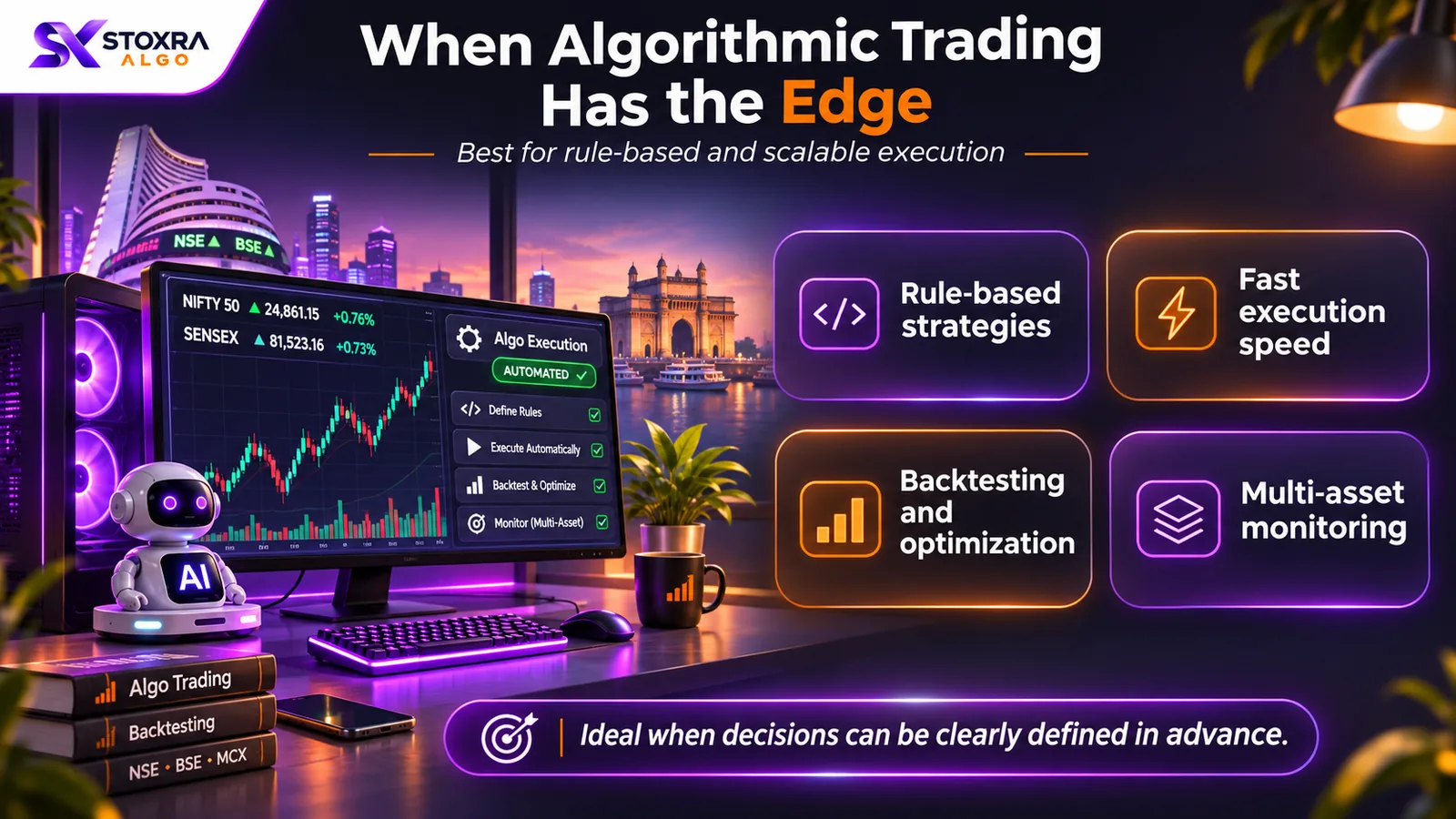
Where algorithmic trading can have a process advantage
Rule discipline: a system can check the same programmed conditions repeatedly instead of improvising. Efficient monitoring: software can evaluate multiple predefined signals in parallel, subject to available data and infrastructure. Auditability: tests, logs and version history can make specific actions easier to investigate.
These advantages are conditional. If the historical data are wrong, the order logic is faulty or the rule was overfit to the past, the same consistency can magnify the problem.
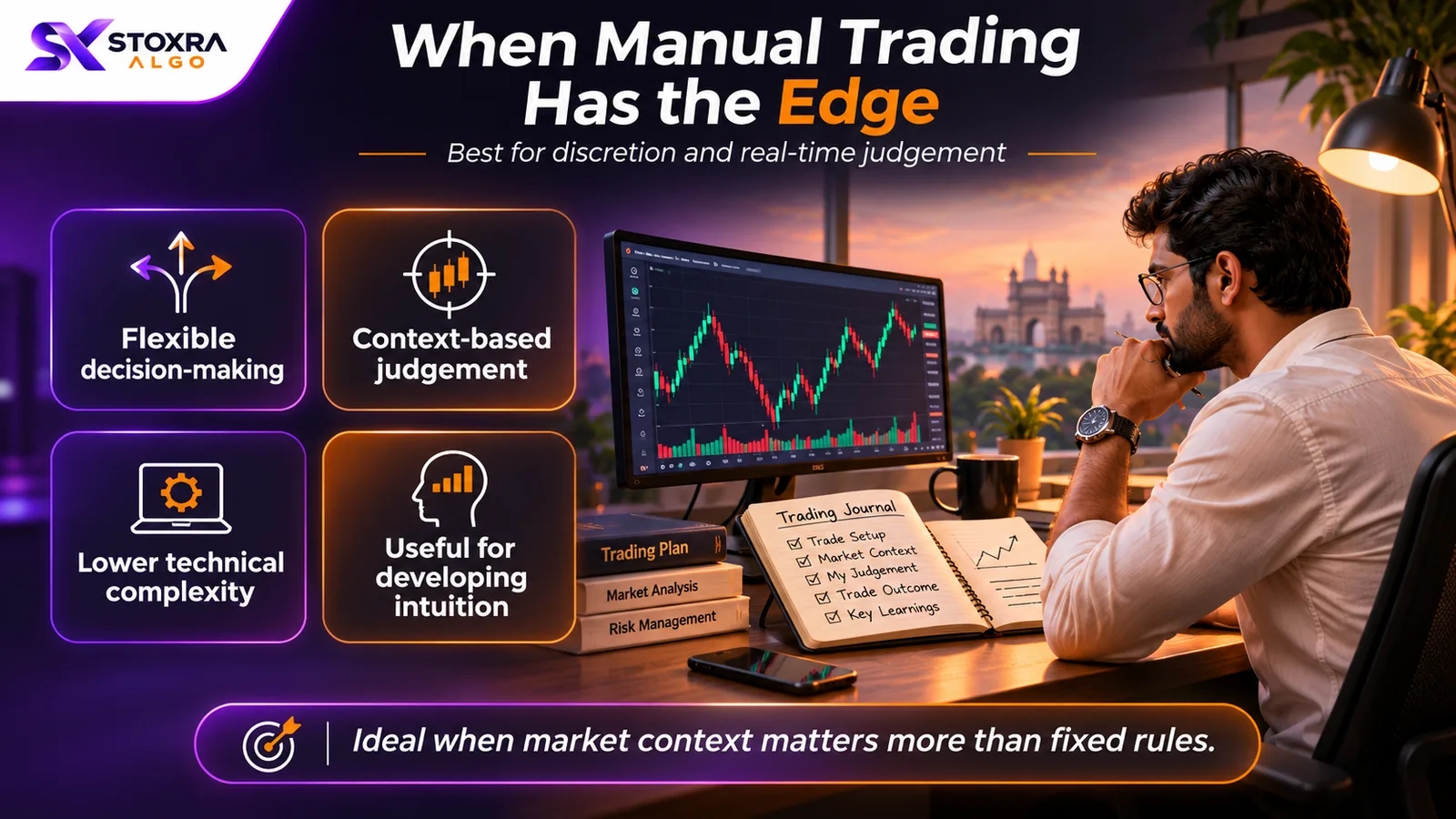
Where manual judgement can be useful
Some situations resist reliable codification: an unusual corporate announcement, a change in liquidity, a one-off market event or an uncertain interpretation of publicly available information. A trader can reconsider a hypothesis when the environment changes. A manual workflow may also need less custom infrastructure for a beginner learning basic market principles.
That flexibility carries trade-offs. Judgement may be affected by fear, fatigue, anchoring and inconsistent risk decisions; a strict journal and risk plan remain important.
Costs, risk and failure modes matter more than a speed contest
Execution costs affect both approaches
Brokerage or platform fees, exchange charges, applicable taxes, bid–ask spread, slippage and market impact can change the result of a trading strategy. Automated tools may also involve data, hosting, vendor, API and monitoring costs. Do not compare profitability using gross hypothetical returns alone.
Common failure modes
- Historical overfitting: a strategy fits old data but fails outside the sample.
- Data and execution mismatch: an assumed backtest fill does not match actual market conditions.
- Operational failure: a software fault or disconnection creates missed, repeated or incorrect orders.
- Discretionary drift: a manual trader changes size, ignores stops or repeatedly overrides a plan.
- Risk-control gaps: neither workflow has a reliable maximum-loss, position-size or emergency-stop policy.
India-specific regulatory checks
SEBI issued the retail algorithmic trading circular on 4 February 2025, followed by implementation-timeline updates. Consult the latest SEBI, exchange and broker instructions before connecting any live automated system. NSE separately describes decision-support and algorithmic trading arrangements.
SEBI's FY25–FY26 individual equity derivatives profitability study provides relevant market-risk context, but it does not establish that retail algorithmic strategies outperform manual traders.
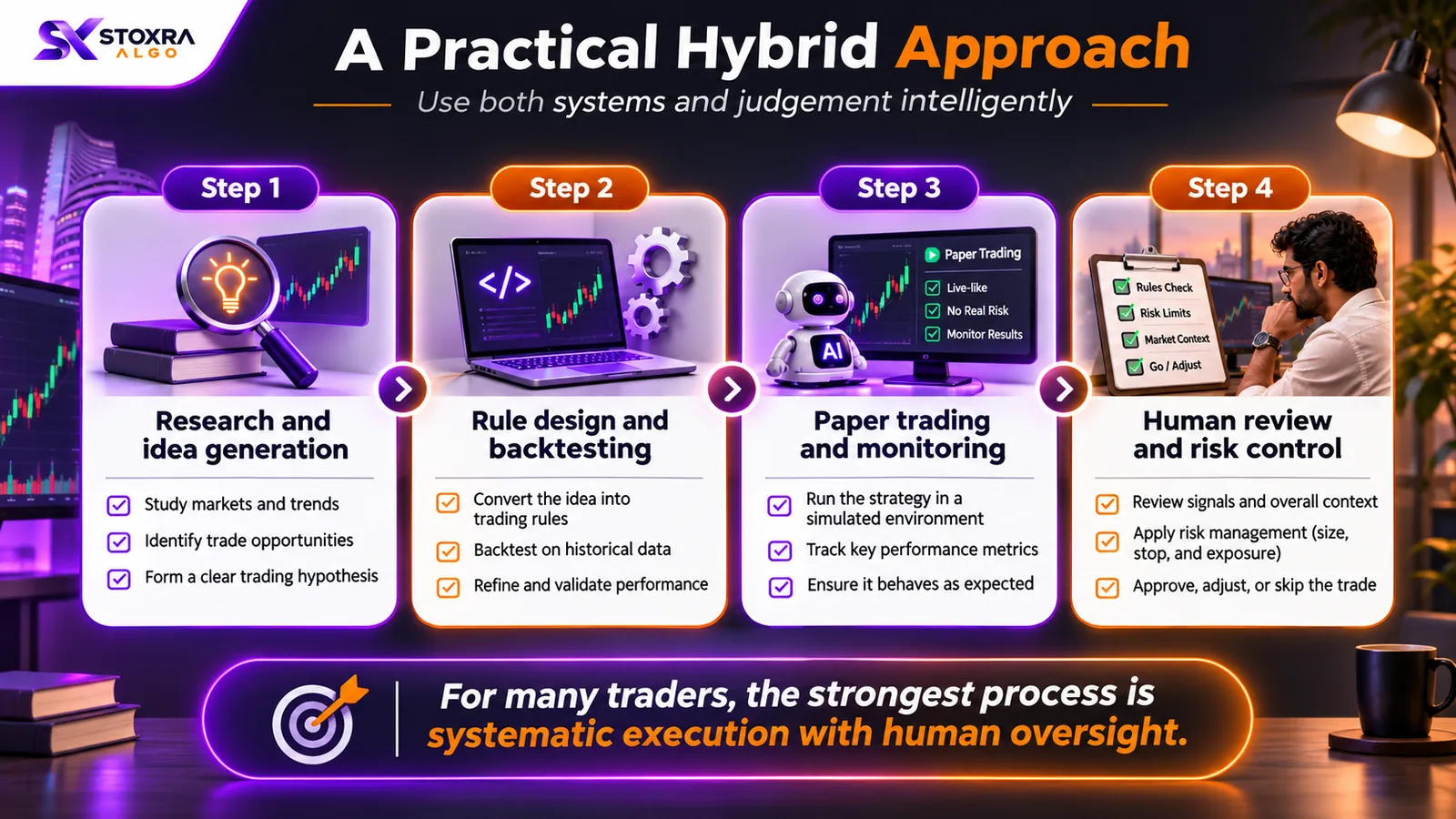
A third option: rules with human oversight
The choice is not always binary. A learner can combine systematic research and explicit rules with manual contextual review, simulated testing and a responsible person supervising the process. That is a workflow for reducing avoidable errors, not a promise of higher returns.
- Write the hypothesis. Define the market idea, data and conditions that would invalidate it.
- Design and test rules. Include trading costs, out-of-sample checks and risk limits.
- Practise in simulation. Record expected behaviour, realistic execution assumptions and exceptions.
- Review before any live use. Confirm broker permissions, controls, oversight and current compliance requirements.
Which approach may suit your current learning goal?
| Your situation | Useful starting point | What to verify |
|---|---|---|
| You can describe a strategy precisely | Research systematic rule definition and historical validation | Input quality, costs, monitoring, broker and exchange rules |
| Your process depends on interpretation | Build a written discretionary checklist and trade journal | Repeatability, evidence standards, position sizing and bias |
| You are completely new | Study both approaches using educational examples and paper practice | Terminology, risk, order mechanics and realistic limitations |
A trading workflow should fit your capabilities and limitations, not a marketing promise about speed, accuracy or returns.
Frequently asked questions about algorithmic vs manual trading
Seven practical questions. These answers focus on the trading process, evidence, risks and Indian-market requirements. No method guarantees returns.
What is the biggest difference between algorithmic and manual trading?
The main difference is how a trade decision is executed. Algorithms consistently apply explicit instructions; manual traders can interpret context not written into a rule, but their choices may vary under pressure.
Is algorithmic trading more profitable than manual trading?
There is no reliable universal answer. Profitability depends on the underlying strategy, market conditions, transaction costs, implementation quality and risk controls—not merely on whether a human or computer places the order.
Can beginners learn algorithmic trading without coding?
Yes. Start by writing an entry rule, an exit rule, a position-size limit and conditions under which trading stops. Understanding those ideas and testing them in simulation is useful before learning code.
Does faster order execution guarantee higher returns?
No. Faster execution can reduce delay for some strategies, but speed does not improve an invalid signal. Slippage, liquidity and trading costs may outweigh any speed advantage.
Is backtesting enough before using real money?
No. Historical testing can reveal behaviour under stated assumptions, but it cannot prove future performance. Test for overfitting, realistic costs and out-of-sample results, then evaluate the process in simulation.
Can I combine manual trading with algorithmic tools?
Yes. A hybrid process might use automated screening and alerts while a person checks market context, sets limits and decides whether to act. Exactly what can be automated depends on available tools and applicable rules.
Is algorithmic trading allowed for retail traders in India?
Retail algorithmic trading is subject to the applicable SEBI, exchange and broker frameworks. What is permitted depends on the execution model and current implementation requirements; consult official guidance and your broker before going live.
Sources, methodology and limitations
Method: This is an educational comparison of decision and execution processes, not an empirical study ranking trading profitability. Examples are explicitly hypothetical. Provider-specific performance, fees and capability claims have not been independently tested here.
- SEBI: Safer participation of retail investors in algorithmic trading (4 February 2025).
- SEBI: Extension of implementation timeline (30 September 2025).
- SEBI: Individual equity derivatives profitability study, FY25–FY26 (20 August 2026).
- NSE: Decision-support tools and algorithmic trading arrangements.
Research reviewed: 23 November 2026. This page is written by STOXRA, which offers trading education and tools. It should not be read as independent testing or a guarantee of platform outcomes.
Illustrations: STOXRA-original educational visuals. Any numbers or trading screens shown in those illustrations are fictional, not price feeds, real accounts or live-product screenshots.
Disclaimer: Educational information only—not a recommendation to trade, investment advice or a promise of profitability. Trading and derivatives involve financial risk.
Continue learning with STOXRA Algo
Interested in learning how rules, testing and risk checks connect? Read What Is STOXRA Algo? for an overview of its documented features and limitations. The next related comparison pages will be linked only after their destinations are verified live.