Nifty vs Bank Nifty — Which Is Better for Beginner Options Traders in India?
Two popular index names can hide very different sector and contract exposures. Verify current contract specs and control risk. Compare the criteria, risks, example and seven practical FAQs.
STOXRA editorial research note · 23 November 2026 · India · Educational comparison
Quick answer: Verify current contract specs and control risk. Two popular index names can hide very different sector and contract exposures. Every comparison below focuses on practical criteria, not a guaranteed result. Suitability depends on the individual reader’s objectives, experience, costs and risk capacity.
We start with a simple reader question: Two popular index names can hide very different sector and contract exposures. The answer requires separating definitions from outcomes. A method, app or investment wrapper can change the workflow; it cannot independently promise profits, remove losses or guarantee suitability. This article uses a common set of trade-off checks rather than a universal winner.
How to read this comparison
Evaluate each option against the same practical task. A good comparison explains not only what changes, but also what cannot be known from a headline feature list or a persuasive example.
Side-by-side: the decision factors that matter
Compare equivalent objectives and assumptions. This is a qualitative evaluation framework, not a ranked performance test.
| Factor | NIFTY 50 index options | NIFTY Bank index options |
|---|---|---|
| Underlying | Diversified large-cap sector representation | Banking-sector-focused index |
| Concentration | Broader sector balance | Sector-specific concentration risk |
| Contract terms | Verify live NSE strike, lot and expiry details | Verify live NSE strike, lot and expiry details |
| Beginner check | Liquidity, volatility and risk per trade | Concentration, volatility and premium exposure |
Method note: Features, price, access, regulatory requirements and contract terms may change. Recheck official information before relying on them.
Understand index construction
Begin with the definition, not a claim about which alternative wins. This is why the first lens is “Understand index construction”. Define precisely what each alternative does before comparing results.
Sector concentration and drivers
The next distinction concerns what is measured and how an actual decision is made. Ask which input, data source or operational constraint changes the meaning of “Sector concentration and drivers”. An attractive interface cannot replace a verified process.
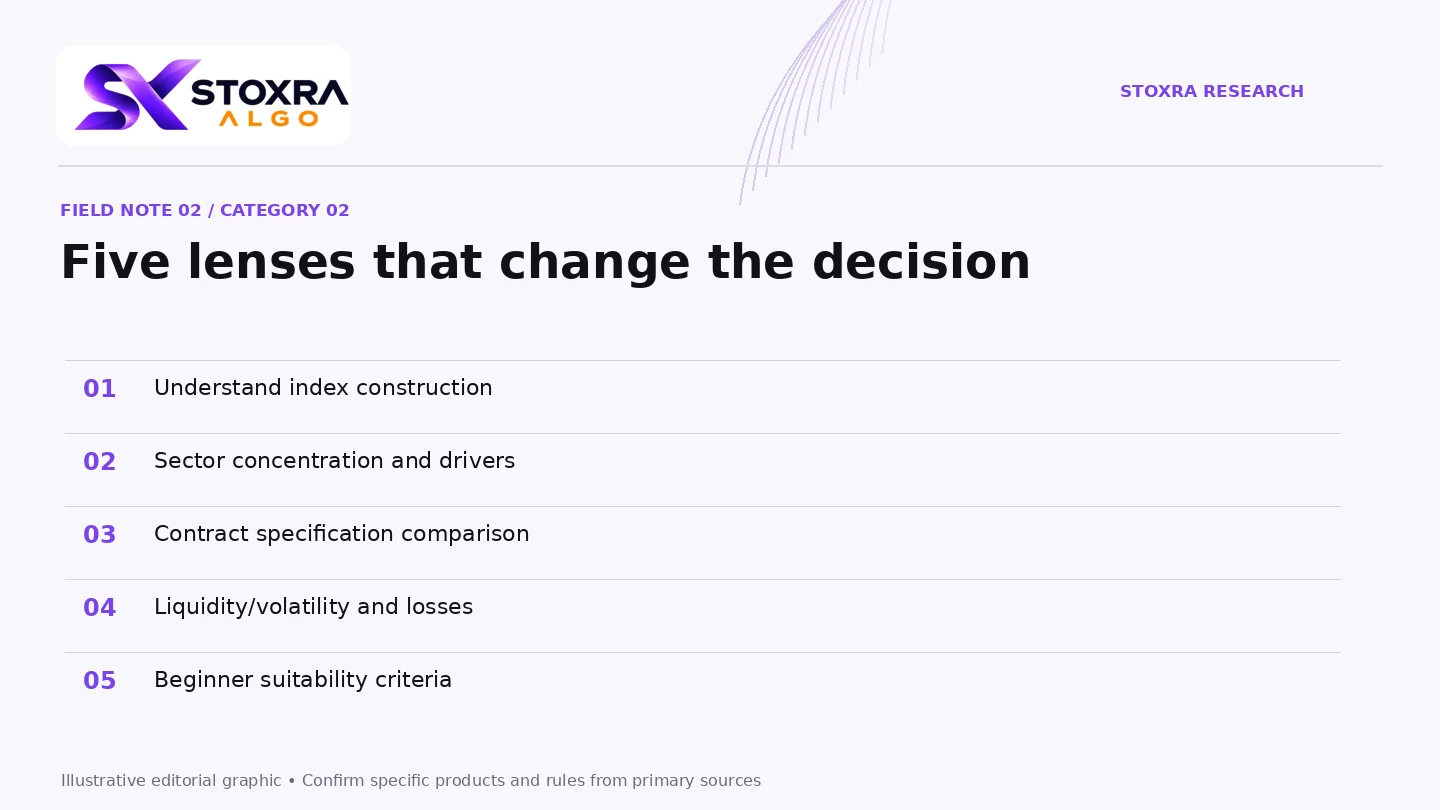
Contract specification comparison
A fair comparison needs a consistent frame: identical goals, time horizon and assumptions. Use a written checklist for “Contract specification comparison”. Compare evidence and limitations before assuming two options deliver equivalent outcomes. Illustrative context: Same hypothetical delta exposure in different index options.
Liquidity/volatility and losses
Risks become visible when the underlying assumptions fail or markets behave differently. For “Liquidity/volatility and losses”, record uncertainty, execution constraints and costs rather than relying on a single attractive backtest or marketing claim.
Beginner suitability criteria
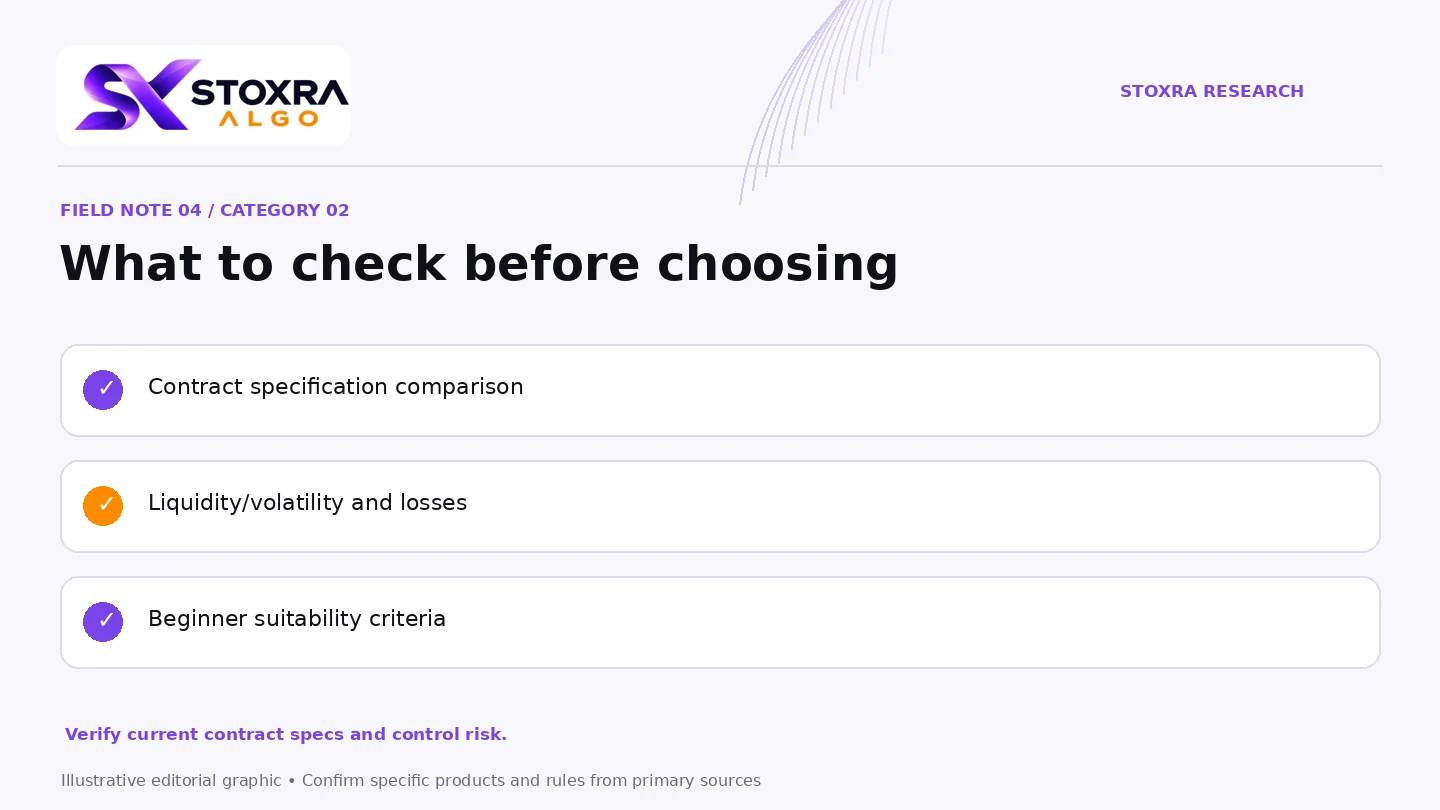
The useful outcome is a decision rule that readers can check and revisit. After evaluating “Beginner suitability criteria”, return to the decision: verify current contract specs and control risk.
A worked scenario: focus on the process
Same hypothetical delta exposure in different index options. Treat this as a hypothetical educational exercise. You cannot use it to estimate a real return without instrument specifications, fill assumptions, fees and a valid dataset. Ask what information was available before the decision and which variables could make the comparison misleading.
What would make one approach more suitable?
Verify current contract specs and control risk.. Use that as a working decision question, not a recommendation. Record the time horizon, what the reader needs to know in advance, the operating risks, and the evidence that would make the current conclusion wrong.
Costs, uncertainty and important limitations
Evidence limits: This is a practical explanation, not independent provider testing, a live trading strategy, investment advice or an empirical performance ranking. No tool or trading style should be described as the winner solely because it is faster, more automated, cheaper or historically profitable.
Research checklist: NSE Nifty Indices fact sheets, exchange contracts updated as of date. Check the original source and its publication date, distinguish a provider claim from independent verification, and identify risks that remain even if the described method works as intended.
Frequently asked questions
The seven most useful questions about this comparison, with direct answers rather than keyword-stuffed repetition.
What is the clearest difference between nifty 50 index options and nifty bank index options?
NIFTY 50 index options and NIFTY Bank index options perform different jobs or have different exposure. In this comparison, underlying is the first distinction: diversified large-cap sector representation versus banking-sector-focused index.
When might nifty 50 index options be appropriate?
Consider nifty 50 index options only when its constraints fit your actual objective. Check concentration and verify: broader sector balance. This does not establish higher returns or lower risk.
When might nifty bank index options be appropriate?
NIFTY Bank index options may suit a different process. In particular, sector-specific concentration risk. Decide using time, experience, liquidity and the kind of evidence you can evaluate.
How should costs and risk affect the comparison?
Compare all relevant costs and possible losses rather than a headline fee or return. A key warning here is beginner check: Liquidity, volatility and risk per trade versus Concentration, volatility and premium exposure. The exact charges and risks depend on the instrument and provider.
Can these approaches be combined?
Sometimes, but combining overlapping methods can add complexity without adding useful diversification or information. The practical aim is to make the process complementary: Verify current contract specs and control risk..
Does Bank Nifty always move more than Nifty?
Use a small, documented educational example and a consistent comparison rubric. For illustration, same hypothetical delta exposure in different index options. Keep the assumptions, cost treatment and time horizon visible.
What should readers in India verify before acting?
Refer to the current exchange, regulator and service-provider material relevant to the product. Review nSE Nifty Indices fact sheets, exchange contracts updated as of date, because contract terms and platform features can change. Nothing here is personalized investment advice.
Sources and editorial methodology
We provide source material for relevant regulations, contracts or investment structures. Refer to the specific official page for up-to-date details; the editorial comparisons and illustrations are our own.
- NSE — Equity derivatives contract specifications
- SEBI — FY25–FY26 individual derivatives profitability study
Research review: 23 November 2026. STOXRA publishes this article and develops trading education and technology. Where STOXRA is in the product category, it has an editorial conflict of interest; no independent ranking or performance validation is claimed.
Risk notice: Markets and financial products carry risk. Simulations and example illustrations are not live trading results.
Continue with STOXRA education
For background on structured trading workflows, see What Is STOXRA Algo?. Related Category 02 comparisons will be linked only when their routes are verified live.