Top AI Trading Platforms in India for Automated Stock Market Trading (2026 Guide)
A platform is not just an app: data, rule engine, controls and broker relationship matter. Choose a platform by end-to-end reliability and constraints. Compare the criteria, risks, example and seven practical FAQs.
STOXRA editorial research note · 23 November 2026 · India · Educational comparison
Quick answer: Choose a platform by end-to-end reliability and constraints. A platform is not just an app: data, rule engine, controls and broker relationship matter. Every comparison below focuses on practical criteria, not a guaranteed result. Suitability depends on the individual reader’s objectives, experience, costs and risk capacity.
We start with a simple reader question: A platform is not just an app: data, rule engine, controls and broker relationship matter. The answer requires separating definitions from outcomes. A method, app or investment wrapper can change the workflow; it cannot independently promise profits, remove losses or guarantee suitability. This article uses a common set of trade-off checks rather than a universal winner.
How to read this comparison
Evaluate each option against the same practical task. A good comparison explains not only what changes, but also what cannot be known from a headline feature list or a persuasive example.
Side-by-side: the decision factors that matter
Compare equivalent objectives and assumptions. This is a qualitative evaluation framework, not a ranked performance test.
| Factor | Evaluation criterion | Evidence to inspect |
|---|---|---|
| Define an integrated platform | Verify scope, limitations and current official documentation before deciding. | Compare evidence, timestamp and what the provider does not establish. |
| Broker, data and order architecture | Verify scope, limitations and current official documentation before deciding. | Compare evidence, timestamp and what the provider does not establish. |
| Strategy builder and backtest | Verify scope, limitations and current official documentation before deciding. | Compare evidence, timestamp and what the provider does not establish. |
| Security and costs | Verify scope, limitations and current official documentation before deciding. | Compare evidence, timestamp and what the provider does not establish. |
Method note: Features, price, access, regulatory requirements and contract terms may change. Recheck official information before relying on them.
Define an integrated platform
Begin with the definition, not a claim about which alternative wins. This is why the first lens is “Define an integrated platform”. Define precisely what each alternative does before comparing results.
Broker, data and order architecture
The next distinction concerns what is measured and how an actual decision is made. Ask which input, data source or operational constraint changes the meaning of “Broker, data and order architecture”. An attractive interface cannot replace a verified process.
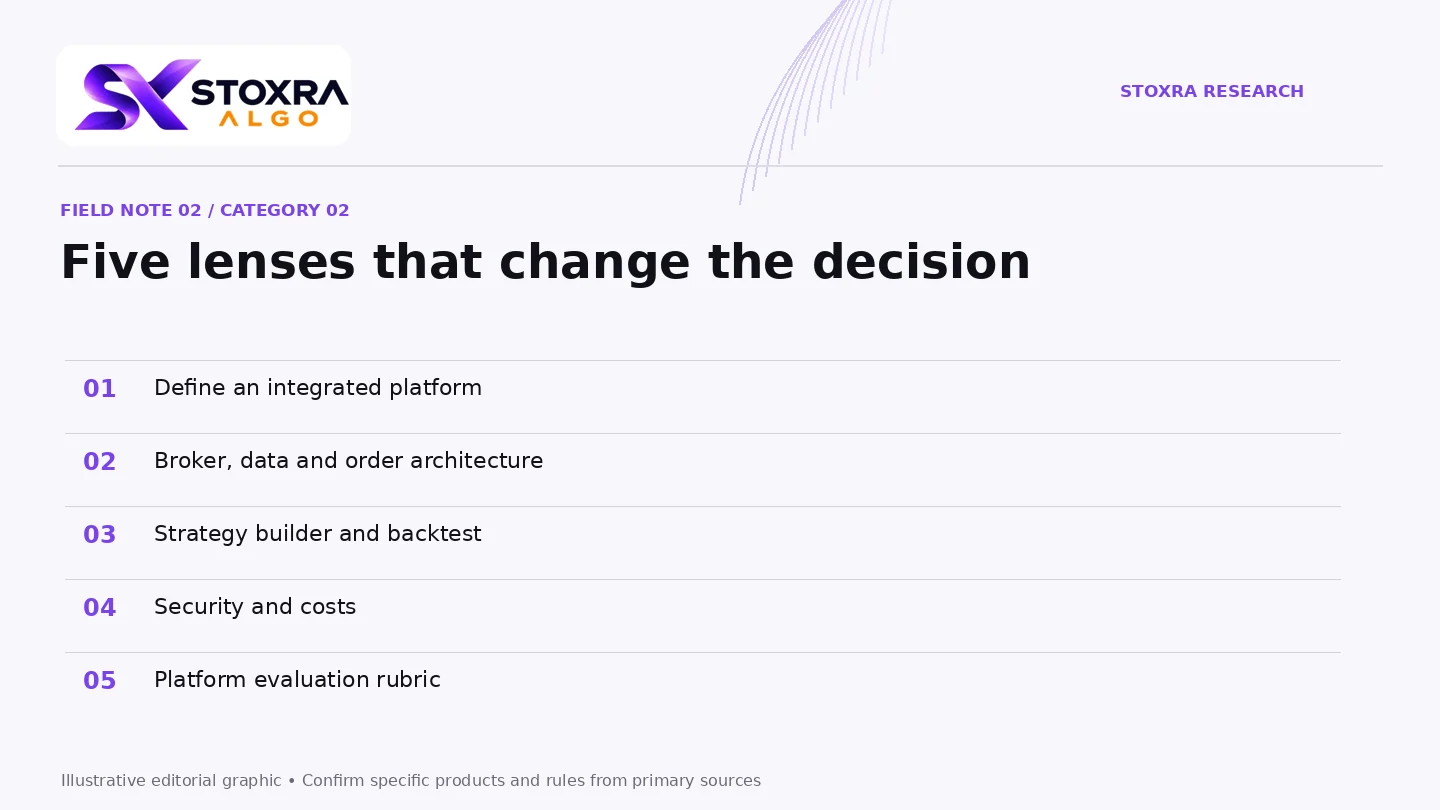
Strategy builder and backtest
A fair comparison needs a consistent frame: identical goals, time horizon and assumptions. Use a written checklist for “Strategy builder and backtest”. Compare evidence and limitations before assuming two options deliver equivalent outcomes. Illustrative context: Illustrative full workflow from idea to sandbox execution.
Security and costs
Risks become visible when the underlying assumptions fail or markets behave differently. For “Security and costs”, record uncertainty, execution constraints and costs rather than relying on a single attractive backtest or marketing claim.
Platform evaluation rubric
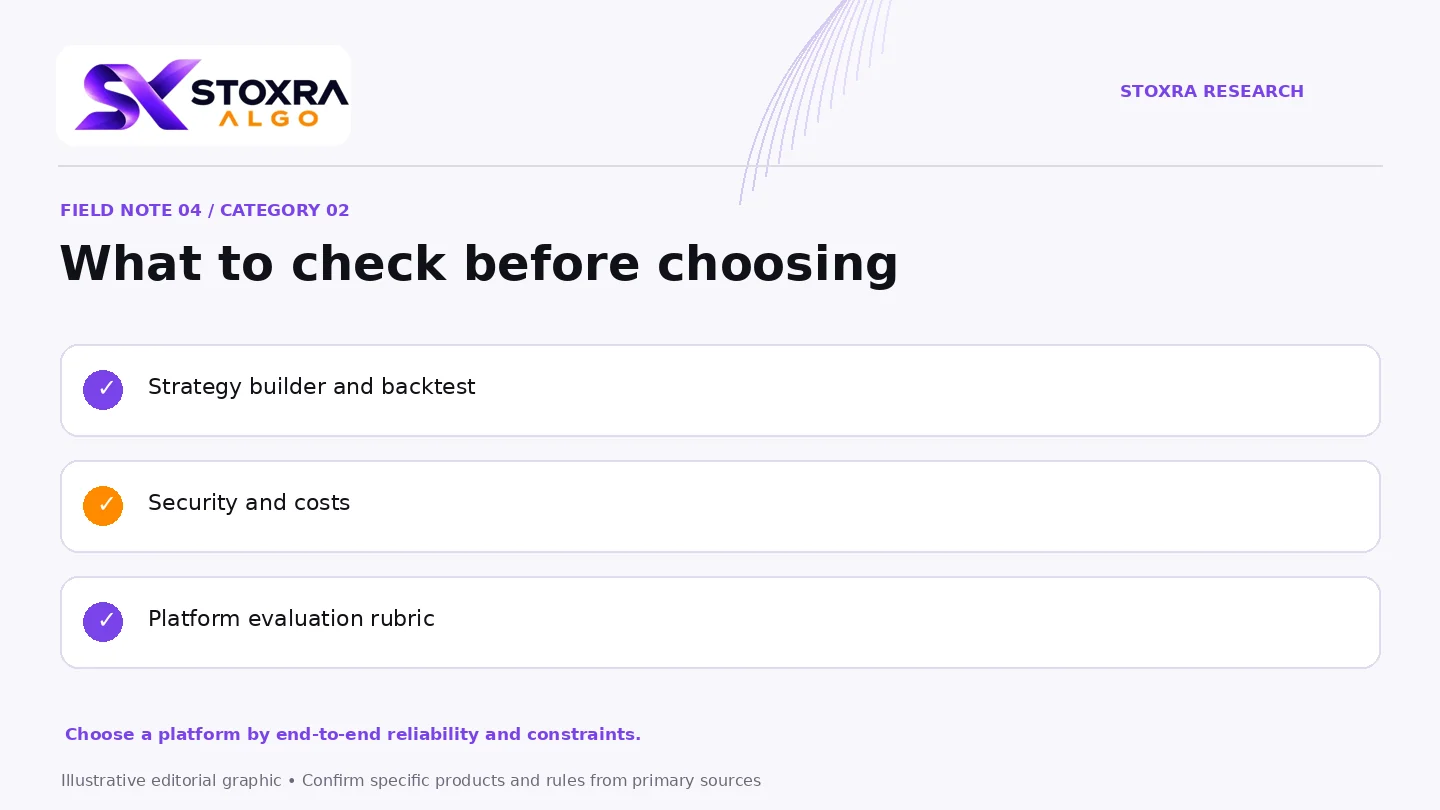
The useful outcome is a decision rule that readers can check and revisit. After evaluating “Platform evaluation rubric”, return to the decision: choose a platform by end-to-end reliability and constraints.
A worked scenario: focus on the process
Illustrative full workflow from idea to sandbox execution. Treat this as a hypothetical educational exercise. You cannot use it to estimate a real return without instrument specifications, fill assumptions, fees and a valid dataset. Ask what information was available before the decision and which variables could make the comparison misleading.
What would make one approach more suitable?
Choose a platform by end-to-end reliability and constraints.. Use that as a working decision question, not a recommendation. Record the time horizon, what the reader needs to know in advance, the operating risks, and the evidence that would make the current conclusion wrong.
Costs, uncertainty and important limitations
Evidence limits: This is a practical explanation, not independent provider testing, a live trading strategy, investment advice or an empirical performance ranking. No tool or trading style should be described as the winner solely because it is faster, more automated, cheaper or historically profitable.
Research checklist: Current vendor docs; broker/API regulatory checks; affiliation disclosure. Check the original source and its publication date, distinguish a provider claim from independent verification, and identify risks that remain even if the described method works as intended.
Frequently asked questions
The seven most useful questions about this comparison, with direct answers rather than keyword-stuffed repetition.
How should a beginner compare options in top ai trading platforms in india for automated stock market trading (2026 guide)?
Start with one real task and a written list of necessary features. Define an integrated platform. Avoid ranking tools purely by their marketing labels or screenshots.
Does a free or popular option automatically mean it is best?
No. Price and popularity do not verify data accuracy, supported instruments, reliability, after-sales service or suitability. Review official documentation and the actual terms of the particular provider.
What evidence is needed to make a fair comparison?
Use a consistent rubric for every candidate. Check strategy builder and backtest, document the timestamp and verify the relevant official source. Provider claims should be labelled separately from independently established facts.
How should costs be compared?
Count subscriptions, exchange data fees, brokerage, spreads, transaction costs and any applicable taxes where relevant. Different products disclose different parts of the total cost, so compare equivalent usage.
What is a common comparison mistake?
Ignoring the boundary between function and outcome. For this topic, Integrated ecosystem and automation, not standalone AI tools/apps.. A feature list alone does not prove reliability or profitable results.
Do all AI trading platforms automatically place orders?
Use a documented, low-stakes educational scenario: illustrative full workflow from idea to sandbox execution. Record data freshness, usability, export options and limitations, without assuming example results would occur live.
What should readers in India check?
Before subscribing or trading, verify current vendor docs; broker/API regulatory checks; affiliation disclosure. The relevant regulator, exchange, issuer and provider sources may change over time.
Sources and editorial methodology
We provide source material for relevant regulations, contracts or investment structures. Refer to the specific official page for up-to-date details; the editorial comparisons and illustrations are our own.
- SEBI — Retail investors in algorithmic trading
- SEBI — Implementation timeline for retail algorithmic trading
- SEBI — FY25–FY26 individual derivatives profitability study
Research review: 23 November 2026. STOXRA publishes this article and develops trading education and technology. Where STOXRA is in the product category, it has an editorial conflict of interest; no independent ranking or performance validation is claimed.
Risk notice: Markets and financial products carry risk. Simulations and example illustrations are not live trading results.
Continue with STOXRA education
For background on structured trading workflows, see What Is STOXRA Algo?. Related Category 02 comparisons will be linked only when their routes are verified live.