How to Evaluate a Company Before Investing?
Learn how to evaluate a company before investing by analysing its business model, financial statements, management, growth opportunities, risks, competitive advantage, and valuation.
What Does It Mean to Evaluate a Company?
Company evaluation is the process of deciding whether a business is financially strong, capable of growing, responsibly managed, and reasonably priced. It is the core of stock market basics and fundamental analysis.
The objective is not to predict tomorrow’s price. It is to understand what you are buying, how the company creates value, and what could permanently damage that value.
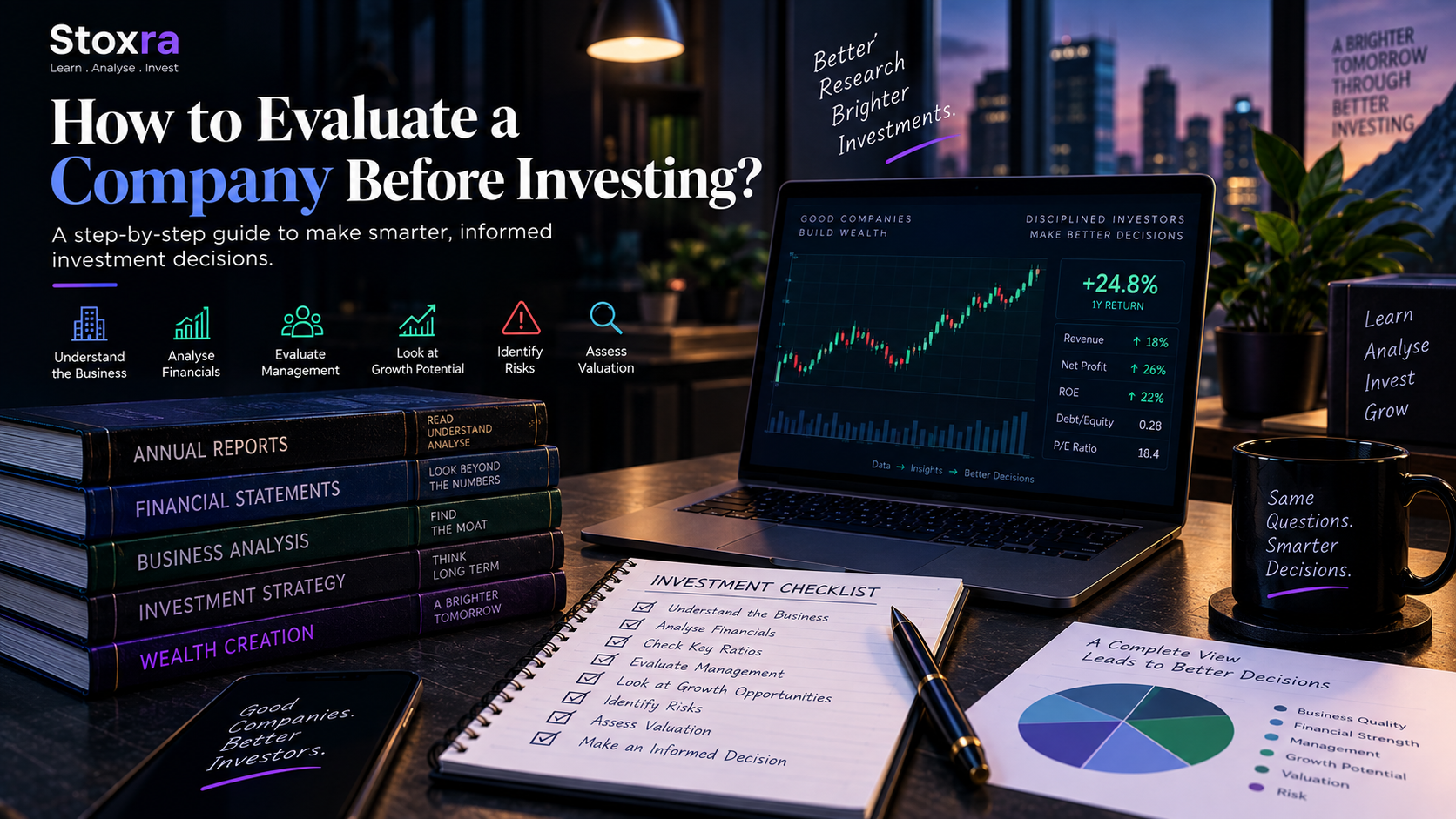
1. Understand the Company’s Business Model
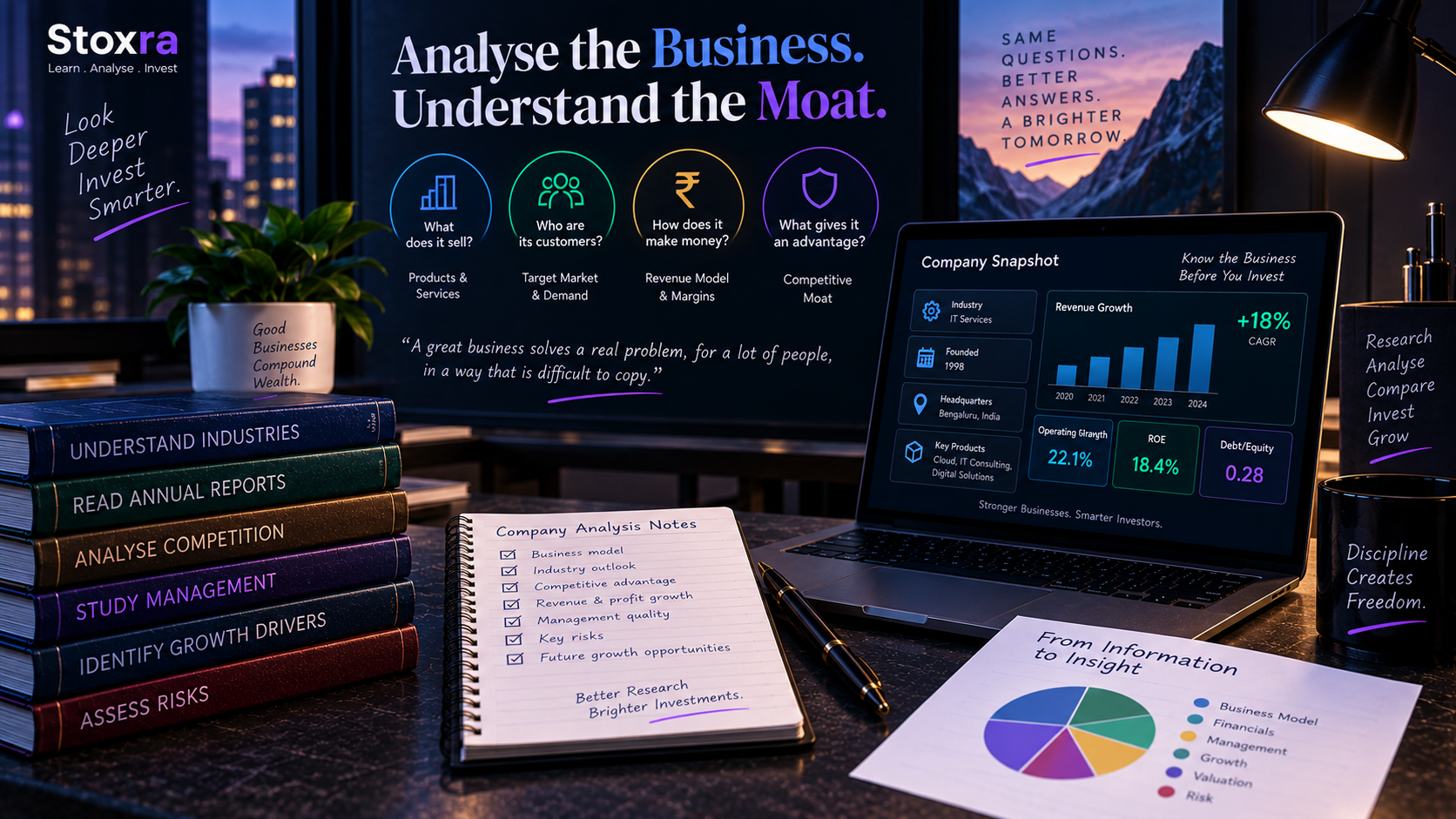
Start with simple questions: What does the company sell? Who buys it? How does it make money? Why do customers choose it? What could make customers leave?
Products
Understand the main products or services and how essential they are to customers.
Customers
Check whether revenue depends on a few customers, one geography, or one industry.
Revenue Model
Identify recurring revenue, pricing power, margins, and the drivers of demand.
Competitive Advantage
Look for brand strength, network effects, cost advantages, distribution, or switching costs.
Read the annual report, investor presentation, and management discussion. Use a stock market terminology guide if unfamiliar terms make the documents difficult to follow.
2. Study the Financial Statements
Financial statements show whether the business model is producing real economic results. Review at least five years when reliable data is available.
| Statement | What to Examine |
|---|---|
| Profit and loss statement | Revenue growth, operating profit, net profit, margins, and exceptional items. |
| Balance sheet | Cash, debt, working capital, equity, and asset quality. |
| Cash-flow statement | Operating cash flow, capital expenditure, free cash flow, and cash conversion. |
Revenue growth is useful only when it translates into sustainable profits and cash. A company can report rising sales while collecting cash slowly or spending heavily to maintain growth. Learn how to read a company balance sheet before relying on headline numbers.
3. Check the Important Financial Ratios
Ratios make comparison easier, but they should explain the business rather than replace it.
ROE
Measures profit generated from shareholders’ equity.
ROCE
Measures returns generated from capital employed, including debt and equity.
Debt-to-Equity
Shows how heavily the business relies on borrowed capital.
Operating Margin
Shows how much operating profit remains from revenue.
EPS
Shows profit attributable to each share; read more in Stoxra’s EPS guide.
P/E Ratio
Compares market price with earnings and must be judged against growth and quality.
4. Evaluate Management and Governance
Management controls capital allocation, acquisitions, debt, dividends, and expansion. Review whether leaders communicate clearly and deliver what they previously promised.
- Promoter and insider ownership
- Promoter pledging
- Related-party transactions
- Auditor qualifications or resignations
- Capital allocation history
- Executive compensation and shareholder treatment
Strong governance does not guarantee success, but weak governance can destroy value even when financial ratios look attractive. Avoid the common mistakes beginners make, especially trusting management claims without checking filings.
5. Analyse Growth Opportunities
Growth should come from identifiable drivers rather than vague promises. Examine industry demand, market size, product launches, capacity expansion, distribution, pricing power, and the company’s ability to reinvest profit.
Ask whether growth is profitable. Fast revenue growth with falling margins, rising receivables, or heavy borrowing may be less attractive than slower growth funded by strong cash generation.
6. Identify the Major Risks
Financial Risk
High debt, weak interest coverage, refinancing needs, or poor cash conversion.
Business Risk
Strong competition, customer concentration, disruption, or changing demand.
Regulatory Risk
Licensing, policy changes, litigation, or compliance exposure.
Valuation Risk
A good business bought at an excessive price may still deliver poor returns.
Write down the three most serious ways your investment thesis could fail. Risk management is not only for traders; it is essential for long-term investors too. Stoxra’s risk-management principles provide useful general discipline, even when your holding period is longer.
7. Understand Valuation Before Investing
A company can be excellent and still be a poor investment if the market price already assumes years of perfect execution. Compare valuation with earnings growth, margins, balance-sheet quality, and peer multiples.
| Valuation Check | Question |
|---|---|
| P/E | Is the earnings multiple justified by growth and quality? |
| Price-to-book | Is book value meaningful for this type of business? |
| EV/EBITDA | How does valuation look before financing and tax effects? |
| Growth versus price | What growth is already priced into the stock? |
Use a stock screener to create a shortlist, then conduct deeper research. Screening is the beginning of analysis, not the final decision.
Company Evaluation Scorecard
Give each area a score from 1 to 10. This tool is a research aid, not a recommendation engine.
Relevant Tools for Company Research
Research and Learning
Use Stoxra’s learning hub to strengthen your analysis process.
AI Research
Explore AI tools for stock analysis to organise information and compare documents.
Technical Context
After fundamental research, use technical analysis for price and trend context.
Paper Trading
Test an investment thesis with paper trading before committing capital.
Market Updates
Follow Stoxra market news for earnings, sector, and company developments.
Investing Platform
Use the Stoxra AI trading platform as a research companion, not a substitute for judgment.
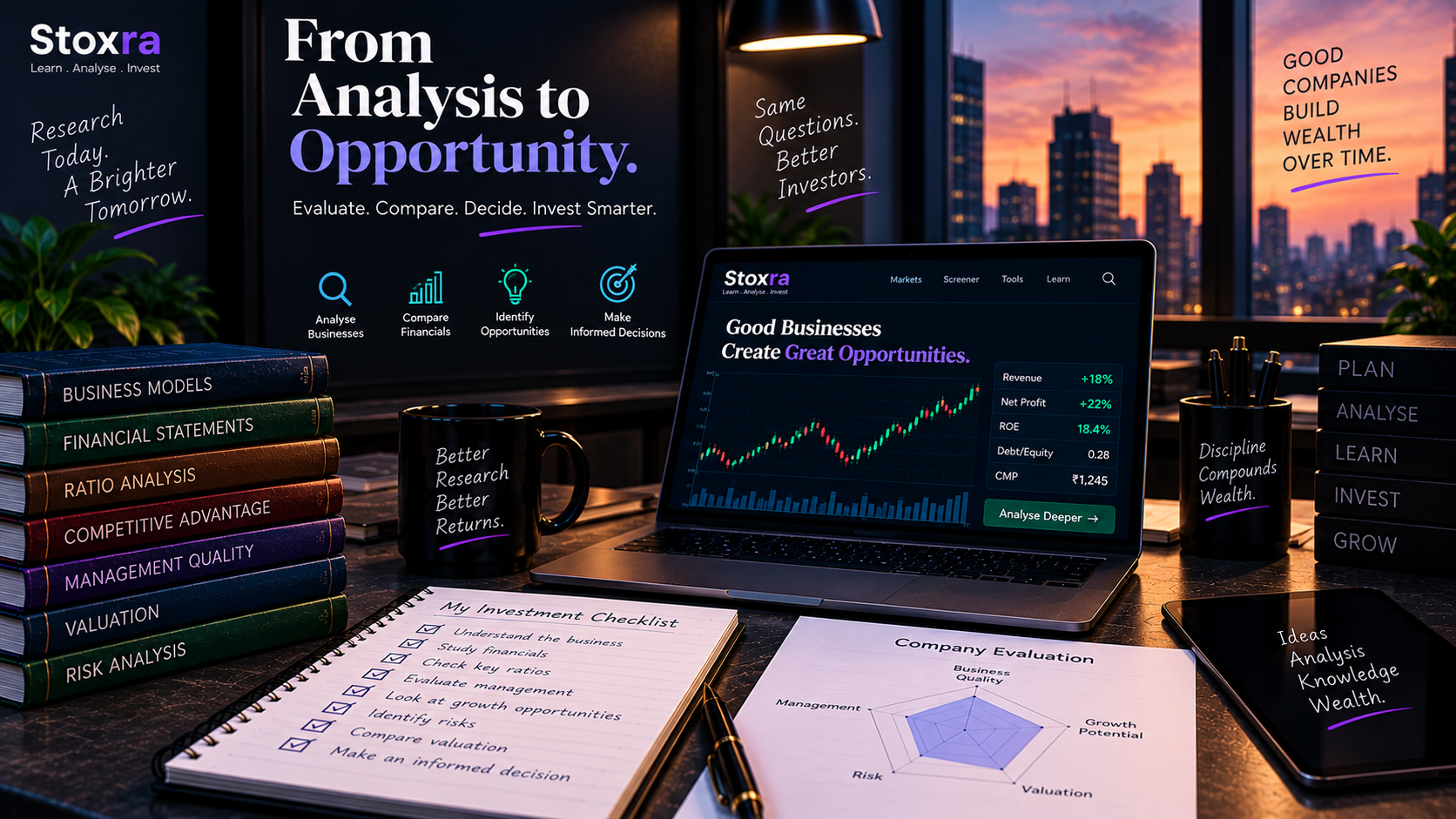
Beginner’s Final Checklist
- Can I explain how the company makes money?
- Are revenue and profits growing for credible reasons?
- Is operating cash flow healthy?
- Is debt manageable?
- Does management allocate capital responsibly?
- Does the company have a durable advantage?
- What are the biggest risks?
- Is the valuation reasonable?
- What would make me change my mind?
Frequently Asked Questions
Start with the business model. If you cannot explain how the company earns money and why customers need it, you are not ready to evaluate its financials.
How many years of financial data should I study?Five years is a useful starting point when reliable data is available. Longer history helps identify cycles, exceptional events, and consistency.
Is a low P/E ratio enough to buy a stock?No. A low P/E may reflect weak growth, high risk, falling earnings, poor governance, or a structurally declining business.
Should beginners use a stock screener?Yes, as a filtering tool. A screener helps create a shortlist, but the final decision requires business, financial, management, risk, and valuation research.
Final Takeaway
Evaluating a company before investing means building a complete evidence-based view. Study the business, verify the financial statements, assess management, understand growth, identify risks, and compare valuation. The goal is not to find a perfect company; it is to understand whether the potential return justifies the risks and price.