Is Commodity Trading Income Taxable in India?
Commodity trading income can be taxable in India. Understand the tax treatment of commodity futures and options, CTT, trading profits and losses, expenses and key tax considerations for Indian traders.
Is Commodity Trading Income Taxable in India?
Yes, commodity trading income can be taxable in India. However, the exact tax treatment depends on the nature and classification of the transaction, how it was executed or settled, applicable expenses, losses and the tax rules relevant to the period being reported.
Key Takeaway
Eligible exchange-traded commodity derivative transactions can receive non-speculative treatment when the applicable conditions are satisfied. However, not every commodity-related transaction should automatically be treated the same way. Traders should maintain proper records and check the rules applicable to their specific transaction and tax period.
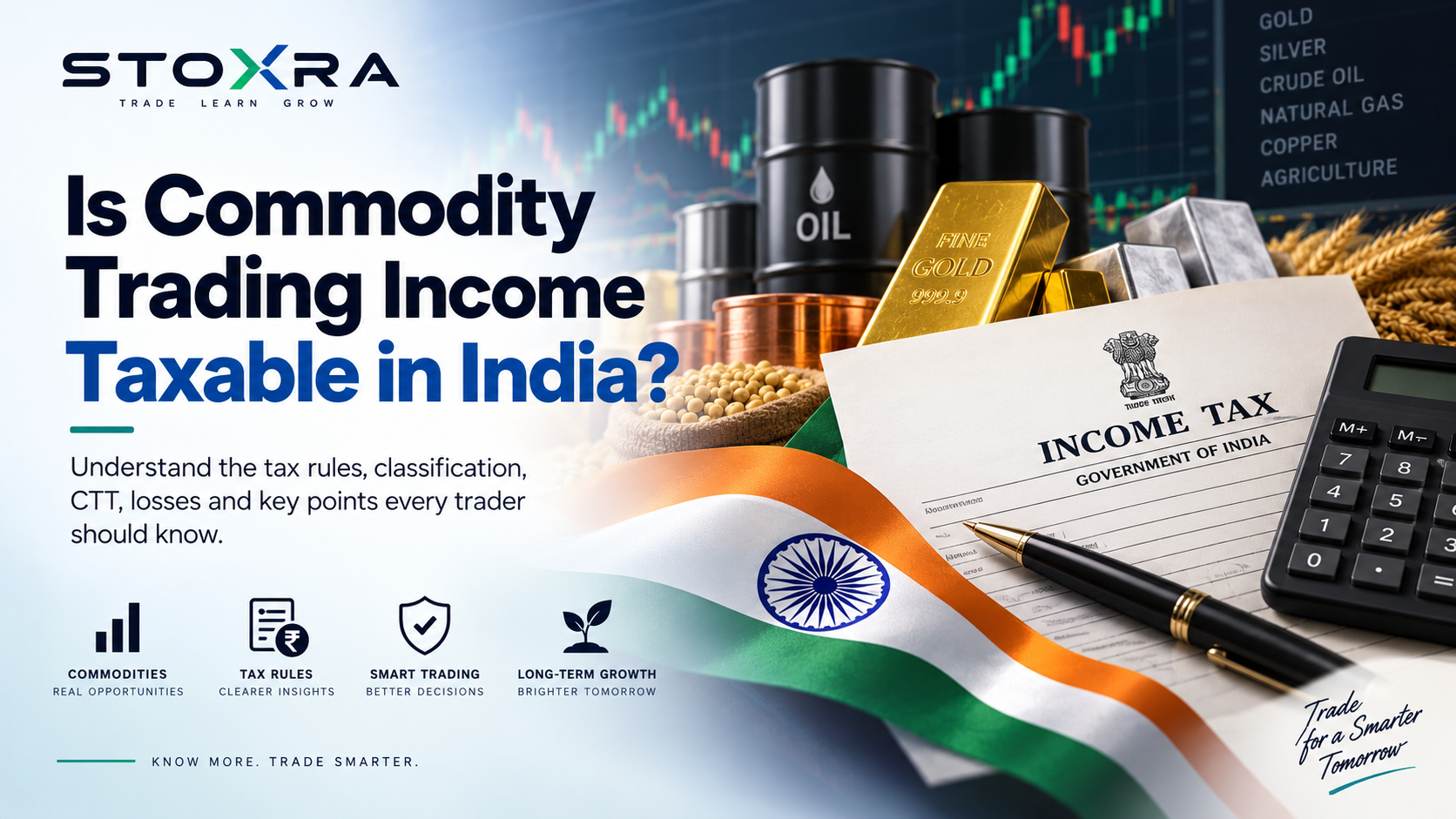
What Is Commodity Trading?
Commodity trading involves buying and selling instruments linked to commodities such as gold, silver, crude oil, natural gas and other commodities. Traders can participate through eligible market instruments offered on recognised exchanges through registered intermediaries.
Commodity trading may involve futures, options or other eligible exchange-traded instruments. The way a transaction is entered into, settled and recorded can affect its accounting and tax treatment.
Before moving into commodity trading, beginners should understand common market terminology. Our stock market terminology guide can help explain frequently used trading terms.
If you are completely new to financial markets, start with our stock market basics guide for beginners before exploring derivatives.
Is Commodity Trading Taxable in India?
Yes. Income or profits arising from commodity trading can be taxable. The important question is how the particular transaction should be classified under the applicable tax provisions.
Eligible exchange-traded commodity derivative transactions can fall outside the definition of a speculative transaction when the relevant statutory conditions are satisfied.
Therefore, it is not accurate to assume that every commodity trade is automatically speculative or that every commodity profit receives exactly the same tax treatment.
Exchange-Traded Derivatives
Eligible commodity derivative transactions may qualify for non-speculative treatment when the relevant legal conditions are satisfied.
Physical Commodity Activity
Physical buying and selling can involve different accounting and tax considerations depending on the nature of the activity.
How Is Commodity Trading Income Classified?
Classification is one of the most important parts of understanding commodity trading taxation. The same broad commodity category can contain transactions with different tax consequences.
For eligible exchange-traded commodity derivatives, applicable provisions can provide an exception from the general definition of a speculative transaction when the prescribed conditions are fulfilled.
If trading is carried on as a business, the income may generally need to be considered under the applicable business-income framework rather than being automatically treated as a capital gain.
Pro Tip
Do not decide your tax classification only from your broker's profit-and-loss statement. Keep contract notes, trade reports, ledger statements and other supporting records so that the nature of the transactions can be properly established.
Commodity Futures and Income Tax
A commodity futures contract is a derivative whose value is linked to an underlying commodity. A trader may take a futures position without purchasing the physical commodity itself.
Where the transaction satisfies the relevant requirements for non-speculative treatment, the resulting trading activity can be considered under business-income principles.
The exact tax calculation still depends on the taxpayer's overall circumstances and the rules applicable to the relevant tax period.
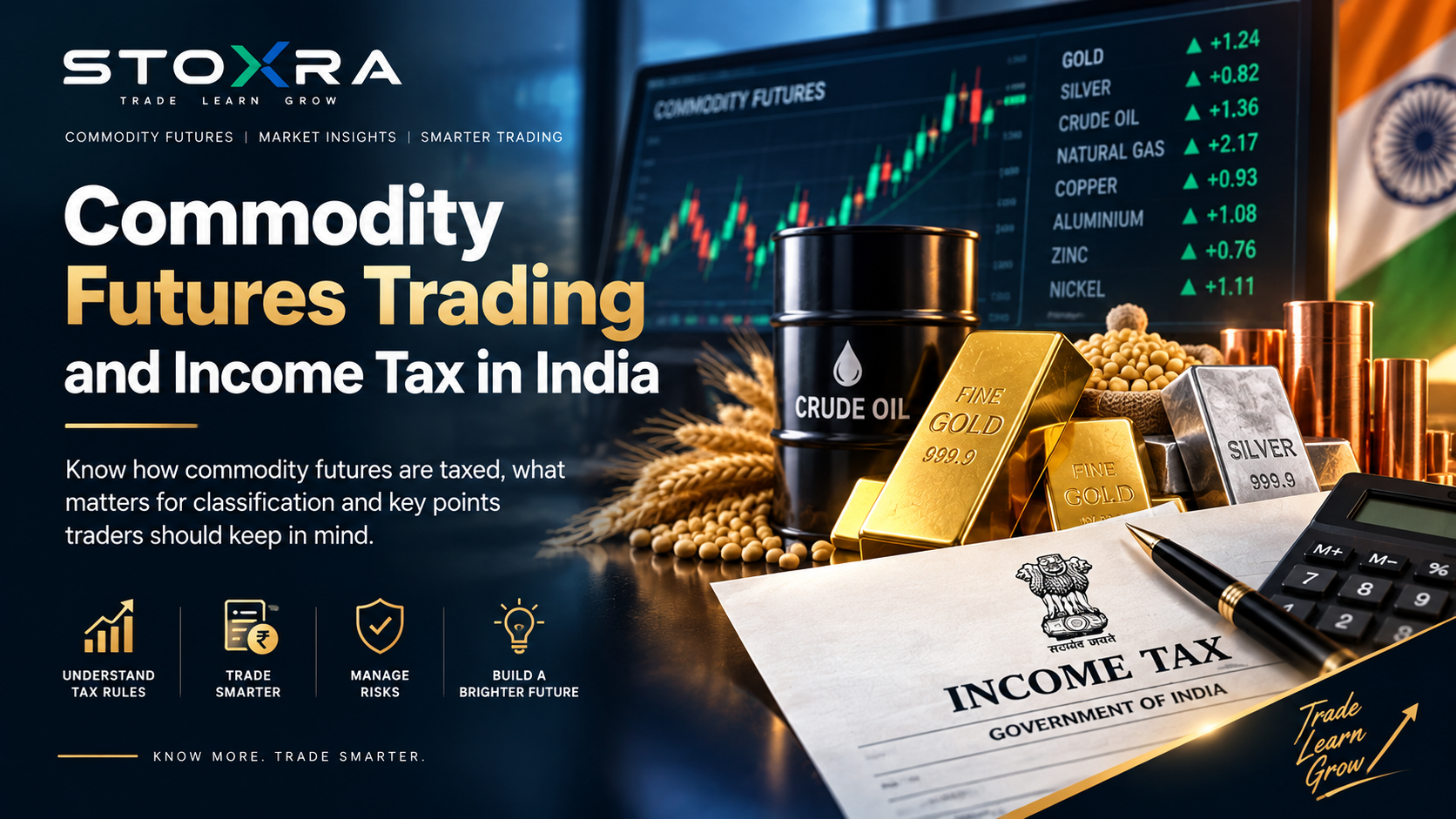
Commodity Options and Taxation
Commodity options have their own contractual characteristics and can involve different transaction and settlement scenarios.
The tax treatment should therefore be determined from the actual transaction rather than from a general assumption that all options are taxed identically.
Traders should review the relevant contract notes and transaction statements and consider the applicable tax provisions for the financial year in which the transaction took place.
Traders who also participate in equity or index options can learn more about risk differences in our guide to option buying vs option selling .
Simple Example of Commodity Trading Profit
Illustrative Example
Suppose a trader has an eligible commodity trading profit of ₹1,00,000 during a tax period.
That ₹1,00,000 should not automatically be interpreted as the final income-tax payable. Other taxable income, eligible expenses, losses, deductions and applicable tax rules may affect the final computation.
This is only a simplified educational representation. Actual tax computation can involve additional provisions and adjustments.
Can Commodity Trading Expenses Be Considered?
Where trading activity is carried on as a business, certain expenses may be relevant in determining business income, subject to applicable provisions and proper documentation.
- Brokerage and eligible transaction charges
- Exchange-related charges
- Professional accounting or tax-related expenses where applicable
- Eligible communication and internet expenses
- Other legitimate business expenses where permitted
An expense should not be treated as deductible merely because it was incurred while trading. Its eligibility, business purpose and supporting documentation should be considered.
What Is Commodity Transaction Tax (CTT)?
Commodity Transaction Tax, or CTT, is a transaction-level tax applicable to specified taxable commodity transactions under the relevant provisions.
CTT and income tax are different concepts. A transaction-level tax does not by itself determine the taxpayer's final annual income-tax liability.
| Concept | What It Means | Why It Matters |
|---|---|---|
| Income Tax | Tax associated with taxable income | Relevant to the taxpayer's overall tax computation |
| CTT | Transaction-level levy on specified commodity transactions | Applies according to the relevant transaction and provisions |
| Trading Charges | Brokerage and other transaction-related charges | May be relevant to trading costs and business-income calculations |
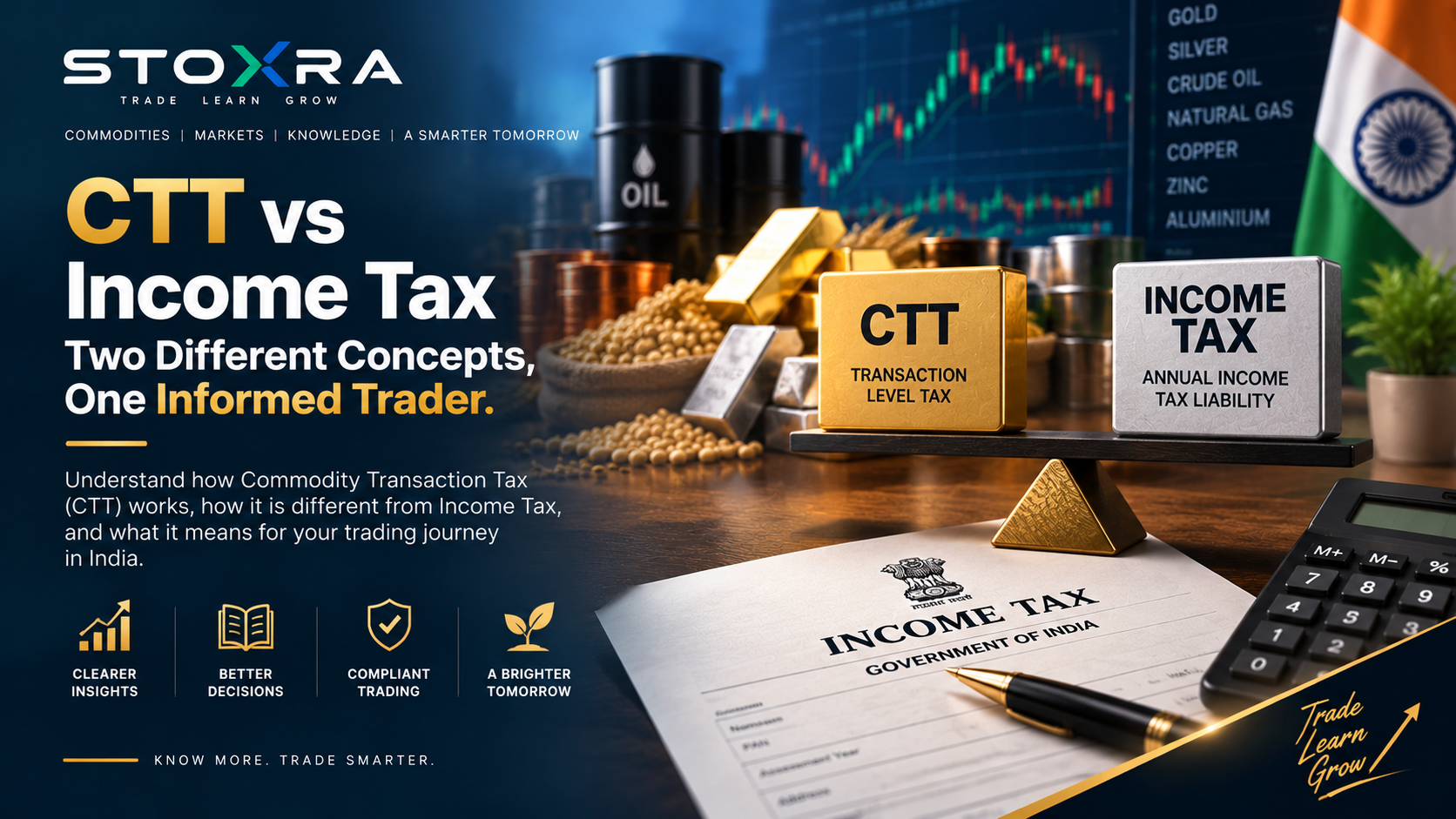
Does Paying CTT Mean There Is No Income Tax?
Important
No. CTT and income tax serve different purposes. Paying a transaction-level levy does not automatically remove an income-tax obligation.
Traders should calculate and report taxable income according to the applicable provisions for the relevant tax period.
Commodity Trading Losses and Tax Treatment
Losses are just as important as profits when understanding commodity trading taxation.
If an eligible commodity derivative transaction qualifies for non-speculative treatment, the resulting loss can be governed by the applicable business-loss provisions.
A loss that falls under a different classification may be subject to different set-off and carry-forward rules. Traders should therefore avoid assuming that every trading loss can be adjusted against every type of income.
Strong risk management remains important because tax treatment does not protect trading capital from market losses.
Commodity Trading Loss vs Speculative Loss
| Feature | Non-Speculative Business Transaction | Speculative Transaction |
|---|---|---|
| Basic Classification | May apply to eligible commodity derivatives when applicable conditions are satisfied. | Applies where the transaction falls within the applicable speculative definition. |
| Loss Treatment | Governed by applicable business-loss provisions. | Separate speculative-loss rules may apply. |
| Records | Contract notes, trade reports and business records should be maintained. | Transaction classification and supporting records remain important. |
| Carry-Forward | Subject to applicable provisions and filing requirements. | Subject to separate applicable provisions. |
Do Commodity Traders Need to File an Income-Tax Return?
If your income or circumstances create a return-filing requirement, you need to comply with the applicable income-tax return rules.
Active traders should not assume that trading income automatically means a return is unnecessary. Filing requirements depend on the applicable rules and the taxpayer's circumstances.
Traders should also consider whether their trading activity creates additional reporting or record-keeping requirements. When the tax position is complex, professional tax advice can help avoid incorrect classification or reporting.
What Records Should Commodity Traders Maintain?
Good documentation can make tax reporting easier and can also help traders understand their real trading performance.
- ✓ Broker contract notes
- ✓ Exchange trade reports
- ✓ Profit and loss statements
- ✓ Ledger statements
- ✓ Brokerage and transaction-charge records
- ✓ Relevant bank statements
- ✓ Eligible business-expense records
- ✓ Previous tax-return records
- ✓ Supporting documents for losses
- ✓ Other relevant transaction records
How Risk Management and Tax Planning Work Together
Tax planning should never replace proper trading risk management. Excessive position sizing, leverage and uncontrolled drawdowns can damage trading capital regardless of the tax treatment.
Learn about position sizing and techniques to reduce drawdown risk before increasing your exposure.
You can also explore our guides on options trading risk management and other educational resources for understanding market risk.
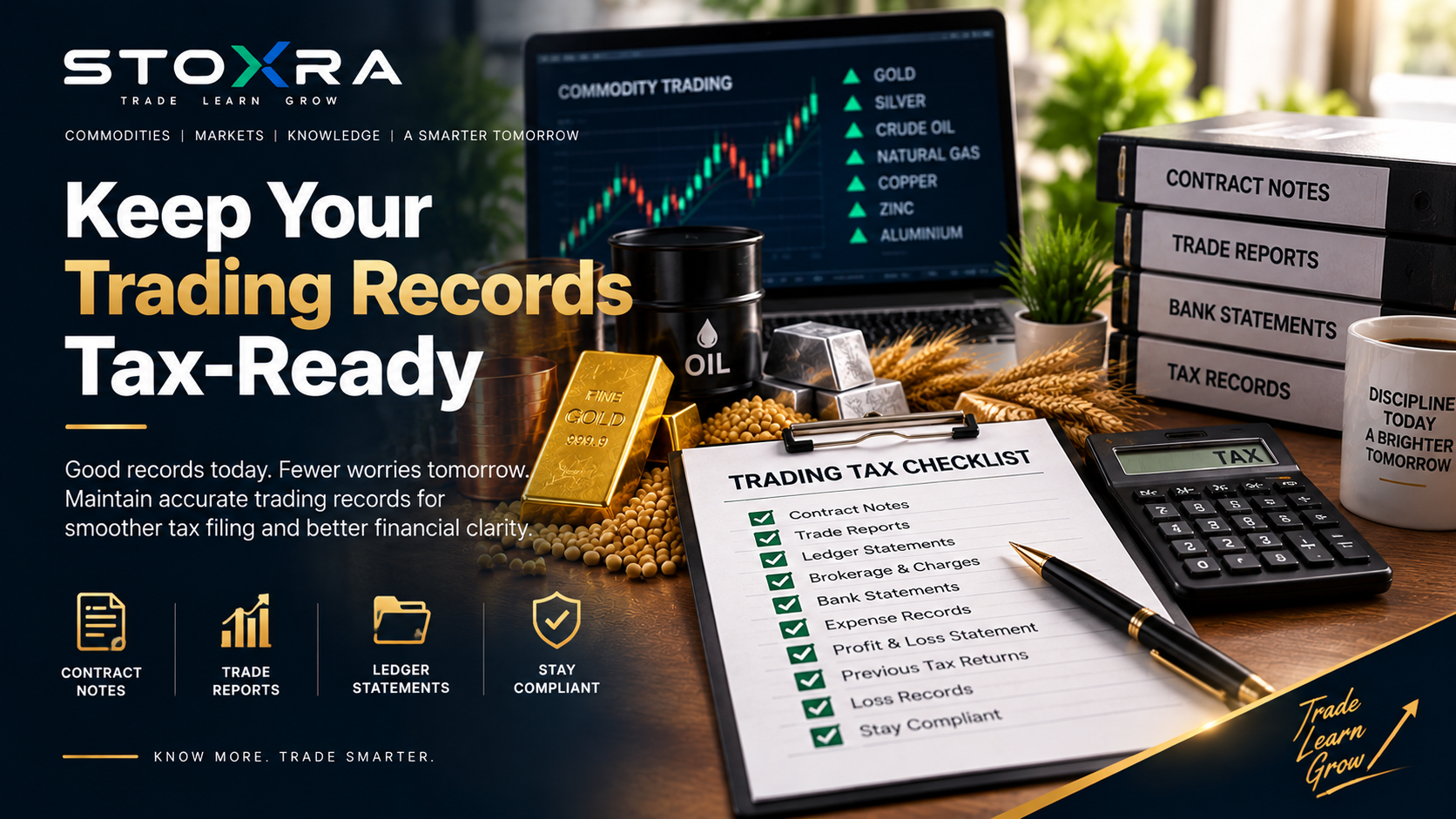
How to Keep Commodity Trading Tax Records Organised
Keeping trading records organised throughout the year is generally easier than reconstructing transactions at the end of the financial year.
Trading Records
- Contract notes
- Trade confirmations
- Broker statements
- Profit and loss reports
Financial Records
- Bank statements
- Expense records
- Tax documents
- Supporting invoices
What Should Beginners Know About Commodity Taxation?
Beginners should avoid assuming that commodity trading taxation is determined simply by whether a trade generated a profit or loss. Classification, transaction type, settlement method and applicable legal provisions can all matter.
It is also important to distinguish between trading costs, transaction taxes and income-tax obligations. These are separate components of the overall cost and reporting process.
Pro Tip
Before filing your return, reconcile your broker statement, trading ledger, bank records and tax-related documents. Differences between these records should be investigated instead of being ignored.
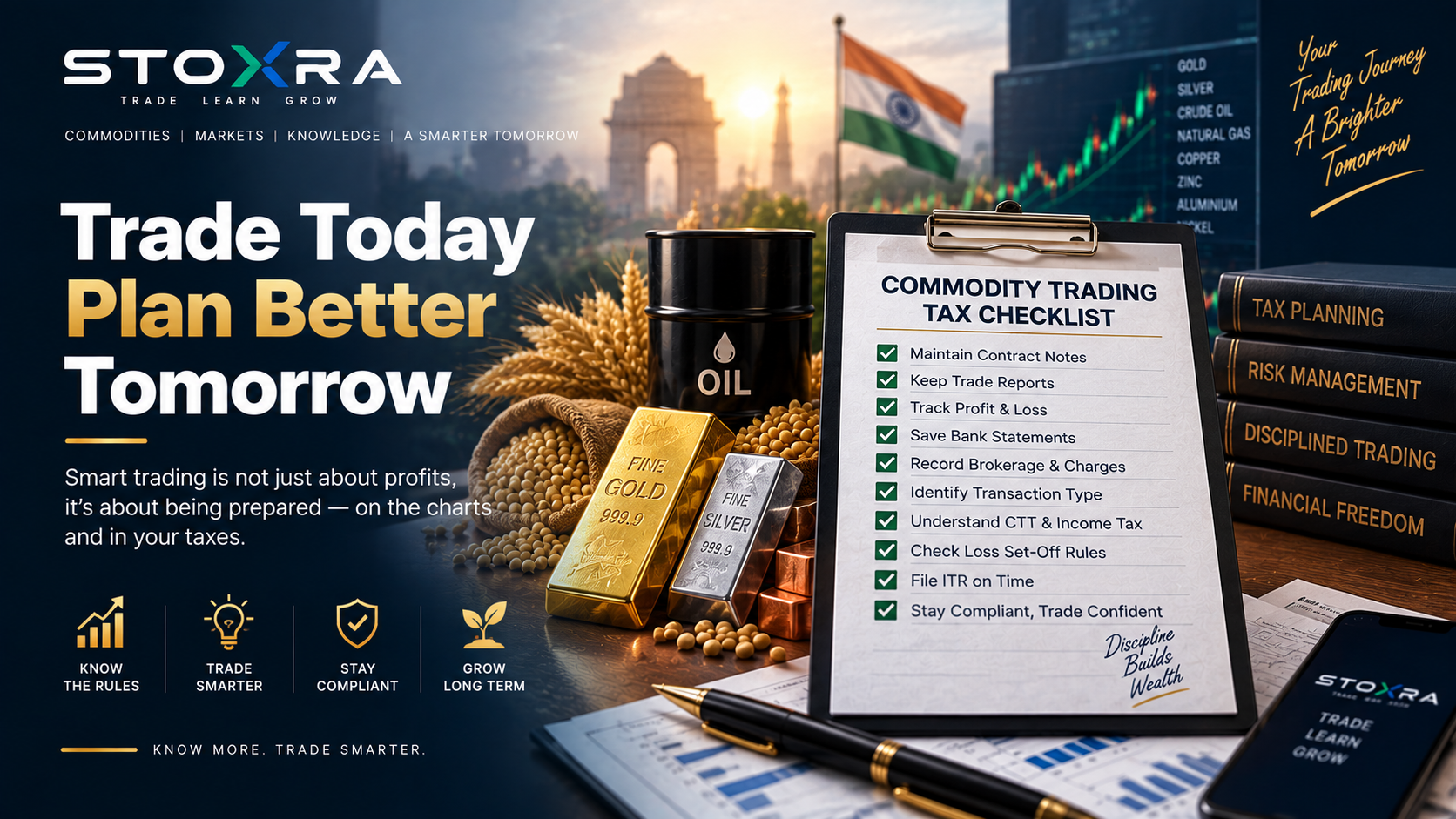
Commodity Trading Taxation Checklist
- ✓ Identify the type of commodity transaction
- ✓ Determine the applicable classification
- ✓ Review exchange and settlement details
- ✓ Calculate trading profit or loss
- ✓ Maintain contract notes
- ✓ Maintain broker statements
- ✓ Record eligible expenses properly
- ✓ Review applicable transaction taxes
- ✓ Check loss set-off rules
- ✓ Check carry-forward requirements
- ✓ Review income-tax return requirements
- ✓ Reconcile trading records before filing
Common Mistakes Commodity Traders Should Avoid
Ignoring Classification
Assuming every commodity transaction receives identical tax treatment can lead to incorrect reporting.
Ignoring Trading Expenses
Traders should properly document relevant expenses rather than estimating costs without supporting records.
Ignoring Loss Rules
Different types of losses can be subject to different set-off and carry-forward provisions.
Waiting Until Filing Time
Reconstructing an entire year's trading history at the last moment can increase the risk of missing important records.
Is Commodity Trading Taxable for Individuals?
Commodity trading income earned by an individual can be taxable when the applicable conditions create taxable income. The correct treatment depends on the nature of the transactions and the provisions applicable to the taxpayer and relevant tax period.
The amount of tax cannot be determined simply from the gross trading profit because the final calculation can depend on other income, eligible expenses, losses, deductions and applicable tax rules.
Why Professional Tax Advice Can Be Useful
Commodity trading can become complicated when a trader has multiple instruments, substantial turnover, losses, several brokers or other sources of income.
In such cases, a qualified tax professional can help review transaction classification, records, applicable deductions, loss treatment and return-filing requirements.
Important
Tax rules can change over time. Always verify the provisions applicable to the financial year and assessment year relevant to your transactions before filing a tax return.
A Simple Commodity Taxation Framework
↓
Determine the Applicable Classification
↓
Calculate Trading Profit or Loss
↓
Review Eligible Expenses
↓
Check Applicable Transaction Taxes
↓
Review Set-Off and Carry-Forward Rules
↓
Maintain Supporting Documents
↓
Check Income-Tax Return Requirements
↓
File Accurate Tax Information
Final Takeaway
Commodity trading income can be taxable in India, but the exact treatment depends on the nature and classification of the transaction. Eligible exchange-traded commodity derivatives may receive non-speculative treatment when the relevant statutory conditions are met.
Traders should therefore focus on proper classification, accurate calculation of profit or loss, appropriate record keeping and compliance with the rules applicable to the relevant tax period.
CTT, brokerage and other trading costs should also be distinguished from the taxpayer's overall income-tax liability. A well-organised record of contract notes, broker statements, expenses and losses can make the reporting process much easier.
Most importantly, tax treatment should never be used as a reason to take excessive trading risk. Sound risk management, accurate records and informed decision-making remain essential for every trader.
Explore Smarter Market Analysis With STOXRA
Understanding taxation is only one part of becoming a disciplined market participant. Structured research, risk management, market analysis and technology can help traders build a more systematic approach.
Explore the STOXRA AI Trading Platform to learn more about technology-supported market analysis and trading workflows.
Explore STOXRA AI Trading PlatformFrequently Asked Questions
Is commodity trading income taxable in India?
Yes. Commodity trading income can be taxable in India. The exact treatment depends on the type and classification of the transaction and the applicable tax provisions.
Are commodity futures taxable?
Eligible exchange-traded commodity futures may receive non-speculative treatment when the applicable statutory conditions are satisfied. The specific transaction should be reviewed before determining its tax treatment.
Are commodity options taxable?
Commodity options can generate taxable income or losses. Their treatment depends on the nature of the transaction, settlement details and applicable provisions for the relevant tax period.
Is CTT the same as income tax?
No. Commodity Transaction Tax and income tax are separate concepts. Paying CTT does not automatically eliminate an income-tax obligation.
Can commodity trading losses be carried forward?
The treatment of a commodity trading loss depends on its applicable classification and the rules governing set-off and carry-forward. Traders should check the provisions relevant to the transaction and tax period.
Do commodity traders need to maintain records?
Yes. Traders should maintain relevant contract notes, broker statements, trade reports, ledgers, expense records and other supporting documents needed to substantiate their transactions.
Can trading expenses be considered for tax purposes?
Certain expenses may be relevant where trading is carried on as a business, subject to applicable provisions, business purpose and proper documentation.
Should I consult a tax professional?
Professional advice can be useful when trading activity is substantial or involves multiple instruments, significant losses, multiple brokers or other complex tax circumstances.
Disclaimer
This article is provided for educational and informational purposes only and should not be treated as investment, financial, tax or legal advice. Tax treatment can depend on the nature of the transaction, applicable laws, financial year, assessment year and the taxpayer's individual circumstances. Tax rules may change over time. Readers should verify the applicable provisions and consider consulting a qualified tax professional before making tax or financial decisions.