What Is a Stock Split?
A stock split increases the number of shares investors own while proportionally reducing the price per share. Learn how stock splits work, understand split ratios with examples, and see why traders pay attention to them.
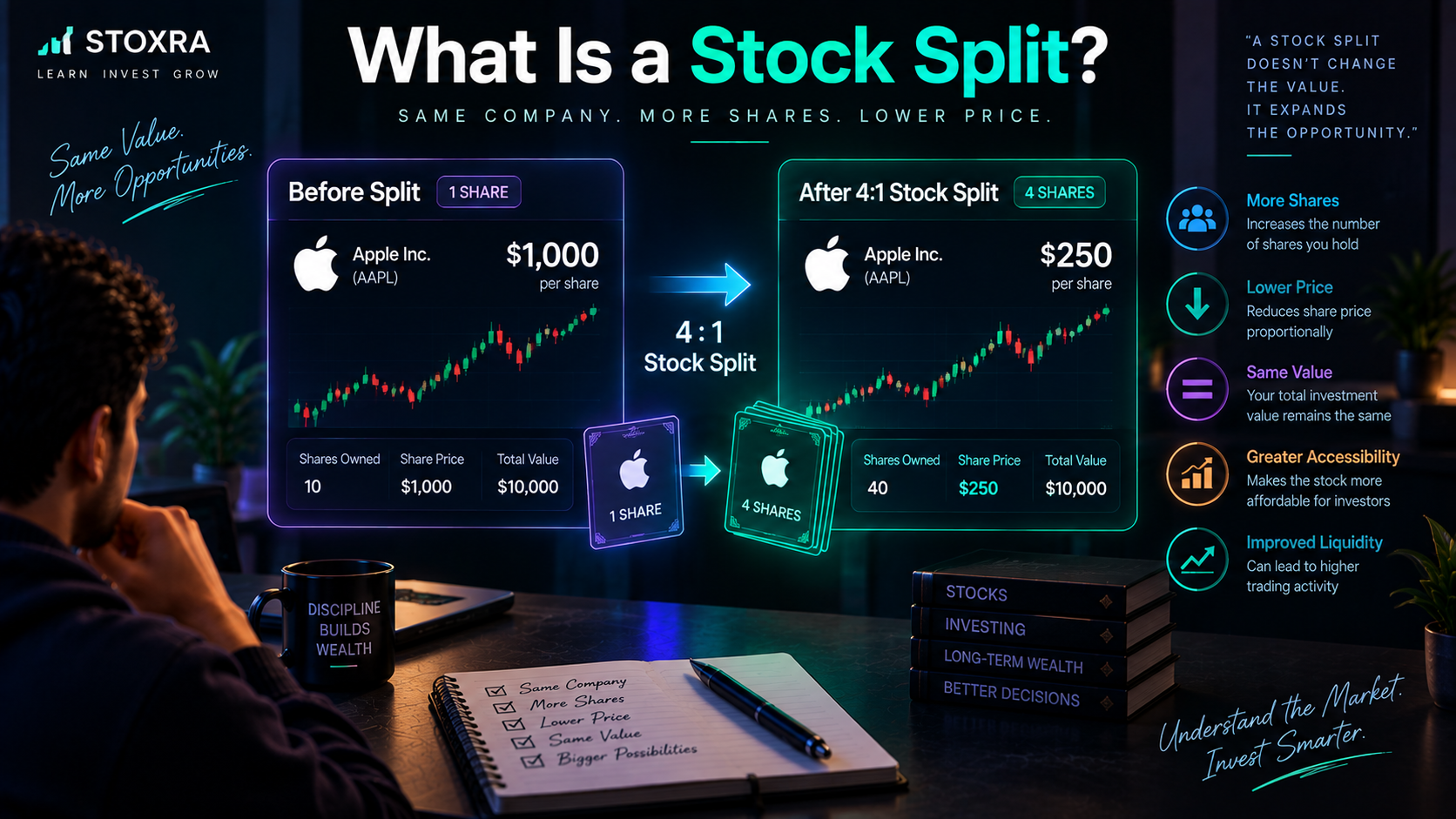
Illustrative stock-split example. The numbers shown are educational and are not live market data.
What Is a Stock Split?
A stock split happens when a company divides its existing shares into a larger number of shares while reducing the price per share proportionally.
Imagine you own one share priced at ₹1,000. If the company announces a 2:1 stock split, that one share can become two shares, with the theoretical price adjusted to approximately ₹500 per share immediately after the split adjustment.
Your number of shares has increased, but the arithmetic value of your holding has not increased simply because the split happened. The company itself has not suddenly become twice as valuable. Instead, the ownership has been divided into a greater number of smaller units.
This is why traders should avoid the common mistake of seeing a lower post-split share price and assuming the stock has suddenly become fundamentally cheaper.
For beginners, it helps to understand a stock split alongside concepts such as market capitalization, shares outstanding, share price and corporate actions.
How Does a Stock Split Work?
A stock split can be understood through four simple steps.
01 · Company Announces the Split
The company announces a specific split ratio, such as 2:1, 3:1 or 4:1, subject to the applicable corporate-action process.
02 · The Ratio Is Applied
Existing shares are divided according to the announced ratio. A 4:1 split means each existing share becomes four shares.
03 · The Price Is Adjusted
The share price is adjusted proportionally. This keeps the arithmetic value of the position approximately unchanged at the split adjustment.
04 · The Market Continues Trading
After the adjustment, the stock continues trading based on supply, demand, company performance, expectations and broader market factors.
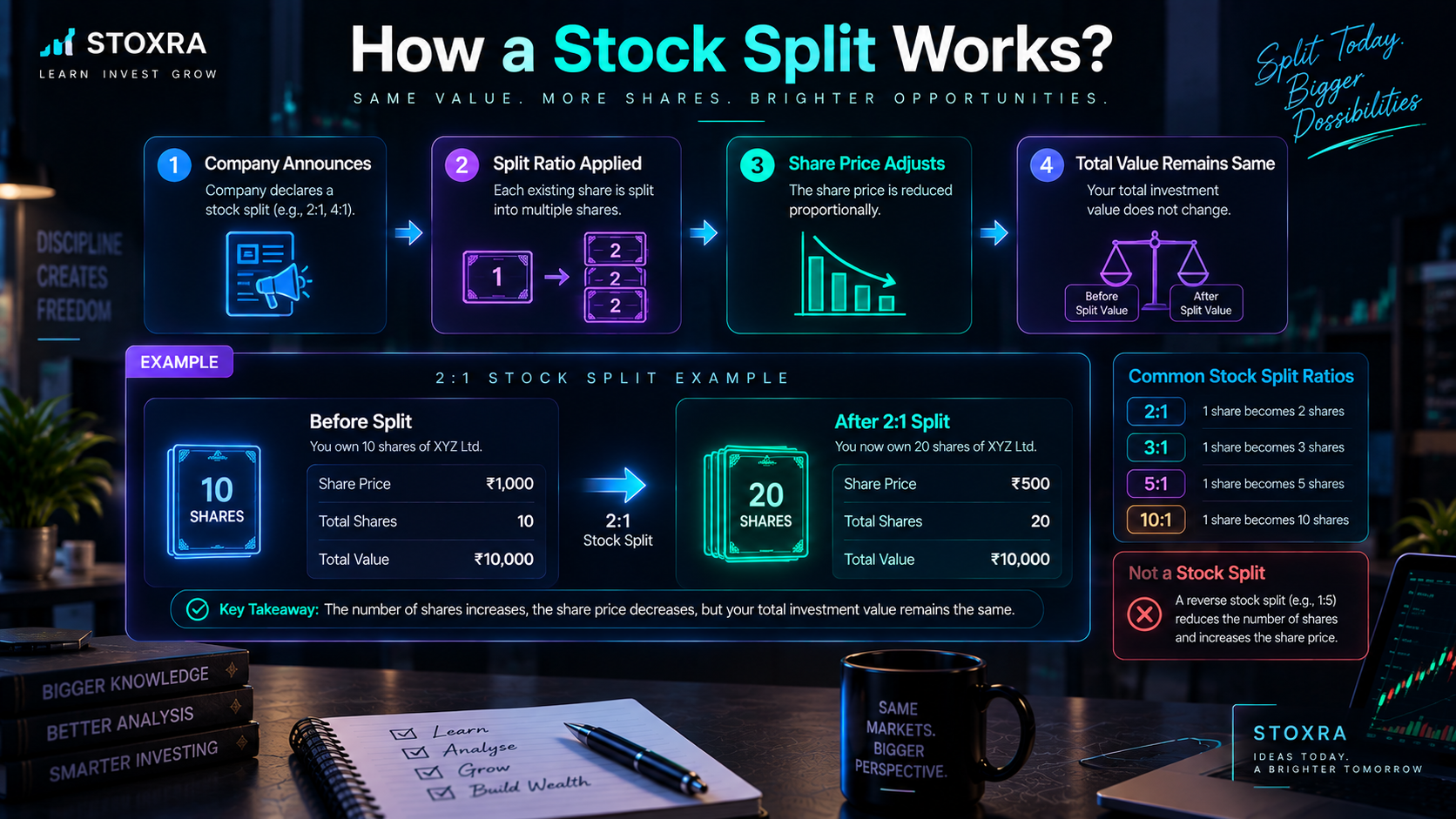
Example of a 2:1 stock split. Values are illustrative and are not live prices.
Stock Split Formula
Adjusted Price ≈ Existing Price ÷ Split Multiplier
For a simple forward split, the basic arithmetic is straightforward. Suppose you own 20 shares priced at ₹500 each and the company executes a 2:1 split.
| Metric | Before Split | After 2:1 Split |
|---|---|---|
| Shares owned | 20 | 40 |
| Illustrative price | ₹500 | ₹250 |
| Illustrative position value | ₹10,000 | ₹10,000 |
The key point is that the number of shares and the price per share move in opposite directions proportionally.
What Does a 2:1 Stock Split Mean?
A 2:1 stock split means that each existing share is divided into two shares.
If you owned 100 shares before the split, you would generally hold 200 shares after the split. If the pre-split price was ₹800, the theoretical adjusted price would be approximately ₹400.
The important word here is approximately. Once trading resumes, the actual market price can immediately move because buyers and sellers determine the market price.
What Does a 4:1 Stock Split Mean?
A 4:1 stock split multiplies the number of shares by four and divides the price per share by four on an adjustment basis.
For example, suppose an investor owns 10 shares at an illustrative ₹1,000 per share. The position is worth ₹10,000 before the split. Following a 4:1 split, the investor would have 40 shares at an illustrative adjusted price of ₹250 per share.
Why Do Companies Split Their Stocks?
Companies may choose to split their shares for several practical and market-related reasons.
Lower Per-Share Price
A split reduces the quoted price of an individual share. Some companies may consider a lower nominal price more accessible to a broader range of investors.
Trading Accessibility
A lower share price can make it easier for investors with smaller amounts of capital to purchase shares, depending on the broker and market structure.
Market Participation
Companies may view a more accessible share price as helpful for attracting a broader shareholder base.
Market Signalling
Investors may interpret a stock split as a sign that management is comfortable with the company's long-term share-price trajectory. However, this is sentiment—not proof of future performance.
What Actually Changes After a Stock Split?
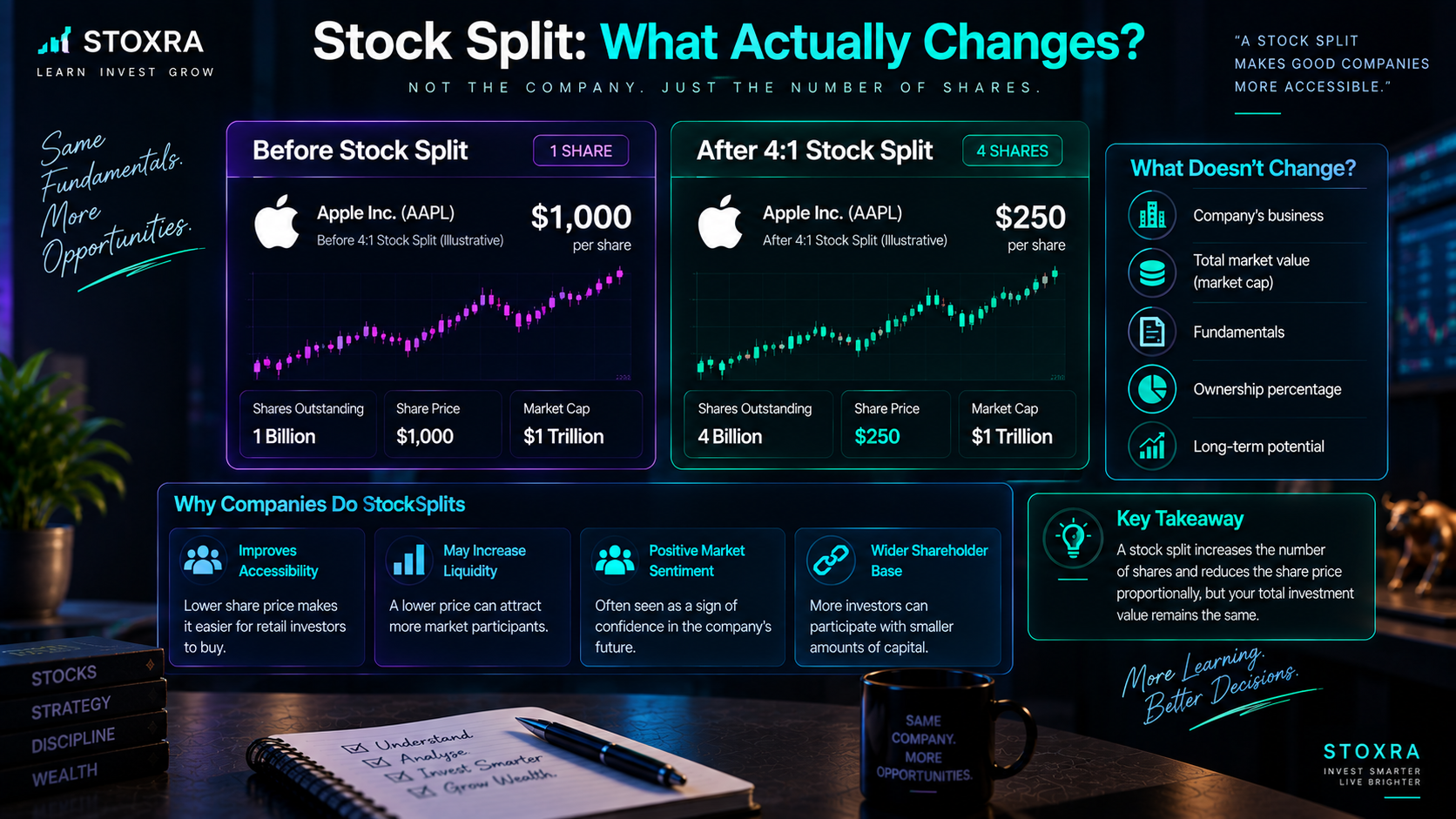
Illustrative before-and-after stock-split comparison. The company and underlying business do not automatically become more valuable because of the split.
One of the easiest ways to understand stock splits is to separate share count from economic ownership.
| Factor | What Happens? |
|---|---|
| Number of shares you own | Increases according to the split ratio |
| Price per share | Adjusted proportionally |
| Percentage ownership | Generally unchanged by the split itself |
| Underlying business | Not changed merely because of the split |
| Future market price | Can move based on supply, demand and fundamentals |
Stock Split vs Market Capitalization
A stock split can make the share count rise dramatically while the company's market capitalization remains proportionally unchanged at the split adjustment.
Market capitalization is commonly calculated as share price multiplied by shares outstanding. If the number of shares increases four times and the share price is divided by four, the arithmetic market capitalization remains broadly equivalent, ignoring subsequent market movement.
This is why traders should not conclude that a company has become four times larger simply because it completed a 4:1 split.
Learn more about this concept in Stoxra's market capitalization guide.
Stock Split vs Reverse Stock Split
A normal stock split increases the number of shares and decreases the price per share proportionally.
A reverse stock split works in the opposite direction. Multiple existing shares are consolidated into fewer shares while the price per share is adjusted upward proportionally.
| Action | Shares | Price Per Share |
|---|---|---|
| Forward stock split | Increases | Decreases proportionally |
| Reverse stock split | Decreases | Increases proportionally |
Stock Split vs Bonus Issue
Beginners often confuse stock splits with bonus issues because both can result in investors holding more shares.
They are not the same corporate action. A stock split divides existing shares into smaller units. A bonus issue involves the company issuing additional shares to eligible shareholders according to a specified ratio and applicable corporate-action rules.
The accounting treatment, mechanics and implications can differ, so traders should check the company's official corporate-action announcement instead of assuming the two actions are identical.
Does a Stock Split Make a Stock Cheaper?
This question needs careful wording.
A stock split makes the quoted price per share lower. It does not automatically make the underlying business cheaper based on its fundamentals.
Consider two companies:
- Company A trades at ₹100 per share.
- Company B trades at ₹1,000 per share.
You cannot conclude that Company A is cheaper or more attractive simply from those two prices. The number of shares, earnings, growth prospects, debt, profitability and valuation all matter.
This is the same reason traders should learn stock-market terminology before making decisions based on a single number.
Interactive Stock Split Calculator
Stock Split Calculator
Enter your current shares, current price and split ratio to see the illustrative post-split share count and adjusted price.
Why Does a Stock Split Matter to a Trader?
A stock split matters because corporate actions can influence how traders interpret price charts, historical prices, liquidity and market sentiment.
One important issue is chart adjustment. Historical prices are often adjusted by market-data providers so that a stock split does not create a misleading artificial price gap in a long-term chart.
Traders should also pay attention to the corporate-action dates and exchange announcements rather than relying only on social-media posts.
For a beginner learning to trade, a stock split should be treated as information to understand—not as an automatic buy signal.
Common Stock Split Mistakes Beginners Make
1. "The Price Fell, So It's Cheap"
A lower post-split price does not automatically mean the business has become undervalued.
2. "I Have More Shares, So I'm Richer"
Share quantity alone does not determine portfolio value. Price per share and total position value matter too.
3. "Every Split Is Bullish"
A split can attract attention, but it cannot guarantee future price appreciation.
4. Ignoring the Corporate Action
Traders should understand the record date, ex-date and applicable exchange/depository process when a real stock split occurs.
What Should Traders Check After a Stock Split?
If you are analyzing a stock after a split, look beyond the split itself. A disciplined trader can review:
- Revenue and earnings growth
- Profitability and margins
- Debt and cash flows
- Valuation multiples
- Trading volume and liquidity
- Price trend and market structure
- Sector performance
- Corporate announcements
- Risk management and position sizing
These concepts connect directly with building a trading plan, trading discipline and stock selection.
Frequently Asked Questions
A stock split divides existing shares into multiple shares and reduces the price per share proportionally. The split itself does not automatically increase the total value of your investment.
What does a 2:1 stock split mean?It generally means one existing share becomes two shares, with the share price adjusted proportionally.
What does a 4:1 stock split mean?One existing share becomes four shares and the price per share is adjusted to approximately one-fourth of its previous level.
Does a stock split increase market capitalization?Not by itself. Because the share count and share price adjust proportionally, the split itself does not create equivalent new market value. Subsequent market movements can change market cap.
Is a stock split a good reason to buy a stock?Not on its own. A split is a corporate action, not proof that the company's future performance will improve. Traders should analyze the business, valuation, trend, risk and broader market context.
Is a stock split the same as a bonus issue?No. They are different corporate actions. A stock split divides existing shares, while a bonus issue involves issuing additional shares according to the applicable terms.
Continue Learning With Stoxra
A stock split makes much more sense when you understand the wider stock market ecosystem. Continue learning through these related Stoxra resources and authoritative market institutions.
Understand the Market Before You Trade It
A stock split is only one piece of the market puzzle. Build your foundation with stock-market education, research and risk-aware practice before putting capital at risk.
Explore StoxraEducational market content for Stoxra, designed to make financial concepts easier for beginners to understand.
Disclaimer: This article is for educational purposes only and does not constitute investment, trading, tax or financial advice. Stock prices can rise or fall, and corporate actions do not guarantee future returns. Always verify corporate-action details through official exchange, company or regulatory sources before making investment decisions.