What Is Grey Market Premium in IPOs?
Grey Market Premium in IPOs: Meaning, Calculation, and Risks
When a company launches an Initial Public Offering, investors compare its business model, financial performance, valuation and expected listing. Alongside these formal details, one unofficial figure often attracts attention: the Grey Market Premium. For further reading, see Stock Market Basics For Beginners India Guide.
A rising GMP may suggest optimism, while a falling or negative GMP may indicate caution. Investors can also compare different approaches through AI vs Manual Trading before choosing a research workflow. However, the grey market operates outside the regular exchange system. Its quotes can change quickly and should never replace proper research.
What Is Grey Market Premium?
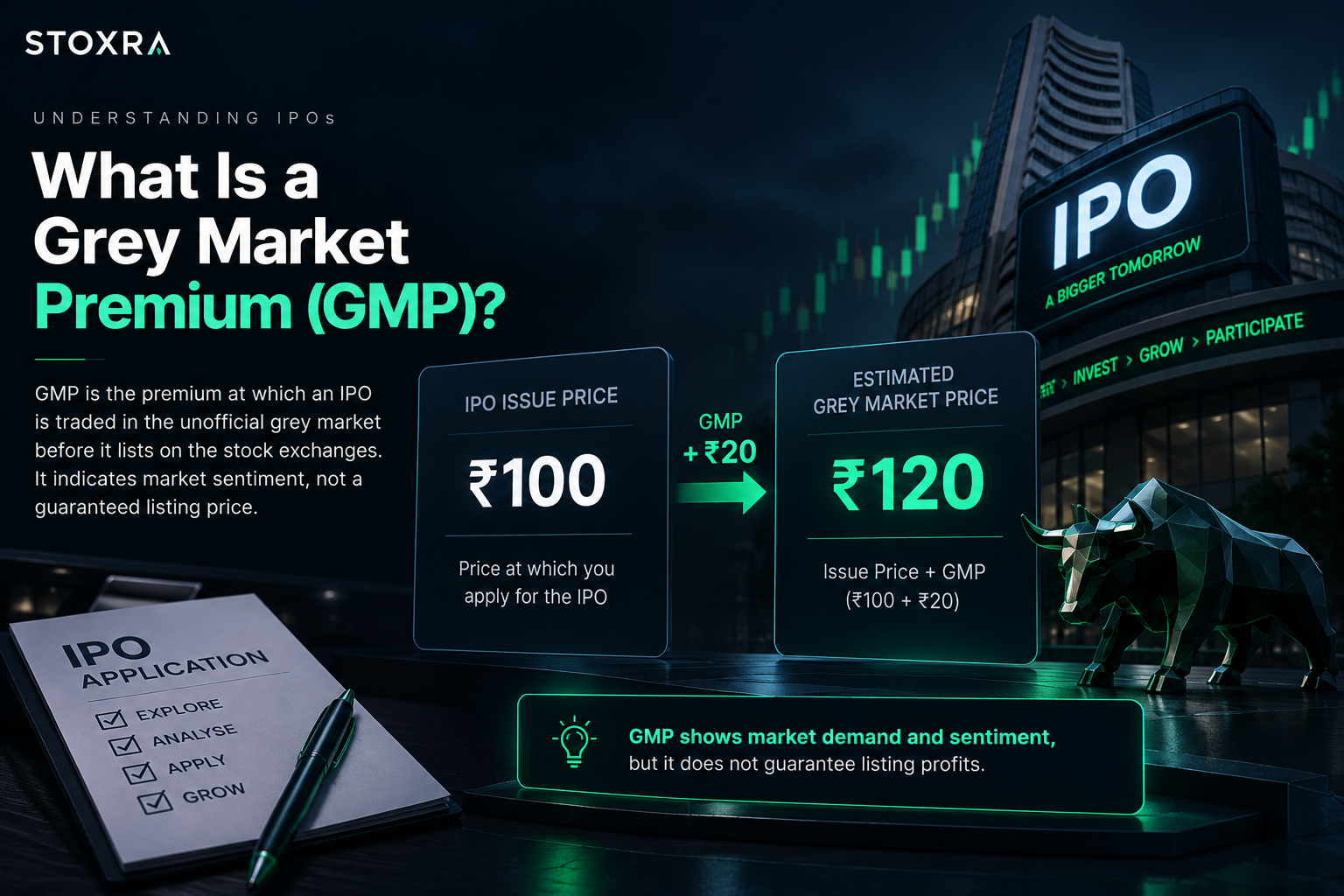
Grey Market Premium is the additional amount at which an IPO share is reportedly traded in the unofficial market before its official stock-exchange listing. Unlike an exchange-traded price, a grey-market quote does not come from a transparent public order book. Beginners can build the basics through Stoxra Learn before interpreting unofficial market signals.
For example, if an IPO has an issue price of ₹100 and a reported GMP of ₹20, the implied grey-market price is ₹120. That figure reflects the reported premium at that moment; it does not guarantee that the stock will list at ₹120.
GMP is an unofficial sentiment indicator—not a confirmed listing price, guaranteed profit or substitute for analysing the company. For further reading, see What Is Technical Analysis In Stock Tading A Complete Beginn.
How Is GMP Calculated?
The basic calculation is simple: add the reported GMP to the IPO issue price. Investors can also calculate the premium percentage by dividing GMP by the issue price and multiplying the result by 100. For further reading, see Algorithmic Trading Strategies Beginners India.
Grey Market Price Calculator
Enter an issue price and reported GMP to estimate the implied grey-market price.
This calculation is illustrative. It is useful to understand the difference between an estimate and an executed market price; Paper Trading vs Real Trading explains the importance of separating practice from real-money decisions. It does not account for listing-day demand, market volatility, taxes, charges or changes in sentiment between the application date and listing date.
How Does the Grey Market Work?
The grey market is an informal market where IPO-related interests may be discussed or traded through private arrangements before shares begin trading on an exchange. Because it is unofficial, quotes may vary between sources and may not be independently verifiable. This is one reason investors should understand what AI trading is and use tools as research support rather than as a promise of certainty.
GMP can move as subscription activity, broader market conditions and investor expectations change. A number reported several days before listing may be very different by the time the stock actually begins trading.
For foundational context, read Stoxra’s stock-market basics for beginners and review relevant IPO updates such as Central Mine Planning IPO and GMP news.
What Factors Influence GMP?
GMP is shaped by several overlapping factors. A high premium may reflect enthusiasm, but it does not automatically prove that an IPO is fairly valued or financially strong. Risk awareness also matters when exploring funded trading in India, where rules and risk limits differ from IPO investing.
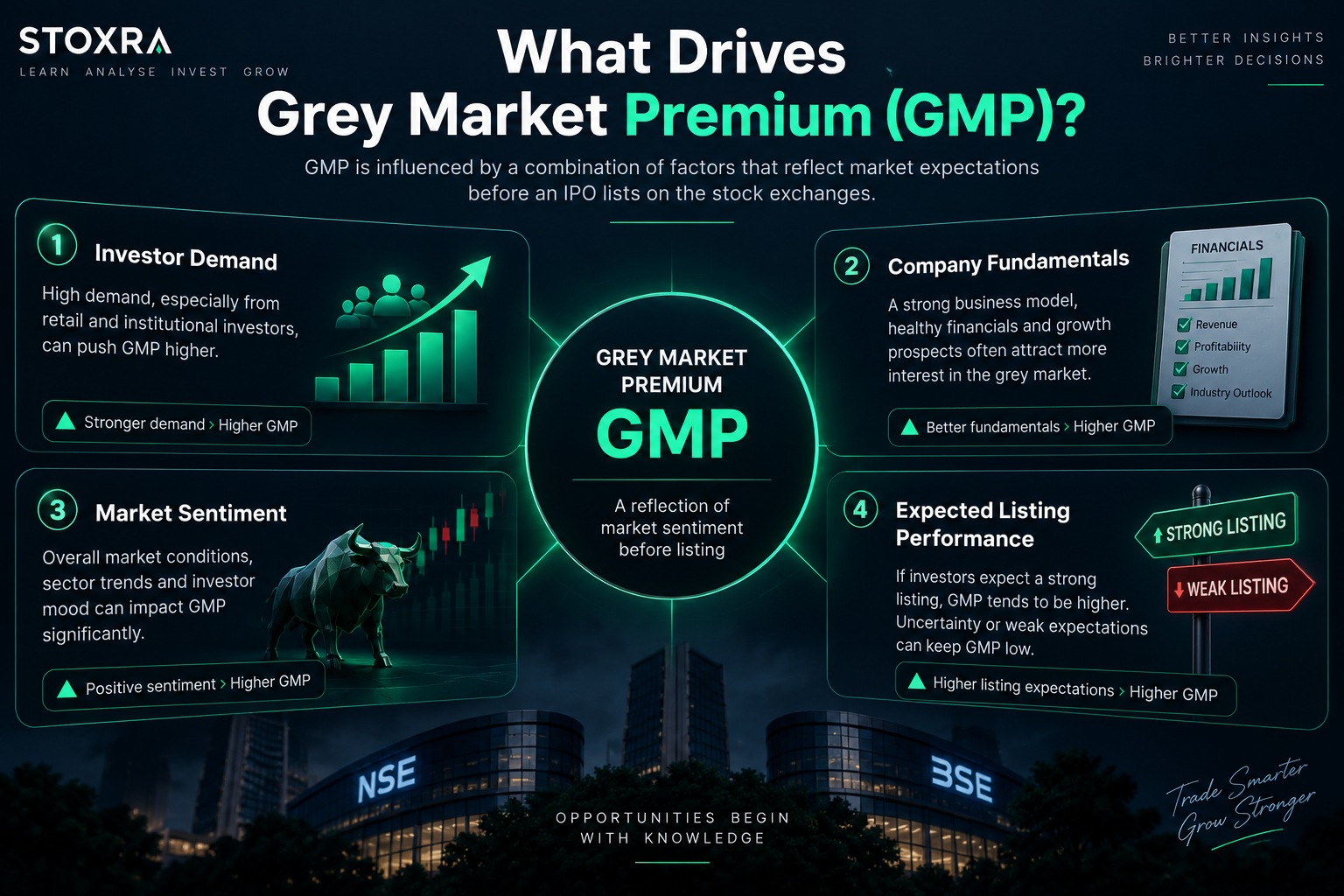
Investor demand
Interest from retail, high-net-worth and institutional investors can influence expectations. Strong subscription does not guarantee For further reading, see Algorithmic Trading Vs Manual Trading Which Strategy Performs Better.
Company fundamentals
Revenue, profitability, debt, competitive position and future prospects affect how investors assess the offer.
Market and sector sentiment
Broader market trends, sector performance and volatility can push GMP higher or lower.
Expected listing performance
If participants expect strong buying after listing, the reported premium may rise. Uncertainty can narrow the premium or turn it negative.
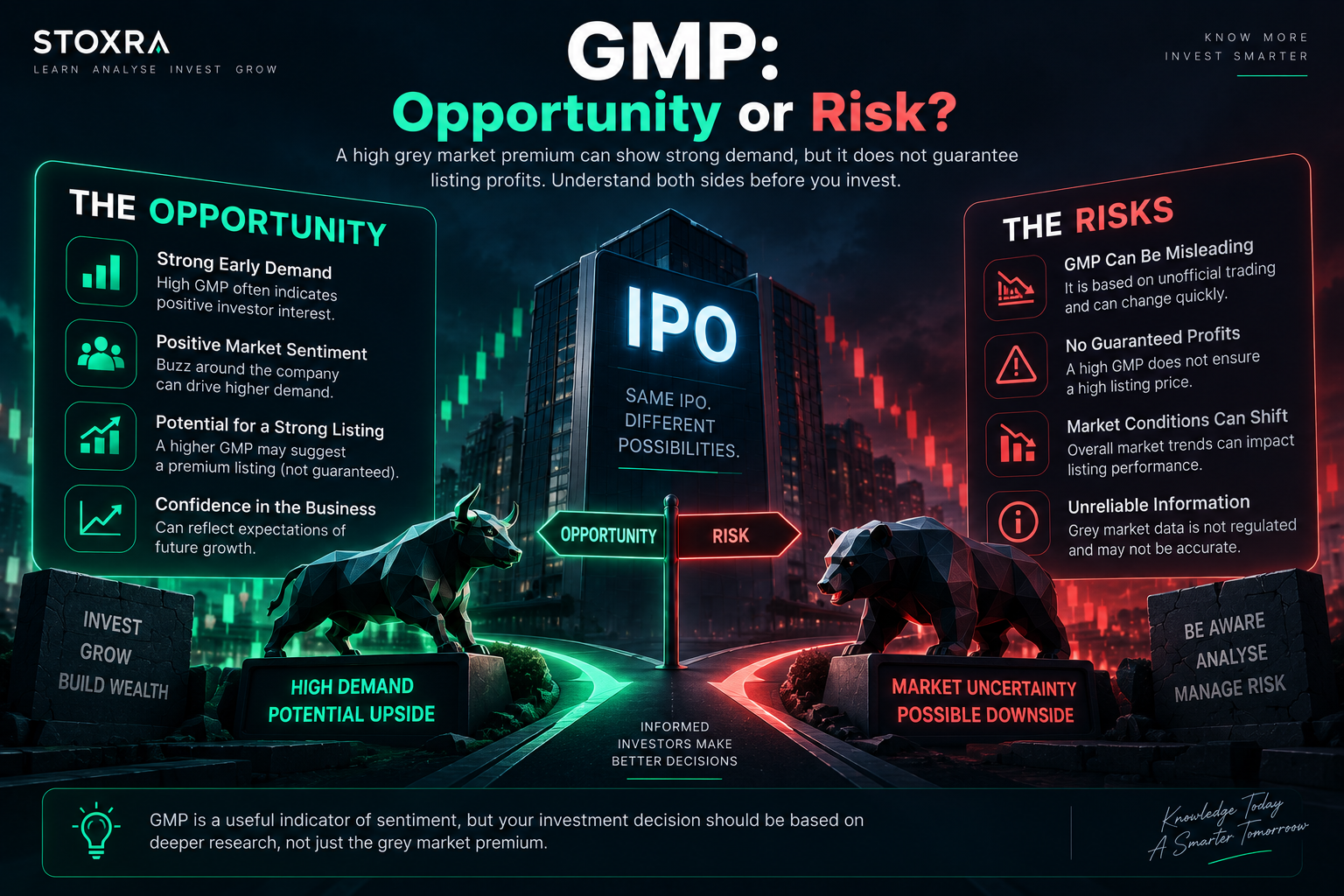
Does a High GMP Guarantee Profit?
No. The actual listing price is determined by buying and selling on the recognised exchange and may differ substantially from unofficial estimates. Investors should also understand the legal framework around financial activity, including whether AI trading is legal in India.
| GMP indication | Possible interpretation | What it does not prove |
|---|---|---|
| High positive GMP | Unofficial optimism or demand | Guaranteed listing gains |
| Low or zero GMP | Limited enthusiasm or uncertainty | That the IPO is automatically unattractive |
| Negative GMP | Weak sentiment or downside expectations | The exact listing price or final outcome |
Investors should also avoid confirmation bias. Focusing only on a positive GMP can cause them to overlook valuation, debt, profitability, governance and industry risks.
How Beginners Should Evaluate an IPO
Use GMP as one small input in a broader review. A structured learning process is more useful than chasing one number, and trading competitions can help users practise decision-making without treating practice results as guaranteed returns. Before applying, work through this checklist:
- Understand the company’s products, customers and business model.
- Review revenue, profit, cash flow and debt trends.
- Compare the issue valuation with similar listed companies.
- Check how the company plans to use IPO proceeds.
- Review promoter, governance, legal, industry and competitive risks.
- Consider subscription data and GMP without treating either as a guarantee.
- Decide how much capital you can afford to expose to market risk.
For additional research support, explore Stoxra’s AI tools for stock-market analysis and its guide to technical analysis in stock trading. These resources should complement—not replace—fundamental research.
Useful Stoxra Resources
- AI Trading Platform
Explore AI-assisted research and market-analysis workflows.
- Stock-Market Terminology
Clarify common investing and listing-related terms.
- Common Beginner Mistakes
Learn how emotional decisions can affect investment choices.
- AI and Stock-Market Research
Understand how AI can support analysis without removing risk.
Make Better-Informed Market Decisions
Build your market knowledge, compare company fundamentals and use research tools before making an investment decision.
Explore Stoxra’s AI Trading PlatformGMP, Kostak Rates and Subject to Sauda: What Is the Difference?
IPO discussions often include several unofficial terms that beginners may confuse with Grey Market Premium. GMP refers to the reported premium on an IPO share over its issue price. Kostak rates, on the other hand, generally refer to an amount associated with selling or transferring an IPO application before the allotment outcome. “Subject to Sauda” is another term used in informal IPO-market discussions and usually refers to an arrangement whose outcome depends on the applicant receiving an allotment.
These terms are not interchangeable. A GMP quote attempts to indicate sentiment toward the expected listing, while application-related arrangements involve different risks and conditions. Because these transactions take place outside the regular exchange mechanism, the terms, reliability and enforceability of an arrangement may vary. Beginners should not participate merely because a social-media post presents a number as certain or risk-free.
The safest approach is to understand the formal IPO process first: application, bid confirmation, allotment, refund or unblocking of funds, and listing. Unofficial terminology should be treated as background information rather than as a replacement for official exchange and company disclosures.
Where Can Investors Find IPO GMP Information?
GMP figures are commonly circulated through informal market channels, broker discussions, websites, messaging groups and social-media posts. However, the source of a quote matters. A number may be delayed, based on limited transactions, copied from another source or presented without a timestamp. Two sources can therefore show different GMP figures for the same IPO.
When reviewing a reported premium, check whether the information includes the date and time, the issue price, the lot size and a clear explanation of what the figure represents. Treat unexplained screenshots and claims such as “100% listing gain” with particular caution. A reliable research process compares unofficial sentiment with the IPO’s official offer documents and the broader market environment.
Stoxra’s stock-market basics guide can help beginners understand the difference between market information, analysis and an actual tradable price. You can also use the AI tools for stock-market analysis resource to understand how research tools may organize information without eliminating uncertainty.
How Should You Read GMP Alongside IPO Fundamentals?
GMP becomes more useful when it is placed beside the company’s fundamentals. Start by reading the offer document and understanding what the company does, how it earns revenue, who its customers are and how it plans to use the funds raised. Then examine revenue growth, profitability, operating cash flow, debt levels and return ratios where relevant.
Valuation is equally important. An IPO can have a positive GMP and still be expensive compared with similar listed companies. Conversely, a low GMP does not automatically mean that the business is weak. The market may be cautious because of short-term sentiment, while the company’s long-term prospects may require deeper analysis.
Also review the structure of the issue. An offer for sale, for example, may provide proceeds to existing shareholders rather than directly to the company. Fresh issue proceeds may be intended for expansion, debt repayment, working capital or general corporate purposes. These details can change how investors interpret the offer.
Ask three separate questions: What is the unofficial market sentiment? Is the IPO valuation reasonable? Can the business justify the valuation over time? GMP answers only the first question imperfectly.
Common Mistakes Beginners Make When Tracking GMP
One common mistake is checking GMP repeatedly and treating every movement as a meaningful signal. Small changes may reflect temporary sentiment rather than a durable change in demand. Another mistake is comparing GMP values across IPOs without considering their different issue prices, lot sizes, sectors and business models.
Beginners may also calculate an expected listing price but forget that the estimate excludes brokerage charges, taxes, other costs and the possibility of a lower listing. Some investors assume that a positive GMP means an IPO is safe, while others assume that a negative GMP guarantees a loss. Both conclusions are too strong.
- Do not confuse a quote with a confirmed market price. GMP is unofficial and may not be independently verifiable.
- Do not ignore valuation. Strong demand can already be reflected in a high issue price.
- Do not rely on one source. Check timing, context and consistency.
- Do not use borrowed money casually. Listing outcomes can differ from expectations.
- Do not overlook your own risk tolerance. An IPO may be unsuitable even when sentiment is positive.
For broader decision-making habits, review Stoxra’s guide to common stock-market mistakes. Learning to question assumptions is more valuable than memorising a single premium figure.
What Happens After the IPO Lists?
Once the shares begin trading on a recognised exchange, the official market price becomes available through the exchange’s price-discovery process. Buyers and sellers place orders, and the opening price reflects the interaction of actual demand and supply. The listing price may be above, near or below the issue price, regardless of the earlier GMP.
After listing, the stock can remain volatile as investors react to market conditions, company announcements, profit booking and changes in expectations. A strong opening does not necessarily mean the business is worth buying at that price. Similarly, a weak opening does not by itself establish that the company has poor long-term prospects.
Investors who receive allotment should decide in advance how they will respond to different outcomes. A written plan can reduce emotional decisions, especially when the stock moves sharply in the first few trading sessions. Those who do not receive allotment should avoid chasing the stock solely because it listed at a premium.
For a broader understanding of how trading decisions differ from long-term investing, explore AI vs Manual Trading and Paper Trading vs Real Trading. These resources reinforce the importance of process, testing and risk management.
Frequently Asked Questions
This article is for educational and informational purposes only and is not investment advice, a recommendation or a guarantee of IPO performance. GMP figures are unofficial, may be inaccurate and can change rapidly. Investors should independently review offer documents, financials, valuation, risks and applicable regulations before making any investment decision. Stoxra is not responsible for losses resulting from decisions based on this content.