Paper Trading vs Backtesting
Paper trading and backtesting serve different purposes. Learn which to use first, how they differ, and how to combine both into a stronger strategy-testing process.
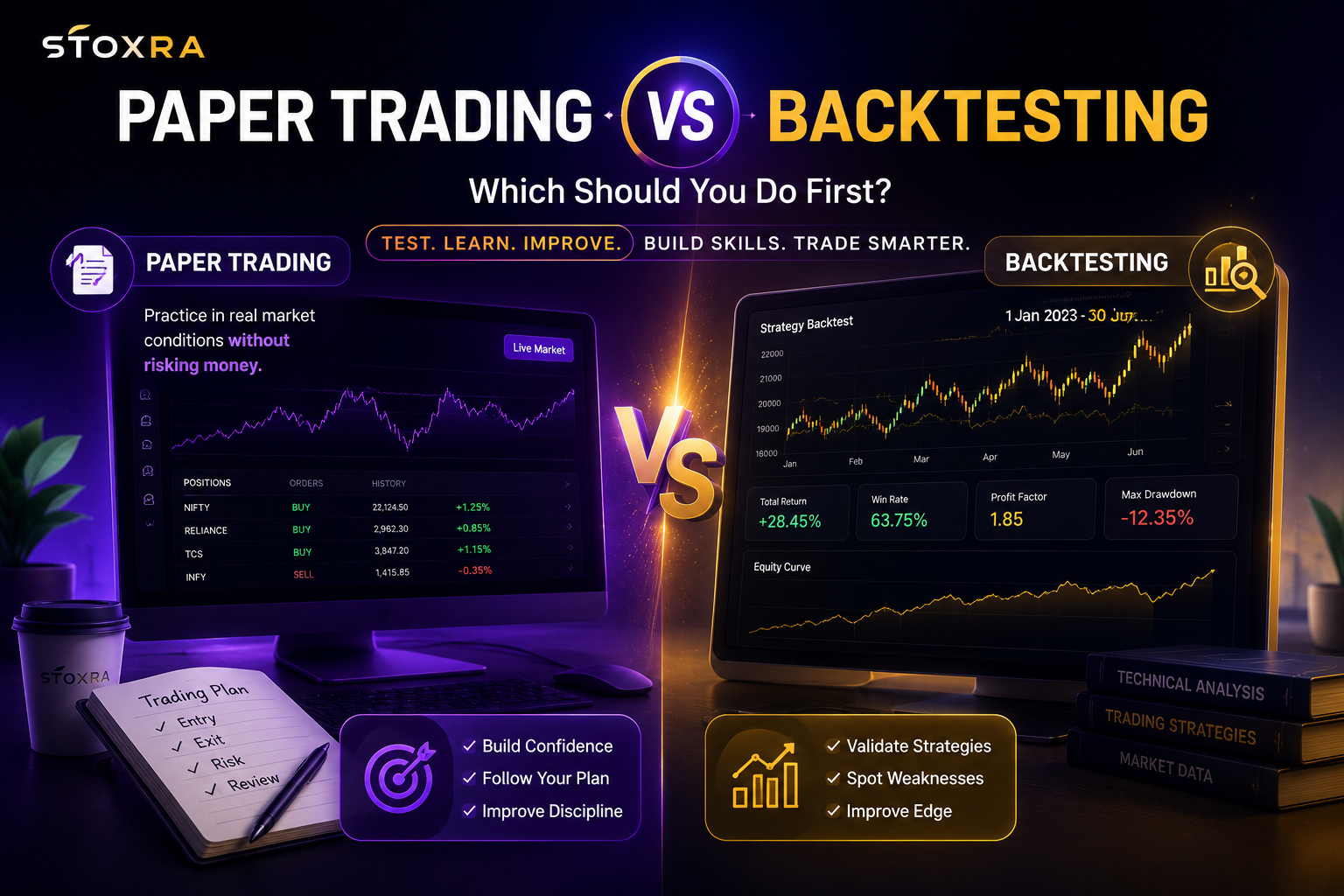
Backtest first. Paper trade second.
Useful next reads: paper trading platforms, paper trading vs demo trading, and paper trading vs real trading.
Backtesting is useful for quickly checking whether a clearly defined strategy had reasonable historical behaviour. Paper trading then lets you practise the same rules against current market conditions without immediately risking real capital.
Paper Trading vs Backtesting at a Glance
Paper Trading
Simulate trades using current market conditions and virtual capital.
- Tests execution habits
- Builds trading discipline
- Exposes you to current market behaviour
Backtesting
Apply predefined rules to historical market data and analyse hypothetical results.
- Tests historical behaviour
- Quickly evaluates many observations
- Helps refine a strategy before live-style testing
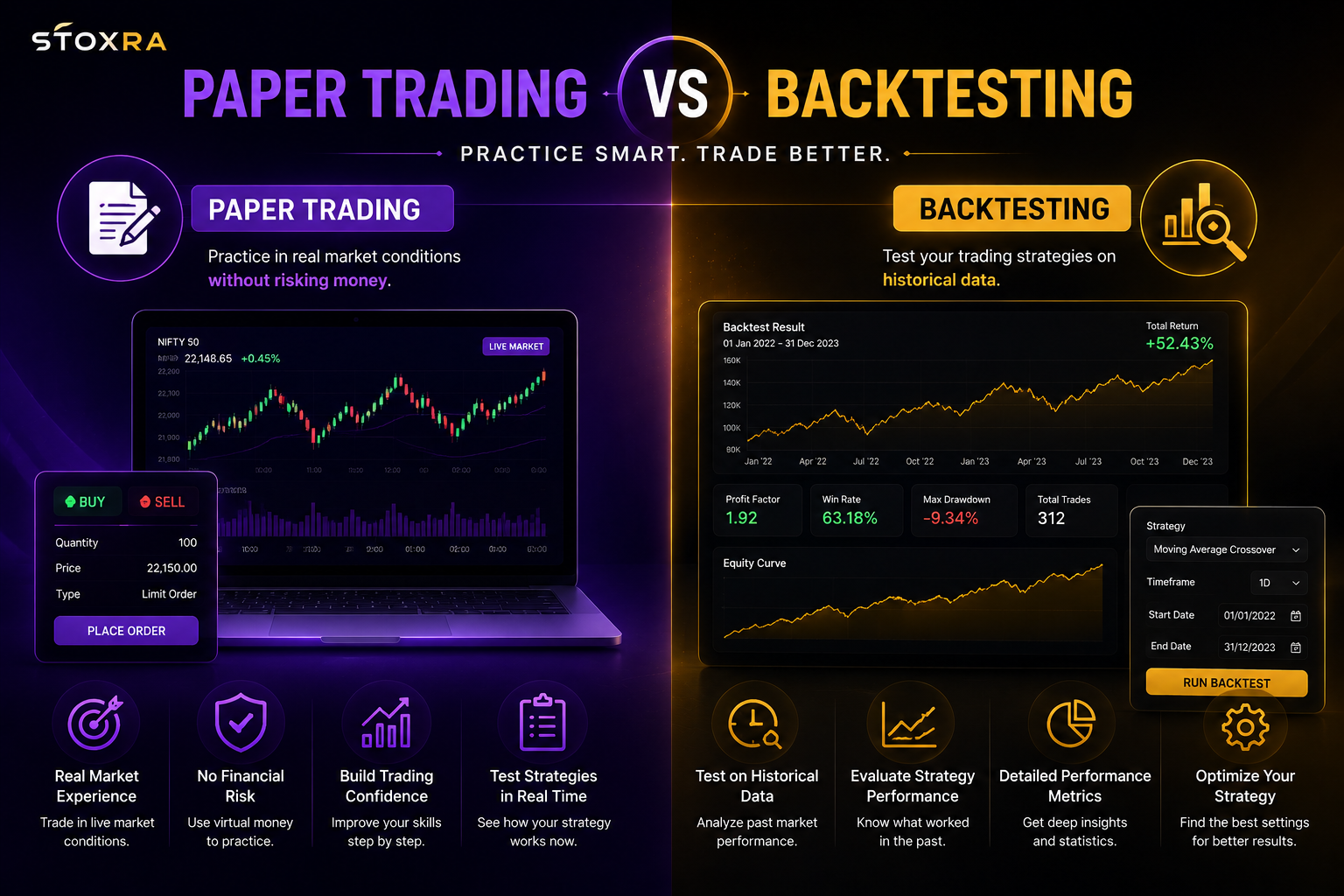
What Is Paper Trading?
Paper trading is a simulated trading environment where you use virtual money instead of real capital. It allows you to practise entries, exits, position management and strategy execution without immediately exposing your account to financial loss.
A useful paper-trading process should still be treated seriously. Unrealistic position sizes or random entries can make the exercise almost worthless.
Practice
Execute the rules instead of simply reading about them.
Discipline
Learn whether you can follow your own entry and exit rules.
Feedback
Observe how your process behaves during actual market sessions.
If you want a deeper introduction, read Stoxra's paper trading guide . You can also compare paper trading vs demo trading before choosing a practice environment.
What Paper Trading Cannot Prove
Paper trading is useful, but it is not a guarantee that the same strategy will produce the same results with real money.
Execution
Simulated fills may differ from actual live execution.
Costs
Brokerage, slippage and market impact may be different.
Emotion
Virtual losses usually do not create the same psychological pressure.
For the transition from simulated to real execution, see paper trading vs real trading .
What Is Backtesting?
Backtesting applies predefined trading rules to historical market data. Instead of waiting months or years for observations to arrive, a trader can evaluate many historical periods much faster.
For example, a strategy might define a moving-average crossover, entry condition, stop-loss and exit rule. A backtest can then apply those rules to historical prices and generate hypothetical results.
This distinction becomes especially important when building algorithmic trading strategies . Rules need to be defined before you can properly test them.
Why Traders Backtest
Speed
Evaluate years of historical observations without waiting years.
Measurement
Examine metrics such as return, drawdown, trades and win rate.
Weaknesses
Identify conditions where a strategy historically struggled.
For a practical example, explore how algorithmic trading bots work and why historical results need careful interpretation.
Key Differences
| Factor | Paper Trading | Backtesting |
|---|---|---|
| Data | Current / live-market environment | Historical data |
| Speed | Requires time | Very fast |
| Main Goal | Practice execution | Evaluate historical behaviour |
| Emotional Pressure | Lower than live trading | Usually very low |
| Historical Testing | Limited | Strong |
| Live-Market Practice | Stronger | Not the objective |
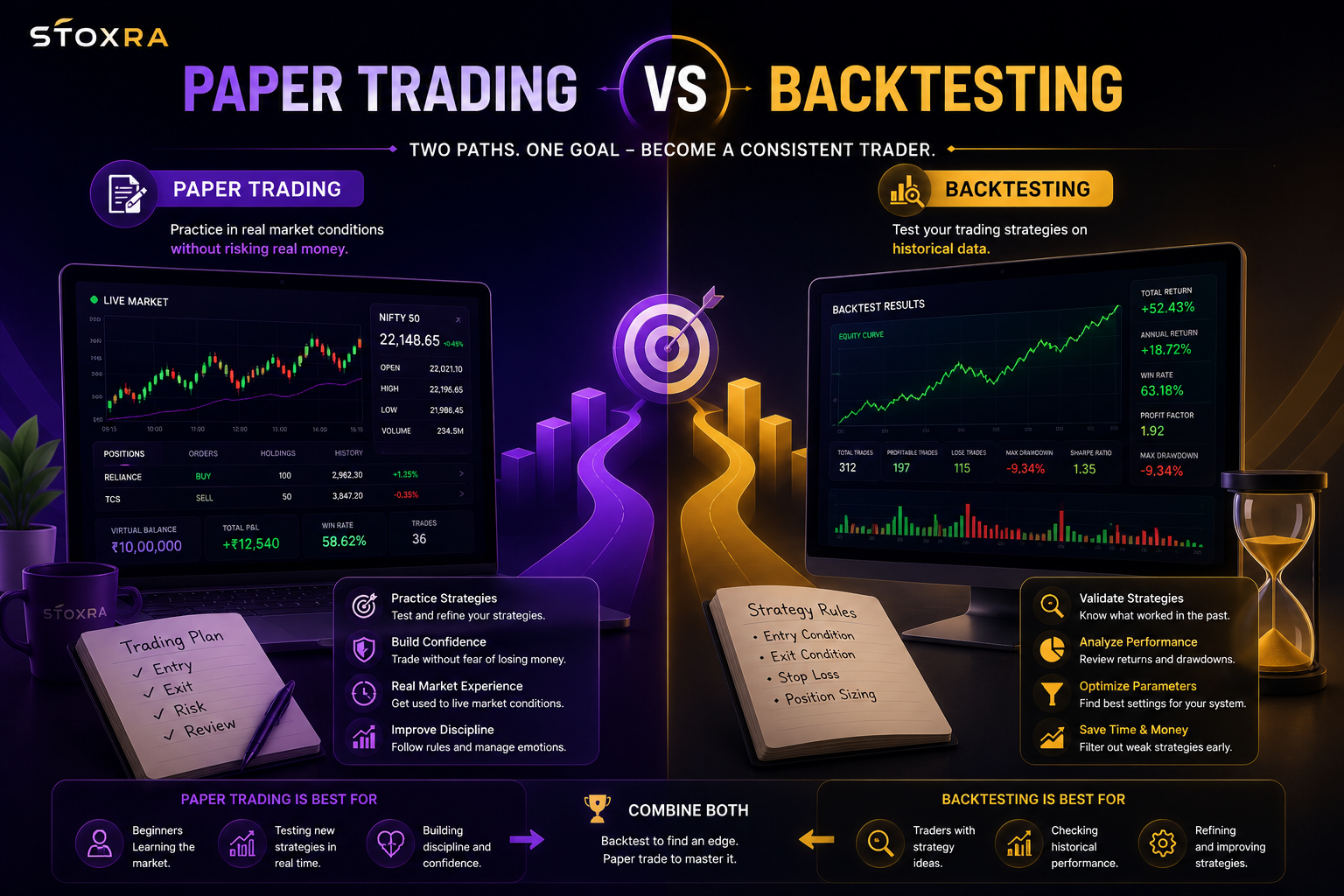
Which Should You Do First?
For most rule-based strategies, a sensible sequence is:
Define
Write the entry, exit, risk and position-sizing rules.
Backtest
Check whether the idea has reasonable historical behaviour.
Paper Trade
Practise the same rules against current market conditions.
Only after those stages should you seriously consider whether the strategy deserves real-money testing.
Find Your Testing Path
Use this simple educational tool to determine which stage should come next. It is a workflow guide, not a trading recommendation.
How to Make a Backtest More Useful
- Define the rules before looking for the best historical settings.
- Include realistic assumptions where possible.
- Account for transaction costs and execution limitations.
- Avoid repeatedly optimising against the same dataset.
- Test different historical market conditions.
- Keep some data genuinely unseen during development.
This becomes particularly important when working with professional-style algorithmic strategies .
How to Make Paper Trading Useful
Use Realistic Size
Avoid practising with unrealistic positions that you could never trade.
Follow One Strategy
Do not change rules every time a trade loses.
Journal Results
Record the setup, execution, risk and outcome.
A dedicated paper trading environment can make this process easier to practise consistently.
You can also read Stoxra's comparison of paper trading platforms before choosing a practice workflow.
Why a Good Backtest Can Still Fail
Historical performance can look convincing and still fail to survive changing market conditions.
Overfitting
Too much optimisation can make a strategy fit historical noise.
Regime Changes
Market behaviour can change after the historical sample ends.
Execution
Slippage, liquidity and costs can change real-world results.
This is one reason Stoxra's guide on algorithmic trading bots emphasises the gap between historical testing and live conditions.
Tools That Can Support Strategy Testing
AI Analysis
Use AI as an analysis and learning aid rather than a replacement for understanding the strategy.
Explore AI Tools →Continue Learning
Strategy testing sits inside a larger trading process. These Stoxra resources can help you build that process:
Test the Idea Before Testing Your Capital
A strategy deserves evidence before it deserves real money. Start with clear rules, test the historical behaviour, then practise the strategy in current market conditions.
Stoxra combines paper trading, market analysis and structured learning tools so you can build the process before moving toward live execution.
Explore Stoxra →Start paper trading on Stoxra →
Explore Premium →Frequently Asked Questions
For a clearly defined rules-based strategy, backtesting is generally the better first validation step because it can evaluate historical behaviour quickly. Paper trading can follow once the rules have passed that initial check.
Is paper trading the same as backtesting?No. Backtesting applies rules to historical data. Paper trading simulates execution using current market conditions and virtual capital.
Can backtesting guarantee future profits?No. Historical results depend on the data, assumptions and methodology used. Future market conditions can differ significantly.
Is paper trading completely risk-free?It removes the direct financial risk of losing real trading capital, but it does not remove learning risk. Poor habits or unrealistic simulation can produce misleading confidence.
How long should I paper trade?There is no universal number of days. The sample should be large enough to observe the strategy across meaningful market conditions and enough trades to evaluate your process.
Why can a strategy pass a backtest but fail in practice?Possible reasons include overfitting, unrealistic execution assumptions, transaction costs, changing market conditions, insufficient data and differences between simulated and actual execution.
Can beginners use paper trading?Yes. Paper trading can provide a way to practise market mechanics and strategy execution before committing real capital.
Can AI replace backtesting and paper trading?No. AI can assist with analysis and organisation, but traders still need to understand the strategy, validate assumptions and evaluate results.
Backtesting and paper trading are not competitors. They are different stages of the same validation process.
Use historical data to investigate the idea, then use current-market simulation to test whether you can actually execute it. Only after both stages provide useful evidence should real-money testing even enter the conversation.
Financial Disclaimer: This article is for educational and informational purposes only and does not constitute investment, financial or trading advice. Backtesting and paper-trading results are hypothetical or simulated and do not guarantee future performance. Actual trading involves market risk, execution risk, transaction costs and the possibility of loss. Conduct independent research and consider your own financial circumstances and risk tolerance before making investment decisions.