Trading Psychology: Why It Matters for Every Trader | Stoxra
Understand trading psychology, common emotional mistakes, trader discipline, fear and greed, and practical ways to develop a more consistent trading mindset.
Trading Psychology: Why It Matters for Every Trader
Trading is not only about charts, indicators and market data. A trader's ability to manage emotions and follow a disciplined process can have a major influence on trading decisions.
This is where trading psychology becomes important. Trading psychology refers to the emotional and mental factors that influence how a person analyses the market, enters a trade, manages risk and exits a position.
Fear, greed, overconfidence, impatience and the desire to recover losses can all affect decision-making. Understanding these behaviours can help traders build a more structured and consistent approach.
Key Takeaway
Trading psychology is about managing emotions and following a predefined process. The goal is not to eliminate fear or greed, but to prevent emotions from overriding your trading plan, risk limits and disciplined decision-making.
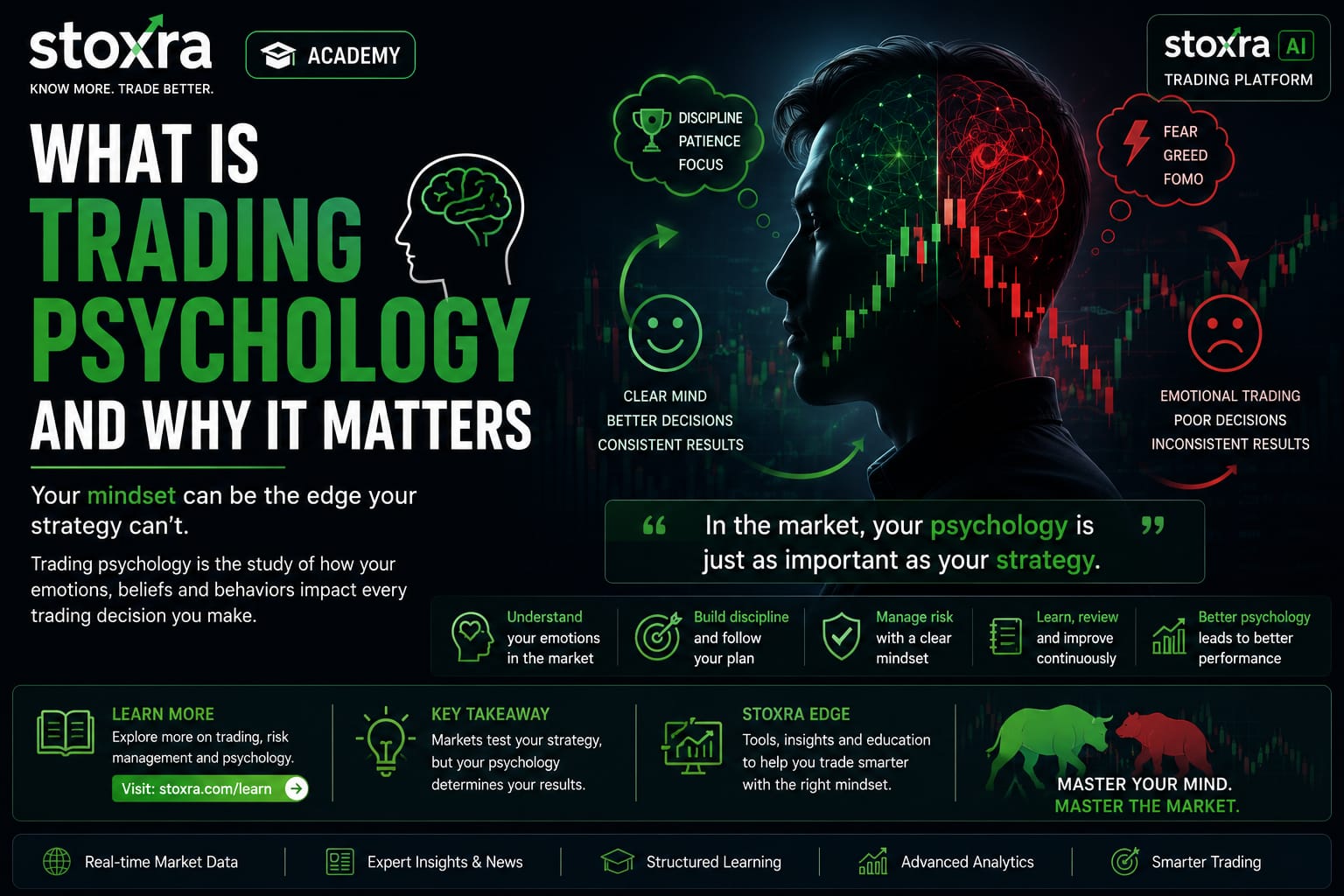
What Is Trading Psychology?
Trading psychology is the study of how emotions, thoughts and behavioural patterns affect trading decisions.
Two traders can look at exactly the same chart and make completely different decisions because their risk tolerance, experience, confidence and emotional responses are different.
A disciplined trader focuses on following a predefined process instead of allowing short-term emotions to control every decision.
Beginners can first strengthen their foundation by learning stock market basics for beginners and understanding common stock market terminology .
Why Does Trading Psychology Matter?
A technically strong trading strategy can still produce poor results if a trader cannot follow it consistently.
For example, a trader may have a valid stop-loss level but move it further away after the trade starts losing. Another trader may exit a profitable position too early because of fear.
These decisions are often influenced by psychology rather than the original trading plan. A written trading plan can help create a more consistent decision-making process.
Traders should also understand the stock market rules every beginner should know before developing a repeatable trading routine.
The Main Emotions in Trading
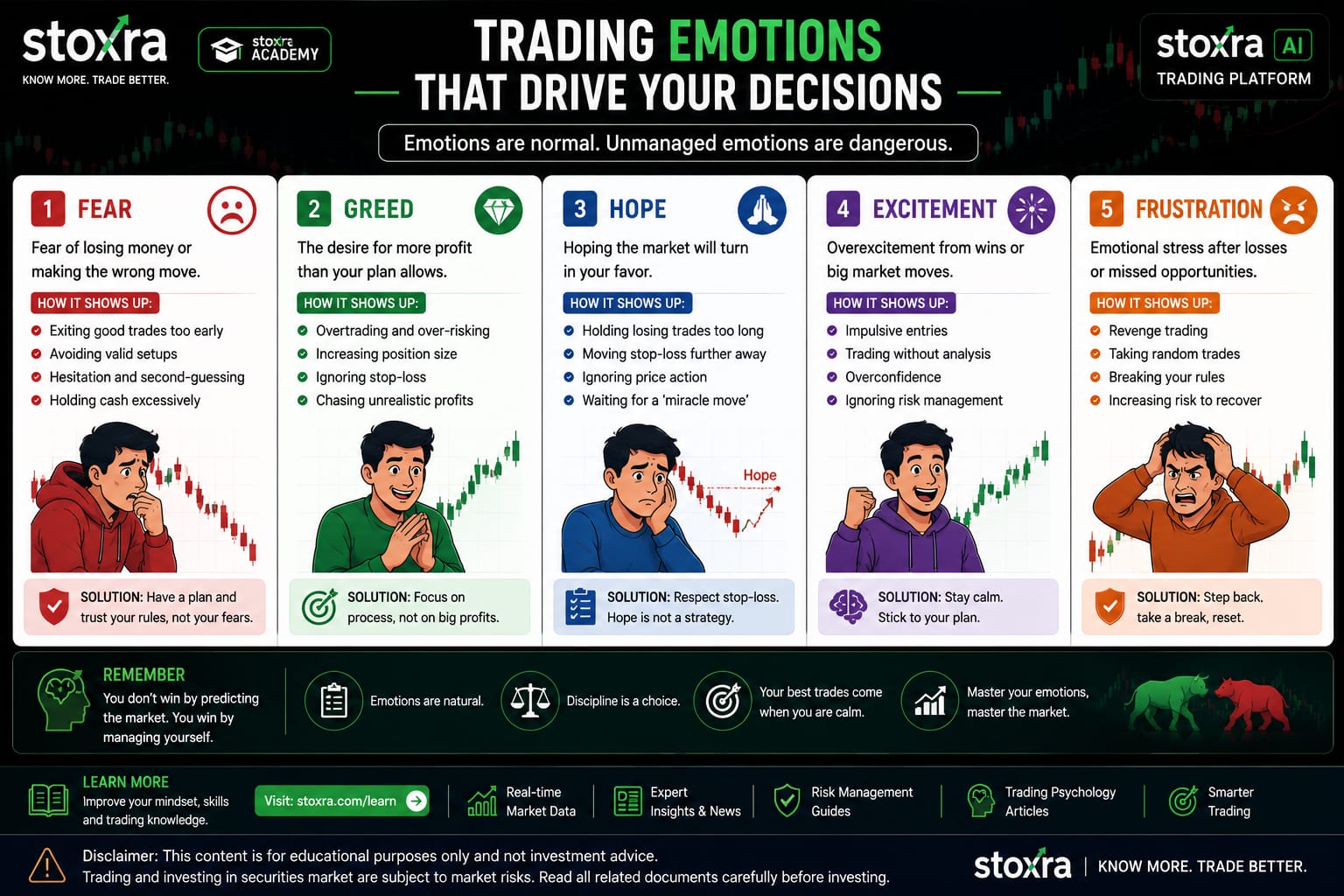
| Emotion | Possible Trading Behaviour |
|---|---|
| Fear | Exiting too early or avoiding valid setups |
| Greed | Taking excessive risk or chasing profits |
| Overconfidence | Increasing position size without proper justification |
| Impatience | Entering trades without confirmation |
| Revenge | Trying to recover losses through impulsive trades |
Fear in Trading
Fear is one of the most common emotions experienced by traders.
After experiencing losses, a trader may become afraid of taking another trade. Alternatively, fear can cause a trader to close a position too quickly even when the original trading thesis remains valid.
The objective is not to completely eliminate fear. Instead, traders can use predefined risk limits and trading rules to prevent fear from controlling their decisions.
A clearly defined daily loss limit can also help prevent a trader from making increasingly emotional decisions after multiple losing trades.
For additional risk-control ideas, traders can explore intraday risk management and learn how predefined limits can support disciplined execution.
Greed in Trading
Greed can encourage traders to take larger risks after experiencing successful trades. A trader may increase position size, ignore a planned exit or continue holding a trade because they expect an even larger profit.
Profit targets, position sizing and predefined exit rules can help reduce emotionally driven decisions.
Position sizing is particularly important because taking excessive exposure can make normal market fluctuations feel psychologically difficult to manage.
Traders can also study risk management techniques for reducing drawdown to understand why controlling downside risk is an important part of long-term trading.
What Is Revenge Trading?
Revenge trading happens when a trader attempts to recover a recent loss through emotional or impulsive trading.
For example, after losing ₹2,000, a trader may immediately enter another position with a much larger size in an attempt to recover the money.
Taking a break after a significant loss and reviewing the trading plan can be more useful than immediately trying to recover the loss.
Traders should also understand FOMO trading mistakes , because the fear of missing out can create the same type of impulsive behaviour.
Overconfidence After Winning Trades
Psychological problems do not occur only after losses. A series of successful trades can also create overconfidence.
A trader may start believing that every trade will work, increase position sizes or ignore risk-management rules.
One useful principle is: past success does not guarantee future success.
Maintaining consistent trade expectancy and realistic win-rate expectations can help traders avoid judging their ability from a short winning streak.
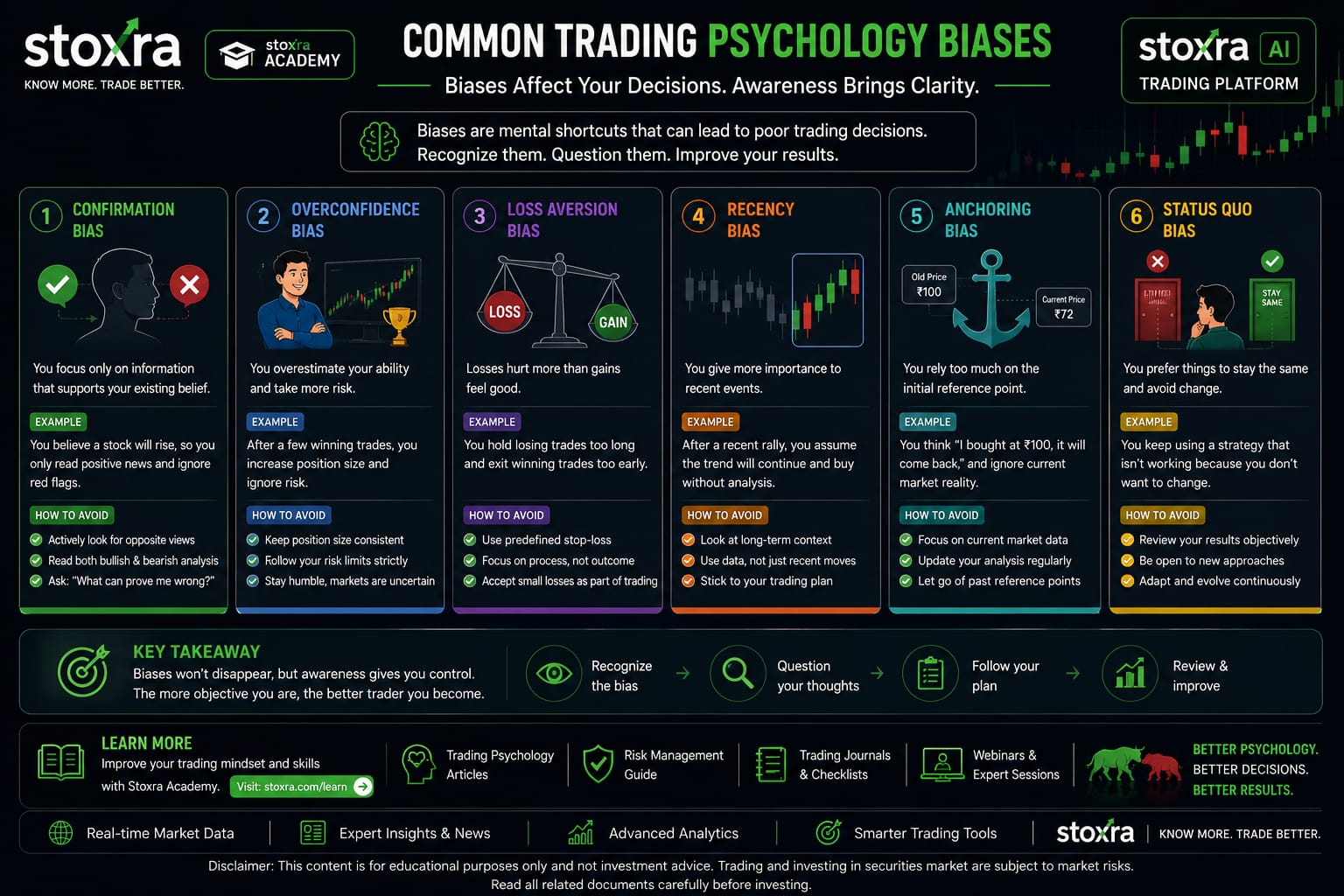
How Cognitive Biases Affect Traders
Human decision-making can be influenced by cognitive biases .
Confirmation Bias
A trader may search for information that supports an existing position while ignoring evidence that contradicts it.
Recency Bias
A trader may give too much importance to recent market events when making a decision.
Loss Aversion
People often experience losses more strongly than equivalent gains. This can cause traders to hold losing positions for too long.
Herding
Traders may follow the crowd simply because many other market participants appear to be taking the same position.
Learning how fundamental and qualitative information can complement market analysis is also useful. See qualitative vs quantitative analysis of stocks for a broader analytical perspective.
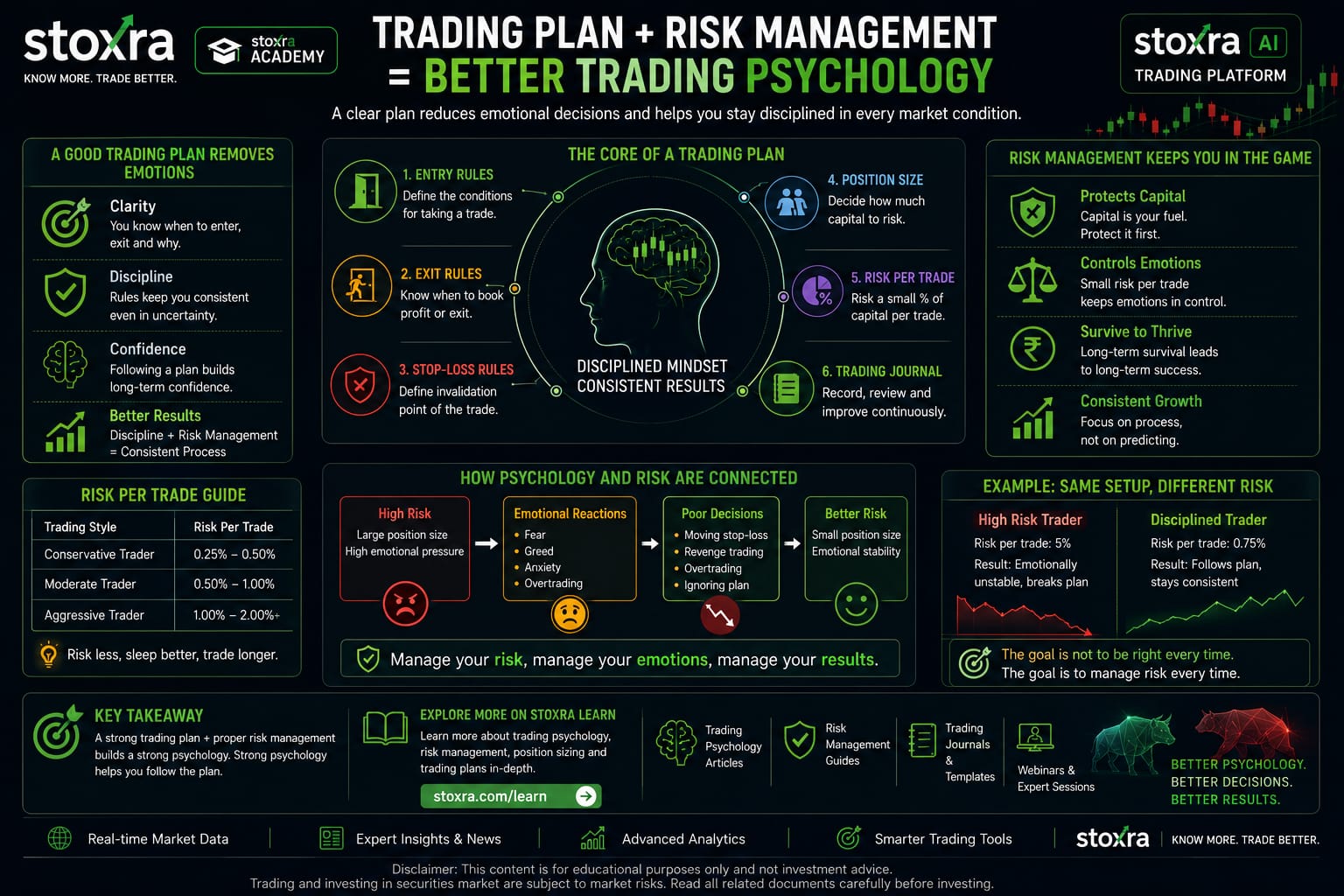
Trading Psychology and Risk Management
Risk management and psychology are closely connected.
If a position is too large relative to a trader's available capital or risk tolerance, even a normal market fluctuation can create significant emotional pressure.
Appropriate position sizing can therefore make it easier to follow a trading plan.
For traders focusing specifically on short-term strategies, options trading risk management is another useful area to study when dealing with derivatives.
Traders who want to understand how predefined exits work can also review stop-loss concepts for options trading .
Why Trading Discipline Matters
Trading discipline means following predefined rules even when emotions encourage a different decision.
A disciplined trader may define:
- Entry conditions
- Stop-loss level
- Profit-taking rules
- Maximum risk per trade
- Maximum daily loss
- Conditions for staying out of the market
The purpose of discipline is not to predict every market move. It is to create a repeatable decision-making process.
How to Build a Strong Trading Mindset
1. Create a Trading Plan
Write down your entry criteria, exit conditions, risk limits and position-sizing rules before taking trades.
A structured trading plan can reduce the need to make important decisions while under emotional pressure.
2. Accept That Losses Are Possible
No trading strategy wins every trade. Accepting this reality can help reduce emotional reactions to individual losses.
3. Use Consistent Position Sizing
Avoid dramatically increasing position size because of excitement or frustration.
4. Avoid Chasing the Market
If a price has already moved significantly, waiting for a suitable setup may be better than entering purely because of fear of missing out.
5. Maintain a Trading Journal
Recording trades can help identify repeated emotional and behavioural mistakes.
Traders can learn how to maintain a structured trading journal to record decisions, risk and lessons from each trade.
What Is a Trading Journal?
A trading journal is a record of trading decisions and their outcomes.
Useful information can include:
- Trade date and time
- Instrument
- Entry price
- Exit price
- Position size
- Reason for entering
- Reason for exiting
- Risk taken
- Emotional state
- Lessons learned
Over time, this record can help traders identify patterns in their own behaviour. A journal can reveal whether losses are being caused by the strategy itself or by repeated execution and discipline problems.
How to Control Emotions While Trading
Completely removing emotions from trading is unrealistic. A better goal is to prevent emotions from overriding a predefined process.
Useful habits include:
- Predefine the maximum acceptable loss.
- Use appropriate position sizing.
- Avoid trading immediately after a large loss.
- Take breaks when emotionally stressed.
- Follow predefined entry and exit rules.
- Review trades regularly.
Another useful approach is to practise strategies in a controlled environment before putting significant capital at risk. Traders can learn more about paper trading vs real trading to understand how practice and live execution differ.
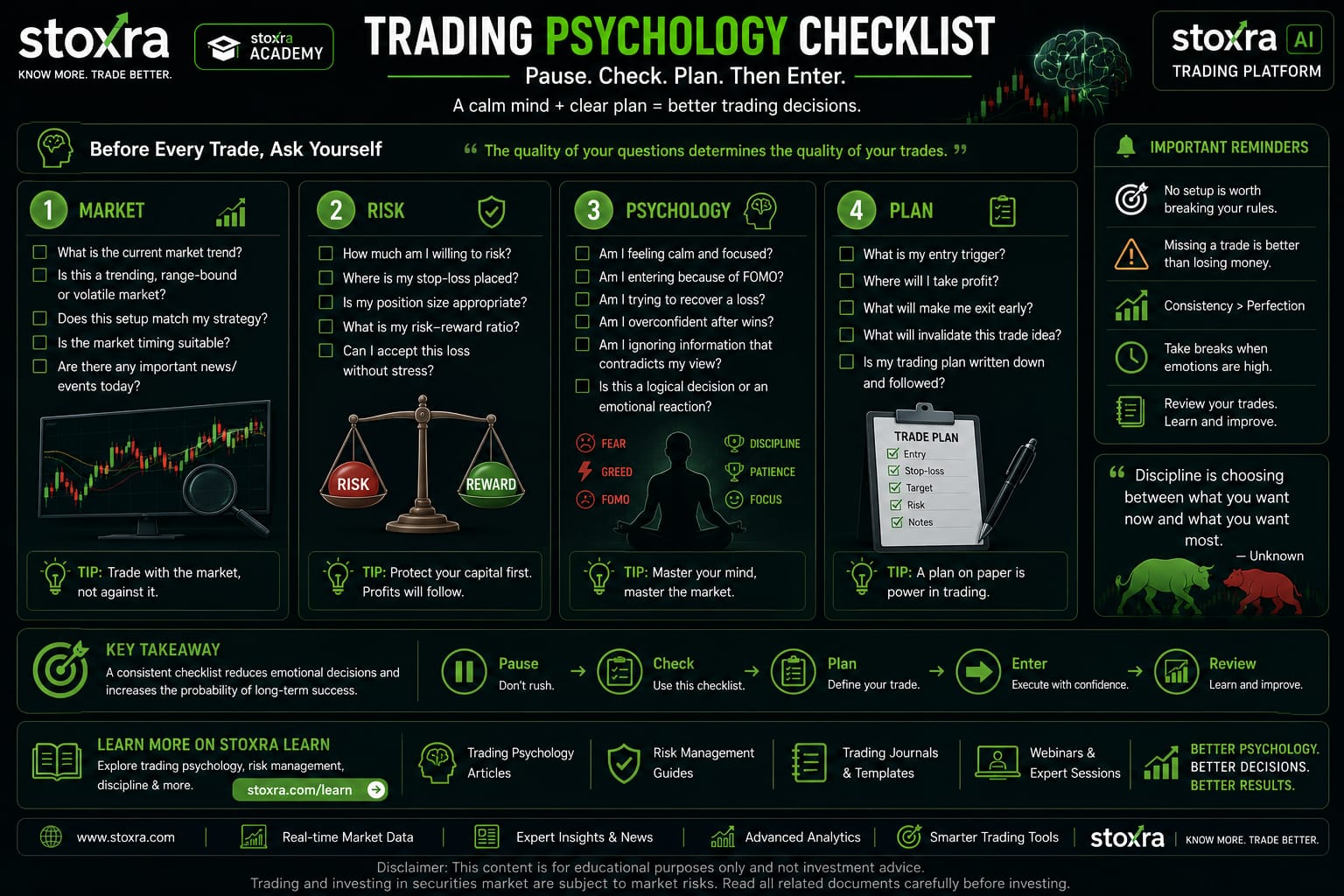
Trading Psychology Checklist
- ☑ Do I have a clear trading plan?
- ☑ Do I know my maximum risk?
- ☑ Is my position size appropriate?
- ☑ Am I entering because of a valid setup?
- ☑ Am I chasing the market?
- ☑ Am I trying to recover a previous loss?
- ☑ Am I following my stop-loss rules?
- ☑ Have I recorded this trade in my journal?
- ☑ Am I making this decision based on analysis rather than emotion?
Common Trading Psychology Mistakes
- Trading without a plan.
- Risking too much on a single trade.
- Moving a stop-loss because of fear.
- Chasing a rapidly moving stock.
- Revenge trading after a loss.
- Increasing position size after a winning streak.
- Ignoring evidence that contradicts a trade thesis.
- Taking too many trades because of boredom.
One particularly common problem is entering and exiting trades without a clear plan . This can become even more damaging when emotions are already elevated.
Beginners should also understand broader stock market mistakes that can affect decision-making and risk management.
A Simple Psychological Framework
A useful framework for traders is:
The objective is to create a repeatable process where each trade becomes a learning experience rather than an emotional reaction.
Regularly reviewing the journal can help identify whether a trader is repeatedly breaking the same rules, increasing risk after wins or taking impulsive trades after losses.
Trading Psychology and Technical Analysis
Technical analysis can help traders create objective rules for entries, exits and confirmation. However, even a strong technical setup can be poorly executed when emotions take over.
Traders can learn more about technical analysis in stock trading and use it alongside a predefined risk-management process.
Understanding tools such as the 100-day moving average can also help traders build objective rules rather than making decisions purely from emotion.
For traders interested in intraday analysis, VWAP trading strategy is another technical concept that can be studied as part of a structured process.
The combination can be viewed as:
Trading Psychology and Better Market Analysis
Psychology should not be separated from analysis. A trader may use fundamental, technical or quantitative information, but the final result can still be affected by how consistently the plan is executed.
For example, traders who use technical indicators should understand their purpose rather than adding multiple indicators simply because they appear popular.
A structured approach to options trading indicators can help reduce random decision-making.
Likewise, traders interested in technology-assisted research can explore AI tools for stock market analysis in India while still applying independent judgment and risk controls.
Final Takeaway
Trading psychology is an important part of becoming a disciplined trader. Charts and technical-analysis strategies can help identify opportunities, but emotions can influence how those opportunities are handled.
The goal is not to eliminate fear, greed or uncertainty. The goal is to build a process that prevents these emotions from controlling important decisions.
A strong trading mindset combines discipline, appropriate risk management, patience and continuous review.
Continue Learning With STOXRA
Explore more educational resources through STOXRA Learn and discover how technology can support structured market research through the STOXRA AI Trading Platform .
Frequently Asked Questions
What is trading psychology?
Trading psychology refers to the emotional and mental factors that influence trading decisions and behaviour.
Why is trading psychology important?
It can influence discipline, risk management, entry and exit decisions and the ability to follow a trading plan consistently.
What emotions affect traders?
Common emotions include fear, greed, impatience, overconfidence and frustration.
How can traders control emotions?
Using a trading plan, appropriate position sizing, predefined risk limits, journaling and regular review can help reduce emotionally driven decisions.
What is revenge trading?
Revenge trading is an attempt to recover a recent loss through impulsive or excessively risky trades.
Can trading psychology guarantee profitable trading?
No. Good psychology and discipline cannot guarantee profits. They are tools for improving decision-making and managing risk.
Disclaimer
This article is for educational and informational purposes only and does not constitute investment, financial or trading advice. Trading and investing involve risk, and losses are possible. Always conduct your own research, understand the risks involved and make decisions according to your individual circumstances and risk tolerance.