What Is Debt-to-Equity Ratio Explained Simply?
Learn what the debt-to-equity ratio means, how to calculate it, interpret high and low levels, compare companies, and assess financial risk.
Debt-to-Equity Ratio: Meaning, Formula, and Basics
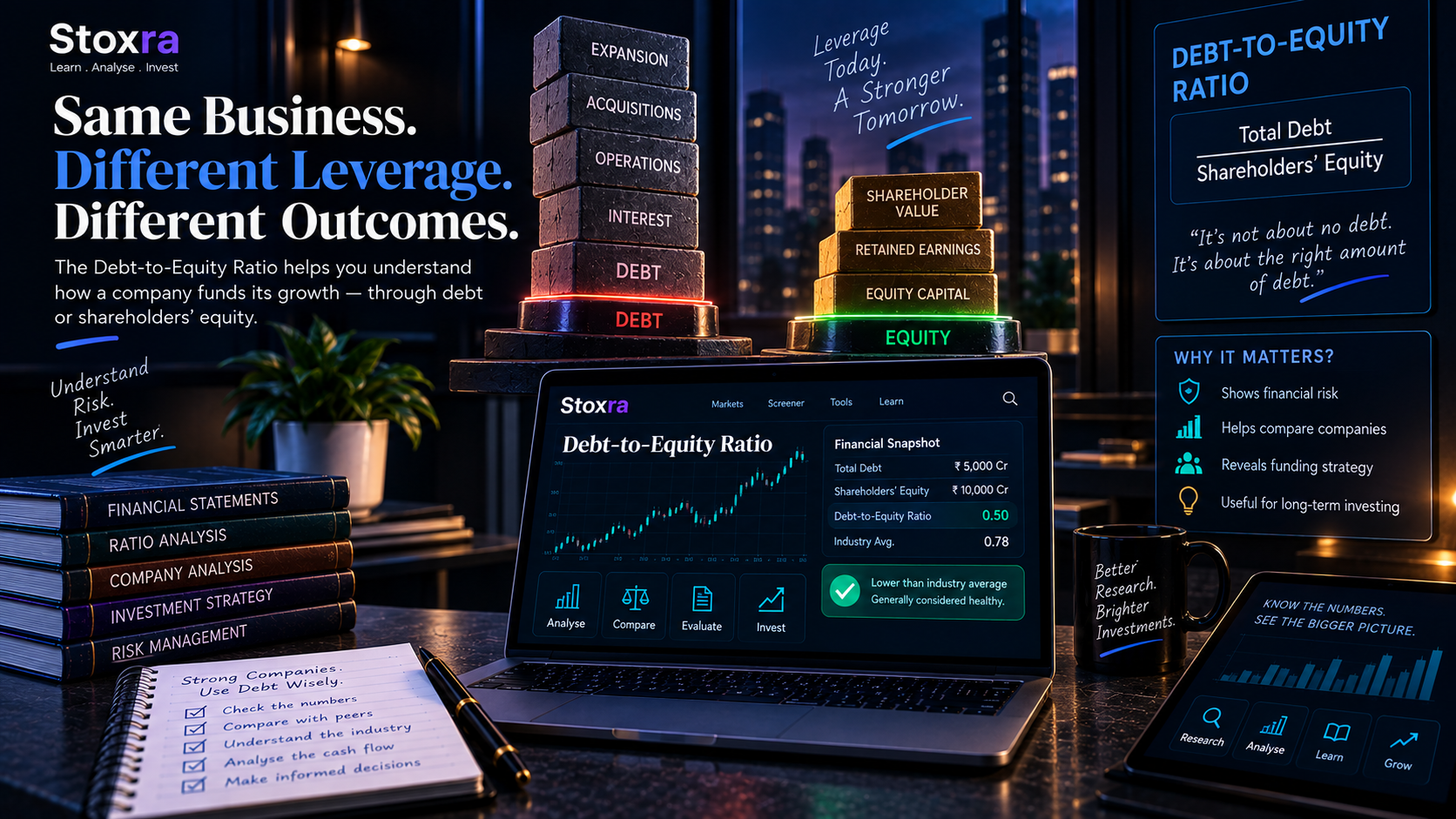
The debt-to-equity ratio, often shortened to D/E ratio, shows how much borrowed capital a company uses for every rupee of shareholders' capital. In simple terms, it answers: How much debt supports each ₹1 invested by shareholders?
For beginners learning stock market basics , this is an important financial ratio because a company can report strong profits while still carrying significant repayment obligations.
A low ratio may indicate a larger equity cushion. A high ratio may indicate greater financial leverage. Neither is automatically good or bad without understanding the business model, cash generation, and industry.
How Is the Debt-to-Equity Ratio Calculated?
The basic formula is:
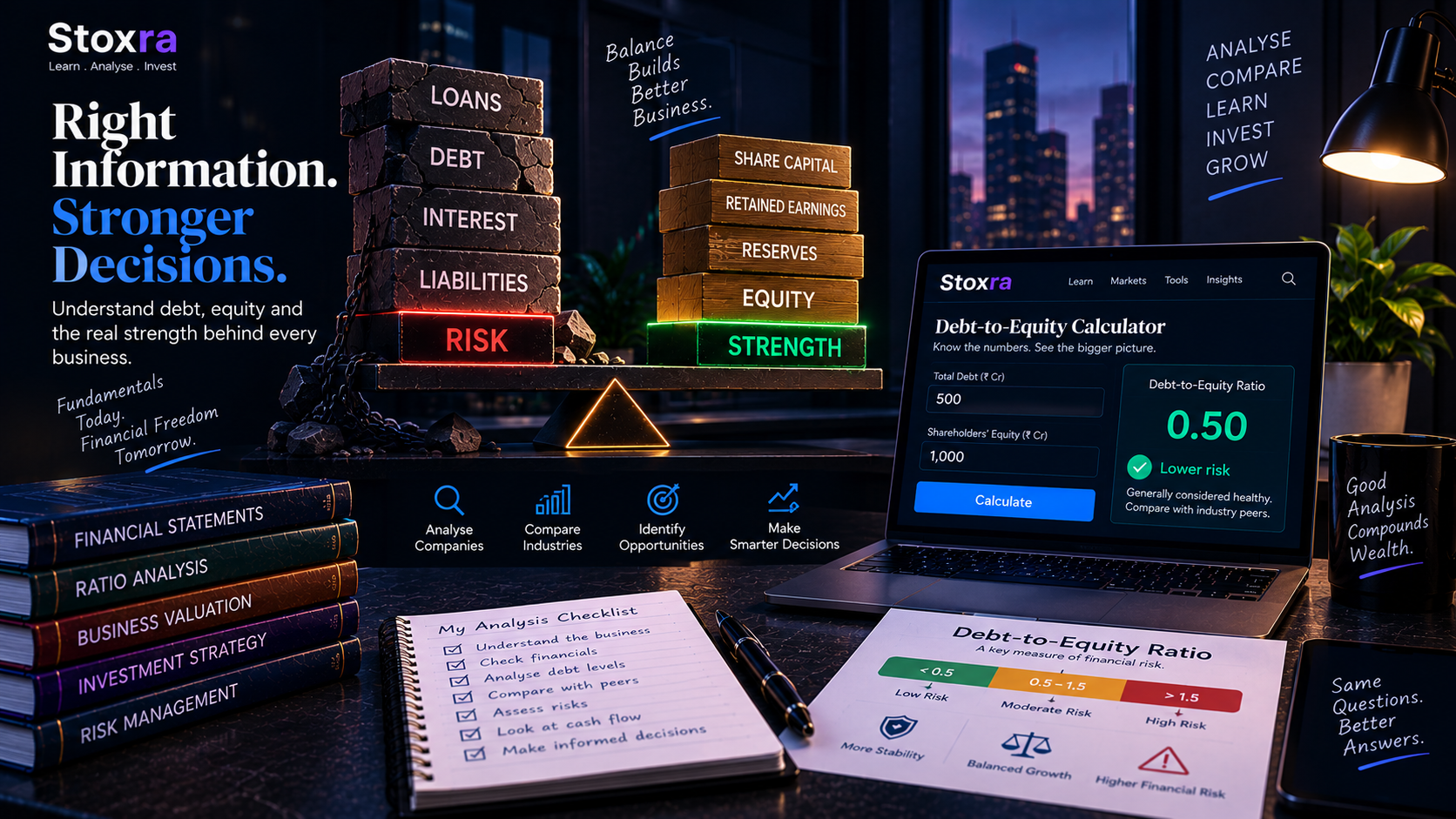
For example, suppose a company has ₹500 crore in total debt and ₹1,000 crore in shareholders' equity:
The result means the company uses ₹0.50 of debt for every ₹1 of shareholder equity.
When collecting the figures, read the balance sheet carefully. Stoxra's guide on how to read a company's balance sheet can help you distinguish debt, equity, cash, and other liabilities.
Debt Is Not the Same as Total Liabilities
Total liabilities can include trade payables, tax obligations, provisions, lease liabilities, and other items. These do not always behave like interest-bearing loans or bonds.
For a reliable comparison, use the same definition of debt across companies. If you use total debt for one company and total liabilities for another, the comparison may be misleading.
How to Interpret Debt-to-Equity Ratio
Low D/E
Usually means the company depends less on borrowing and has a larger equity cushion. It may reduce financial stress, but it can also reflect cautious expansion.
Moderate D/E
May indicate a balanced funding structure. The ratio is more meaningful when operating cash flow and interest coverage are healthy.
High D/E
Shows heavier dependence on borrowed capital. It can magnify shareholder returns during good periods and magnify losses during weak periods.
A useful starting framework is:
| Ratio range | Initial interpretation |
|---|---|
| Below 0.5 | Relatively conservative leverage for many non-financial businesses. |
| 0.5 to 1.5 | Potentially manageable, depending on industry, cash flow, and interest costs. |
| Above 1.5 | Requires deeper review of repayment capacity and refinancing risk. |
These are screening ranges, not universal rules. Banks, infrastructure companies, utilities, real-estate businesses, and manufacturers often operate with different capital structures.
There is no single ideal D/E ratio for every company. Compare the number with three benchmarks:
- Industry peers: Compare companies with similar business models and capital requirements.
- Company history: Check whether debt is rising, falling, or remaining stable over several years.
- Cash-flow strength: Determine whether the company generates enough cash to service and repay its debt.
A ratio that looks high may be reasonable for a company with stable regulated revenue. The same ratio may be dangerous for a cyclical company whose sales and profits change sharply.
Also compare leverage with return on equity and return on capital. Debt can increase ROE, but a higher ROE caused mainly by leverage is not necessarily evidence of a stronger business.
Debt Risk, Productive Borrowing, and Capital Structure
Interest Expenses Reduce Flexibility
Interest must generally be paid whether revenue is growing or falling. During a slowdown, the same interest bill can consume a larger share of operating profit.
Refinancing Can Become Expensive
Loans and bonds that mature soon may need to be refinanced at higher interest rates. This risk becomes more important when credit conditions tighten.
Downturns Become Harder to Absorb
Businesses with high fixed obligations have less flexibility to reduce costs. Investors should check whether operating cash flow can cover interest and principal repayments.
Leverage Magnifies Outcomes
Borrowing can improve shareholder returns when the business earns more than its financing cost. But when operating performance weakens, leverage can magnify losses and increase the chance of financial distress.
Review the common stock-market mistakes beginners make before treating a single ratio as a complete investment decision.
When Debt Can Be Productive
Debt is not automatically bad. Productive borrowing can finance a factory, logistics network, technology platform, acquisition, or expansion before the company has generated enough internal cash.
Business Expansion
Borrowing can fund new capacity or distribution when demand is visible.
Asset Creation
Debt may be sensible when it finances assets that generate recurring cash flow.
Ownership Retention
Debt can reduce the need to issue new shares and dilute existing shareholders.
The key question is whether management is borrowing for productive growth or using new debt to cover recurring weakness. Read the company's annual report and capital-allocation disclosures to understand the purpose of the borrowing.
Other Financial Ratios to Check With D/E
| Ratio | What it helps you understand |
|---|---|
| Debt-to-assets | What proportion of assets is financed by debt. |
| Interest coverage | How comfortably operating profit covers interest expense. |
| Net debt-to-EBITDA | Debt after cash compared with operating earnings. |
| ROE | Profit generated from shareholders' equity. |
| ROCE | Returns generated from capital employed. |
| Current ratio | Short-term liquidity rather than long-term leverage. |
For example, a company may have a moderate D/E ratio but weak cash flow. Another may have high debt but very stable cash generation. The full financial picture matters.
Debt-to-Equity Calculator and Practical Analysis
Calculate the D/E Ratio
Enter debt and shareholders' equity in the same currency unit.
The calculator gives you a starting number, not an investment verdict. After calculating the ratio, ask:
- Is the ratio rising faster than revenue and profit?
- Can operating profit comfortably cover interest?
- Is operating cash flow positive and consistent?
- Are large loans or bonds due soon?
- Is the debt funding productive assets or covering losses?
- How does the ratio compare with competitors?
Use the result with the company's EPS , margins, cash flow, and valuation rather than relying on debt alone.
Relevant Tools and Beginner's Checklist
Learn the Basics
Build your foundation with Stoxra Learn and the stock-market terminology guide .
Evaluate Companies
Use the company evaluation framework to combine debt, growth, management, valuation, and risk.
Research With AI
Explore AI tools for stock analysis , while verifying figures in primary filings.
Practise Research
Use paper trading to practise investment decisions without immediately risking capital.
Understand Price Trends
After fundamental research, review technical analysis for price and trend context.
Follow Developments
Read Stoxra market news for earnings, sector, and company updates.

Before investing, use this checklist:
- Can I explain how the company makes money?
- Is debt increasing faster than operating performance?
- Is operating cash flow consistently positive?
- Can EBIT cover interest expense comfortably?
- Are debt maturities manageable?
- Is borrowing being used for productive growth?
- Does management communicate its debt strategy clearly?
- Is the company's leverage reasonable compared with peers?
FAQs and Final Takeaway
No. Lower leverage can reduce risk, but it may also mean the company is not using capital efficiently. Compare debt with growth, profitability, and industry norms.
What does a D/E ratio of 1 mean?It means total debt equals shareholders' equity. The company uses ₹1 of debt for every ₹1 of shareholder capital.
Can the ratio be negative?Yes. A negative ratio can occur when shareholders' equity is negative. This usually signals accumulated losses or serious balance-sheet weakness and requires deeper investigation.
Should banks use the same D/E benchmark?No. Banks and financial institutions use leverage differently from ordinary operating companies. Capital adequacy, asset quality, and regulatory ratios are more relevant.
Where can I find debt and equity figures?Look at the balance sheet in the company's annual report, quarterly filing, or investor presentation. Confirm the reporting period and units before calculating.
The debt-to-equity ratio is a simple way to understand how much a company depends on borrowing compared with shareholder capital. A low ratio may provide a stronger equity cushion, while a high ratio may increase financial risk—but the right interpretation depends on cash flow, interest coverage, debt maturity, industry structure, and management quality.
Use the D/E ratio as a starting point for research, not as a final verdict. Strong investing decisions come from combining the balance sheet, income statement, cash-flow statement, valuation, and long-term business outlook.