What Is IPO Lot Size and How It's Decided?
Learn what IPO lot size means, how the number of shares in an IPO lot is decided, how to calculate the minimum investment and what investors should check before applying.
What Is IPO Lot Size and How It's Decided?
When investors apply for an Initial Public Offering (IPO), they often see terms such as lot size, issue price, minimum investment, price band, cut-off price and application quantity.
For a first-time investor, these terms can be confusing. One of the most important is IPO lot size.
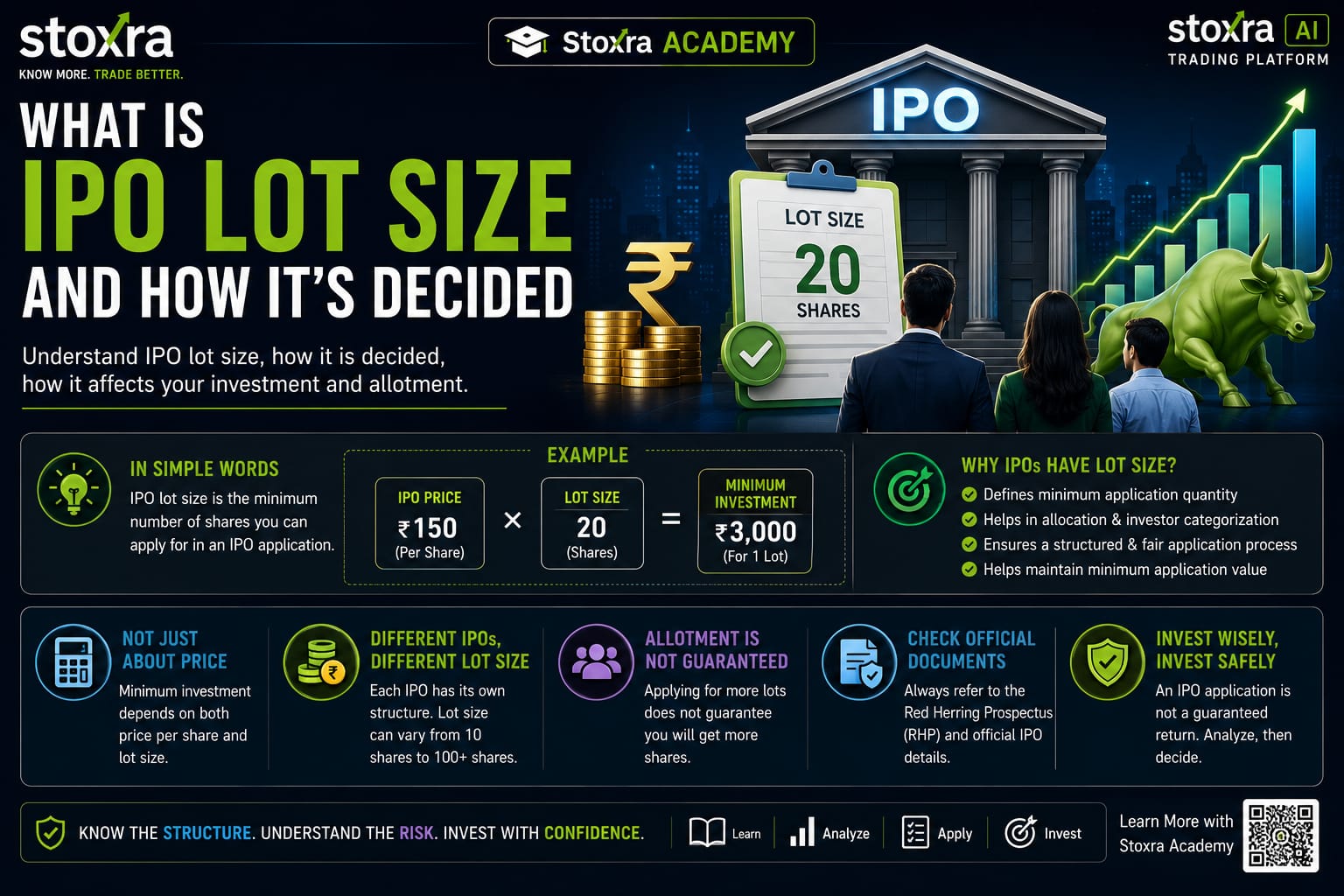
In simple terms, the IPO lot size is the number of shares grouped together for one application lot in a particular IPO, subject to the applicable issue structure and regulatory requirements.
For example, if an IPO has a lot size of 20 shares and the issue price is ₹150 per share, one lot represents:
20 × ₹150 = ₹3,000
So ₹3,000 would be the basic application amount for one lot, before considering the specific application mechanism and applicable rules.
But who decides this lot size? Why does one IPO have a lot size of 10 shares while another may have 50 shares? And does applying for more lots increase the chances of allotment?
Let's understand how IPO lot size works and what investors should check before submitting an application.
Investors who are new to the market may also benefit from understanding basic stock market terminology before exploring IPO-specific concepts.
Key Takeaway
IPO lot size tells you how many shares are grouped into one application lot. The basic application amount can be estimated by multiplying the applicable price per share by the lot size. However, lot size alone does not tell you whether an IPO is a good investment or whether you will receive an allotment. Always review the official issue documents, investor category, valuation, financials and risk factors before applying.
What Is an IPO Lot Size?
An IPO lot size represents the number of shares grouped together for an IPO application. Instead of allowing investors to apply for any arbitrary number of shares, the issue specifies a particular lot size.
For example:
- IPO price = ₹200
- Lot size = 15 shares
Then:
1 lot = 15 shares
Application amount = ₹200 × 15 = ₹3,000
If an investor applies for two lots:
30 shares × ₹200 = ₹6,000
The exact application rules can vary depending on the type of issue, investor category and applicable regulations.
Understanding these basic calculations is part of learning how the broader market works. For beginners, the stock market basics for beginners can provide useful background before moving into IPO analysis.
Why Do IPOs Have a Lot Size?
Lot sizes help structure the IPO application process.
They can help determine:
- Minimum application quantity
- Minimum application amount
- Additional application quantities
- Application structure
- Investor participation requirements
The lot size is therefore not simply a number chosen for convenience. It forms part of the IPO's overall issue structure.
For investors, knowing the lot size makes it easier to calculate how much money may be required for an application and to compare different IPO opportunities.
Before participating in any market product, beginners should understand the basic stock market rules for beginners and distinguish educational information from investment decisions.
How Is IPO Lot Size Decided?
The lot size is determined as part of the IPO structure and is disclosed in the relevant issue documents.
Factors involved in determining the application structure can include:
- Issue price
- Minimum application value
- Regulatory requirements
- Investor category
- Number of shares offered
- Allocation framework
- Overall issue structure
The issuer and its advisors structure the issue in accordance with applicable requirements and the terms disclosed in the offer documents.
Investors should therefore check the official offer document and issue details rather than relying only on social-media posts or unofficial IPO calculators.
Lot size should also not be confused with company valuation. Investors evaluating an IPO can learn more about how to value a stock using fundamental analysis before making an investment decision.
A broader qualitative and quantitative review can also help investors understand why application size alone should not determine an investment decision. See qualitative vs quantitative analysis of stocks for additional context.
IPO Price vs Lot Size
These two terms are different.
| Term | Meaning |
|---|---|
| IPO Price | The price at which shares are offered to investors under the IPO. |
| Lot Size | The number of shares included in one application lot. |
| Application Amount | The basic amount calculated by multiplying the applicable price by the lot size. |
Formula
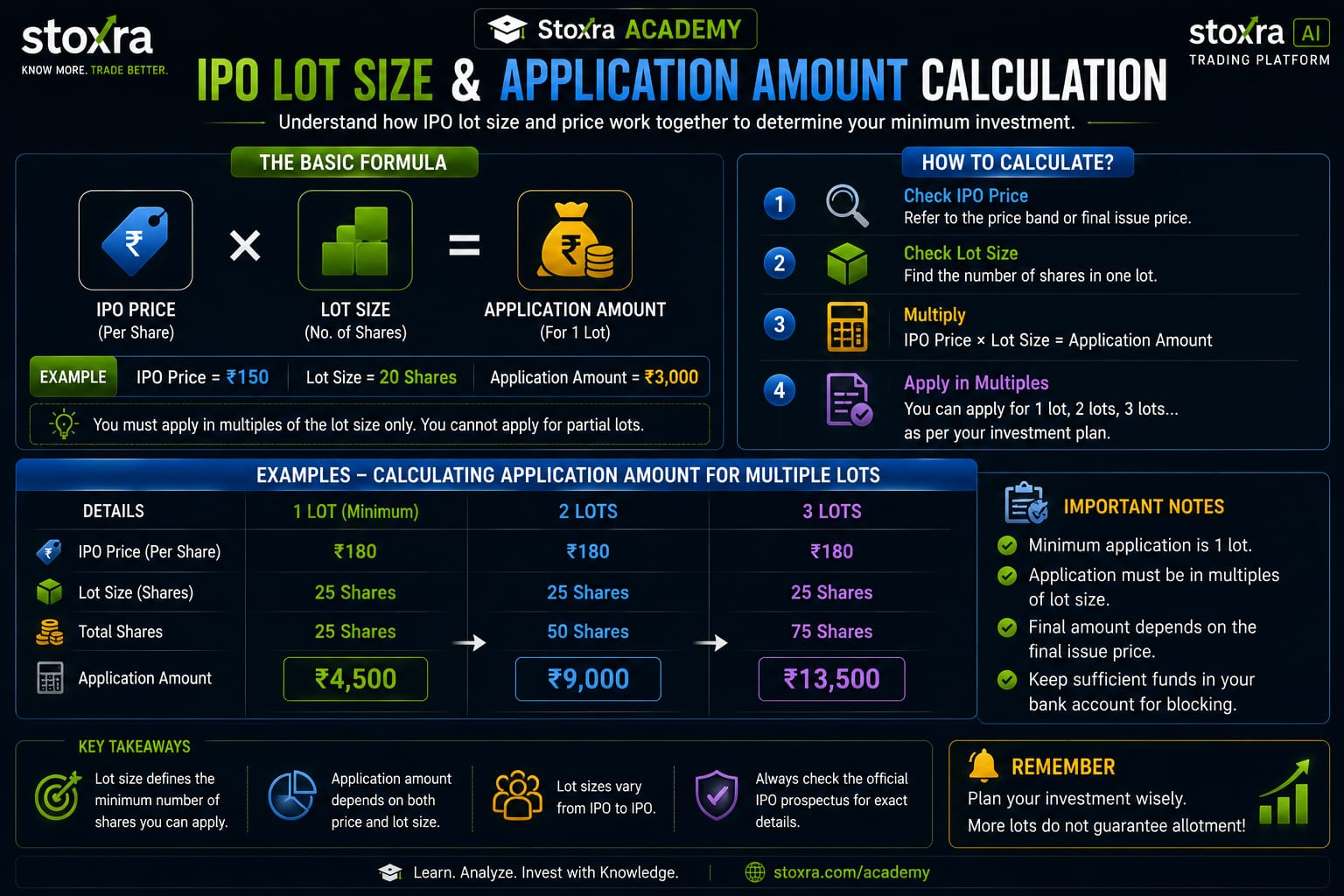
Minimum application amount = IPO price per share × lot size
For example:
- Issue price = ₹250
- Lot size = 12 shares
₹250 × 12 = ₹3,000
So one lot represents an application amount of ₹3,000 under this hypothetical example, subject to the specific issue's application and payment rules.
Investors who are still learning basic market concepts can also review technical analysis in stock trading to understand how IPO shares may later be analysed after listing.
How to Calculate IPO Investment for Multiple Lots
Suppose:
- IPO price = ₹180
- Lot size = 25 shares
One Lot
25 × ₹180 = ₹4,500
Two Lots
50 × ₹180 = ₹9,000
Three Lots
75 × ₹180 = ₹13,500
The number of lots an investor can apply for depends on the applicable investor category, issue rules and available funds.
Always check the official issue details before applying.
Investors should also avoid making decisions based purely on popularity or informal market discussions. Understanding common stock market mistakes beginners make can help investors approach IPO decisions more carefully.
What Happens When the IPO Is Oversubscribed?
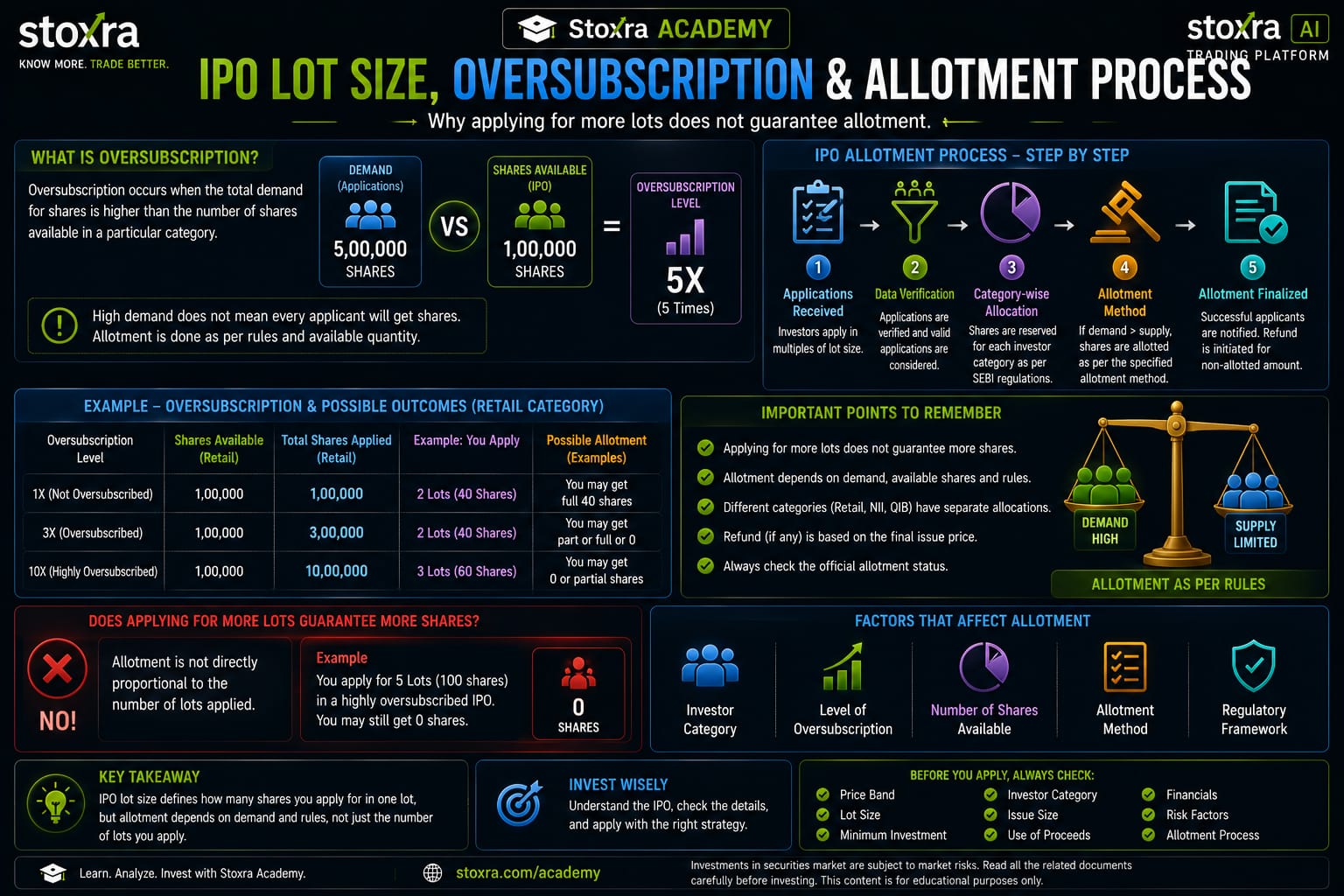
Oversubscription occurs when the demand for shares is greater than the number of shares available in a particular category.
For example, imagine an IPO has:
- 1,00,000 shares available
- 5,00,000 shares applied for
The demand is five times the available quantity.
In such a situation, simply applying for more lots does not guarantee an allotment. The allotment mechanism depends on the investor category and applicable rules.
This is why investors should understand the allotment process rather than assuming that a larger application automatically guarantees more shares.
IPO activity can change significantly from one period to another. STOXRA's coverage of the March IPO surge and companies filing for IPOs provides additional context on activity in the primary market.
Does Applying for More Lots Guarantee More Shares?
No.
Applying for more lots does not automatically guarantee allotment.
IPO allotment depends on factors such as:
- Investor category
- Demand
- Shares available
- Applicable allotment rules
- Number of valid applications
Important Point
More lots ≠ Guaranteed allotment
This is an important point for new IPO investors.
A heavily subscribed issue can have a very different allotment outcome from an undersubscribed issue. Investors should therefore separate IPO demand from their assessment of the underlying company.
IPO Lot Size and Minimum Investment
Lot size directly affects the basic amount needed to submit an application.
| IPO Price | Lot Size | One Lot |
|---|---|---|
| ₹100 | 20 | ₹2,000 |
| ₹150 | 20 | ₹3,000 |
| ₹200 | 15 | ₹3,000 |
| ₹250 | 12 | ₹3,000 |
This illustrates why two IPOs with completely different share prices can still have a similar basic application amount.
The price per share alone does not tell you the minimum application amount.
You need both:
Price × Lot Size
This distinction is especially useful when comparing companies at different price points. Fundamental analysis should go beyond the application amount and consider the company's business, financial position, valuation and risks.
IPO Lot Size for Retail Investors
Retail investors need to pay particular attention to the application limits and rules applicable to the retail category.
The exact limits and framework can change as regulations evolve.
Therefore, investors should always check the latest issue-specific information and applicable regulatory requirements before submitting an application.
Do not assume that the rules for one IPO automatically apply to another.
Investors can also use STOXRA's learning resources to build a stronger understanding of investing and market concepts before applying for public issues.
For investors who want to practise understanding market mechanics without immediately using real capital, the paper trading vs real trading guide can provide useful educational context.
IPO Lot Size and HNI / NII Applications
IPO applications are divided into investor categories.
Depending on the issue and prevailing rules, non-institutional investors, often referred to as NII, can have different application requirements from retail investors.
The minimum application size and allocation mechanism can therefore differ by category.
An investor should confirm:
- Category eligibility
- Minimum application requirement
- Maximum application limits
- Applicable allocation rules
These details should be checked from the official issue documents before submitting an application.
Investors should also remember that an IPO application is different from an active trading position. Once a stock is listed, investors may use different approaches to study price behaviour, including candlestick patterns for beginners .
What Is Cut-Off Price in an IPO?
In a book-built IPO, investors may encounter the term cut-off price.
The cut-off option generally allows eligible retail investors to indicate that they are willing to apply at the final issue price determined through the book-building process, subject to applicable rules.
For example, if the price band is:
₹95 – ₹100
and the final issue price is determined at:
₹100
an investor who selected the applicable cut-off option can have the application considered at the final issue price, provided all other conditions are satisfied.
The exact mechanics should always be checked in the issue's official documents.
Investors should not confuse the IPO cut-off price with technical indicators or trading levels used after listing.
IPO Price Band and Lot Size
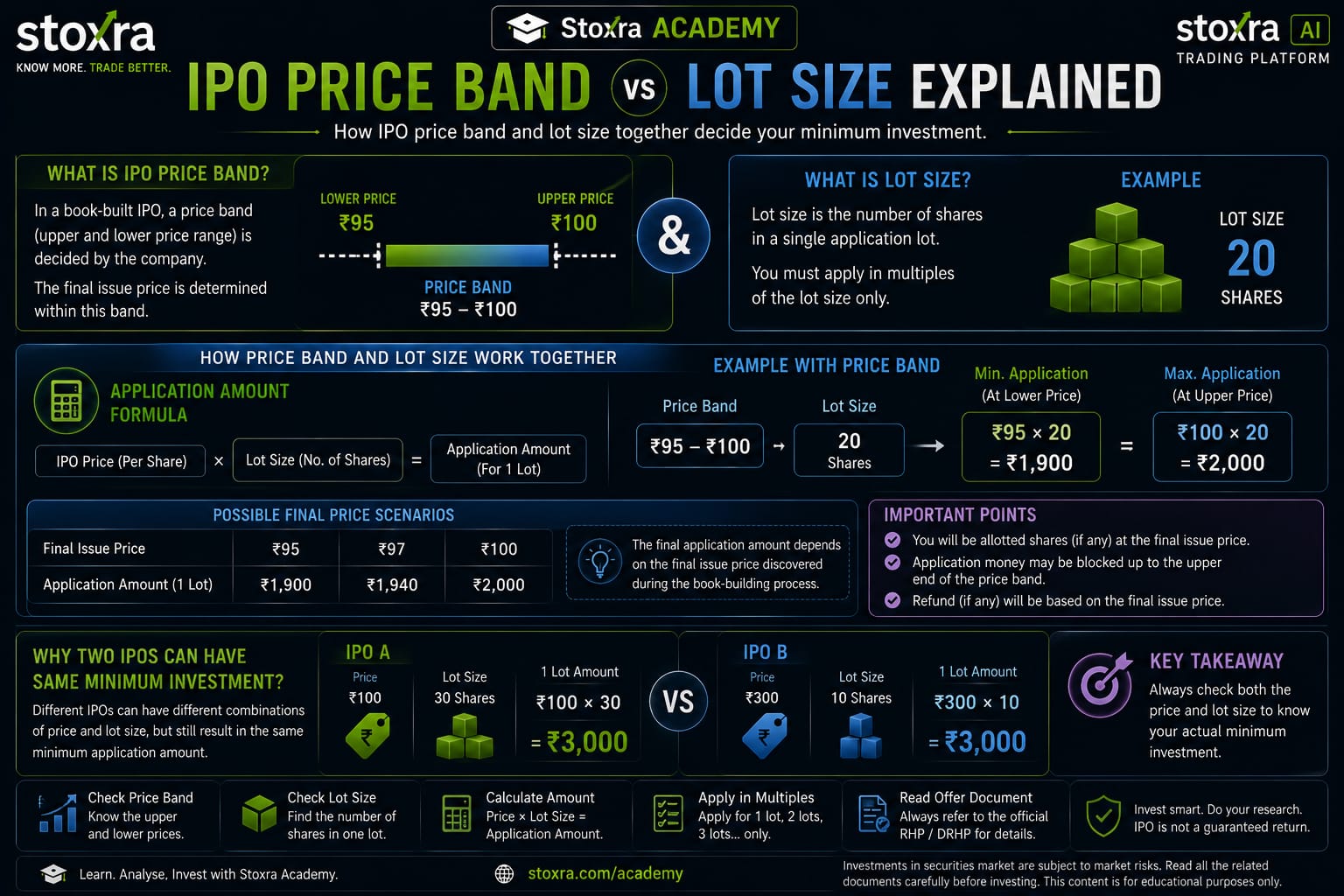
Many book-built IPOs have a price band.
For example:
- Price Band: ₹95–₹100
- Lot Size: 20 shares
If the final issue price is ₹100:
20 × ₹100 = ₹2,000
The final application amount therefore depends on the applicable issue price and the number of shares in the lot.
This is why investors should check the final issue price and official IPO details before calculating the required funds.
Why Can Lot Sizes Differ Between IPOs?
You may notice that one IPO has:
Lot Size = 10 shares
while another has:
Lot Size = 50 shares
There is no requirement that every IPO use the same lot size.
The issue structure depends on its specific circumstances and applicable regulatory framework.
Differences can result from factors such as:
- Issue price
- Desired minimum application amount
- Regulatory framework
- Investor-category requirements
- Overall issue structure
Therefore, investors should evaluate each IPO separately rather than assuming that the lot size from a previous IPO will apply to the next issue.
The same principle applies when comparing trading or investing opportunities. A stock with a low share price is not automatically cheaper in valuation terms. Investors should look beyond price and study the underlying business and financial information.
IPO Lot Size and Application Amount
Consider two hypothetical IPOs.
IPO A
Price = ₹100
Lot size = 30
Minimum application:
₹100 × 30 = ₹3,000
IPO B
Price = ₹300
Lot size = 10
Minimum application:
₹300 × 10 = ₹3,000
Although the share prices are very different, the basic application amount is the same in this hypothetical example.
This demonstrates why lot size is an important part of understanding an IPO.
It also shows why investors should not judge an IPO only by looking at its per-share price.
Once a stock is listed, investors may also use market indicators to study its price behaviour. For example, learning about the 100-day moving average can help beginners understand one commonly used technical-analysis concept.
What Should Investors Check Before Applying?
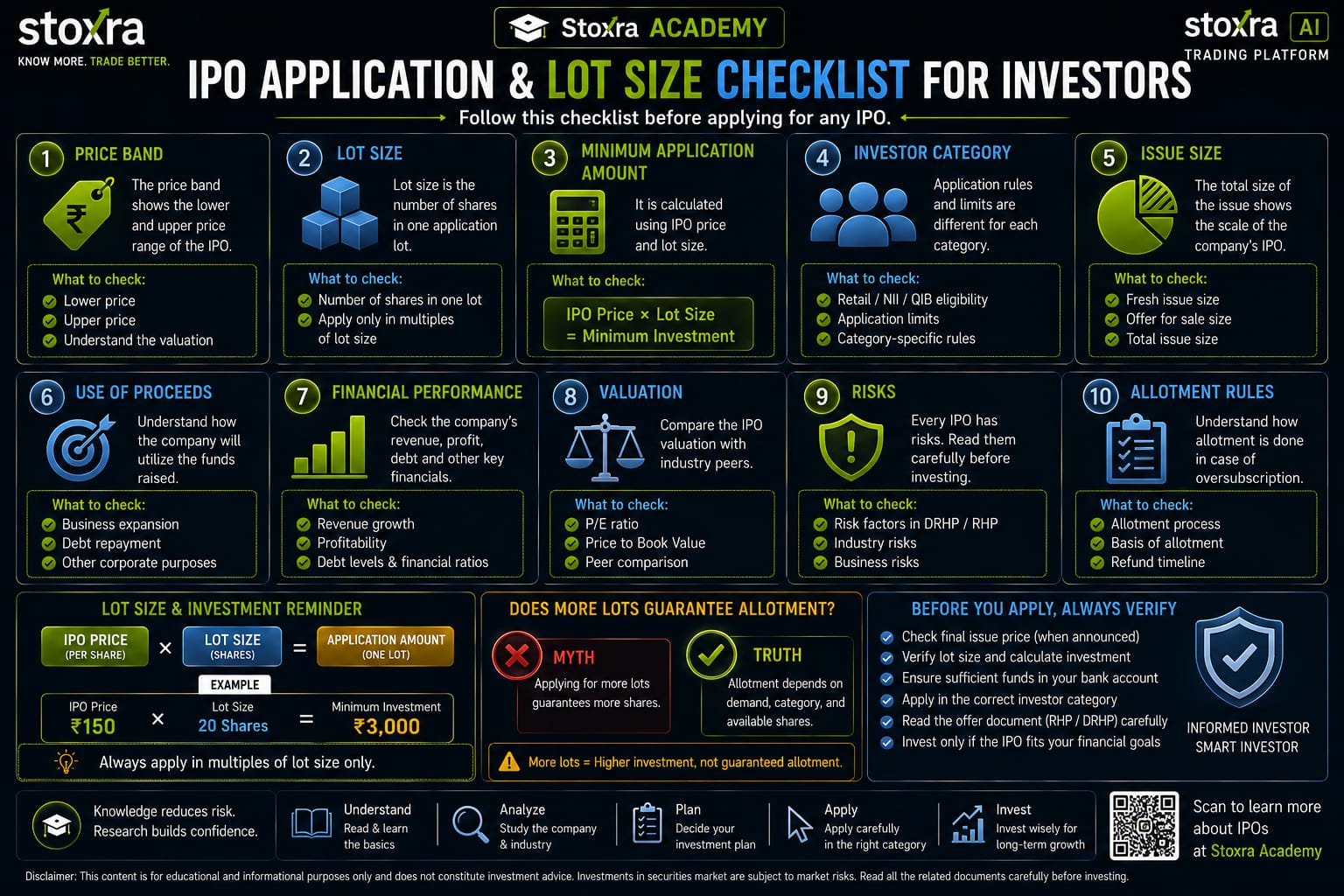
Before submitting an IPO application, check the following:
- Price Band: What is the IPO's price range?
- Lot Size: How many shares are included in one lot?
- Minimum Application Amount: Calculate Price × Lot Size.
- Investor Category: Confirm whether the application is being made under the appropriate category.
- Issue Size: Understand the overall number and value of shares being offered.
- Use of Proceeds: Check what the company intends to do with the IPO proceeds.
- Financial Performance: Review revenue, profitability, debt and other relevant financial information.
- Valuation: Compare the company's valuation with relevant peers where appropriate.
- Risks: Read the risk factors disclosed in the offer document.
- Allotment Rules: Understand how shares are allocated if the issue is oversubscribed.
Investors can also understand the difference between qualitative and quantitative factors through STOXRA's guide to qualitative vs quantitative analysis of stocks .
Investors should also avoid assuming that a heavily subscribed IPO automatically represents a good investment. IPO demand and company fundamentals are separate considerations.
The same discipline applies to trading. Before entering any market position, investors should understand their potential downside rather than focusing only on potential returns. Beginners can review intraday risk management to understand this broader principle.
IPO Lot Size vs IPO Allotment
These terms should not be confused.
Lot Size tells you the number of shares in an application lot.
Allotment tells you how many shares are actually assigned to your application.
For example:
You apply for:
2 lots = 40 shares
But if demand is extremely high, you may receive:
0 shares
or an allotment determined under the applicable rules.
Application quantity ≠ Guaranteed allotment quantity
This distinction is important because an IPO application is an allocation process, whereas secondary-market trading involves buying and selling shares after listing. Those activities involve different decisions, risks and market conditions.
Common Mistakes About IPO Lot Size
Mistake 1: Assuming One Lot Is Always the Same
Lot sizes vary between issues.
Mistake 2: Looking Only at IPO Price
The minimum application amount depends on both price and lot size.
Mistake 3: Assuming More Lots Guarantee Allotment
They do not.
Mistake 4: Ignoring Investor Category
Different categories can have different requirements.
Mistake 5: Using Unofficial Information
Always verify the final issue details from official documents.
Mistake 6: Ignoring the Risk Factors
A manageable application amount does not mean the IPO itself is low-risk.
Mistake 7: Confusing IPO Application With Trading
An IPO application is not the same as an intraday or derivatives trade. Investors should understand the differences before applying or trading.
For example, derivatives can involve substantially different risk characteristics. Investors interested in options should first understand options trading risk management rather than assuming IPO investing and options trading use the same framework.
Avoiding basic investing mistakes is especially important for first-time investors. Understanding stock market rules for beginners can help build a more disciplined approach to market participation.
A Simple IPO Lot Size Checklist
Before applying:
- ☑ Check the IPO price band
- ☑ Check the final issue price when available
- ☑ Check the lot size
- ☑ Calculate the application amount
- ☑ Confirm your investor category
- ☑ Check application limits
- ☑ Review the company's financials
- ☑ Read the risk factors
- ☑ Understand the allotment process
- ☑ Verify information from official sources
If you are building your overall market knowledge, you can also explore STOXRA's resources on trend-following strategies , options trading indicators and other market concepts after understanding the fundamentals.
IPO Lot Size and Fundamental Analysis
Lot size tells you about the structure of an application, but it does not tell you whether the underlying company is attractive at its offer price.
Investors should therefore separate two questions:
How much do I need to apply? vs. Is the company worth investing in?
The first question involves the IPO's price, lot size and application rules. The second requires deeper analysis of the business, financial performance, competitive position, valuation and risks.
Beginners can also learn the difference between company analysis approaches through STOXRA's qualitative and quantitative analysis guide .
Understanding how to value a stock can also help investors avoid treating a low share price or affordable lot size as proof that an IPO is cheap.
IPO Lot Size vs Market Price After Listing
The IPO application process and the secondary market are different stages.
During the IPO, investors apply under the issue's stated terms and lot structure. After listing, the stock trades in the secondary market and its market price can move above or below the issue price.
Therefore, a ₹3,000 IPO application does not mean that the investment will remain worth ₹3,000 after listing.
Market conditions, company performance, investor sentiment and supply and demand can all affect the post-listing price.
Beginners can build broader market knowledge through STOXRA's stock market basics guide before moving into more advanced market analysis.
Why IPO Lot Size Should Not Be the Main Investment Decision
A small lot size can make an IPO appear affordable, but affordability and investment quality are different concepts.
For example, two companies could both require ₹3,000 for one lot while having very different:
- Revenue growth
- Profitability
- Debt levels
- Business models
- Competitive advantages
- Valuations
- Risk profiles
This is why investors should avoid choosing an IPO merely because the minimum application amount fits their available capital.
Investors should also be aware of behavioural mistakes such as FOMO. STOXRA's guide on FOMO trading mistakes explains why market excitement can sometimes lead to poor decisions.
IPO Research and Market Analysis
IPO research can involve both quantitative and qualitative information.
Quantitative information may include revenue, profit, margins, debt, cash flows and valuation metrics.
Qualitative information can include the business model, management, competitive environment, industry structure and potential risks.
Investors can also improve their understanding of market terminology through STOXRA's stock market terminology guide .
The goal should be to understand what you are buying rather than simply focusing on how much money is required to submit an application.
How Technical Analysis Can Matter After IPO Listing
Technical analysis generally becomes more relevant once the stock is listed and sufficient market-price data becomes available.
Beginners can explore technical analysis in stock trading to understand concepts such as price trends, support, resistance and indicators.
Other educational resources include the VWAP trading strategy , candlestick patterns and 100-day moving averages .
These tools should not be treated as guarantees of future price movements. They are analytical techniques that may be used alongside broader research and risk management.
Using Paper Trading to Learn Market Mechanics
Investors who are learning trading concepts may want to practise without immediately committing real capital.
STOXRA's paper trading vs real trading guide explains the difference between simulated trading and live-market participation.
Paper trading cannot reproduce every aspect of real investing or trading, but it can help beginners understand order execution, position management and market mechanics.
For beginners researching platforms, STOXRA also provides educational information on paper trading platforms .
Technology and IPO Research
Modern investors may use technology to organize financial information, compare companies and study market data.
AI-based tools can assist with research workflows, but investors should verify important information against reliable primary sources and official documents.
STOXRA's guide to AI tools for stock market analysis provides additional educational context.
Investors interested in algorithmic systems can also explore algorithmic trading in simple terms to understand how rule-based systems differ from discretionary investing.
Technology can support research, but it does not remove investment risk or replace independent verification.
Final Takeaway
IPO lot size is the number of shares grouped together for an IPO application.
It plays an important role in determining the basic application amount.
The basic calculation is:
IPO Application Amount = Price Per Share × Lot Size
However, investors should not look at lot size in isolation.
Before applying for an IPO, consider:
Lot Size + Issue Price + Investor Category + Allotment Rules + Company Fundamentals + Valuation + Risks
Most importantly, an IPO application is not a guaranteed investment return.
The fact that an IPO is popular or heavily subscribed does not mean that every investor will receive an allotment or that the stock will generate a profit after listing.
Always verify the latest issue-specific information and read the official offer documents before making an investment decision.
Pro Tip
Do not choose an IPO only because its lot size requires a relatively small amount of money. A low application amount does not automatically mean low risk or good valuation. Evaluate the business, financial performance, valuation, issue structure and disclosed risks before applying.
Frequently Asked Questions
What is IPO lot size?
IPO lot size is the number of shares grouped into one application lot for a particular IPO.
How do I calculate the IPO application amount?
Multiply the applicable IPO price per share by the lot size.
Application amount = Price × Lot Size
Does applying for more lots guarantee allotment?
No. Allotment depends on demand, investor category and the applicable allotment mechanism.
Can different IPOs have different lot sizes?
Yes. Lot sizes can differ between IPOs depending on the issue structure and applicable requirements.
Where can I find the official IPO lot size?
Check the official IPO issue documents and the issue details provided through authorized intermediaries.
Is IPO lot size the same as the number of shares I will receive?
No. Lot size describes the application quantity. Actual allotment depends on the applicable allotment process.
Does a higher IPO subscription mean the IPO is a better investment?
Not necessarily. Subscription data describes demand for the issue, while investment quality depends on factors such as the company's business, financial performance, valuation, risks and future prospects.
Can IPO lot size change between different issues?
Yes. Different IPOs can have different lot sizes because their issue structures, pricing and applicable requirements can differ.
Should beginners apply for an IPO only because the minimum investment is low?
No. The minimum application amount is only one part of an IPO decision. Investors should also study the company's financials, valuation, risks and offer documents.
Build Your Stock Market Knowledge With STOXRA
Want to understand IPOs, investing, trading and market concepts more systematically? Explore STOXRA's educational resources before making financial decisions.
Disclaimer
This article is for educational and informational purposes only and is not investment advice. IPOs and equity investments involve market risk, and investors may lose money. IPO rules, investor categories, application limits, price bands and allotment procedures can change. Always verify the latest official issue documents, applicable regulations and information from authorized sources before applying.