Kelly Criterion Explained: How Much to Risk on Each Trade
Learn how the Kelly Criterion helps traders calculate optimal position size based on win probability and risk-reward ratio, and why fractional Kelly is often preferred for safer risk management.
Kelly Criterion Explained: How Much to Risk on Each Trade
One of the most important questions in trading is not simply “What should I buy or sell?”
It is:
“How much should I risk?”
A trader can have a strategy with a positive expected outcome and still experience serious losses if position sizes are too large.
This is where position sizing becomes important. Traders can also review position sizing for intraday trading to understand how trade size can be linked to available capital and risk limits.
The Kelly Criterion is a mathematical framework originally developed for maximizing the long-term growth rate of capital under specific assumptions. In trading and investing discussions, it is often used as a framework for determining how much capital could theoretically be allocated to a strategy when the trader has an estimated edge.
However, the Kelly Criterion should not be treated as a guaranteed formula for profitable trading. Its output depends heavily on the quality of the inputs and the assumptions behind the model.
Key Takeaway
The Kelly Criterion is a mathematical position-sizing framework, not a guaranteed trading instruction. Its result depends on estimated win probability and payoff characteristics. Because those estimates can be uncertain in real markets, traders may consider fractional Kelly and additional risk limits rather than blindly using the full theoretical result.
What Is the Kelly Criterion?
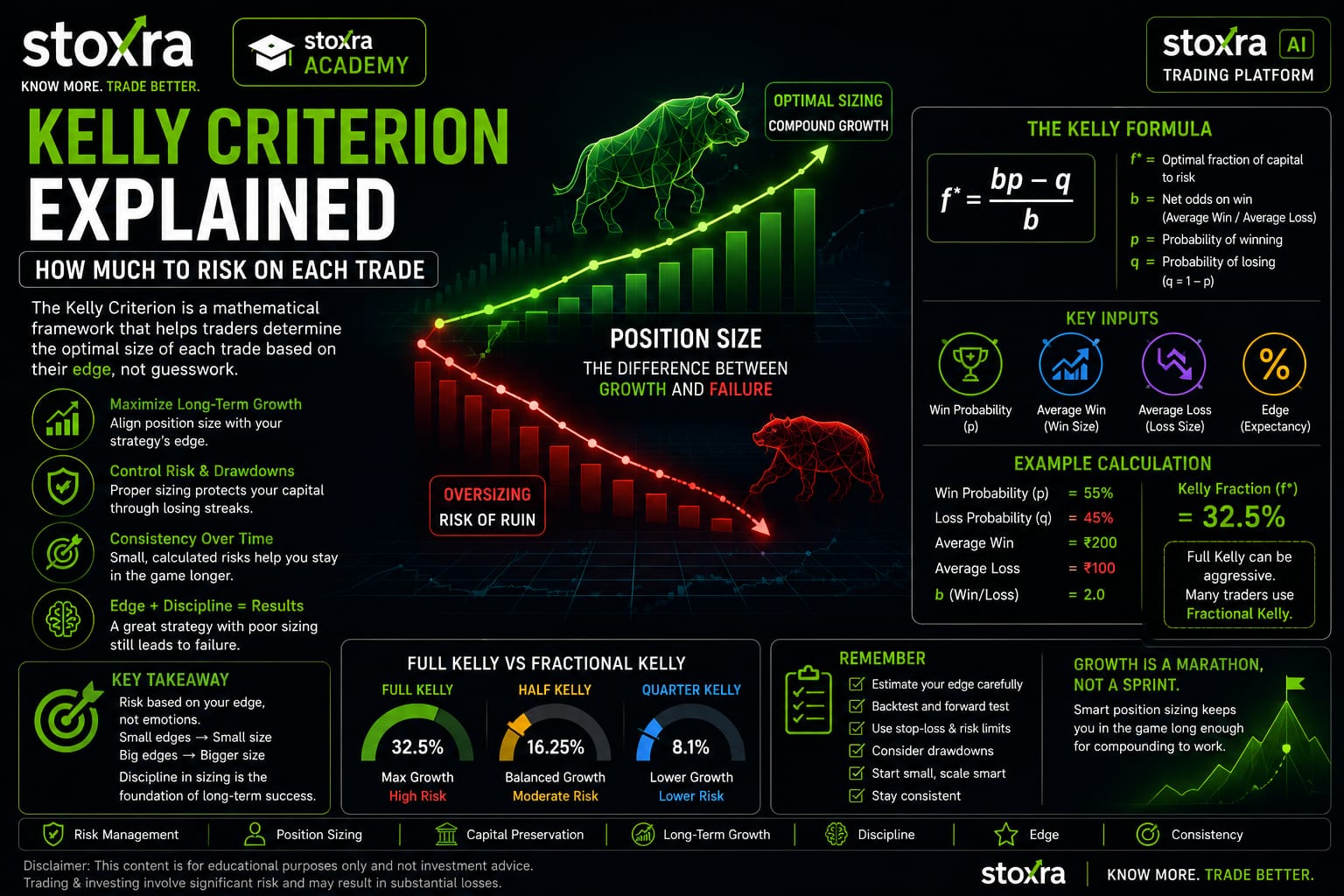
The Kelly Criterion is a position-sizing framework that attempts to determine the fraction of capital that should theoretically be allocated to a favorable-risk opportunity.
In simplified trading discussions, it uses factors such as:
- Probability of winning
- Probability of losing
- Average win
- Average loss
The basic idea is:
If you have a measurable edge, position size should reflect that edge rather than being chosen randomly.
A larger estimated edge can produce a larger theoretical position. A smaller edge should produce a smaller position.
But there is an important warning: a mathematically calculated position size can still be too aggressive for a real trader.
That is one reason fractional Kelly approaches are commonly discussed.
Before using mathematical position sizing, beginners should also understand stock market basics for beginners .
Why Position Sizing Matters
Suppose two traders use exactly the same strategy.
Trader A risks a small amount on each trade. Trader B risks a very large amount.
Even if both have the same win rate, their account trajectories can be dramatically different.
Position sizing affects:
- Potential returns
- Potential losses
- Drawdowns
- Emotional pressure
- Risk of large capital depletion
This is why position sizing is part of risk management, not just trade execution.
For traders who want to understand the psychological side of position sizing, the trading psychology guide can provide useful context.
It is also useful to understand common stock market mistakes beginners make before applying an aggressive position-sizing method.
The Basic Kelly Formula
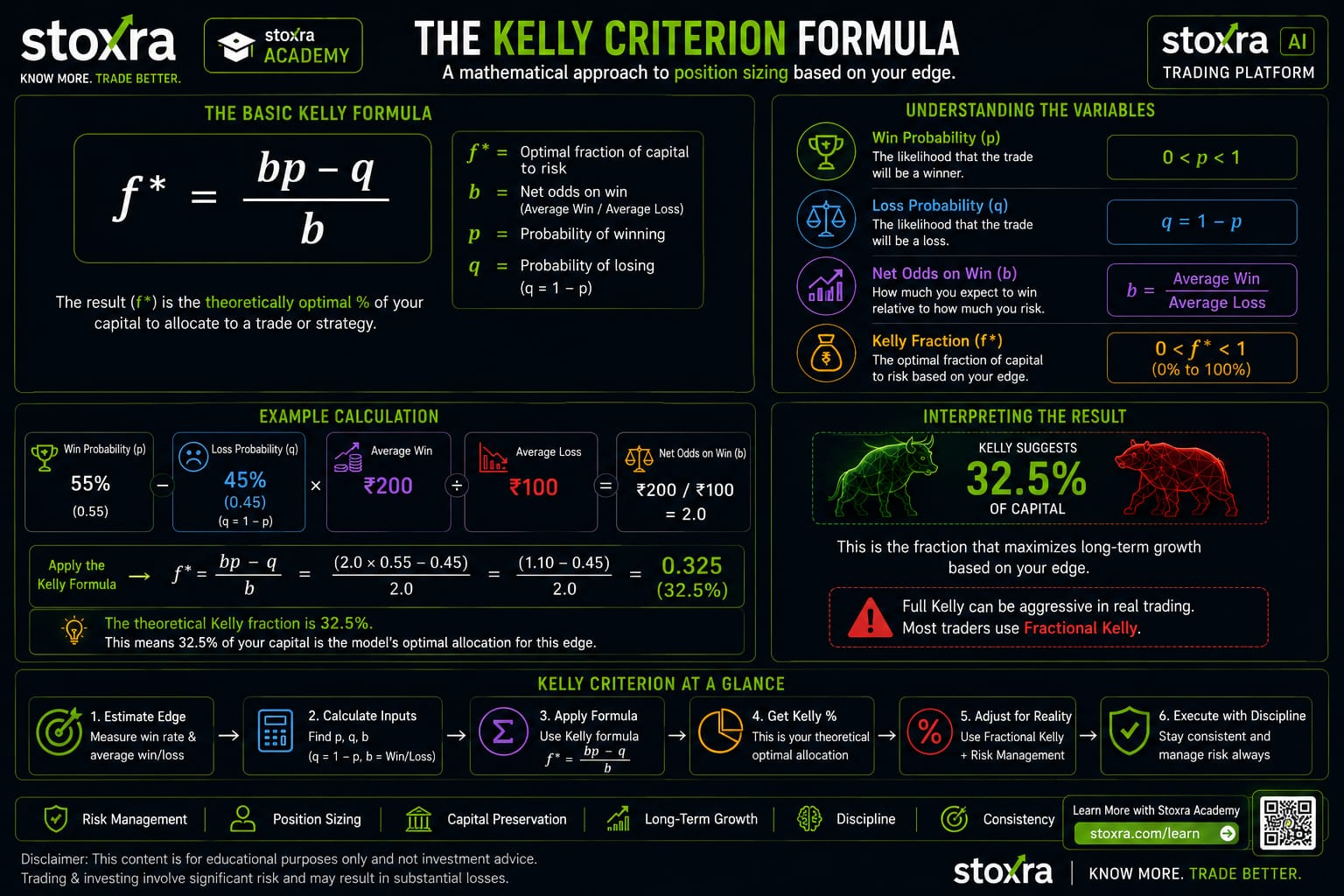
A commonly used form of the Kelly Criterion is:
Where:
- f* = theoretical fraction of capital to allocate
- b = net odds received on a winning trade
- p = probability of winning
- q = probability of losing
- q = 1 − p
The formula should be interpreted carefully because real trading outcomes rarely behave exactly like a simple mathematical model.
The quality of the probability and payoff estimates is therefore critical. A trader should avoid treating the calculated number as a prediction of future returns.
Kelly Criterion Example
Suppose a trading strategy has:
- Win probability = 55%
Therefore:
p = 0.55
and:
q = 0.45
Suppose the average winning trade is twice the size of the average losing trade.
Then:
b = 2
f* = (2 × 0.55 − 0.45) / 2
f* = 0.325
Therefore, the theoretical Kelly fraction is:
32.5%
This is an extremely important example because it shows why blindly using the full Kelly output can be inappropriate for many traders.
A theoretical 32.5% allocation does not mean a trader should simply put 32.5% of their account into one trade.
The result depends on assumptions about probability, payoff and repeated outcomes.
What Does Kelly Percentage Mean?
The Kelly percentage represents the theoretical fraction of capital that the model suggests allocating under its assumptions.
For example:
Full Kelly = 20%
does not necessarily mean:
“Risk 20% of your account at the stop-loss.”
Allocation and actual risk at the stop are different concepts.
This distinction is particularly important for leveraged products, derivatives and volatile assets.
A trader must understand the actual amount that could be lost if the trade reaches its stop or if the position experiences adverse movement.
Traders can also study stop-loss strategies for options trading when learning how predefined exits interact with position sizing.
Kelly Criterion and Win Rate
Win rate is one of the inputs that can influence Kelly calculations.
Suppose a strategy wins:
60% of the time
and loses:
40% of the time.
That sounds attractive.
But win rate alone does not determine whether a strategy has a positive edge.
Strategy A
- Win rate: 60%
- Average win: ₹100
- Average loss: ₹200
Strategy B
- Win rate: 40%
- Average win: ₹300
- Average loss: ₹100
The second strategy has a lower win rate but may have stronger mathematical expectancy.
This is why Kelly-style calculations should consider both probability and payoff, rather than looking at win rate alone.
For a deeper understanding of this relationship, see trade expectancy vs win rate .
Kelly Criterion and Risk-Reward Ratio
The size of wins relative to losses is another important factor.
Suppose:
Average win = ₹200
and:
Average loss = ₹100
The win-to-loss ratio is:
2:1
If a trader's probability estimates are reliable, a larger average win relative to the average loss can increase the strategy's mathematical edge.
But a high risk-reward ratio does not automatically mean the strategy is good.
The probability of achieving those outcomes also matters.
Traders should understand basic stock market terminology before comparing these metrics.
Kelly Criterion vs Fixed-Fractional Position Sizing
These are not the same approach.
| Approach | Basic Idea |
|---|---|
| Fixed-Fractional | Risk a predetermined percentage or amount per trade. |
| Kelly-Based | Estimate position allocation from probability and payoff characteristics. |
Fixed-Fractional Position Sizing
A trader decides in advance to risk a fixed percentage or fixed amount per trade.
For example:
- Risk = ₹1,000 per trade
- Risk = 0.5% of account equity
The position is then adjusted according to the stop-loss distance.
This approach is often easier to apply consistently because the risk limit is defined before the trade.
Kelly-Based Position Sizing
Kelly attempts to calculate position allocation from the strategy's estimated probability and payoff characteristics.
The key difference is:
Fixed fractional = predetermined risk framework
Kelly = edge-based mathematical allocation
Many traders may prefer simpler risk limits because estimating probabilities accurately can be difficult.
For broader risk-management concepts, see intraday risk management .
Why Full Kelly Can Be Aggressive
The Kelly Criterion is based on assumptions about the probability distribution and the repeated opportunities being considered.
In real trading, those assumptions can be uncertain.
Your estimated:
- Win rate
- Average win
- Average loss
- Strategy edge
may all change.
If the inputs are wrong, the calculated Kelly fraction can also be wrong.
A trader who overestimates their edge could therefore end up taking much more risk than intended.
This is one reason fractional Kelly is often considered.
Traders should also understand broader drawdown risk-management techniques because protecting capital is an important part of long-term trading.
What Is Fractional Kelly?
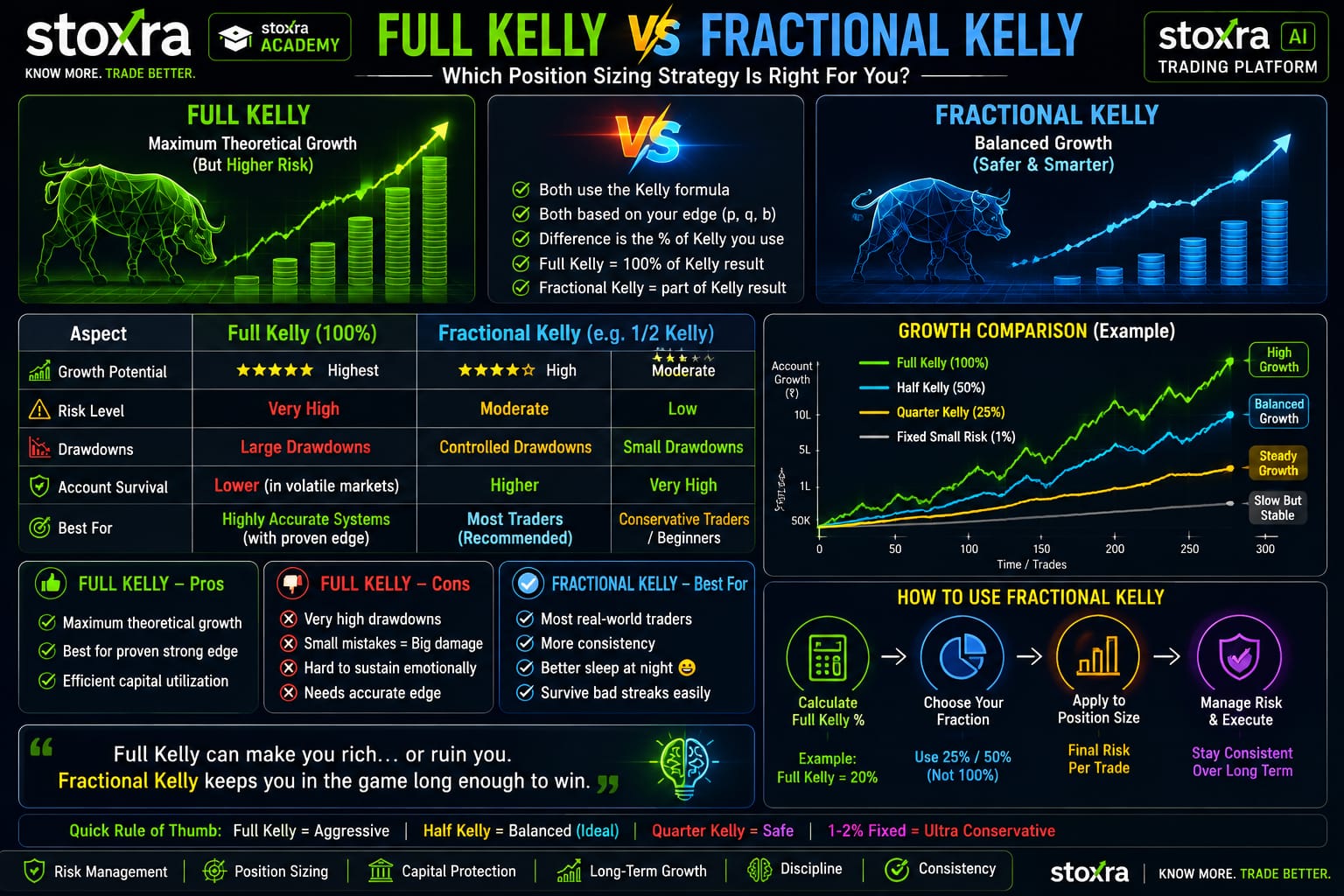
Fractional Kelly means using only a portion of the full Kelly result.
For example, suppose:
Full Kelly = 20%
A trader could theoretically consider:
- Half Kelly = 10%
- Quarter Kelly = 5%
The purpose is to reduce the aggressiveness of the full Kelly allocation.
The exact fraction should not be treated as a universal rule.
The appropriate risk level depends on:
- Strategy reliability
- Drawdown tolerance
- Market volatility
- Liquidity
- Leverage
- Account size
- Trader objectives
Kelly Criterion and Drawdowns
Position sizing affects drawdowns.
Even a strategy with positive expectancy can experience a sequence of losses.
Suppose a trader uses a very aggressive position size. A losing streak can produce a large decline in account equity.
A smaller position size can reduce the impact of the same losing streak.
This matters psychologically as well.
Large drawdowns can cause traders to:
- Abandon their strategy
- Increase risk to recover losses
- Revenge trade
- Stop following their rules
- Make emotional decisions
Traders can learn more about options trading risk management and daily loss limits when building practical risk controls.
Therefore, theoretical growth should always be considered alongside survivability and drawdown tolerance.
Kelly Criterion Is Not a Stop-Loss Formula
This is another important distinction.
Kelly determines a theoretical allocation based on an estimated edge. A stop-loss determines when a particular trade idea is considered invalid or when a predefined loss threshold is reached.
They solve different problems.
| Concept | Question It Answers |
|---|---|
| Kelly | How much capital should theoretically be allocated? |
| Stop-Loss | At what price or condition should the position be exited? |
| Position Size | How many shares, contracts or units should be traded? |
These concepts can work together, but they should not be confused.
How Stop-Loss Affects Position Size
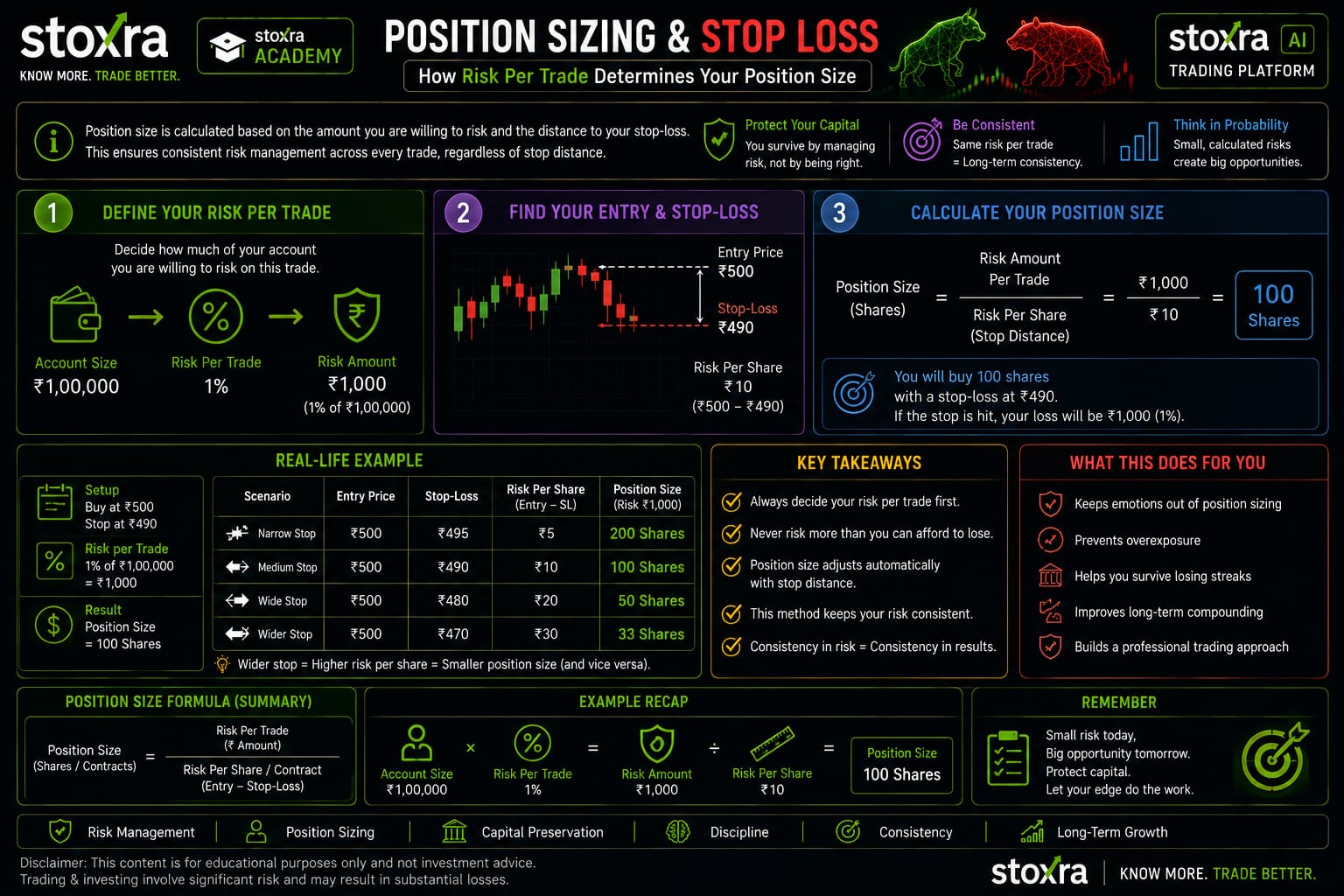
Suppose a trader has:
Account size = ₹1,00,000
and decides that the maximum acceptable loss on a particular trade is:
₹1,000
If the entry price is ₹500 and the stop-loss is ₹490:
Risk per share = ₹10
Therefore:
This is a simple risk-based position-sizing calculation.
Notice that this calculation is different from calculating a Kelly fraction.
A stop-loss framework can therefore complement position sizing without replacing it.
Kelly Criterion and Trading Leverage
Leverage can make position sizing even more important.
A trader may control a position worth much more than the capital deposited.
That can increase both potential gains and potential losses.
With leveraged products such as futures and options, a seemingly small price movement can have a significant effect on account equity.
Therefore, traders should evaluate:
- Notional exposure
- Margin requirements
- Maximum potential loss
- Stop-loss distance
- Contract size
- Volatility
- Liquidity
Traders should also avoid increasing exposure simply because a recent trade was successful.
For traders learning derivatives, the options rollover guide can help explain another important concept around derivative positions.
A Practical Kelly Workflow
A trader researching Kelly-based sizing can follow a structured process.
Step 1: Collect Trading Data
Record a meaningful sample of historical trades.
- Number of trades
- Winning trades
- Losing trades
- Average win
- Average loss
Step 2: Calculate Win Probability
Estimate:
Win rate = Winning trades ÷ Total trades
Step 3: Calculate Payoff Ratio
Estimate:
Average win ÷ Average loss
Step 4: Calculate Theoretical Kelly
Use the appropriate Kelly formula for the strategy.
Step 5: Stress-Test the Result
Ask:
- What happens if the win rate is lower?
- What happens if average wins decrease?
- What happens during a losing streak?
- What happens if volatility increases?
Step 6: Consider Fractional Kelly
If full Kelly produces an allocation that is too aggressive, a fractional approach may reduce exposure.
Step 7: Apply Additional Risk Limits
Set practical constraints based on:
- Account size
- Maximum trade loss
- Maximum daily loss
- Drawdown tolerance
- Liquidity
Example: Kelly vs Practical Risk Management
Imagine a trader's historical strategy produces a theoretical Kelly result of:
25%
A trader might initially think:
“Kelly says 25%, so I should allocate 25%.”
That would be an oversimplification.
The trader should first ask:
- Is the 25% estimate based on enough data?
- Are the results from live trading or backtesting?
- Could the win rate change?
- Are transaction costs included?
- Could market conditions change?
- Can the trader emotionally tolerate the drawdown?
If the assumptions are uncertain, using a smaller fraction or a separate risk cap may be more appropriate.
The important lesson is:
A mathematical output is not automatically a suitable trading instruction.
Traders can also compare this approach with paper trading vs real trading before applying a strategy with real capital.
Common Mistakes With the Kelly Criterion
-
Using a Small Sample
A Kelly calculation based on a very small number of trades may produce unreliable estimates of win probability and payoff. -
Overestimating the Win Rate
Assuming that a historical win rate will remain unchanged can lead to excessive position sizing. -
Ignoring Average Loss
Looking only at winning trades can make a strategy appear stronger than it actually is. -
Using Full Kelly Without a Risk Cap
Full Kelly can produce an aggressive allocation when the estimated edge is high. -
Ignoring Trading Costs
Brokerage, spreads, slippage and other costs can reduce realised returns. -
Ignoring Market Regime Changes
A strategy can perform differently in trending, sideways or highly volatile markets. -
Increasing Risk After Winning
A short winning streak does not necessarily mean the underlying edge has permanently increased. -
Trying to Recover Losses Quickly
Traders should avoid changing their risk framework simply because of a recent losing trade. -
Confusing Allocation With Risk
The percentage allocated to a position is not necessarily the same as the amount that can be lost at the stop-loss. -
Ignoring Behavioural Discipline
A sophisticated mathematical model still requires a trader to execute consistently.
Traders who repeatedly increase exposure, chase losses or break predefined rules can also learn from FOMO trading mistakes .
Kelly Criterion and Trading Discipline
Position sizing only works when it is connected to a consistent process.
A trader can calculate an appropriate theoretical allocation but still undermine the system by changing position size randomly from one trade to another.
This is why traders should create rules for:
- Maximum exposure
- Maximum loss per trade
- Maximum daily loss
- Position-size adjustments
- Stop-loss placement
- Trade review
A disciplined trader should also understand important stock market rules for traders and maintain a consistent process.
How a Trading Journal Can Improve Kelly Estimates
A trading journal can provide the historical data required to estimate win probability and average payoff.
Useful information can include:
- Entry and exit price
- Position size
- Profit or loss
- Trade setup
- Risk taken
- Market conditions
- Execution mistakes
- Emotional state
Over time, this information can help traders distinguish between the performance of the strategy and the quality of its execution.
Traders can also review paper trading strategies before using real capital to test a new process.
Kelly Criterion and Technical Analysis
The Kelly Criterion does not tell a trader when to enter or exit a market. It addresses position allocation under a particular set of assumptions.
Entry and exit decisions may come from a separate trading strategy, such as technical analysis, fundamental analysis or systematic rules.
Traders can learn more about technical analysis in stock trading to understand how market setups can be evaluated separately from position sizing.
For indicator-based research, traders can also explore the 100-day moving average and VWAP trading strategies .
Kelly Criterion, Backtesting and Paper Trading
Before relying on historical performance estimates, traders should understand whether the results came from backtesting, simulated trading or live trading.
Backtested results can be useful for research, but they may not fully capture slippage, liquidity constraints, execution delays or changes in market behaviour.
Paper trading can provide another controlled environment for evaluating execution.
Traders can explore paper trading platforms in India before considering live implementation.
How Technology Can Support Position-Sizing Research
Technology can make it easier to organise trading data, analyse historical outcomes and monitor market information.
Traders researching technology-based workflows can explore STOXRA AI Trading Platform and AI tools for stock market analysis .
These tools should be treated as research and decision-support resources, not as guarantees of future performance.
Traders interested in systematic approaches can also learn about algorithmic trading and how predefined rules can be used to structure a trading process.
Practical Risk Management Checklist
Before applying any Kelly-based position-sizing approach, consider the following checklist:
- ☑ Do I have enough historical trades?
- ☑ Is my estimated win rate reliable?
- ☑ Have I calculated average win and average loss?
- ☑ Have I considered trading costs?
- ☑ Have I considered slippage?
- ☑ Have I stress-tested the assumptions?
- ☑ Do I have a maximum trade-loss limit?
- ☑ Do I have a maximum daily-loss limit?
- ☑ Is the position size compatible with my risk tolerance?
- ☑ Can I tolerate the potential drawdown?
- ☑ Am I using leverage responsibly?
- ☑ Have I documented the trade in my journal?
For additional risk-management education, see risk-management techniques to reduce drawdown .
Kelly Criterion: A Simple Decision Framework
A practical way to think about Kelly is:
The framework begins with identifying whether a measurable edge exists. The trader then estimates the relevant probabilities and payoff characteristics.
After calculating the theoretical result, the next step is not necessarily immediate execution. The result should be stress-tested against different assumptions and practical risk limits.
This approach is more useful than treating the Kelly percentage as a simple buy-or-sell instruction.
Final Takeaway
The Kelly Criterion provides a mathematical framework for thinking about position sizing when a trader has an estimated statistical edge.
Its main inputs include probability of winning, probability of losing and payoff characteristics. However, these estimates can be uncertain in real markets.
That means a full Kelly result should not automatically be interpreted as the amount a trader should put at risk on every trade.
A more practical framework combines:
Edge → Position Size → Stop-Loss → Risk Limit → Drawdown Control → Review
The objective should not simply be maximum theoretical growth. A robust trading process should also consider capital preservation, uncertainty, execution quality and the trader's ability to tolerate losses.
Pro Tip
Never treat a Kelly percentage as a guaranteed risk level. Validate your trading statistics, stress-test the assumptions and combine any theoretical allocation with practical risk limits before using real capital.
Continue learning through Stoxra Learn for more educational resources on trading, investing and market analysis.
Frequently Asked Questions
What is the Kelly Criterion?
The Kelly Criterion is a mathematical framework used to estimate the theoretical fraction of capital that could be allocated to an opportunity based on probability and payoff assumptions.
Is the Kelly Criterion a guaranteed way to make money?
No. The Kelly Criterion does not guarantee profits. Its output depends on estimates of probability, payoff and other assumptions that may be wrong or may change over time.
What is Full Kelly?
Full Kelly refers to the theoretical allocation produced by the Kelly calculation under the assumptions used by the model.
What is Fractional Kelly?
Fractional Kelly means using a portion of the full Kelly result. For example, half Kelly uses 50% of the theoretical full-Kelly allocation.
Does Kelly determine my stop-loss?
No. Kelly and stop-loss rules solve different problems. Kelly concerns theoretical capital allocation, while a stop-loss defines an exit condition or predefined loss threshold for a trade.
Can beginners use the Kelly Criterion?
Beginners can study the Kelly Criterion as an educational position-sizing concept, but they should understand its assumptions and limitations before applying it to real-money trading.
Why is win rate not enough for Kelly?
Win rate alone does not describe the complete trading edge. Average win, average loss and other payoff characteristics are also important.
How can traders improve their Kelly estimates?
Traders can maintain a detailed trading journal, collect a meaningful sample of trades, calculate actual win and loss statistics and regularly review whether the underlying strategy remains consistent.
Disclaimer
This article is provided for educational and informational purposes only and does not constitute investment, financial, trading or tax advice.
The Kelly Criterion is a mathematical framework and its results depend on assumptions, estimates and historical data. Real-world trading outcomes can differ significantly from theoretical calculations.
Trading and investing involve market risk, including the possible loss of capital. Leverage and derivatives can increase both potential gains and losses. Always conduct your own research, understand the risks involved and consider your individual financial circumstances and risk tolerance before making any investment or trading decision.